Skip to content

Visit Busan : what to do, where to stay and when to go

South Korea's second city, Busan lives facing the sea: towers along Haeundae beach, the Jagalchi fish market where you eat upstairs, colourful houses clinging to the hills of Gamcheon and temples perched on the cliffs. Two to three days cover the essentials, by metro and bus.

At a glance

Visa
None
Tourist stay of up to 90 days
7-day budget
€707
Per person, comfort profile, excluding international flights.

Why visit Busan?

Busan is the second city of South Korea, with around 3.3 million inhabitants, and the country's main port, on the south-east coast. It combines city beaches, seafood markets and Buddhist temples by the water. Allow two to three nights, ideally in April, May or October.

When to visit Busan

Temperatures, rainfall and crowds month by month, to pick your window.
When to visit Busan
MonthTemperaturesRainCrowdsVerdict
January0 to 8 °C5 dQuietThe coldest month is mild by Korean standards, dry and very sunny: ideal for markets and temples without the crowds.
February2 to 10 °C6 dQuietStill cool but bright; Lunar New Year, depending on the year, closes shops and fills the KTX for a few days.
March5 to 14 °C8 dModerateSpring arrives earlier than in Seoul: first cherry blossoms at month's end, still a brisk wind on the coast.
April10 to 18 °C9 dBusyCherry blossom in early April on Dalmaji-gil and along the rivers: a lovely time, book early.
May15 to 22 °C9 dBusyThe sunniest month, mild and pleasant for the Igidae and Taejongdae coastal trails; the sea is still cool.
June18 to 25 °C10 dModerateBeaches open and humid heat builds; the rainy season (jangma) sets in at month's end.
July22 to 28 °C14 dPackedThe wettest month, yet Korean holidays pack Haeundae from late in the month; typhoon risk begins.
August24 to 30 °C12 dPackedThe hottest month, the sea at its warmest and beaches packed; watch for typhoons that can close beaches and ferries.
September20 to 26 °C9 dModerateThe sea is still warm and crowds thin after the holidays, but typhoons remain possible until late September, with a peak around Chuseok.
October15 to 23 °C5 dPackedThe best month: dry, bright, 22°C in the afternoon, and the city runs to the rhythm of the international film festival.
November8 to 17 °C6 dModerateGentle cool and red foliage at Beomeosa and Geumjeongsan; crowds fall away and prices follow.
December2 to 10 °C5 dQuietA dry, sunny winter, rarely below freezing by day: a good low season to combine Busan and Gyeongju.
Source: Normales KMA (Korea Meteorological Administration) 1991-2020, station de Busan (tableau climatique Wikipedia) ; jours de pluie = jours avec au moins 0,1 mm ; température de la mer : moyennes mensuelles seatemperature.info pour Busan (eaux côtières, pas une mesure de plage) ; risque typhon de juillet à fin septembre selon France Diplomatie (fiche Corée du Sud, mise à jour 15 septembre 2026) ; relevé novembre 2026

Busan's must-sees

Ten places to understand the city, from temples facing the sea to the traces of the Korean War.

Haedong Yonggungsa

Buddhist temple founded in the 14th century on the coastal rocks of Gijang, best visited at sunrise before the tour groups arrive.

Beomeosa Temple

Large temple founded under the Silla kingdom on the slopes of Mount Geumjeong, reachable by bus from metro line 1.

Geumjeongsanseong Fortress

The country's largest mountain fortress, whose ramparts of about 17 km snake along the ridges above the city, to explore on foot or by cable car.

Jagalchi Market

Often described as Korea's largest seafood market, where you pick your fish live before having it prepared upstairs.

Gukje Market

A maze of market lanes born from post-war trading, between street stalls, clothing, kitchenware and small eateries.

Oryukdo Skywalk

Glass walkway suspended above the cliffs, facing the Oryukdo islets that mark the entrance to Busan harbour.

Igidae coastal trail

A coastal path of a few kilometres between rocks and pine woods, with one of the finest views of the Haeundae towers.

UN Memorial Cemetery

The only United Nations cemetery in the world, where soldiers from several countries who fell in the Korean War rest, French troops among them.

Songdo Cable Car

Cabins, some with glass floors, gliding over Songdo bay, the country's first developed beach in the early 20th century.

Busan X the Sky

Observation deck on the top floors of the LCT tower, more than 400 m up, overlooking the whole Haeundae coastline.

What to see in Busan?

Haeundae, Dalmaji-gil and the east coast

Haeundae is the country's best-known beach: around 1.5 km of sand lined with towers, including the LCT and its observation deck more than 400 m up. To the west, Dongbaekseom islet can be walked around in about thirty minutes. To the east, Blueline Park follows the coast from Mipo to Songjeong for nearly 5 km along a former railway, by panoramic beach train or suspended sky capsule: book online at weekends. In early April, the cherry trees of Dalmaji-gil hill bloom above the sea. It is the most convenient area to stay in summer.

Gwangalli and the Gwangan Bridge

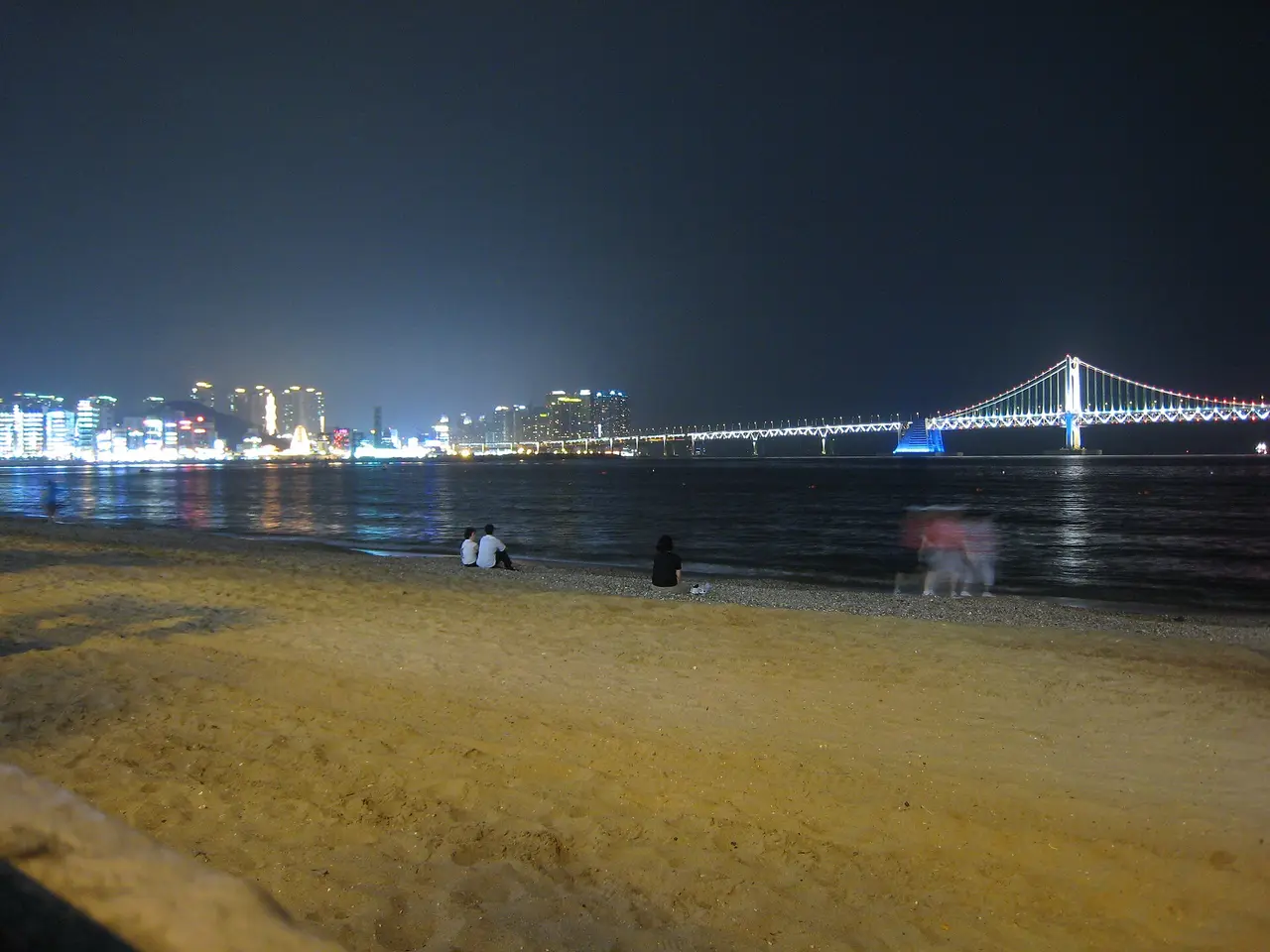
Smaller than Haeundae and livelier at night, Gwangalli beach faces the Gwangan Bridge, a double-deck suspension bridge around 7.4 km long, lit up every night. The seafront lines up upstairs cafes, raw fish restaurants and bars, with the best view of the bridge between 8 pm and midnight. A drone show takes place every Saturday evening, in two sessions, unless cancelled for weather: check the calendar before you go. Allow an evening, from Gwangan station on metro line 2, about a quarter of an hour from Haeundae.

Nampo, the old port and the markets

The historic centre spreads around Nampo harbour. Jagalchi market sells live fish, octopus and shellfish; you choose on the ground floor and eat upstairs, closed on some Tuesdays, usually the first and third of the month. Behind it, Gukje market, born during the Korean War, and BIFF Square, linked to the film festival held every autumn, are explored on foot. Yongdusan Park and its 120 m tower overlook it all. A little further north, the so-called Shanghai Street, opposite Busan station, forms the Chinatown. Allow a full day.

Gamcheon and the Saha hillsides

On the slopes of Saha, Gamcheon is a district of terraced houses built by refugees in the 1950s, repainted and dotted with artworks since a cultural project launched in 2009. Ride the minibus up from Toseong station on line 1, about ten minutes, then walk back down the stairways. Two hours are enough; come early on a weekday morning, as the village is still lived in and the lanes fill up in the afternoon. Keep noise down and do not photograph the inside of homes.

Yeongdo island and Taejongdae

Linked to the centre by several bridges, including Yeongdo Bridge, a drawbridge raised on Saturdays at 2 pm for a quarter of an hour, Yeongdo island has the city's wildest coastline. At its southern tip, Taejongdae park alternates cliffs, a lighthouse and pine forest, served by the little Danubi train on a loop of about 4 km. On the west coast, Huinnyeoul Culture Village perches its white houses above the sea along a coastal path. Half a day to a full day, by bus from Nampo.

Seomyeon, Jeonpo and Busan's food

Where metro lines 1 and 2 cross, Seomyeon is the modern shopping hub: underground arcades, Bujeon market and, a few streets away, Jeonpo cafe street set in former workshops. Above all, it is the district to try local specialities: dwaeji gukbap, a pork and rice soup served at any hour, and milmyeon, cold wheat noodles created by refugees from the North, ideal in summer. Busan fishcake, eomuk, is sold on skewers in the markets. One evening is enough, and the area stays busy late.

How much it costs

Per person per day, excluding international travel.
Budget
49 €/ day
2 406 € for 2 people, 7 days, return flights included
Accommodation
17 €
Food
20 €
Local transport
4 €
Sights and activities
8 €
Comfort
101 €/ day
3 134 € for 2 people, 7 days, return flights included
Accommodation
40 €
Food
35 €
Local transport
8 €
Sights and activities
18 €
Premium
262 €/ day
5 388 € for 2 people, 7 days, return flights included
Accommodation
130 €
Food
70 €
Local transport
22 €
Sights and activities
40 €
Prices checked: Relevé novembre 2026, hors pics de juillet-août et d'octobre. Sources non officielles (agrégateurs et blogs, à revérifier) : lits en dortoir de 20 000 à 40 000 KRW, hôtel milieu de gamme vers 110 000 KRW la chambre, ticket de métro unique autour de 1 500 KRW (viatravelers.com, koreatipsdaily 2026, gotripzi). Conversion au taux BCE du 10 novembre 2026 : 1 EUR = 1501,56 KRW. Occupation : dortoir pour backpacker, double partagée à deux pour comfort et premium. Vol A/R Paris-Busan avec escale (pas de vol direct) estimé à 860 EUR par personne, moyenne de décembre 2026 relevée par ou-et-quand.net, soit 1720 EUR pour deux inclus dans le total semaine.

Getting there

Airports serving Busan, from main hubs to secondary ones.
  • CJJCheongju International Airport/Cheongju Air Base (K-59/G-513)CheongjuMain
  • CJUJeju International AirportJeju CityMain
  • GMPGimpo International AirportSeoulMain
  • ICNIncheon International AirportSeoulMain
  • MWXMuan International AirportMuanMain
  • PUSGimhae International AirportBusanMain

Entry, health and safety

For FR travellers

Entry requirements

No visa for a tourist stay

Pour un court séjour touristique de moins de 90 jours, les Français sont dispensés de visa. L'exemption temporaire du K-ETA est prolongée jusqu'au 31 décembre 2026 (un K-ETA déjà délivré reste valable). À l'arrivée, une déclaration d'entrée est obligatoire : e-Arrival Card gratuite en ligne (e-arrivalcard.go.kr) jusqu'à 3 jours avant, ou formulaire papier sur place. Passeport en cours de validité et non abîmé ; la règle des six mois ne s'applique pas.

Stay allowed for up to 90 days.

Health

Advised: Vaccinations du calendrier français à jour, dont la rougeole (hausse des cas signalée en 2026). Selon les conditions de séjour : hépatite A, fièvre typhoïde, et encéphalite japonaise pour un séjour en zone rurale de mai à octobre.

Assurance couvrant soins et rapatriement indispensable ; peu de médecins anglophones hors des hôpitaux internationaux, l'application Emergency Ready App aide à trouver les urgences. Typhons possibles de juillet à fin septembre, le sud du pays étant le plus exposé. France Diplomatie signale à Busan une hausse des cas de violences sexuelles avec usage de GHB dans les lieux de vie nocturne : surveillez votre verre. La DMZ, loin de Busan, est en zone orange.

Safety

Normal precautions

Emergency

112 (police) / 119 (pompiers et ambulances)

Checked in novembre 2026 against the official source. Entry rules change: check the official source before you travel, it alone is authoritative.

Practical information for Busan

Entry and K-ETA

Visa-free for under 90 days; K-ETA is suspended for French nationals until 31 December 2026, but an arrival declaration is still due: the e-Arrival Card online within 3 days before arrival, or a paper form on landing (France Diplomatie).

T-money card

Contactless card sold in convenience stores (GS25, CU, 7-Eleven), topped up in cash, valid on the metro, buses and most taxis in Busan as in Seoul.

Gimhae Airport

Domestic and Asian flights; the Busan-Gimhae light rail connects to metro line 2 at Sasang, and limousine buses serve Seomyeon and Haeundae.

KTX from Seoul

Roughly 2h15 to 2h45 to Busan station depending on stops; book on the Korail app or at the counter, especially on Friday evenings and weekends.

Navigation apps

Google Maps gives few walking directions in Korea: install Naver Map or KakaoMap, more reliable for the metro, buses and walking.

Power sockets

Type C and F sockets, 220 V: European chargers work without an adapter.

Tipping

No tipping custom in restaurants or taxis; service is included and leaving change can cause surprise.

Monsoon and typhoons

Rainy season from late June to July, typhoons possible from July to September: follow alerts, as ferries and Blueline Park may be suspended.

1330 tourist hotline

Travel helpline run by the Korea Tourism Organization, with English-speaking operators; emergencies: 112 for police, 119 for ambulance and fire.

Busan in pictures

Photo credits : Syced, CC0, Wikimedia Commons ; VN.NguyenDucDuy, CC BY-SA 4.0, Wikimedia Commons

Frequently asked questions about Busan

How many nights should you spend in Busan after Seoul?
Two nights cover Haeundae, Jagalchi, Gamcheon and an evening in Gwangalli. Three nights let you add Taejongdae and Haedong Yonggungsa temple without rushing. The KTX links Seoul and Busan in 2h15 to 2h45 depending on stops, which saves a domestic flight.
Is it better to stay in Haeundae, Seomyeon or Nampo?
Haeundae suits a beach stay, especially in summer, but lies nearly an hour by metro from the old port. Seomyeon, where lines 1 and 2 cross, is the most central. Nampo, close to the KTX station, is ideal for a short stop focused on the markets.
How do you get from Gimhae Airport to Haeundae?
The simplest option is the direct limousine bus to Haeundae. Otherwise, take the Busan-Gimhae light rail to Sasang, then metro line 2 to Haeundae, about an hour and a half in total. Gimhae also has direct flights to several Asian cities, including Shanghai, Tokyo and Osaka.
When can you swim at Haeundae?
Lifeguarded swimming opens in June and peaks in July and August, when the beach is very crowded. The water stays pleasant into September, but typhoons can then close the beaches. By October, the sea is for looking at rather than swimming in.
Can you visit Gyeongju as a day trip from Busan?
Yes. The KTX reaches Singyeongju station in about thirty minutes, then a bus runs to Bulguksa temple and the historic centre. One day is enough for the burial mounds, Bulguksa and Seokguram grotto, but a night there lets you see the sites lit up.
How do you get to Haedong Yonggungsa temple?
Take the Donghae line to Osiria station, then a bus or a twenty-minute walk. The temple opens very early: come at sunrise, as the narrow steps above the rocks get packed by late morning, especially at weekends.
Is K-ETA required to arrive in Busan in 2026?
Not for French nationals: the temporary K-ETA exemption is extended until 31 December 2026, according to France Diplomatie. You must, however, declare your arrival, via the e-Arrival Card online within the three days before or on a paper form at the airport, at Incheon as at Gimhae.

Plan your trip to Busan

Build your day-by-day itinerary and manage budget, bookings and packing in PlanTripNow.
Aperçu de l'application PlanTripNow