Skip to content

Visit Cebu: what to see in town and around, and when to go

Cebu is the ideal starting point for the Visayas: see the cross planted by Magellan in 1521, taste the country's best lechon, then go swimming with the sardines of Moalboal, descend the Kawasan waterfalls or cross to the Chocolate Hills of Bohol.

At a glance

Visa
None
Tourist stay of up to 30 days
7-day budget
€595
Per person, comfort profile, excluding international flights.

Why visit Cebu?

Cebu, the second metropolis of the Philippines, is the country's oldest city, founded by the Spanish in 1565, and the gateway to the Visayas islands. People come for its heritage, its food and quick access to the dive sites and waterfalls of the west coast. Allow three to four days, ideally from February to May.

When to visit Cebu City

Temperatures, rainfall and crowds month by month, to pick your window.
When to visit Cebu City
MonthTemperaturesRainCrowdsVerdict
January24 to 30 °C12 dPackedThe Sinulog festival on the third Sunday: giant parades, a packed city and sky-high hotel prices.
February24 to 30 °C9 dModerateDrier air and a calm 27 °C sea, a good time for diving at Moalboal.
March25 to 31 °C7 dModerateThe heart of the dry season: ideal for Kawasan canyoneering and the islands.
April26 to 32 °C5 dBusyThe driest month, but Holy Week fills the ferries and beaches.
May26 to 33 °C9 dModerateThe hottest month at nearly 33 °C, with the first late-day thunderstorms.
June26 to 32 °C13 dQuietThe south-west monsoon begins: short showers, falling prices and still-good diving.
July25 to 32 °C15 dQuietFrequent rain and possible typhoons in the archipelago: keep ferry plans flexible.
August25 to 32 °C13 dQuietGreen season, Kawasan Falls at full flow, but water sometimes murky after rain.
September25 to 32 °C14 dQuietStill wet and typhoon-prone, with some of the lowest hotel rates.
October25 to 31 °C15 dQuietThe rainiest month: follow PAGASA bulletins before any crossing.
November25 to 31 °C12 dModerateTransition to the dry season, the sea still at 29 °C and few tourists.
December25 to 30 °C14 dBusyYear-end holidays, still frequent showers and ferries in high demand.
Source: Normales climatologiques 1991-2020 de PAGASA, station de l'aéroport international de Mactan (fiche officielle), recoupées avec Weathermonth (réanalyse Open-Meteo) ; température de la mer seatemperature.info recoupée avec climate-data.org et weather2travel.com, relevé novembre 2026

Cebu's must-sees

Heritage, flavours and nature, the stops that make a trip to Cebu.

Magellan's Cross

A cross planted in 1521 by Magellan's expedition, sheltered in a pavilion with a painted ceiling, in the heart of the city.

Basilica del Santo Niño

A basilica founded in 1565 housing the statue of the Holy Child, the oldest religious object in the Philippines.

Fort San Pedro

A small triangular Spanish fort by the port, with ramparts and a garden, one of the archipelago's oldest.

Taoist Temple

A colourful temple in the Beverly Hills district, with a clear view over the city and harbour.

Casa Gorordo

A 19th-century Parian mansion turned museum on the life of wealthy families in colonial times.

Moalboal sardine run

A shoal of millions of sardines seen by snorkelling from the beach, about three hours from Cebu.

Kawasan Falls

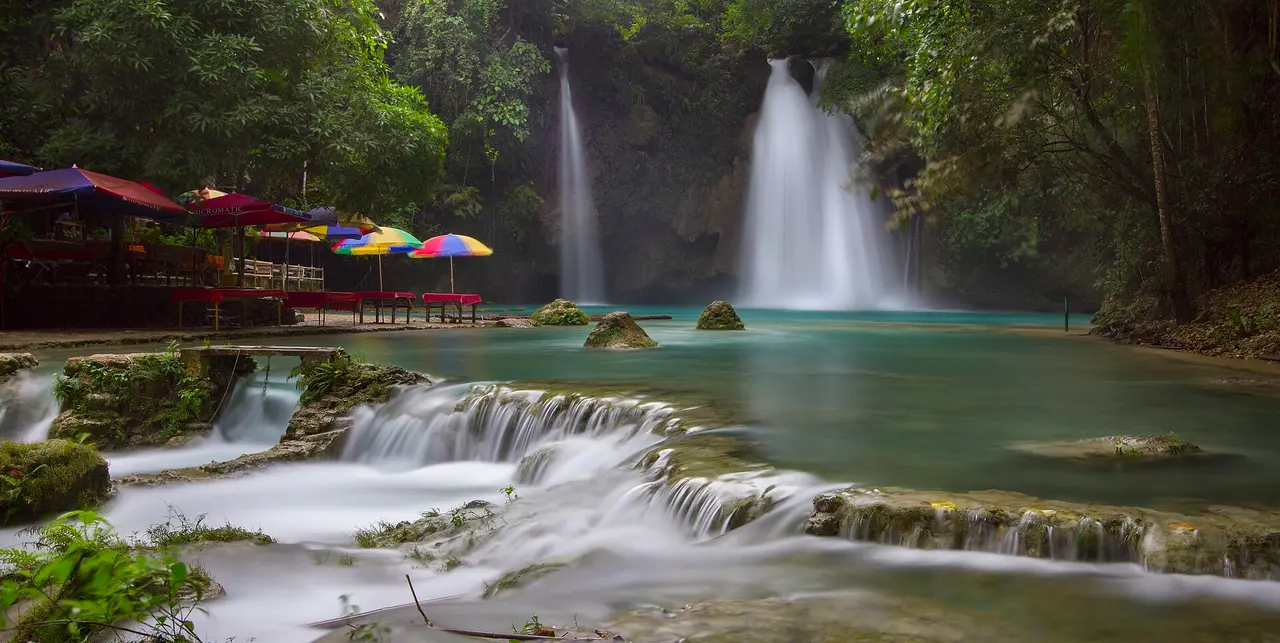
Badian's waterfalls and turquoise pools, the goal of guided canyoneering descents on the west coast.

Tops Lookout

A viewpoint on the Busay heights, the best place for sunset over the city.

Chocolate Hills

Bohol's conical hills, brown in the dry season, about two hours by fast ferry from Cebu.

What to discover in Cebu?

The historic centre, cradle of colonisation

This is where Magellan landed in 1521. His cross, sheltered in a small painted pavilion, faces the Basilica del Santo Niño, which keeps the country's oldest religious statue. A few streets away, Fort San Pedro, built by the Spanish, is the smallest and one of the oldest in the archipelago. Allow half a day on foot, with covering clothes for the basilica.

Parian, Colon and Carbon market

The Parian district, the old Chinese quarter, keeps Casa Gorordo, a 19th-century mansion turned museum, and the Yap-Sandiego house, among the oldest in the country. Colon Street is said to be the oldest street in the Philippines. Carbon market, huge and noisy, sells fruit, fish and flowers; come in the morning and keep your belongings close. Avoid carrying valuables there.

The Busay heights

North of the city, the Busay hills offer cooler air and panoramas. The Taoist Temple in the Beverly Hills district, colourful and free, overlooks the city. Higher up, the Temple of Leah, a mock Roman temple, and the Sirao flower garden attract photographers. Tops lookout is the best spot for sunset; go up by Grab or taxi, about half an hour away.

Lechon and Cebuano food

Cebu claims the best lechon in the Philippines, a spit-roasted suckling pig stuffed with lemongrass and garlic, served by weight in specialist restaurants. Local food can also be tasted at Larsian market, rows of grills open in the evening, and in puso, rice cooked in woven palm leaves. A simple meal costs under 4 euros according to Numbeo. Order lechon by the kilo to share.

Moalboal, Kawasan and the west coast

About three hours south-west by road, Moalboal is famous for its giant sardine run, visible by snorkelling from Panagsama beach, and for its turtles. Nearby, in Badian, canyoneering follows the river down to the turquoise pools of Kawasan Falls, guided and equipped. Further south, Oslob offers swimming with whale sharks, a controversial practice since the animals are fed. Start very early for both.

Mactan, the islets and Bohol

Mactan Island, linked by bridges and home to the airport, concentrates the beach resorts. Outrigger boats take visitors from there to the Hilutungan and Nalusuan marine sanctuaries, known for snorkelling. Fast ferries link Cebu to Bohol in about two hours: the Chocolate Hills, the tarsier sanctuary and the Loboc river fill a day, ideally by car with a driver. Book ferries a day ahead.

How much it costs

Per person per day, excluding international travel.
Budget
33 €/ day
2 262 € for 2 people, 7 days, return flights included
Accommodation
11 €
Food
9 €
Local transport
3 €
Sights and activities
10 €
Comfort
85 €/ day
2 990 € for 2 people, 7 days, return flights included
Accommodation
28 €
Food
22 €
Local transport
10 €
Sights and activities
25 €
Premium
245 €/ day
5 230 € for 2 people, 7 days, return flights included
Accommodation
100 €
Food
55 €
Local transport
30 €
Sights and activities
60 €
Prices checked: Relevé novembre 2026 : Numbeo (mis à jour le 12/11/2026) pour repas, cafés, bière, transports et taxis ; Hostelz, Momondo, Skyscanner et Trip.com pour l'hébergement (lit en auberge env. 11 €, 3 étoiles env. 55 € la chambre, 5 étoiles env. 200 € la chambre). Lit en dortoir pour backpacker, chambre double partagée à deux pour comfort et premium. Vol A/R Paris-Cebu avec une ou deux escales env. 900 € par personne (Trabber 671 € en moyenne, Cheapflights et Farecompare autour de 900 à 960 €), hors juillet-août et fêtes. Les excursions à la journée vers Oslob, Kawasan ou Moalboal pèsent dans le poste activités.

Getting there

Airports serving Cebu City, from main hubs to secondary ones.
  • BCDBacolod-Silay International AirportBacolod CityMain
  • AAVAllah Valley AirportSurallahSecondary
  • BAGLoakan AirportBaguioSecondary
  • BPHBislig AirportBisligSecondary
  • BQADr. Juan C. Angara AirportBalerSecondary
  • BSOBasco AirportBascoSecondary

Entry, health and safety

For FR travellers

Entry requirements

No visa for a tourist stay

Pas de visa préalable pour un séjour touristique de 30 jours au plus à compter de l'arrivée, sur présentation d'un billet de retour ou de continuation vers un pays tiers. Chaque voyageur doit remplir en ligne la carte eTravel sur la plateforme officielle, idéalement dans les 72 heures avant le départ ; son QR code est demandé par les compagnies et l'immigration.

Stay allowed for up to 30 days.

Health

La majeure partie des Philippines est en vigilance renforcée ; Cebu n'est pas en zone déconseillée, mais des incursions de groupes armés sont signalées dans le sud des Visayas, sur les côtes sud des îles de Cebu et de Bohol. Criminalité élevée : vols à l'arraché, cambriolages. Typhons de mai à décembre et risque sismique élevé. Zones formellement déconseillées : Basilan, Sulu, Tawi-Tawi et l'ouest de Mindanao.

Safety

Increased caution

Checked in novembre 2026 against the official source. Entry rules change: check the official source before you travel, it alone is authoritative.

Practical information for Cebu

Entry

French citizens need no visa for up to 30 days, with a return ticket and the eTravel card completed online within 72 hours before departure. Check the rules for your nationality.

Safety

France advises heightened vigilance across most of the Philippines; armed group incursions are reported on the south coasts of Cebu and Bohol, so check before staying there.

Mactan airport

The international airport is on Mactan Island, about half an hour from the centre depending on traffic; direct flights link Cebu to several Asian hubs.

Grab and taxis

Grab is the simplest option in town; for trips to Moalboal or Kawasan, hiring a car with a driver saves hours.

Ferries

Fast ferries to Bohol and the islands from Cebu port, to book in high season; cancelled during typhoon alerts.

Whale sharks

In Oslob, whale sharks are fed for tourists, a practice criticised by many marine biologists.

Sinulog

On the third Sunday of January, the Santo Niño festival draws huge crowds: book accommodation months ahead.

Water

Do not drink tap water; bottled or filtered water only, including on excursions.

Cebu City in pictures

Photo credits : Rollymagpayo, CC BY-SA 4.0, Wikimedia Commons ; LMP 2001, CC BY-SA 4.0, Wikimedia Commons ; Carlo Joseph Moskito, CC BY-SA 4.0, Wikimedia Commons ; Philip Nalangan, CC BY 4.0, Wikimedia Commons

Frequently asked questions about Cebu

Is Cebu worth a visit or just a stopover?
The city itself takes one or two days, between Spanish heritage, markets and hills. Its real value is as a base for Moalboal, Kawasan, Mactan and Bohol. Allow three to four days in total to enjoy these trips.
Should you swim with the Oslob whale sharks?
It is a personal choice: the encounter is guaranteed, but the animals are fed daily, which many biologists consider harmful to their behaviour and migrations. If you prefer watching without feeding, other sites in the Philippines offer seasonal encounters.
How do you get from Cebu to Bohol?
By fast ferry from Cebu port to Tagbilaran, about two hours, with several departures a day. Bohol can be seen in a day by car with a driver, but two nights there let you also enjoy the beaches of Panglao.
Can you get from Cebu to Moalboal by bus?
Yes, buses leave Cebu South Bus Terminal for Moalboal in about three to four hours depending on traffic. A car with a driver is faster and lets you combine Moalboal and Kawasan Falls in the same day.
What is the best season for Cebu?
From February to May, the driest season, with April the least rainy month. From June to December, rain and typhoons can disrupt ferries and sea trips. January is lively with the Sinulog festival but very expensive.
Cebu or Manila to start a trip to the Philippines?
Cebu is more practical for the Visayas, Bohol and dive sites, with direct flights from several Asian hubs. Manila offers more history and museums. Many travellers combine both with a domestic flight of about an hour and a half.
Where can you dive near Cebu?
Moalboal for its sardine run and turtles, the Hilutungan and Nalusuan islets around Mactan for easy marine sanctuaries, and Malapascua, further north, known for thresher sharks. Check the certification of dive centres.
What should you eat in Cebu?
Lechon, roast suckling pig with crispy skin, is the island's speciality. Also try puso, rice cooked in woven palm leaves, the evening grills at Larsian market and dried mangoes, the region's pride.

Plan your trip to Cebu City

Build your day-by-day itinerary and manage budget, bookings and packing in PlanTripNow.
Aperçu de l'application PlanTripNow