Skip to content

Visit Doha : what to see, when to go and how to prepare

Between the curve of the Corniche and the ochre lanes of Souq Waqif, Doha has gained two museums by I. M. Pei and Jean Nouvel in twenty years. Many travellers spend two days here between flights, but the city deserves a trip out to the dunes that slide into the inland sea.

At a glance

Visa
None
Tourist stay of up to 90 days
7-day budget
€840
Per person, comfort profile, excluding international flights.
Recommended length
2 days
For a first trip, without rushing.

Why stop over in Doha?

Doha holds most of what there is to see in Qatar: the Museum of Islamic Art, the National Museum, Souq Waqif and the new northern districts, all linked by a metro that opened in 2019. Two to four days are enough, from November to March. In 2026 the French foreign ministry rates the whole country at heightened vigilance.

When to visit Doha

Temperatures, rainfall and crowds month by month, to pick your window.
When to visit Doha
MonthTemperaturesRainCrowdsVerdict
January15 to 23 °C2 dBusyThe mildest month: 23 °C in the afternoon, ideal for walking the Corniche.
February16 to 24 °C2 dBusyCool nights in the Khor Al Adaid desert, so pack a fleece for the camp.
March19 to 28 °C2 dBusyThe last truly comfortable month, with a few showers and the odd sandstorm.
April23 to 33 °C1 dModerateAlready 33 °C: Souq Waqif in the evening, air-conditioned museums in the heat of the day.
May28 to 39 °C0 dQuietClose to 40 °C, dune trips become an ordeal after mid-morning.
June31 to 42 °C0 dVery quietHotels slash their rates, but 42 °C all but shuts down the outdoors.
July32 to 42 °C0 dVery quietBest avoided: 32 °C nights and stifling humidity, even the sea brings no relief.
August32 to 41 °C0 dVery quietA 34 °C Gulf and muggy air: a stay spent almost entirely indoors.
September30 to 39 °C0 dQuietStill oppressive, though rates stay low before the season picks up again.
October27 to 36 °C0 dModerateThe heat eases by month's end and Katara's terraces reopen in the evening.
November22 to 30 °C0 dBusyThe best compromise: 30 °C days, a 28 °C sea and the Khor Al Adaid beaches back in play.
December17 to 25 °C1 dPackedPeak crowds around the 18 December National Day and the year-end holidays.
Source: Normales 1992-2021 du Qatar Meteorology Department (reprises par Wikipédia, article Doha, relevé octobre 2026), recoupées avec climatestotravel.com (Doha) : écarts inférieurs à 1 °C. Jours de pluie et température de la mer du golfe Persique d'après climatestotravel.com. Affluence et prix estimés d'après la saison touristique hivernale (novembre à mars), la fête nationale du 18 décembre, le ramadan et le creux estival.

Doha's must-sees

Seven places for a short stay, from Islamic art to the falconers of the souq.

Museum of Islamic Art

I. M. Pei's building, opened in 2008 at the end of the Corniche, holds manuscripts, ceramics and carpets from three continents. Closed on Wednesdays.

National Museum of Qatar

Jean Nouvel's desert-rose-inspired building, opened in 2019, tells the country's story around the restored palace of Sheikh Abdullah. Closed on Tuesdays.

Souq Waqif

Old Doha's rebuilt market, with its spices, frankincense and terrace restaurants, best explored in the evening when the heat eases.

Falcon Souq

Next to Souq Waqif, it gathers falcon dealers, leather hoods and a specialist veterinary hospital, a rare chance to see falconry up close.

Msheireb house museums

Four restored homes, including Bin Jelmood House on the history of slavery in the Indian Ocean and the Gulf, in the heart of the pedestrian district.

National Library

In Education City, a vast terraced hall under a glass roof designed by OMA, open to the public and reached by the metro Green Line.

Dhow on the bay

One hour on a traditional boat from the Corniche harbour, ideally at sunset, to see West Bay and the Museum of Islamic Art from the water.

What to discover in Doha?

The bay and its seven kilometres of Corniche

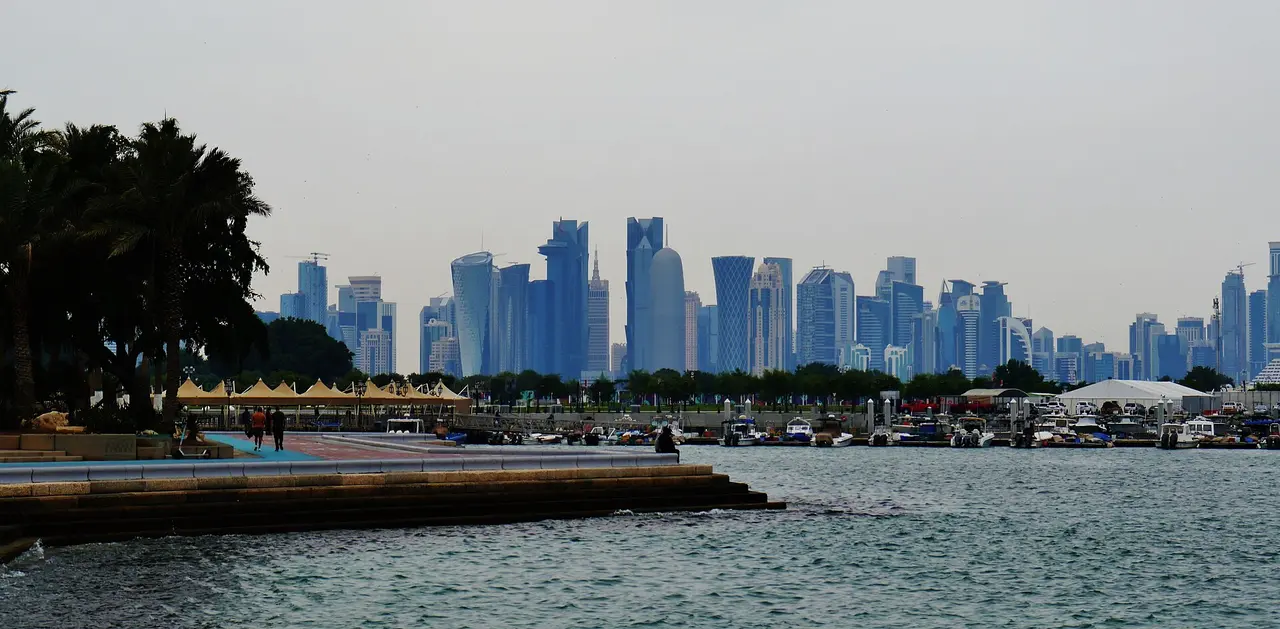
The Corniche traces a crescent of about 7 km around the bay, from the Museum of Islamic Art in the south to the West Bay towers in the north. You can walk or cycle it, but only early in the morning or after 5 pm from April onwards, when afternoons already reach 33 °C. The dhows moored in the harbour offer one-hour trips on the water, the best view of the skyline, especially as the towers light up. These boats recall the Gulf's pearling past, which you also find in Bahrain, across the Gulf of Bahrain.

The old market quarter, between souqs and stone houses

Souq Waqif was rebuilt in the 2000s on the historic market site, with mud walls, exposed beams and stalls of spices, frankincense and textiles. It comes alive mainly after sunset, when the terraces serve grills and shisha. Right next door, the Falcon Souq and its veterinary hospital show a very living side of Qatari culture. Ten minutes away on foot, the pedestrian Msheireb district has replaced the old centre with shaded streets and four house museums telling the city's story, from pearl diving to oil.

West Bay, the vertical city

Most of the office towers and large hotels are grouped in this district reclaimed from the sea, north of the Corniche. There is less to visit than in Dubai, and it is mostly a place to sleep and dine: hotel restaurants are the only places serving alcohol, in licensed venues. The metro Red Line links West Bay to the centre in a few stops for 2 riyals a ride. At sunset, the view from the Museum of Islamic Art park opposite is better than from the towers themselves.

The seaside north: Katara, The Pearl and Lusail

Katara Cultural Village brings together a seafront amphitheatre, a blue-tiled mosque, mud-brick pigeon towers and a paid beach. Further north, The Pearl artificial island lines up marinas and pastel facades in Qanat Quartier, a kind of recreated Venice. Beyond it, Lusail is a new city built around the stadium of the 2022 World Cup final. Allow half a day for Katara and The Pearl, ideally in late afternoon, and take the metro to Katara station to avoid traffic on the coast road.

Education City, the architects' campus

West of the centre, Qatar Foundation has gathered branches of foreign universities and a few remarkable buildings. The Qatar National Library, designed by OMA, is free to explore: its terraced shelves under a vast glass roof are worth the trip. Mathaf, the Arab museum of modern art, shows twentieth-century painters from across the Arab world. The Education City Mosque is recognisable by its two tilted minarets. All these addresses are served by the metro Green Line: allow a full day, and check each venue's closing days.

The southern desert and the inland sea

In the far south-east of Qatar, on the Saudi border, Khor Al Adaid is a saltwater bay hemmed in by dunes, reachable only by 4x4 across the sand. Shared trips last about four hours, from 9 am to 1 pm, and cost 220 to 330 riyals per person depending on the number of passengers. The French foreign ministry advises against venturing alone off paved roads: phone coverage is weak and insurance does not always apply. From May to September, at 39 to 42 °C, the trip becomes gruelling: keep it for winter.

Heat, Ramadan and safety: choosing your moment

The comfortable window runs from November to March, with 22 to 30 °C in the afternoon. From June to August, highs top 41 °C and nights stay above 30 °C: the city is then lived in malls and air-conditioned museums, in exchange for the lowest hotel prices. During Ramadan, museum hours change and it is best not to eat or drink in public during the day. Finally, after Iranian strikes on Qatari territory in 2026, check the official travel advice and register for alerts before you leave.

Sample itineraries

Three routes built around the time you actually have.
2daysRecommended

Doha in 2 days: the Museum of Islamic Art, the Corniche and Souq Waqif

  1. Day 1: Museum of Islamic Art, the Corniche and Souq Waqif
  2. Day 2: National Museum, Msheireb and sunset at Katara

Best for: A short stopover, often between two flights: the two major museums, the waterfront and the old souq, without leaving the centre. The desert and the new northern districts are left for another trip. 2026 context: the French foreign ministry rates Qatar at heightened vigilance after Iranian strikes, so check the advisory before you go.

How much it costs

Per person per day, excluding international travel.
Budget
52 €/ day
2 088 € for 2 people, 7 days, return flights included
Accommodation
25 €
Food
18 €
Local transport
3 €
Sights and activities
6 €
Comfort
120 €/ day
3 040 € for 2 people, 7 days, return flights included
Accommodation
42 €
Food
48 €
Local transport
10 €
Sights and activities
20 €
Premium
305 €/ day
5 630 € for 2 people, 7 days, return flights included
Accommodation
120 €
Food
90 €
Local transport
35 €
Sights and activities
60 €
Prices checked: Relevé du 11 octobre 2026, hors haute saison (novembre et décembre sont les mois les plus chers). Change : 1 € = 4,079 QAR (taux de référence BCE du 9 octobre 2026, 1 € = 1,1206 USD, combiné à l'ancrage du riyal qatari à 3,64 QAR pour 1 USD fixé par le décret n° 34 de 2001, ancrage cité via Wikipédia et non via la banque centrale). Repas et transports : Numbeo Doha, mise à jour du 11 octobre 2026, 107 contributeurs et 997 relevés sur 12 mois (repas bon marché 35 QAR, dîner de milieu de gamme pour deux 250 QAR, ticket de métro 2 QAR, taxi 7 QAR de prise en charge). Hébergement : aucune auberge de jeunesse listée à Doha sur Hostelworld le 11 octobre 2026, le profil backpacker repose donc sur les petits hôtels les moins chers (meilleures offres de 21 à 25 € la chambre selon Kayak et momondo, pages non datées) ; 3 étoiles autour de 84 € et 5 étoiles de 139 à 379 € la nuit selon Kayak et Trip.com (comparateurs, non sources officielles, écarts importants). Musées : 50 QAR pour un adulte non résident au musée d'Art islamique (Qatar Museums, annonce de 2023 reprise par Qatar Living en juin 2026, source non officielle). Safari de demi-journée dans les dunes et à Khor Al Adaid : 220 à 330 QAR par personne en véhicule partagé (Discover Qatar, page non datée ; Qatar Living, juillet 2026). Transport et activités premium (chauffeur, guide privé) : estimations calculées à partir de ces tarifs, sans source directe. Vol A/R Paris-Doha : 680 € par personne, milieu de la fourchette habituelle de 549 à 812 € relevée par momondo (données du 9 octobre 2026, vol direct Qatar Airways de 6 h 20 à l'aller). Hébergement par nuit et par personne : chambre simple bon marché pour backpacker, chambre double partagée à deux pour comfort et premium. weekTwoPax = 7 jours x 2 personnes + 2 vols. Contexte régional instable en 2026 : prix susceptibles d'évoluer vite.

Getting there

Airports serving Doha, from main hubs to secondary ones.
  • DIADoha International AirportDohaMain
  • DOHHamad International AirportDohaMain
  • XJDAl Udeid Air BaseAr RayyanSecondary

Entry, health and safety

For FR travellers

Entry requirements

No visa for a tourist stay

Dispense de visa pour les ressortissants français, pour un court séjour de moins de 90 jours. Un billet de retour ou de continuation et un justificatif d'hébergement doivent être présentés à l'arrivée. Assurance maladie obligatoire, souscrite en ligne avant le départ auprès d'un assureur agréé, pour tout séjour de plus de 30 jours.

Stay allowed for up to 90 days.

Passport valid for 6 months beyond your return date.

Health

Advised: Mise à jour du calendrier vaccinal français (diphtérie, tétanos, poliomyélite, coqueluche, rougeole) ; selon les conditions et la durée du séjour : hépatite A, fièvre typhoïde, hépatite B pour les séjours fréquents ou prolongés.

Sécurité (France Diplomatie, fiche mise à jour le 15 septembre 2026, carte du 17 juillet 2026) : tout le pays, Doha comprise, est en vigilance renforcée. Après de nouvelles frappes iraniennes visant le territoire qatarien, la situation régionale reste très instable : en cas d'alerte, suivre les consignes des autorités, se mettre à l'abri, rester à l'écart des installations militaires et ne pas approcher des débris de projectiles. Inscription au Fil d'Ariane recommandée. Règles locales (même fiche) : importation d'alcool et de porc interdite, alcool consommé uniquement dans les établissements sous licence, ivresse sur la voie publique punie ; tenue au-dessus des genoux refusée dans certains lieux publics comme les musées, y compris en transit à l'aéroport ; marques d'affection en public à proscrire ; certains médicaments à base d'opiacés (Tramadol) interdits même sur ordonnance. Santé : MERS-CoV présent, éviter le contact avec les dromadaires ; chaleur extrême l'été.

Safety

Increased caution

Emergency

999

Checked in octobre 2026 against the official source. Entry rules change: check the official source before you travel, it alone is authoritative.

Practical information for Doha

Visa

French nationals are exempt for stays of under 90 days. A return ticket, proof of accommodation and a passport valid for over 6 months are required (French foreign ministry, September 2026).

Currency

Qatari riyal, pegged to the dollar at 3.64 riyals per dollar: about 4.08 riyals per euro in October 2026.

Museum dress code

Cover shoulders and knees: clothing above the knee is refused in some public places, museums included, and the rule also applies in the airport transit area.

Alcohol

Importing it is banned, even in small amounts. Served only in licensed venues, mainly hotels. Public drunkenness is punishable.

Weekend

Friday and Saturday. On Friday mornings many places only open in the early afternoon, Qatar Museums venues around 1.30 pm.

Closing days

The Museum of Islamic Art closes on Wednesdays and the National Museum on Tuesdays: do not plan both on the same day without checking.

Metro

Three lines (Red, Green, Gold) serving Hamad Airport, Souq Waqif, the National Museum, Katara and Education City. Standard ticket 2 riyals.

Ramadan

Shorter hours in museums and shops, restaurants closed during the day: avoid eating, drinking or smoking in public before the fast is broken.

Medicines

Some opiate-based medicines, such as Tramadol, are banned even with a French prescription. Travel with an English prescription using generic names.

Safety in 2026

Heightened vigilance across the country (French foreign ministry, 15 September 2026) after Iranian strikes. If an alert sounds, take shelter. Emergencies: 999.

Doha in pictures

Photo credits : Zairon, CC BY 4.0, Wikimedia Commons ; Alex Sergeev (www.asergeev.com), CC BY-SA 3.0, Wikimedia Commons ; Diego Delso, CC BY-SA 3.0, Wikimedia Commons ; Michael Coghlan, CC BY-SA 2.0, Wikimedia Commons

Frequently asked questions about Doha

Can you travel to Doha after the 2026 Iranian strikes?
Yes, travel is not advised against: the French foreign ministry rates all of Qatar at heightened vigilance (map of 17 July 2026). It asks for the utmost vigilance, following local authority instructions, taking shelter if an alert sounds and keeping away from military sites. Check the advisory just before you leave.
Is a 48-hour stopover in Doha enough?
For the Museum of Islamic Art, the National Museum, Souq Waqif and a sunset at Katara, yes. You need an extra day for the Khor Al Adaid dunes, and another for Education City and The Pearl. Check the museums' closing days before you fix the dates of your stopover.
How much is entry to the Museum of Islamic Art?
The fare announced by Qatar Museums in its 2023 pricing reform, and repeated by local guides in 2026, is 50 riyals for a non-resident adult, about 12 euros. Entry is free for under-16s and for residents with their ID card.
Can you drive to Khor Al Adaid on your own?
It is not recommended. The inland sea can only be reached by crossing dunes in a 4x4, phone coverage is weak and the French foreign ministry notes that vehicles are insured there only under certain conditions. Book an operator with an experienced driver, on a shared trip of about four hours.
Where can you have an alcoholic drink in Doha?
Only in licensed venues, mostly the bars and restaurants of the large hotels in West Bay, on the Corniche and on The Pearl. Do not bring alcohol in your luggage: private imports are banned and bags are screened on arrival.
Can the Doha Metro take you from the airport to the museums?
Yes. The Red Line starts at Hamad International Airport and meets the Gold Line at Msheireb, which serves the Souq Waqif and National Museum stations. A standard ticket costs 2 riyals. For the Museum of Islamic Art, allow a short walk along the Corniche or a taxi.
Which months should you avoid in Doha because of the heat?
July and August are the hardest: 41 to 42 °C in the afternoon, nights above 30 °C and a 32 to 34 °C sea that no longer cools you down. June and September are hardly better. If you have no choice, hotels then offer their lowest rates of the year.

Plan your trip to Doha

Build your day-by-day itinerary and manage budget, bookings and packing in PlanTripNow.
Aperçu de l'application PlanTripNow