Skip to content

Visit Hanoi , capital of Vietnam for a thousand years

Hanoi is best explored on foot, through the merchant lanes of the Old Quarter, around Hoan Kiem Lake where the city exercises at dawn, and along the shady avenues of Ba Dinh. Here a bowl of pho is eaten on a plastic stool, and Ha Long Bay is only three hours away by road.

At a glance

Visa
None
Tourist stay of up to 45 days
7-day budget
€392
Per person, comfort profile, excluding international flights.
Recommended length
3 days
For a first trip, without rushing.

Why visit Hanoi?

Hanoi, the capital of Vietnam, is the gateway to the north of the country, an 11-hour direct flight from Paris. It brings together the Old Quarter of the 36 guilds, Hoan Kiem Lake, the Temple of Literature founded in 1070 and the Ho Chi Minh Mausoleum. Ha Long Bay and Ninh Binh can be visited as day trips. The best months are October and November, dry and mild.

When to visit Hanoi

Temperatures, rainfall and crowds month by month, to pick your window.
When to visit Hanoi
MonthTemperaturesRainCrowdsVerdict
January15 to 20 °C11 dModerateThe coolest month, 20 °C in the afternoon and 15 °C at night under grey skies: bring a jacket for evenings by Hoan Kiem Lake.
February16 to 21 °C12 dBusyDrizzle and low skies; Tet (6 February in 2027) fills the markets with peach blossom and kumquat trees, but many shops close for several days.
March19 to 24 °C18 dBusyMild but humid, with almost daily drizzle that barely soaks: the Old Quarter stays pleasant on foot, Ha Long Bay often in mist.
April22 to 28 °C16 dBusySpring settles in at around 28 °C: a good month for Ninh Binh, with green rice fields and the mist starting to lift.
May25 to 32 °C17 dQuietThe heat arrives suddenly, above 31 °C, along with the first storms; the rice harvest turns the Ninh Binh countryside gold late in the month.
June26 to 34 °C16 dQuietThe hottest month, close to 34 °C with stifling humidity: sightseeing early in the morning, an air-conditioned break in the afternoon.
July27 to 33 °C18 dModerateFrequent thunderstorms and the year's most expensive flights from Paris, around 1,130 euros median; Ha Long cruises are sometimes cancelled by storms.
August26 to 33 °C18 dModerateThe wettest month, over 300 mm, with streets flooding after downpours; flights still at their peak.
September25 to 32 °C14 dQuietThe rain eases and National Day on 2 September decks Ba Dinh Square in flags, but the mausoleum closes for its annual maintenance.
October22 to 30 °C10 dPackedHanoians' favourite season: dry air, 30 °C at most and clear skies; it is also peak occupancy for Old Quarter hotels.
November19 to 26 °C7 dPackedMild and bright, one of the best months for Ha Long Bay, with the cheapest flight of the year at 766 euros median.
December15 to 22 °C7 dBusyDry but cool, 15 °C in the morning: ideal for walking around the city, less so for swimming at Ha Long; the year-end holidays are busy.
Source: Températures (moyennes des maxima et minima quotidiens, moyenne calculée comme leur demi-somme) et jours de pluie : normales 1991-2020 de l'Organisation météorologique mondiale pour la station de Hanoï, fournies par l'Administration météorologique et hydrologique du Vietnam (worldweather.wmo.int, relevé du 10 octobre 2026). Attention, le seuil de jour de pluie est de 0,1 mm : de janvier à avril, beaucoup de ces jours sont de simples bruines (crachin), avec moins de 80 mm sur le mois. Ville sans façade maritime : pas de température de la mer. Prix : vols Paris-Hanoï sur Kayak (novembre le mois le moins cher à 766 € en médiane, juillet 1 128 € et août 1 110 €), relevé du 10 octobre 2026 ; Têt 2027 le 6 février. Fermeture annuelle du mausolée de Hô Chi Minh pour entretien de début septembre à début novembre (en 2026 du 4 septembre au 2 novembre selon Vietnam News). Affluence : estimation éditoriale.

Hanoi's must-sees

From the city's lakes to the limestone peaks nearby, what makes the trip worthwhile.

The Huc bridge and Ngoc Son temple

The red lacquered bridge leading to the temple on Jade Islet, on Hoan Kiem Lake, best seen early in the morning.

Guild streets

Hang Ma, Hang Bac, Hang Buom: merchant lanes where each street has kept its speciality for centuries.

Van Mieu doctors' steles

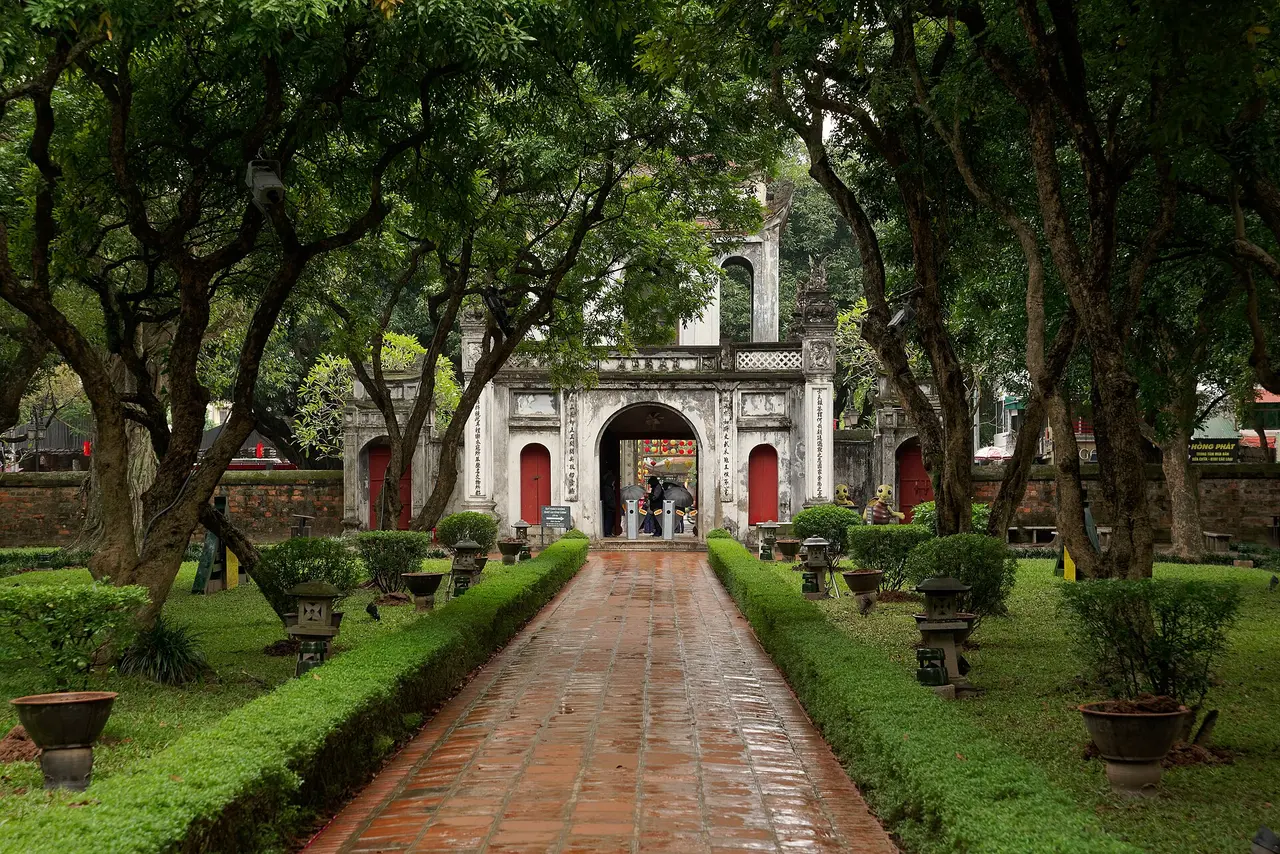
82 steles on stone turtles engraved with the names of mandarin examination laureates, from 1442 to 1779.

Mausoleum and stilt house

The granite monument on Ba Dinh Square and the simple house where Ho Chi Minh lived, to visit in the morning.

Tran Quoc pagoda

The oldest pagoda in the city, on a peninsula in West Lake, superb at sunset.

Water puppets

An art born in the rice paddies of the delta, performed every evening at the Thang Long theatre by Hoan Kiem Lake.

Crossing Long Bien bridge

Two kilometres of steel girders over the Red River, reserved for trains, two-wheelers and pedestrians.

Ha Long Bay cruise

Hundreds of limestone islets about three hours away by road, ideally with a night on board.

Trang An rowing boats

A river winding under caves and between the karsts of Ninh Binh, two hours away by train.

What to see in Hanoi?

A thousand years as a capital on the Red River

In 1010, King Ly Thai To moved his capital to a bend of the Red River and named it Thang Long, the rising dragon. The city only took the name Hanoi, the city within the river, in 1831. This long history can be read in layers: a royal citadel listed by UNESCO, Confucian temples, villas and boulevards from the French period, then the monuments of the Socialist Republic. Unlike the great commercial metropolis of the south, Hanoi has kept a slower pace, trees everywhere and a strong neighbourhood life. It is the best introduction to the history of Vietnam, and a place where tradition still shapes daily routines.

The Old Quarter of the 36 guilds

North of Hoan Kiem Lake, a maze of lanes preserves the layout of the merchant city: each street was named after the guild that worked there, and many still keep their speciality. Hang Ma sells votive paper goods and lanterns, Hang Bac silverware, Hang Thiec tinware. The tube houses, narrow at the front and tens of metres deep, hold a shop, a workshop and a home. Step into the old house at 87 Ma May or the Hang Buom communal house, then finish at the covered Dong Xuan market. In the evening, Ta Hien street fills with low stools and draught beer, and the whole district stays lively until late at night.

Hoan Kiem, the lake where everything meets

The Lake of the Returned Sword owes its name to a 15th-century legend: King Le Loi is said to have returned to a golden turtle the magic sword that had helped him drive out the Ming invaders. On an islet, Ngoc Son temple is reached by the red The Huc bridge, the most photographed image of the city. Come at dawn, when hundreds of Hanoians practise tai chi, dance or badminton along the shores. From Friday evening to Sunday evening, the streets around the lake become pedestrian and host musicians, traditional games and families. The Opera House, modelled on the one in Paris, stands a few streets to the east.

Ba Dinh, political Hanoi

It was on Ba Dinh Square that Ho Chi Minh proclaimed independence on 2 September 1945. His granite mausoleum houses his embalmed body, which can be seen in the morning from Tuesday to Sunday, in a silent and supervised queue: shoulders and knees covered, no photos inside. The building closes for several weeks each year for maintenance, in 2026 from early September to early November. Behind it, the modest stilt house where the leader lived contrasts with the yellow colonial-era Presidential Palace. Right next door, the One Pillar Pagoda, founded in 1049 and rebuilt in 1955, rises from its pond like a lotus flower, a small but much revered shrine.

The Temple of Literature, the country's first university

Founded in 1070 in honour of Confucius, Van Mieu welcomed the Quoc Tu Giam six years later, Vietnam's first university, set up to train mandarins. Visitors walk through five successive courtyards, separated by gateways and gardens, up to the Constellation of Literature pavilion, an emblem of the city. The site keeps 82 steles resting on stone turtles, engraved with the names of the laureates of the examinations held from 1442 to 1779 and listed on UNESCO's Memory of the World register. Students still come to pose here in gowns on graduation day. Entry costs 70,000 dong, about 2.50 euros, and it is best visited at opening time.

War memories: Hoa Lo and the museums

Built by the French administration in 1896 as the Maison Centrale, Hoa Lo prison held independence activists, then American pilots shot down during the war, who ironically nicknamed it the Hanoi Hilton. Only part of it remains, now a museum with cells, a guillotine and the official Vietnamese account; entry is 50,000 dong. The Military History Museum, near the Flag Tower, displays planes and tanks, while the Vietnamese Women's Museum tells the story of war and daily life from women's point of view. The Museum of Ethnology, to the west, presents the country's 54 ethnic groups with traditional houses rebuilt in its garden.

West Lake and Long Bien bridge

Larger and more residential than Hoan Kiem, West Lake can be circled by bicycle along some fifteen kilometres of shore. On a peninsula, Tran Quoc pagoda, whose origins go back to the 6th century, is considered the oldest in the city; its red brick tower is spectacular at sunset. The Tay Ho district gathers expats, cafes and grilled fish restaurants. Further east, Long Bien bridge, completed in 1902 and bombed several times during the war, crosses the Red River for nearly two kilometres. Only trains, two-wheelers and pedestrians use it, which makes it a fine walk, especially in the golden light of late afternoon.

Train street: go with your eyes open

Between Le Duan and Phung Hung streets, the railway runs a few centimetres from the house fronts, and cafes used to set their stools on the tracks so customers could watch trains brush past. This viral attraction is regularly banned by the authorities: closures in 2019 and 2022, then police clearing tourists out in February 2026 after a video judged dangerous. In January 2026 the city even proposed ending passenger trains on this stretch. Before going, check the current situation, never sit on the track and follow the officers' instructions. The street remains photogenic even without a train, with its laundry, potted plants and doorstep life.

Eating in Hanoi, from pho to egg coffee

Hanoi claims to be the birthplace of pho, a rice noodle soup in beef broth scented with star anise, eaten in the morning on a plastic stool. At lunchtime comes bun cha, charcoal-grilled pork served with vermicelli, herbs and a sweet and sour sauce, which Barack Obama shared in 2016 in a canteen on Le Van Huu street. Cha ca, fish marinated in turmeric and fried with dill, has given its name to an entire street. For dessert, egg coffee, invented in 1946 at Cafe Giang, blends strong coffee with egg yolk whipped with sugar. Expect to pay less than 2 euros for a street meal.

Ha Long and Ninh Binh, the two great day trips

Hanoi is the base for two UNESCO-listed landscapes of limestone karsts. Ha Long Bay, about 175 kilometres away, is reached in 2.5 to 3.5 hours by shuttle; a day cruise costs 65 to 120 dollars, but a night on board lets you see the islets without the crowds of the day boats. Choose a reputable boat, as France Diplomatie advises caution with very cheap offers. Ninh Binh, 90 kilometres to the south, is about two hours away by train: rowing boats through the caves of Trang An and the ruins of Hoa Lu, a 10th-century capital. Both trips combine well with a wider tour of Southeast Asia.
Sample itineraries

Three routes built around the time you actually have.
3daysRecommended

Hanoi in 3 days: the city, West Lake and Ninh Binh

  1. Temple of Literature, Hoan Kiem and the Old Quarter
  2. Ninh Binh: Trang An and Hoa Lu
  3. West Lake and the Museum of Ethnology

Best for: The most balanced format: a heritage day in the city, a train day to the limestone karsts and rice fields of Ninh Binh, then the more residential Hanoi of West Lake and the Museum of Ethnology.

How much it costs

Per person per day, excluding international travel.
Budget
24 €/ day
1 936 € for 2 people, 7 days, return flights included
Accommodation
7 €
Food
9 €
Local transport
2 €
Sights and activities
6 €
Comfort
56 €/ day
2 384 € for 2 people, 7 days, return flights included
Accommodation
13 €
Food
20 €
Local transport
5 €
Sights and activities
18 €
Premium
168 €/ day
3 952 € for 2 people, 7 days, return flights included
Accommodation
65 €
Food
45 €
Local transport
18 €
Sights and activities
40 €
Prices checked: Relevé du 10 octobre 2026. Dong converti au taux de virement Vietcombank du 10 octobre 2026 (1 € = 28 618 VND, soit 1 000 000 VND = 34,9 €), recoupé avec ExchangeRate-API du même jour (1 € = 28 994 VND). Repas et transport : Numbeo Hanoï, mise à jour du 5 octobre 2026, 909 relevés de 86 contributeurs sur 12 mois, valeurs propres à Hanoï (repas bon marché 1,90 €, repas de milieu de gamme pour deux 20,68 €, bière pression locale 0,96 €, cappuccino 1,68 €, trajet en transport local 0,34 €, prise en charge taxi 0,69 € puis 0,52 € le km). Hébergement : lit en dortoir autour de 7 € (moyenne des prix plancher de 20 auberges sur Hostelworld, page 2026 consultée le 10 octobre 2026, prix non datés) ; hôtel 3 étoiles 26 € et 5 étoiles 129 € la nuit en moyenne selon combien-coute.net (mise à jour du 28 septembre 2026, d'après hotels.com et Booking). Activités : temple de la Littérature 70 000 VND et prison de Hoa Lo 50 000 VND (tarifs relevés par Vietnam Tourism et Vietjet, guides 2026, hausse décidée par la ville en 2023) ; croisière d'une journée dans la baie d'Halong de 65 à 120 USD par personne, plus 30 à 40 USD de navette (Indochina Tour, guide 2026). Vol A/R Paris-Hanoï hors vacances scolaires estimé à 800 € par personne (Kayak, relevé du 10 octobre 2026 : fourchette habituelle 739 à 1 116 €, moyenne 873 €, novembre 766 € en médiane, juillet-août au-delà de 1 100 €). Hébergement par nuit et par personne : dortoir pour le profil routard, chambre double partagée à deux pour les autres. Le poste activités inclut une excursion d'une journée (Halong ou Ninh Binh) répartie sur le séjour. weekTwoPax = 7 jours x 2 personnes + 2 vols.

Getting there

Airports serving Hanoi, from main hubs to secondary ones.
  • CXRCam Ranh International Airport / Cam Ranh Air BaseNha Trang/nha Trang aiurportCam RanhMain
  • DADDa Nang International AirportDa NangMain
  • HANNoi Bai International AirportHanoiMain
  • HPHCat Bi International AirportHaiphongMain
  • LTHLong Thanh International Airport (Under Construction)Ho Chi Minh CityMain
  • PQCPhú Quốc International AirportPhu Quoc IslandMain

Entry, health and safety

For FR travellers

Entry requirements

No visa for a tourist stay

Exemption de visa depuis le 15 août 2023 pour tout séjour de 45 jours au plus, jours d'entrée et de sortie compris, quels que soient le type de passeport et l'objet du voyage. Au-delà, e-visa à demander avant le départ sur le portail national de l'immigration (jusqu'à 90 jours, entrées multiples). Exemption et visa ne sont ni prolongeables ni renouvelables sur place ; un dépassement entraîne des pénalités à régler avant de quitter le pays. Passeport valable au moins six mois à la date d'entrée.

Stay allowed for up to 45 days.

Passport valid for 6 months beyond your return date.

Health

Advised: Vaccinations du calendrier français à jour (diphtérie, tétanos, poliomyélite, coqueluche, rougeole) ; selon la durée et les conditions du séjour, hépatite A, fièvre typhoïde, hépatite B (séjours fréquents ou longs), rage, encéphalite japonaise (cas humains recensés dans les provinces du Nord) et dengue dans certains cas.

Dengue et chikungunya transmis par les moustiques : se protéger, éviter les anti-inflammatoires en cas de fièvre. Rage endémique, y compris en ville : ne pas approcher les animaux errants. Alcool artisanal frelaté au méthanol signalé dans les provinces du Nord et à Hanoï. Eau en bouteille et aliments bien cuits. Côté sécurité, tout le pays est en vigilance renforcée sans zone déconseillée ; à Hanoï, vols à l'arraché (souvent à moto) et pickpockets en hausse dans le vieux quartier des 36 rues et autour du lac Hoan Kiem, fausses réservations de logement en ligne, circulation dangereuse (casque obligatoire, permis adapté à la cylindrée). Inondations de mousson l'été dans le bassin du fleuve Rouge ; prudence sur les croisières très bon marché dans la baie d'Halong. Fiches France Diplomatie mises à jour le 15 septembre 2026.

Safety

Increased caution

Emergency

113 (police), ambassade de France à Hanoï +84 24 3944 57 00

Checked in octobre 2026 against the official source. Entry rules change: check the official source before you travel, it alone is authoritative.

Practical information for Hanoi

Flights from Paris

Vietnam Airlines is the only carrier flying non-stop between Paris and Hanoi, in about 11 hours; expect around 800 euros return outside school holidays (Kayak, October 2026).

Airport

Noi Bai is about thirty kilometres north of the centre; express bus 86 to the Old Quarter, taxis and Grab.

Visa

French nationals are exempt for 45 days with a passport valid for six months; online e-visa beyond that (France Diplomatie, September 2026).

Currency

The dong (VND): 1 euro is worth about 28,600 dong (Vietcombank, 10 October 2026). Cash is essential in canteens and at the Temple of Literature.

Daily budget

About 24 euros a day for backpackers, 56 euros mid-range and 168 euros upmarket, per person and excluding flights.

Time difference

UTC+7 all year: five hours ahead of Paris in summer, six hours in winter.

Getting around

On foot in the Old Quarter, Grab cars or motorbikes for the rest, and elevated metro line 2A towards Ha Dong.

Crossing the street

Walk at a slow, steady pace without stopping: the scooters will flow around you. Never step back suddenly.

Where to stay

The Old Quarter to do everything on foot, south of Hoan Kiem Lake for more calm, Tay Ho for a longer stay.

Dress code

Shoulders and knees covered at the mausoleum and in pagodas; bring a jacket in December and January, when nights drop to 15 °C.

Safety

Bag snatching and pickpocketing are reported in the Old Quarter and around the lake; leave your passport in the hotel safe.

Emergencies

Police 113; French Embassy, 57 Tran Hung Dao street, +84 24 3944 57 00.

Hanoi in pictures

Photo credits : Jakub Hałun, CC BY 4.0, Wikimedia Commons ; Shyamal, CC BY-SA 4.0, Wikimedia Commons ; Rolf Müller ( User:Rolfmueller ), CC BY-SA 3.0, Wikimedia Commons ; thalling55, CC BY 2.0, Wikimedia Commons ; Greg Willis from Denver, CO, usa, CC BY-SA 2.0, Wikimedia Commons

Frequently asked questions about Hanoi

When is the best time to visit Hanoi?
October and November are the most pleasant: dry air, 26 to 30 °C in the afternoon and clear skies. March and April are mild but often misty. From June to August the heat tops 33 °C with frequent storms, and December and January are cool, around 15 °C at night.
How many days do you need in Hanoi?
Two days are enough for the Old Quarter, Hoan Kiem Lake, Ba Dinh and the Temple of Literature. Three days let you add Ninh Binh or West Lake, and four days a cruise with a night on board in Ha Long Bay.
Do you need a visa for Hanoi?
Not for French nationals staying 45 days or less: they have been exempt since August 2023, with a passport valid for six months after entry. Beyond that, an e-visa must be obtained online before departure, valid for up to 90 days and not extendable in the country. Other nationalities should check their own rules.
How do you get from Noi Bai airport to central Hanoi?
The airport is about thirty kilometres north. Express bus 86 serves the railway station and the Old Quarter for a few tens of thousands of dong. Official taxis and Grab cars, booked in the app, drop you at your hotel, which is easier when arriving late.
Can you visit the Ho Chi Minh Mausoleum?
Yes, free of charge, in the morning from Tuesday to Sunday, except during the annual maintenance closure, which in 2026 ran from early September to early November. Clothing must cover shoulders and knees, bags are checked and photos are banned inside.
Is train street still accessible?
Not reliably. The authorities regularly close the cafes along the tracks, police cleared tourists out in February 2026 and the city is considering ending passenger trains on this stretch. Check the situation locally and never sit on the track.
Ha Long Bay or Ninh Binh from Hanoi?
Ha Long offers limestone islets rising from the sea, ideally enjoyed on a cruise with a night on board, about three hours away by road. Ninh Binh, two hours away by train, shows the same peaks among rice fields, by rowing boat, and is easy to do as a day trip.
How much does a trip to Hanoi cost?
Allow about 24 euros a day per person as a backpacker, 56 euros mid-range and 168 euros upmarket, excluding flights. A street meal costs under 2 euros, a night in a three-star hotel around 26 euros and the Paris-Hanoi flight about 800 euros return.
What should you eat in Hanoi?
Beef pho in the morning, bun cha at lunchtime with its charcoal-grilled pork, cha ca with turmeric and dill, and egg coffee, a local speciality since 1946. The best places are often simple pavement canteens with low stools, where locals queue at lunchtime.
Is Hanoi safe for tourists?
Broadly yes, but France Diplomatie reports a rise in bag snatching, often from motorbikes, and pickpocketing in the Old Quarter and around Hoan Kiem Lake. Traffic is the main danger: cross slowly and wear a helmet on a motorbike.

Plan your trip to Hanoi

Build your day-by-day itinerary and manage budget, bookings and packing in PlanTripNow.
Aperçu de l'application PlanTripNow
