Skip to content

Visit Ho Chi Minh City : what to see in Saigon in 2 to 4 days

Saigon never slows down: millions of scooters beneath glass towers, the colonial post office two streets from the palace where the war ended, the smoky pagodas of Cholon and, a day's drive away, the winding canals of the Mekong Delta.

At a glance

Visa
None
Tourist stay of up to 45 days
7-day budget
€364
Per person, comfort profile, excluding international flights.
Recommended length
3 days
For a first trip, without rushing.

Why go to Ho Chi Minh City?

Ho Chi Minh City, still called Saigon by its residents, is Vietnam's largest city and economic engine, linked to Paris by direct flights of about 12 hours. Visitors come for war history, the colonial heritage of District 1 and Cholon, and as a base for the Cu Chi tunnels and the Mekong Delta, a gateway to mainland Southeast Asia. The dry season runs from December to April.

When to visit Ho Chi Minh City

Temperatures, rainfall and crowds month by month, to pick your window.
When to visit Ho Chi Minh City
MonthTemperaturesRainCrowdsVerdict
January23 to 32 °C2 dPackedThe heart of the dry season, 32 °C in the afternoon and barely two days of rain: the best month for District 1 and the Mekong Delta alike, and the busiest.
February23 to 33 °C1 dBusyThe driest month; Tet (6 February in 2027) empties the city as residents head to the provinces, closes many restaurants and fills Nguyen Hue street with flowers.
March25 to 34 °C1 dBusyStill dry, but the heat climbs towards 34 °C: visit the Cu Chi tunnels early in the morning and keep the afternoon for air-conditioned museums.
April26 to 35 °C4 dModerateThe most stifling month before the rains, close to 35 °C; 30 April, Reunification Day, decks the palace in flags and fills hotels with Vietnamese tourists.
May26 to 35 °C13 dQuietThe first afternoon downpours cool the air a little; it is the cheapest month for the flight from Paris, 862 euros median.
June26 to 34 °C16 dQuietThe rainy season has set in: a short, heavy storm late in the day, often fine mornings; Mekong Delta fruit (rambutan, durian) is in season.
July25 to 33 °C19 dModerateThe month with the most rainy days, and the most expensive flight of the year from Paris, around 1,240 euros median.
August25 to 33 °C17 dModerateDaily showers and streets sometimes flooded after a storm; flights still dear, close to 1,100 euros median, but District 1 hotels are quiet.
September25 to 33 °C18 dVery quietThe wettest month by volume, 273 mm: Mekong Delta trips are possible but muddy, and National Day falls on 2 September.
October25 to 32 °C16 dQuietStill 240 mm of rain and high tides that spill into some low-lying districts; gentle prices and no crowds.
November25 to 32 °C9 dModerateThe shift to the dry season, with half as many rainy days as October: a good compromise between clear skies and still reasonable visitor numbers.
December24 to 32 °C5 dPackedThe coolest month, 24 °C at night, and the dry weather returns; Nguyen Hue walking street and District 1 light up for Christmas and New Year.
Source: Températures (moyennes des maxima et minima quotidiens, moyenne calculée comme leur demi-somme) et jours de pluie (seuil 0,1 mm) : normales 1991-2020 de l'Organisation météorologique mondiale pour la station de Hô Chi Minh-Ville, fournies par l'Administration météorologique et hydrologique du Vietnam (worldweather.wmo.int, relevé du 10 octobre 2026). Climat tropical à deux saisons : saison sèche de décembre à avril (moins de 60 mm par mois), saison des pluies de mai à novembre (plus de 200 mm de mai à octobre, 273 mm en septembre). Le centre-ville n'est pas en bord de mer : pas de température de la mer. Prix : vols Paris-Hô Chi Minh-Ville sur Kayak (mai le mois le moins cher à 862 € en médiane, juillet 1 237 € et août 1 098 €), relevé du 10 octobre 2026 ; Têt 2027 le 6 février. Pluies de mousson jusqu'en novembre dans le delta du Mékong selon France Diplomatie (fiche mise à jour le 15 septembre 2026). Affluence et niveaux de prix des autres mois : estimation éditoriale.

Saigon's must-sees

Six places that sum up the city, from the colonial era to the end of the war.

Central Post Office

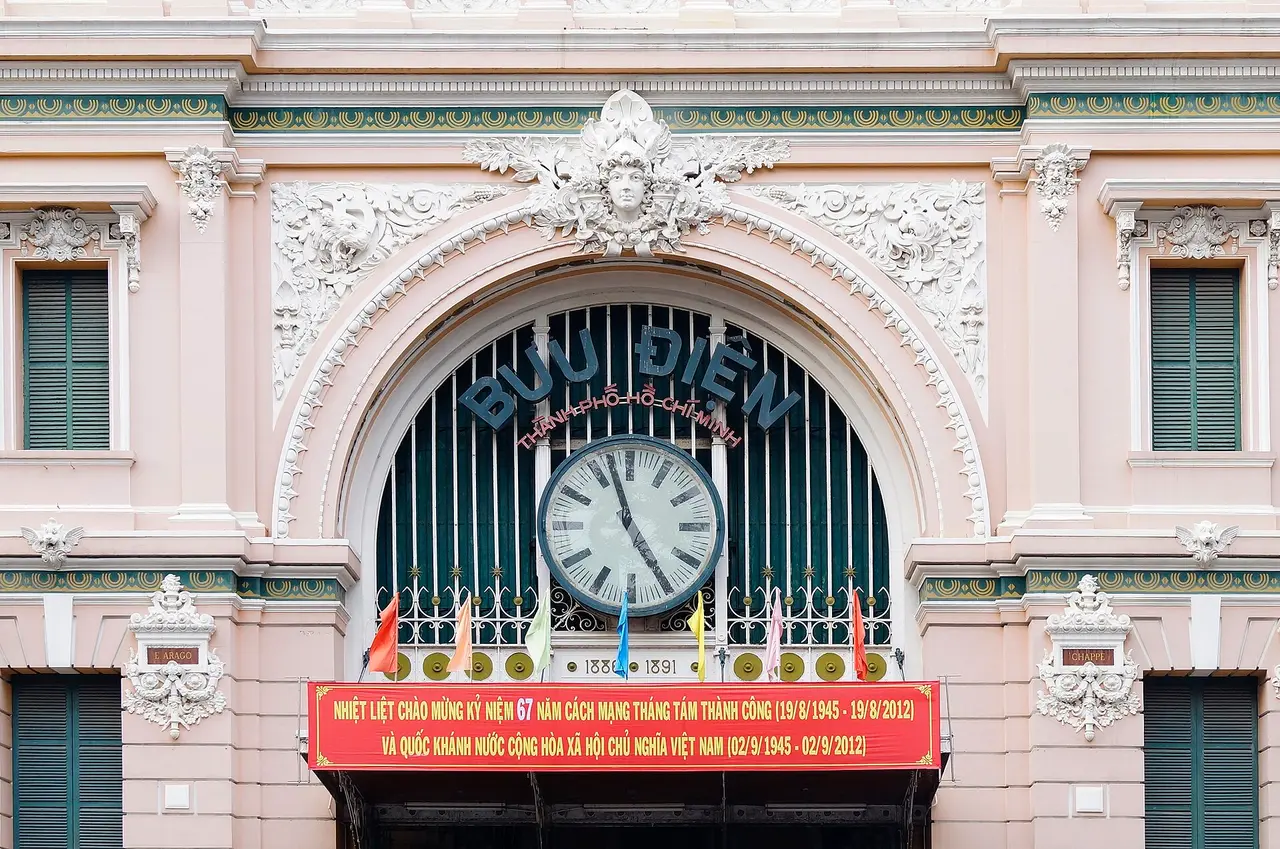
A great vaulted hall from the late 19th century, with wooden counters and old maps, still in service opposite the cathedral.

Reunification Palace

South Vietnam's former presidential palace, intact in its 1960s decor, with bunker, war room and the tank of 30 April 1975.

War Remnants Museum

The city's most visited museum: war photographs, weapons and rooms on Agent Orange. Harrowing, best planned without young children.

Thien Hau Pagoda

The temple of the sea goddess in Cholon, with ceramic roofs and hanging incense coils that burn for days.

Jade Emperor Pagoda

A dim Taoist sanctuary full of carved wooden statues, where people come to pray for fertility and good fortune.

Ben Thanh Market

The covered market in the centre, with its clock tower and soup counters, more authentic in the morning than at tourist hours.

What to see in Ho Chi Minh City?

Saigon or Ho Chi Minh City: one city, two names

Founded in 1698 as Gia Dinh, capital of French Cochinchina and then of South Vietnam, the city became Ho Chi Minh City in 1976. Residents still call it Saigon. In July 2025 it absorbed two neighbouring provinces and abolished its districts, but their old numbers remain the reference for finding your way. It is the fast-paced, commercial counterpart to the capital of Vietnam.

District 1, the colonial and commercial heart

French Saigon can be covered on foot in half a day: the red-brick Notre-Dame Cathedral, completed in 1880 and under restoration until 2027, the Opera House, City Hall and Dong Khoi street, the former rue Catinat. Nguyen Hue walking street comes alive after 7 pm. France Diplomatie reports bag snatching and pickpockets here: keep your phone away from the kerb.

April 1975, told on the spot

On 30 April 1975, a North Vietnamese tank smashed through the gates of the presidential palace and the war was over. The palace, frozen in its 1960s decor, opens from 7 am to 6 pm for 80,000 dong, about 2.80 euros. Ten minutes' walk away, the War Remnants Museum displays reporters' photographs and rooms on Agent Orange. One morning is enough for both.

Cholon, the Chinese city

West of the centre, the former District 5 has housed the city's Chinese community since the 18th century: congregation halls, herbalists, workshops, Thien Hau pagoda and Binh Tay wholesale market. Allow half a day and a Grab ride from District 1, the easiest option. In the morning the wholesalers are in full swing; in the evening, the roast duck eateries take over.

Da Kao and District 3, Saigon of the alleys

North of the centre, Da Kao and the former District 3 reveal a residential city of colonial villas, alleys and pavement cafes. The Jade Emperor Pagoda, built by the Cantonese community in the early 20th century, pairs well with the pink Tan Dinh church and its market. A morning is enough, ideally on a weekday, before the 5 pm traffic jams.

Thu Thiem and the vertical city

Across the Saigon River, Thu Thiem offers the best view of the downtown towers, including the Bitexco tower and its observation deck. Further north, Landmark 81 rises to 461 metres, the national record. Since December 2024, metro line 1 has linked Ben Thanh with Suoi Tien in the east. Come to Thu Thiem in the late afternoon, for the sunset.

Eating in Saigon, from com tam to banh mi

Southern cooking is sweeter and more herb-laden than in the North. The everyday dish is com tam, broken rice with a grilled pork chop, served from 6 am; then come hu tieu, crispy banh xeo and banh mi. A street meal costs under 2 euros, an iced coffee with condensed milk barely more. Very noisy Bui Vien street mainly draws backpackers.

The Cu Chi tunnels, half a day at least

North-west of the city, more than 200 kilometres of tunnels sheltered Viet Cong fighters. The Ben Dinh site, the most visited, costs about 125,000 dong for foreigners; Ben Duoc, further away, is quieter. The sections open to visitors remain tight, best avoided if you are claustrophobic. Leave before 8 am to beat both the heat and the tour buses arriving from town.

The Mekong Delta, then Cambodia

My Tho and Ben Tre can be seen in a day, boat, sampan and orchards included, for 17 to 41 dollars on a group tour. For the floating markets, spend a night in Can Tho and head to Cai Rang at dawn. The delta also opens the road to Cambodia, by boat from Chau Doc or by bus to Phnom Penh. Avoid muddy September and October.

Sample itineraries

Three routes built around the time you actually have.
3daysRecommended

Ho Chi Minh City in 3 days: war history and the Cu Chi tunnels

  1. Reunification Palace and War Remnants Museum
  2. Cu Chi tunnels
  3. Jade Emperor Pagoda and District 3

Best for: The format that tells Saigon's story best: the Reunification Palace and the War Remnants Museum, half a day in the Cu Chi tunnels, then the more intimate city of pagodas and District 3.

How much it costs

Per person per day, excluding international travel.
Budget
23 €/ day
2 082 € for 2 people, 7 days, return flights included
Accommodation
7 €
Food
8 €
Local transport
2 €
Sights and activities
6 €
Comfort
52 €/ day
2 488 € for 2 people, 7 days, return flights included
Accommodation
13 €
Food
18 €
Local transport
5 €
Sights and activities
16 €
Premium
173 €/ day
4 182 € for 2 people, 7 days, return flights included
Accommodation
70 €
Food
45 €
Local transport
18 €
Sights and activities
40 €
Prices checked: Relevé du 10 octobre 2026. Dong converti au taux de virement Vietcombank du 10 octobre 2026 (1 € = 28 618 VND, soit 100 000 VND = 3,49 €), recoupé avec ExchangeRate-API du même jour (1 € = 28 994 VND). Repas et transport : Numbeo Hô Chi Minh-Ville, mise à jour du 5 octobre 2026, 1 080 relevés de 109 contributeurs sur 12 mois (repas bon marché 1,72 €, bière pression locale 0,92 €, cappuccino 1,62 €, trajet en bus 0,24 €, prise en charge taxi 0,65 € puis 0,57 € le km) ; la valeur Numbeo du repas de milieu de gamme pour deux (20,68 €, identique à celle de Hanoï) n'a pas été retenue, remplacée par combien-coute.net (dîner trois plats 10 € par personne, relevé d'octobre 2026). Hébergement : lit en dortoir autour de 7 € (moyenne des 20 prix plancher les plus bas sur Hostelworld, page 2026 consultée le 10 octobre 2026, prix non datés) ; hôtel 3 étoiles 26 € et 5 étoiles 140 € la nuit en moyenne selon combien-coute.net (relevé d'octobre 2026). Activités : palais de l'Indépendance 80 000 VND (site officiel dinhdoclap.gov.vn, tarif en vigueur depuis le 1er mai 2026) ; musée des vestiges de la guerre 40 000 VND et tunnels de Cu Chi (Ben Dinh) 125 000 VND pour les étrangers d'après des guides de voyage non officiels, à vérifier sur place ; excursion d'une journée dans le delta du Mékong (My Tho et Ben Tre) de 17 à 41 USD en groupe (trip.com, Pelago) et 990 000 VND chez Mekong Smile (programme 2026), 81 USD par personne en privé (Mekong Delta Tours). Vol A/R Paris-Hô Chi Minh-Ville hors vacances scolaires estimé à 880 € par personne (Kayak, relevé du 10 octobre 2026 : fourchette habituelle 807 à 1 143 €, moyenne 939 €, mai 862 € en médiane, juillet 1 237 €). Hébergement par nuit et par personne : dortoir pour le profil routard, chambre double partagée à deux pour les autres. Le poste activités inclut une excursion d'une journée (Cu Chi ou delta du Mékong) répartie sur le séjour, en groupe pour les deux premiers profils, privée pour le profil premium. weekTwoPax = 7 jours x 2 personnes + 2 vols.

Getting there

Airports serving Ho Chi Minh City, from main hubs to secondary ones.
  • CXRCam Ranh International Airport / Cam Ranh Air BaseNha Trang/nha Trang aiurportCam RanhMain
  • DADDa Nang International AirportDa NangMain
  • HANNoi Bai International AirportHanoiMain
  • HPHCat Bi International AirportHaiphongMain
  • LTHLong Thanh International Airport (Under Construction)Ho Chi Minh CityMain
  • PQCPhú Quốc International AirportPhu Quoc IslandMain

Entry, health and safety

For FR travellers

Entry requirements

No visa for a tourist stay

Exemption de visa depuis le 15 août 2023 pour un séjour de 45 jours au plus, jours d'entrée et de sortie inclus, quels que soient le type de passeport et le motif du séjour. Au-delà de 45 jours, e-visa obligatoire, à demander avant le départ sur le portail national de l'immigration vietnamien (90 jours au plus, entrées multiples). Ni l'exemption ni le visa ne se prolongent sur place ; tout dépassement est sanctionné et doit être régularisé auprès de l'immigration avant de quitter le pays. Passeport valable au moins six mois à la date d'entrée. Traitement médical : voyager avec l'ordonnance nominative.

Stay allowed for up to 45 days.

Passport valid for 6 months beyond your return date.

Health

Advised: Vaccins du calendrier français à jour ; selon la durée et les conditions du séjour : hépatite A, fièvre typhoïde, hépatite B (séjours fréquents ou prolongés), rage, dengue et chikungunya (épidémie active ou long séjour), encéphalite japonaise, tuberculose pour les enfants de moins de 15 ans.

Plus de transmission du paludisme en zone urbaine au Vietnam ; se protéger des moustiques (dengue, chikungunya) et éviter les anti-inflammatoires en cas de fièvre. Rage endémique, y compris en ville : ne pas approcher les animaux errants. Alcool artisanal frelaté au méthanol : n'acheter qu'en grande enseigne. Côté sécurité, tout le pays est en vigilance renforcée, sans zone déconseillée ; la petite délinquance progresse à Hô Chi Minh-Ville, plus nettement qu'à Hanoï : vols à l'arraché à moto, pickpockets et escroqueries autour de Dong Khoi, Nguyen Hue, Le Lai, Le Loi et Pham Ngu Lao. Laisser le passeport au coffre, se méfier des distributeurs des quartiers touristiques, refuser toute incitation aux jeux d'argent (interdits), vérifier les logements réservés en ligne. En cas de vol, insister pour obtenir une déclaration de vol. Liaison maritime vers Vung Tau : choisir une compagnie établie. Pluies de mousson jusqu'en novembre dans le delta du Mékong. Fiches France Diplomatie mises à jour le 15 septembre 2026.

Safety

Increased caution

Emergency

113 (police), consulat général de France à Hô Chi Minh-Ville +84 28 35 20 68 00

Checked in octobre 2026 against the official source. Entry rules change: check the official source before you travel, it alone is authoritative.

Practical information for Ho Chi Minh City

Flights from Paris

Direct flights of about 12 hours with Vietnam Airlines and Air France; expect 800 to 1,150 euros return, with May the cheapest month (Kayak, October 2026).

Tan Son Nhat airport

Located within the city, north of the centre: bus 109 to the centre, or Grab, more reliable than taxis hailed at the exit.

Crossing the street

Walk at a steady pace, without running or stepping back: the scooters will go around you. Lights are often ignored on right turns.

Rainy season showers

From May to November, storms mostly break in the late afternoon: keep outdoor visits for the morning and a poncho in your bag.

Bag snatching

Reported by France Diplomatie around Dong Khoi, Nguyen Hue, Le Loi and Pham Ngu Lao: passport in the safe, phone away from the kerb.

Paying

The dong rules (1 euro = about 28,600 VND in October 2026); cash for markets and street food, cards accepted in hotels and malls.

Power sockets

220 V current; flat or round pin sockets depending on the building, so a universal adapter avoids surprises.

Ho Chi Minh City in pictures

Photo credits : Prenn, CC BY-SA 3.0, Wikimedia Commons ; Diego Delso, CC BY-SA 3.0, Wikimedia Commons ; Ottre, Public domain, Wikimedia Commons ; HĐ, CC BY-SA 4.0, Wikimedia Commons

Frequently asked questions about Ho Chi Minh City

Should you say Saigon or Ho Chi Minh City?
Both are understood. The official name has been Ho Chi Minh City since 1976, and it appears on documents, the airport and tickets. But residents commonly say Saigon, especially when talking about the centre, and the airport code is still SGN. No Vietnamese will take offence at either name.
Cu Chi tunnels: Ben Dinh or Ben Duoc?
Ben Dinh is the closer and most visited site, used by most group tours. Ben Duoc, further north-west, is quieter and includes a memorial temple. If you want to avoid the crowds, choose Ben Duoc and leave early in the morning.
Can you see the Mekong Delta in a day from Saigon?
Yes, a day in My Tho and Ben Tre is the most common option: boat, sampan, orchards and workshops. It remains fairly touristy. For working floating markets such as Cai Rang, you need to sleep in Can Tho and set off at dawn, so allow at least two days.
Is the War Remnants Museum suitable for children?
With caution. Some rooms, particularly on Agent Orange and atrocities, show very harsh photographs. Children can see the aircraft and tanks in the courtyard, but adults are better off touring the upper floors alone. The Reunification Palace is a more suitable family outing.
Is the Saigon metro useful for tourists?
Not very, for now. Line 1, opened in December 2024, links Ben Thanh station to Suoi Tien in the east, but serves neither the airport nor Cholon. It is mainly handy for reaching Thao Dien and the east of the city; elsewhere, Grab remains more practical.

Plan your trip to Ho Chi Minh City

Build your day-by-day itinerary and manage budget, bookings and packing in PlanTripNow.
Aperçu de l'application PlanTripNow