Skip to content

Things to do in Hoi An : old town, tailors, beaches and My Son

In the evening, hundreds of silk lanterns are reflected in the Thu Bon river, in front of merchant houses that have barely changed since the 18th century. By day, you cycle between rice paddies and vegetable gardens, stop at the tailor's, then head for the beach or the Cham towers of My Son.

At a glance

Visa
None
Tourist stay of up to 45 days
7-day budget
€329
Per person, comfort profile, excluding international flights.
Recommended length
3 days
For a first trip, without rushing.

Why visit Hoi An?

Hoi An is a former trading port in central Vietnam whose old town, a UNESCO World Heritage Site since 1999, has kept the houses of its Chinese, Japanese and Vietnamese merchants. People come for the lanterns, made-to-measure clothes, the countryside by bike and the My Son Sanctuary, an almost unmissable stop on a trip through mainland Southeast Asia. The best time to go is February to April.

When to visit Hoi An

Temperatures, rainfall and crowds month by month, to pick your window.
When to visit Hoi An
MonthTemperaturesRainCrowdsVerdict
January20 to 25 °C14 dModerateEnd of the rainy season, 25 °C and still 14 days of showers: the old town often under grey skies.
February20 to 26 °C7 dBusyTet on 6 February 2027: new lanterns everywhere, but tailors and restaurants close for several days.
March22 to 28 °C7 dBusyPerhaps the best month: 28 °C, barely seven days of rain and lush green Tra Que rice fields to cycle through.
April24 to 31 °C7 dBusyDry air, 31 °C and the sea reaching 26 °C: An Bang finally becomes pleasant for swimming.
May25 to 33 °C10 dModerateAbove 33 °C by noon; visit My Son at opening time, before the heat bears down on the Cham towers.
June26 to 35 °C9 dBusyClose to 35 °C, the hottest month: beach by day, the old town only in the evening.
July26 to 34 °C12 dPackedAsian and European holidays combined, a median 1,320 euro flight from Paris: the lantern lanes overflow every evening.
August26 to 34 °C14 dBusyStill very hot, sea at 30 °C, but late-afternoon storms multiply and herald the typhoon season.
September25 to 32 °C17 dQuietTyphoon and flood season begins: 394 mm of rain, in exchange for the year's cheapest flight, 858 euros median.
October24 to 30 °C21 dVery quietBest avoided: the wettest month, 658 mm, and the Thu Bon river regularly flooding the old town's streets.
November23 to 28 °C21 dVery quietFloods and storms still possible: hotels almost empty, beaches closed on rough-sea days.
December21 to 25 °C21 dQuietRain easing, 25 °C at most: quiet at the tailors, the Hai Van Pass often fog-bound.
Source: Hoi An n'a pas de station de référence de l'Organisation météorologique mondiale : températures (moyennes des maxima et minima quotidiens, moyenne calculée comme leur demi-somme), cumuls et jours de pluie sont les normales 1991-2020 de la station de Da Nang, à 25 km au nord sur la même plaine côtière, fournies par l'Administration météorologique et hydrologique du Vietnam (worldweather.wmo.int, relevé du 10 octobre 2026), recoupées avec le tableau climatique de Da Nang de Wikipédia (écarts inférieurs à 0,5 °C). Jours de pluie au seuil de 0,1 mm. Température de la mer : moyennes mensuelles de Climates to Travel pour la côte de Da Nang (relevé du 10 octobre 2026). Saison des typhons du centre de septembre à début décembre selon Climates to Travel ; crues de la rivière Thu Bon dans la vieille ville surtout en octobre-novembre. Prix : vols Paris-Da Nang sur Kayak (septembre le mois le moins cher à 858 € en médiane, juillet 1 320 € et août 1 153 €), relevé du 10 octobre 2026 ; Têt 2027 le 6 février. Affluence : estimation éditoriale.

Hoi An's must-sees

Eight precise addresses, from the old town to the islands, to tick off with the ticket or along the way.

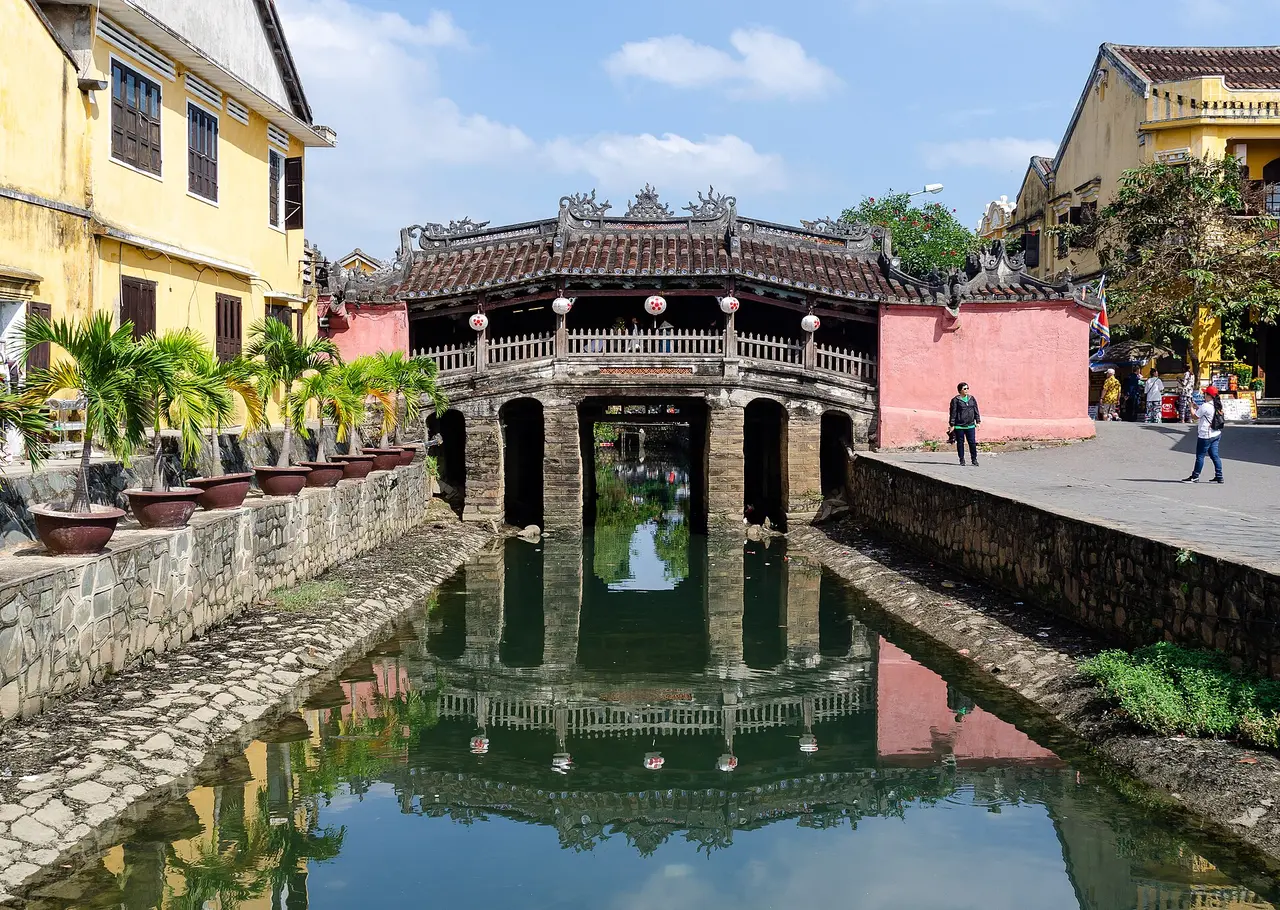
Japanese Covered Bridge

The town's symbol, a small wooden bridge topped by a pagoda, built by the Japanese community and reopened after a long restoration.

Tan Ky House

A merchant house kept in the same family for generations, where Japanese beams, Chinese motifs and a Vietnamese layout come together under one roof.

Phuc Kien Assembly Hall

The largest meeting hall of the Fujian merchants, dedicated to the goddess of the sea, with its incense coils and colourful gateway.

Quan Cong Temple

A Chinese temple dedicated to General Guan Yu, opposite the market, with gilded statues and a life-size red horse, included in the ticket.

Central Market

The town's larder on the Thu Bon: fish at dawn, then counters serving cao lau and mi quang at lunchtime.

Banh Mi Phuong

Hoi An's most famous sandwich counter, made a cult by television, where the queue forms from the morning for 35,000 dong.

Kim Bong Village

On Cam Kim island, a few minutes away by ferry, the carpenters who carved the old town's timber frames still work in front of their workshops.

Cham Islands

A small archipelago and biosphere reserve off Cua Dai, with coral, coves and a fishing village, best done as a day trip.

What to do in Hoi An?

The old town and its entrance ticket

The historic centre is visited with a ticket bought before entering, valid for your whole stay up to three days. The official notice of January 2026 sets two options: 80,000 dong for the Japanese Covered Bridge or Quan Cong temple plus two other monuments, or 120,000 dong, about 4 euros, for a museum and three more monuments. Children under 16 go free. The streets are reserved for pedestrians and bicycles from 9 am to 9.30 pm in summer. Allow one full day, two if you enjoy museums.

Lantern nights on the Thu Bon

Hoi An changes at dusk, when the silk lanterns light up along the facades and riverbanks. A lantern boat costs about 150,000 dong for twenty minutes on the river, where you set a floating candle on the water. Across the bridge, the An Hoi island night market sells lanterns, skewers and sweets. Every month, on the full-moon night, the old town dims its electric lighting in favour of lanterns and traditional games. Arrive before 6 pm to find a spot by the water.

Tailors and craftspeople, made to measure in three days

The town has hundreds of tailoring workshops able to copy a jacket or a dress from a photo. Plan for two fittings and at least 48 hours between order and delivery, which is why it pays to order on day one. Prices noted in 2026 range from 400,000 to 600,000 dong for a simple shirt and from 1.5 to 3 million for a full suit. Compare three shops, feel the fabric and get the final price in writing. Shoemakers work on the same principle for made-to-measure shoes.

Rice fields, vegetable gardens and coconut forest by bike

The countryside starts a few minutes from the old town and is flat, best explored on a bike rented for 30,000 to 50,000 dong a day. To the north, the Tra Que vegetable village grows basil, mint and coriander on hand-watered beds; entry costs 35,000 dong. To the east, the Cam Thanh water coconut forest is explored by basket boat, and the Thanh Ha pottery village, to the west, still shapes clay from the river. Set off at 7 am: by 11 am the heat often tops 30 °C between April and September.

An Bang, Cua Dai and the Cham Islands

Hoi An has two beaches. An Bang, to the north, lines up beach huts and seafood restaurants along a long strip of sand; Cua Dai, further south, has lost much of its sand to erosion. The sea warms from 24 °C in winter to 30 °C in August: swim from April to August, as the autumn swell often closes the beaches. From Cua Dai port, speedboats run to the Cham Islands, a biosphere reserve with snorkelling; entry costs 70,000 dong. Boats stay in port in rough seas.

My Son, the other UNESCO site

Some forty kilometres into the hills, the My Son Sanctuary gathers the brick temples of the Champa kingdom, built between the 4th and 13th centuries and listed by UNESCO in the same year as the old town. Bombed during the war, the site is partly ruined, which makes it more modest than Angkor in Cambodia, but also far less crowded. The ticket costs 150,000 dong and the site opens at 6 am: arrive at opening for the low light and the cool air. Half a day is enough.

The Da Nang side: Marble Mountains and the Hai Van Pass

Since July 2025, Hoi An has come under Da Nang, which absorbed the former Quang Nam province. Its airport, about thirty kilometres away, is the gateway to Hoi An: a Grab costs 250,000 to 350,000 dong. On the way, the Marble Mountains hide pagodas in their caves (40,000 dong), and the Da Nang Museum of Cham Sculpture is a useful complement to My Son. Further north, the Hai Van Pass road offers the finest coastal view in the region, often lost in mist from December to February.

October and November, flood season

This is the other side of the picture. The Da Nang station records 658 mm of rain in October and 486 mm in November, the central typhoon season runs from September to early December, and the Thu Bon river regularly floods the low streets of the old town. Flights are cheaper, 858 euros median in September from Paris, but sea trips and outings to the pass are often cancelled. For a first trip to Vietnam, aim for February to April instead, dry and around 28 °C.

Sample itineraries

Three routes built around the time you actually have.
3daysRecommended

Hoi An in 3 days: My Son, the countryside by bike and the tailors

  1. My Son Sanctuary, then the old town
  2. Cam Thanh, Thanh Ha and Kim Bong
  3. Alterations and merchant houses

Best for: The fullest format without leaving the area: the Cham towers of My Son at dawn, a day of craft villages along the water, and time to have a garment made to measure. No beach in this plan, built for history and craft lovers.

How much it costs

Per person per day, excluding international travel.
Budget
18 €/ day
2 052 € for 2 people, 7 days, return flights included
Accommodation
6 €
Food
7 €
Local transport
2 €
Sights and activities
3 €
Comfort
47 €/ day
2 458 € for 2 people, 7 days, return flights included
Accommodation
17 €
Food
13 €
Local transport
5 €
Sights and activities
12 €
Premium
142 €/ day
3 788 € for 2 people, 7 days, return flights included
Accommodation
70 €
Food
30 €
Local transport
12 €
Sights and activities
30 €
Prices checked: Relevé du 10 octobre 2026, prix hors haute saison (février-avril et juillet-août plus chers). Dong converti au taux de virement Vietcombank du 10 octobre 2026 (1 € = 28 618 VND). Hébergement, repas et transport : guide budget de Vietnam Tourism (vietnamtourism.com, site d'information touristique, mis à jour le 19 septembre 2026) : lit en dortoir 120 000 à 200 000 VND (4 à 7 €), hôtel de charme 800 000 à 1 200 000 VND la chambre double (28 à 42 €), resort à partir de 2 500 000 VND (87 €), plats de rue 25 000 à 50 000 VND, repas assis 60 000 à 180 000 VND, vélo 30 000 à 50 000 VND par jour, Grab aéroport de Da Nang-Hoi An 250 000 à 350 000 VND ; hôtel 4 étoiles 59 € et 5 étoiles 166 € la nuit en moyenne selon combien-coute.net (prix relevés en octobre 2026). Activités : tarifs 2026 du portail officiel du tourisme de Da Nang (danangfantasticity.com, 22 janvier 2026, prix indicatifs) : billet de la vieille ville 120 000 VND pour les étrangers, sanctuaire de My Son 150 000 VND, village de Tra Que 35 000 VND, spectacle Hoi An Memories 600 000 à 1 200 000 VND, Ba Na Hills 1 000 000 VND ; barque aux lanternes 150 000 VND (Vietnam Tourism). Numbeo écarté (13 contributeurs, données en partie estimées). Le poste repas du profil premium est une estimation éditoriale faute de relevé daté des grandes tables. Vol A/R Paris-Da Nang avec escale (pas de vol direct) hors vacances scolaires estimé à 900 € par personne (Kayak, relevé du 10 octobre 2026 : fourchette habituelle 852 à 1 212 €, septembre 858 € en médiane, juillet 1 320 €). Hébergement par nuit et par personne : dortoir pour le profil routard, chambre double partagée à deux pour les autres. weekTwoPax = 7 jours x 2 personnes + 2 vols.

Getting there

Airports serving Hoi An, from main hubs to secondary ones.
  • CXRCam Ranh International Airport / Cam Ranh Air BaseNha Trang/nha Trang aiurportCam RanhMain
  • DADDa Nang International AirportDa NangMain
  • HANNoi Bai International AirportHanoiMain
  • HPHCat Bi International AirportHaiphongMain
  • LTHLong Thanh International Airport (Under Construction)Ho Chi Minh CityMain
  • PQCPhú Quốc International AirportPhu Quoc IslandMain

Entry, health and safety

For FR travellers

Entry requirements

No visa for a tourist stay

Exemption de visa depuis le 15 août 2023 pour tout séjour de 45 jours au plus, jours d'entrée et de sortie compris, quels que soient le type de passeport et l'objet du voyage. Au-delà, e-visa à demander avant le départ sur le portail national de l'immigration (jusqu'à 90 jours, entrées multiples), ni prolongeable ni renouvelable sur place. Passeport valable au moins six mois à la date d'entrée.

Stay allowed for up to 45 days.

Passport valid for 6 months beyond your return date.

Health

Advised: Vaccinations du calendrier français à jour (diphtérie, tétanos, poliomyélite, coqueluche, rougeole) ; selon la durée et les conditions du séjour, hépatite A, fièvre typhoïde, hépatite B (séjours fréquents ou longs), rage, encéphalite japonaise, chikungunya et dengue en cas d'épidémie ou de long séjour.

Dengue et chikungunya transmis par les moustiques, sans traitement curatif pour la dengue : se protéger des piqûres et éviter les anti-inflammatoires en cas de fièvre. Rage endémique dans tout le pays, villes comprises. Pas de transmission du paludisme en zone urbaine. Alcool frelaté au méthanol possible dans les zones touristiques : acheter en grande surface. Eau en bouteille ou traitée. Côté sécurité, tout le Vietnam est en vigilance renforcée sans zone déconseillée. Les provinces du Centre, dont Hoi An et Da Nang, sont les plus exposées aux tempêtes tropicales d'automne, et les crues de mousson y durent jusqu'en novembre : se tenir à l'écart des rivières en crue. Circulation dangereuse (casque obligatoire, permis adapté à la cylindrée) et fausses annonces de logement en ligne en hausse. Fiches France Diplomatie mises à jour le 15 septembre 2026.

Safety

Increased caution

Emergency

113 (police), ambassade de France à Hanoï +84 24 3944 57 00

Checked in octobre 2026 against the official source. Entry rules change: check the official source before you travel, it alone is authoritative.

Practical information for Hoi An

Old town ticket

80,000 or 120,000 dong depending on the option, valid for the whole stay up to three days; free for under-16s.

Pedestrian streets

The old town is reserved for pedestrians and bicycles from 9 am to 9.30 pm in summer and until 9 pm in winter.

From Da Nang airport

About thirty kilometres; 250,000 to 350,000 dong by Grab, around 400,000 with a driver booked through the hotel.

Flights from Paris

No direct flight to Da Nang: one to three stops, often via Ho Chi Minh City, Kuala Lumpur or Hong Kong; usually 852 to 1,212 euros return (Kayak, October 2026).

Bike rental

30,000 to 50,000 dong a day, often lent free by hotels and homestays; the best way to reach Tra Que and An Bang.

Tailor turnaround

Allow at least 48 hours and two fittings; order on day one and pay the balance only after the last alteration.

Flood season

From October to November, the Thu Bon can flood the old town; check the forecast and avoid ground-floor rooms near the river.

Swimming

Calm, warm sea from April to August, between 26 and 30 °C; swell and red flags are common from September to January.

Payment

The dong dominates: 1 euro = about 28,600 dong (Vietcombank, October 2026). Cash at the market and small tailors, cards in hotels.

Hoi An in pictures

Photo credits : Steffen Schmitz ( more photos ), CC BY-SA 4.0, Wikimedia Commons ; DEBA PRASAD ROY, CC0, Wikimedia Commons ; Omar David Sandoval Sida, CC BY-SA 4.0, Wikimedia Commons ; Thong Vo, Titi Wanderer, CC0, Wikimedia Commons

Frequently asked questions about Hoi An

Is the Hoi An old town ticket compulsory?
Yes, visitors must buy it before entering the historic centre, even just to stroll around. It costs 80,000 or 120,000 dong depending on how many monuments are included and stays valid for the whole stay, up to three days. Keep the stub: it is checked at the monument entrances.
How long does it take to have a suit made in Hoi An?
A simple suit can be ready in 24 to 48 hours, but two fittings are needed for a good result. Order on arrival for a three-day stay. Prices noted in 2026 range from 1.5 to 3 million dong, roughly 52 to 105 euros, depending on the fabric.
When is the Hoi An lantern night?
Every month, on the full-moon evening of the lunar calendar, the old town dims its electric lighting in favour of lanterns, with traditional games and songs. The lanterns are lit every other evening too: the full moon mainly adds atmosphere, and large crowds on the riverbanks.
Is it better to stay in Hoi An or Da Nang?
Stay in Hoi An if you are coming for the old town, the lanterns and the countryside: everything can be done by bike. Da Nang suits an urban beach and trips to the Hai Van Pass better. The two are about thirty kilometres apart, and many travellers split two nights each.
Is My Son worth the trip from Hoi An?
Yes, if you are interested in history: it is the main group of Cham temples in Vietnam, listed by UNESCO. The site was partly ruined by bombing, so it is less spectacular than Angkor. Half a day is enough; leave before 6 am to avoid the heat and the groups.
Can you swim in Hoi An in November?
Rarely. November is at the heart of the central rainy and storm season, with more than 480 mm of rain in Da Nang, and the swell often closes An Bang and Cua Dai beaches. To swim in a calm sea at 26 to 30 °C, come between April and August.
Is Hoi An now part of Da Nang?
Yes. Since the administrative reform of July 2025, the former Quang Nam province has been merged into Da Nang, and Hoi An now comes under it. For travellers, nothing changes: the old town ticket, the monuments and access from Da Nang airport remain the same.

Plan your trip to Hoi An

Build your day-by-day itinerary and manage budget, bookings and packing in PlanTripNow.
Aperçu de l'application PlanTripNow