Skip to content

Visit Hong Kong : what to do, when to go and getting around

Hong Kong packs opposite worlds into a tiny space: glass towers and incense-filled temples, dim sum stalls and rooftop bars, century-old ferries and quiet beaches half an hour from the centre. A vertical city where nature is never far away, and where everything is linked by public transport.

At a glance

Visa
None
Tourist stay of up to 90 days
7-day budget
€826
Per person, comfort profile, excluding international flights.

Why travel to Hong Kong?

Hong Kong is a Special Administrative Region of China, with its own currency, the Hong Kong dollar, and its own entry rules: French citizens can stay visa-free for up to 90 days. The city spans Hong Kong Island, Kowloon, the New Territories and more than 200 islands. Three to five days are enough, ideally from October to December.

When to visit Hong Kong

Temperatures, rainfall and crowds month by month, to pick your window.
When to visit Hong Kong
MonthTemperaturesRainCrowdsVerdict
January15 to 19 °C6 dModerateOften clear skies and cool air, ideal for ridge walks, though a light jumper helps in the evening.
February15 to 19 °C8 dBusyLunar New Year fills hotels and ferries and closes many small shops for a few days, so book early.
March18 to 22 °C11 dModerateFrequent fog and drizzle can hide the view from the Peak, but mild temperatures suit hiking.
April21 to 26 °C11 dModerateSpring turns humid and the first thundery showers arrive, still pleasant for the outlying islands.
May25 to 29 °C15 dModerateStart of the rain and typhoon season, with a wave of mainland visitors around 1 May.
June27 to 31 °C19 dQuietThe wettest month, sticky heat and violent downpours: museums by day, strolls in the evening.
July27 to 32 °C18 dModerateThe hottest month with a real typhoon risk: keep some flexibility in your plans.
August27 to 31 °C18 dModerateHumid heat and daily storms, but the warm water makes the beaches of Lamma and Cheung Chau tempting.
September26 to 31 °C15 dQuietStill very hot and at the height of typhoon season, allow a day or two of margin before your flight home.
October24 to 28 °C8 dBusyThe air dries out and the sky clears, but China's Golden Week at the start of the month packs the streets.
November20 to 25 °C6 dBusyThe best month: sunshine, low humidity and maximum visibility from the Peak and the trails.
December16 to 20 °C5 dBusyThe driest month, Christmas lights along the harbour and hotel rates at their peak around New Year.
Source: Normales climatiques 1991-2020 de l'Observatoire de Hong Kong (hko.gov.hk, station du siège à Tsim Sha Tsui) : températures moyennes, minimales et maximales quotidiennes, jours de pluie (au moins 0,1 mm) ; température de la mer = moyenne des relevés de surface de North Point (port Victoria) aux mêmes normales. Saison des typhons de mai à novembre selon France Diplomatie (fiche Chine, mise à jour du 15 septembre 2026). Affluence et prix estimés d'après le calendrier des fêtes (Nouvel An lunaire, semaines d'or de mai et d'octobre de la Chine continentale, fêtes de fin d'année), relevé novembre 2026.

Hong Kong's must-sees

Ten places to get a feel for the city, from Victoria Harbour to the hills of Lantau.

Victoria Peak

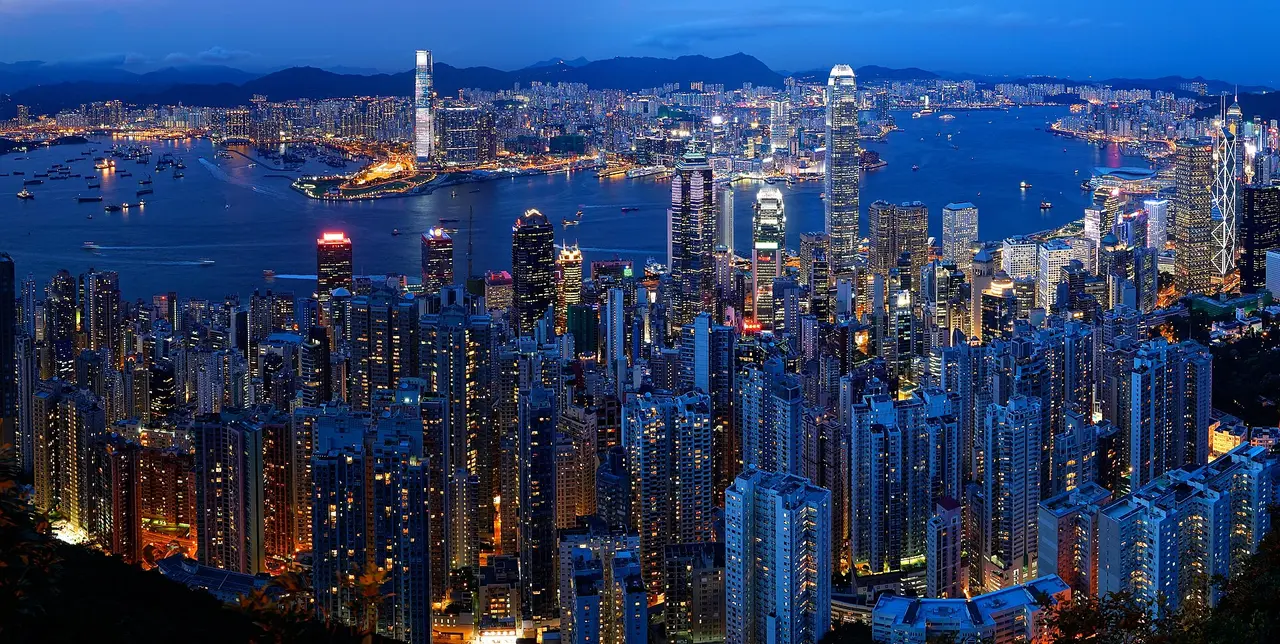
The island's summit at 552 metres, reached by the Peak Tram, with the most famous view over the towers and Victoria Harbour.

Star Ferry

Green and white ferry crossing the harbour since the late 19th century, a short, cheap ride between the island and Kowloon.

Tian Tan Buddha

Seated bronze Buddha at the top of a staircase of some 270 steps, facing Po Lin Monastery on Lantau Island.

Man Mo Temple

19th-century temple in Sheung Wan, dedicated to the gods of literature and war, hung with huge coils of incense.

Temple Street Market

Night market in Yau Ma Tei, with souvenir stalls, fortune tellers and seafood canteens set up on the pavement.

M+ museum

West Kowloon museum of visual culture, covering design, architecture and contemporary Asian art, with a terrace over the harbour.

Wong Tai Sin Temple

Large Taoist temple in Kowloon where worshippers shake fortune sticks to ask about the future.

Island trams

Double-decker trams nicknamed ding ding, running along the island's north shore since 1904 for a few dollars.

Nan Lian Garden

Tang-style classical garden in Diamond Hill, with a golden pavilion, ponds and sculpted pines, free and rarely crowded.

Tai O village

Stilt fishing village on the west of Lantau, known for its dried fish and boat trips.

What to see in Hong Kong?

Central, Sheung Wan and the Mid-Levels

On Hong Kong Island, Central concentrates banks and office towers, but you only need to ride the Mid-Levels escalator, around 800 metres long, to reach the bars and restaurants of SoHo. To the west, Sheung Wan keeps its dried seafood and herb shops and the incense-filled Man Mo Temple. Allow a full day on foot, ending at sunset on the waterfront promenade.

Tsim Sha Tsui and the Kowloon waterfront

The Star Ferry crosses the harbour in about ten minutes to Tsim Sha Tsui. The promenade gives the best view of the island skyline, especially at 8 pm for the daily light show. Further west, the West Kowloon Cultural District is home to the M+ museum and the Hong Kong Palace Museum, each worth half a day, and both usually closed one day a week.

Mong Kok and Yau Ma Tei, everyday Kowloon

Further north, Mong Kok ranks among the most densely populated districts in the world: goldfish market, bird market, sneaker street and the Ladies' Market, all within a few blocks. In Yau Ma Tei, the Temple Street night market comes alive around 6 pm, with fortune tellers, souvenir stalls and open-air canteens. Allow a whole evening there and bring a serious appetite.

Lantau, Ngong Ping and Tai O

The territory's largest island is reached by metro to Tung Chung, then by the Ngong Ping 360 cable car, about 25 minutes above the hills. At the top stand Po Lin Monastery and the great bronze Buddha. The stilt fishing village of Tai O is around twenty minutes away by bus. Allow a full day, avoiding very windy days when the cable car stops.

The islands of Lamma and Cheung Chau

From the Central piers, ferries reach Lamma in about half an hour and Cheung Chau in under an hour. Car-free, these islands alternate sandy beaches, footpaths and seafood restaurants by the water. On Lamma, the trail between Yung Shue Wan and Sok Kwu Wan takes just over an hour on foot. Go on a weekday: at weekends, the ferries are packed.

Hiking and the New Territories

Country parks cover around 40% of the territory. The Dragon's Back trail, on Hong Kong Island, takes about three hours and ends at Big Wave Bay beach. In the northeast, Sai Kung is the base for the Geopark and its beaches reached by water taxi. Hike from October to March: in summer, humid heat and sudden storms make the exposed ridges exhausting.

On to Macau and the mainland

Macau is about an hour away by ferry, or by bus across the Hong Kong-Zhuhai-Macao Bridge, several tens of kilometres long. From West Kowloon station, high-speed trains reach Shenzhen in around twenty minutes and continue to Shanghai or Beijing. Crossing into mainland China means a separate immigration check, carried out in the station before departure, with its own visa rules.

How much it costs

Per person per day, excluding international travel.
Budget
58 €/ day
2 032 € for 2 people, 7 days, return flights included
Accommodation
30 €
Food
18 €
Local transport
5 €
Sights and activities
5 €
Comfort
118 €/ day
3 352 € for 2 people, 7 days, return flights included
Accommodation
58 €
Food
40 €
Local transport
8 €
Sights and activities
12 €
Premium
273 €/ day
9 242 € for 2 people, 7 days, return flights included
Accommodation
128 €
Food
90 €
Local transport
20 €
Sights and activities
35 €
Prices checked: Relevé du 9 novembre 2026. Dollar de Hong Kong converti au taux de référence BCE du 9 novembre 2026 (1 € = 8,7772 HKD). Repas et transport : Numbeo Hong Kong, mise à jour du 8 novembre 2026, 1 969 relevés de 223 contributeurs sur 12 mois (repas bon marché 7,12 €, repas de milieu de gamme pour deux 56,97 €, cappuccino 4,61 €, trajet en transport local 1,17 €, prise en charge taxi 3,30 € puis 1,20 € le km). Hébergement : combien-coute.net, mise à jour du 5 novembre 2026 (auberge ou dortoir pour deux adultes 63 € la nuit en moyenne, hôtel 3 étoiles 115 €, hôtel 5 étoiles 255 €), soit par personne en chambre partagée à deux environ 30, 58 et 128 €. Activités : Peak Tram aller-retour adulte 116 HKD depuis le 29 décembre 2025 (RTHK, 22 décembre 2025), téléphérique Ngong Ping 360 cabine standard aller-retour 295 HKD depuis le 10 juin 2025 (SCMP, tarif non revérifié sur le site de l'exploitant). Vol A/R Paris-Hong Kong hors vacances scolaires (Kayak, relevé du 9 novembre 2026, moyennes sur 12 mois) : routard 610 € (médiane de novembre 608 €, fourchette habituelle 625 à 948 €), confort 850 € (vol direct le moins cher 835 € sur Cathay Pacific), premium 2 710 € (classe affaires à partir de 2 710 €). weekTwoPax = 7 jours x 2 personnes + 2 vols.

Getting there

Airports serving Hong Kong, from main hubs to secondary ones.
  • AATAltay Xuedu AirportAltaySecondary
  • ACXXingyi Wanfenglin AirportXingyiSecondary
  • AEBBaise (Bose) Bama AirportBaiseSecondary
  • AHJHongyuan AirportNgawaSecondary
  • AKUAksu Hongqipo AirportAksuSecondary
  • AOGAnshan Teng'ao Airport / Anshan Air BaseAnshanSecondary

Entry, health and safety

For FR travellers

Entry requirements

No visa for a tourist stay

Hong Kong applique son propre régime d'entrée, distinct de celui de la Chine continentale : pas de visa pour les Français, séjour de 90 jours au maximum. Passeport valable au moins un mois après la date prévue de fin de séjour. Le service d'immigration de Hong Kong peut demander un billet retour ou de continuation et des fonds suffisants pour le séjour. Pour poursuivre vers la Chine continentale, l'exemption chinoise (30 jours, jusqu'au 31 décembre 2026) ou un visa chinois s'applique séparément.

Stay allowed for up to 90 days.

Passport valid for 1 months beyond your return date.

Health

Advised: Vaccinations du calendrier français à jour, notamment diphtérie, tétanos, poliomyélite, coqueluche et rougeole (recommandation générale de France Diplomatie pour la fiche Chine).

Contrat d'assistance ou d'assurance couvrant les frais médicaux impératif avant le départ, y compris pour Hong Kong et Macao. Typhons entre mai et novembre, une dizaine par an en moyenne : suivre les signaux de l'Observatoire de Hong Kong. La législation sur la sécurité nationale s'applique aux étrangers, y compris pour des propos publiés sur les réseaux sociaux ou des activités menées hors de Hong Kong, et peut entraîner des poursuites pénales. Urgences : 999 (police, pompiers, ambulances).

Safety

Normal precautions

Emergency

999 (police, pompiers, ambulances)

Checked in novembre 2026 against the official source. Entry rules change: check the official source before you travel, it alone is authoritative.

Practical information for Hong Kong

Visa-free entry

French citizens can stay up to 90 days without a visa; the system is separate from mainland China's, which has its own border check.

Passport

It must remain valid for at least one month beyond the length of stay, according to the Hong Kong Immigration Department.

Currency

Hong Kong dollar (HKD), pegged to the US dollar; the yuan is not the official currency, even if it is sometimes accepted.

Octopus card

Contactless card for the metro, buses, ferries, trams and many shops; also available as a mobile version.

Power sockets

Type G with three rectangular pins, as in the UK, at 220 V: bring an adapter.

Apps

Unlike the mainland, Google, WhatsApp and social networks work normally in Hong Kong.

Typhoon signal

At signal No. 8, transport and shops gradually close: follow the Hong Kong Observatory, season from May to November.

Tipping

Most restaurants add a 10% service charge to the bill; beyond that, tipping is optional.

Driving on the left

Traffic drives on the left: look right when crossing, and keep right on escalators.

Airport

The Airport Express reaches Hong Kong station, in Central, in about 24 minutes, with in-town check-in available.

Tap water

Meets WHO standards at source, but residents boil it because of the pipes in older buildings.

Emergencies

999 for police, fire and ambulance.

Hong Kong in pictures

Photo credits : Romain Pontida, CC BY-SA 2.0, Wikimedia Commons ; Wilfredor, CC0, Wikimedia Commons ; Richard Mortel from Riyadh, Saudi Arabia, CC BY 2.0, Wikimedia Commons ; Diego Delso, CC BY-SA 3.0, Wikimedia Commons

Frequently asked questions about Hong Kong

Do you need a visa for Hong Kong if you already have the China exemption?
The two systems are independent. French citizens enter Hong Kong visa-free for up to 90 days, while the exemption for mainland China is limited to 30 days. Each border crossing at Shenzhen or West Kowloon counts as an exit and a new entry.
Peak Tram or bus to go up Victoria Peak?
The Peak Tram is the most spectacular, but the queue often exceeds an hour in the late afternoon. Bus 15 from Central climbs a winding road with fine views, and there is almost never a wait. One option is to go up by bus and come down by tram.
Where can you watch the Symphony of Lights?
The show starts every evening at 8 pm and lasts about ten minutes. The Tsim Sha Tsui promenade, near the Clock Tower, gives the clearest view of the island's waterfront. You can also watch it from a boat or a rooftop bar.
How does the Octopus card work for tourists?
It is sold at the airport or in metro stations, topped up at machines and convenience stores, and pays for transport, cafes and supermarkets. A mobile version exists for some phones. The remaining balance can be refunded at the counter before you leave.
Which area should you stay in Hong Kong?
Tsim Sha Tsui is convenient and more affordable, right by the Star Ferry and the metro. Central and Sheung Wan suit those who want to go out at night. Causeway Bay, very lively, is ideal for shopping. Rooms are small everywhere, at every price level.
Can you visit Macau on a day trip from Hong Kong?
Yes. Ferries leave from Sheung Wan and Tsim Sha Tsui and take about an hour; buses also cross the Hong Kong-Zhuhai-Macao Bridge. Bring your passport: Macau has its own immigration check. A day is enough for the historic centre and the Ruins of St. Paul's.
What should you do in Hong Kong during a typhoon?
At signal No. 8, the metro keeps running for a while but ferries, buses and shops stop. Stay at your hotel and follow the Hong Kong Observatory. Flights may be cancelled: keep one or two days of margin between September and October, the most exposed period.
Which hikes can you do in Hong Kong in half a day?
The Dragon's Back, on the island, leads to Big Wave Bay beach in about three hours. The Lamma trail links two villages in just over an hour. For more effort, Lion Rock gives a plunging view over Kowloon. Avoid the hottest hours in summer.
Where can you eat dim sum in Hong Kong?
Dim sum is mostly eaten in the morning and at lunchtime. Tim Ho Wan, known for its barbecue pork buns, has several branches. The large Cantonese teahouses of Central and Sheung Wan still serve from trolleys. Go early at weekends, when families come in numbers.
Can you take the train from Hong Kong to Shanghai or Beijing?
Yes, high-speed trains leave West Kowloon for the major mainland cities, including Shanghai and Beijing. Chinese immigration checks are done inside the station before departure: arrive at least 45 minutes early with your passport.
Is Hong Kong pleasant in summer?
June to September are hot and very humid, with heavy rain and the risk of typhoons. Air conditioning is strong indoors, hence the sharp temperature swings. If you have no choice, keep hikes for the morning and museums for the afternoon.

Plan your trip to Hong Kong

Build your day-by-day itinerary and manage budget, bookings and packing in PlanTripNow.
Aperçu de l'application PlanTripNow