Skip to content

Visiting Luang Prabang : temples, alms and waterfalls

Saffron robes at dawn, monastery roofs layered almost to the ground, wood and brick houses inherited from Indochina, turquoise pools in the jungle and longboats on the Mekong: Luang Prabang needs at least three days, and many travellers stay longer than planned.

Why visit Luang Prabang?

Luang Prabang, the former royal capital of Laos, has been a UNESCO World Heritage Site since 1995 for its preserved ensemble of Buddhist monasteries and colonial architecture on a peninsula where the Mekong meets the Nam Khan. Every morning you can watch the monks' alms round, and the Kuang Si waterfalls are less than an hour away.

Luang Prabang's must-sees

Monasteries, museums and natural sites, to spread between cool mornings in town and afternoons by the water.

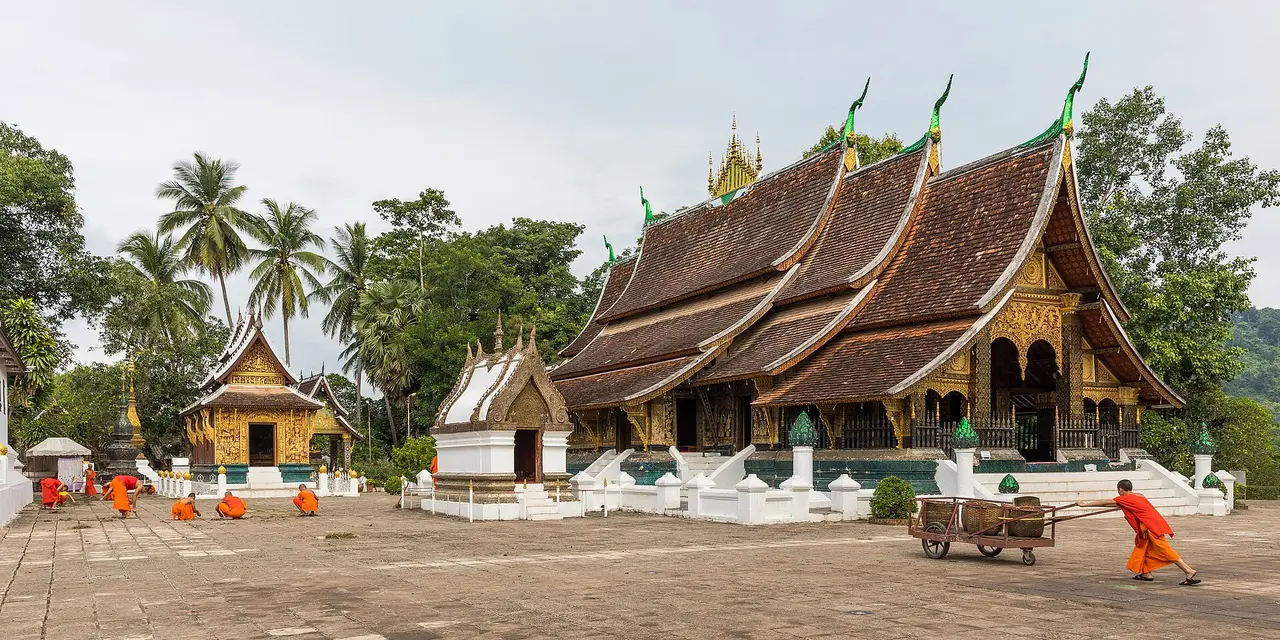
Wat Xieng Thong

A monastery founded around 1560 at the tip of the peninsula, its roof sweeping almost to the ground and a glass mosaic tree of life on its rear wall.

Royal Palace Museum

The early 20th-century royal residence, with throne hall, apartments and the last king's cars. Covered clothing required, no photos inside.

Mount Phousi

A hill in the middle of the peninsula, climbed by just over 300 steps to a golden stupa. A view of both rivers, very busy at sunset.

Wat Mai

A monastery next to the royal palace, whose gilded bas-relief facade tells scenes from the life of the Buddha and local legends.

Wat Visoun

One of the town's oldest monasteries, founded in the early 16th century, famous for its rounded stupa nicknamed the watermelon stupa.

Kuang Si Falls

Tiered limestone cascades and turquoise pools in the heart of the forest, with a trail climbing to the top of the main fall.

Pak Ou caves

Two caves opening on the cliff facing the confluence of the Nam Ou and the Mekong, filled with thousands of Buddha figurines of every size.

Night market

Every evening, hundreds of stalls of weaving, handmade paper and woodwork spread along the main street, with a street food alley at the end.

Traditional Arts Centre

A small ethnology museum at the foot of Phousi devoted to the many ethnic groups of Laos, their costumes, rituals and everyday objects.

UXO Visitor Centre

An exhibition on the unexploded bombs left by the Vietnam War and on clearance work, to understand a major chapter of the country's history.

What to discover in Luang Prabang, from the peninsula to the falls?

The peninsula and Sisavangvong Road

The old town fits on a peninsula about 1.5 km long, crossed by Sisavangvong Road, which becomes Sakkaline then Xieng Thong towards the tip. Along this axis come the former royal palace, some thirty still active monasteries, shuttered colonial houses and the night market that sets up every evening from 5 pm. Everything can be done on foot or by bicycle, and the protected area limits building heights. Stay here to live the town to the rhythm of its bells: it is the heritage jewel of Laos.

The tip and the Nam Khan confluence

At the northern end of the peninsula, the Nam Khan flows into the Mekong below Wat Xieng Thong. The lanes running along the Nam Khan, quieter, line up guesthouses and cafés on stilts. In the dry season, roughly November to May, a bamboo bridge rebuilt every year lets you cross on foot to the opposite bank for a small toll; it is swept away by the floods in the rainy season. Save a late afternoon for this tip, when the low light catches the golden roofs.

The monks' alms round at dawn

Every morning around 5.30 am, monks from the town's monasteries walk barefoot in single file to receive sticky rice from kneeling worshippers: this is tak bat, a religious ritual and not a show. Keep your distance on the opposite pavement, with no flash and no photos in faces, and only take part if you do so respectfully, seated lower than the monks, with rice bought at the market rather than from street sellers. The procession lasts about half an hour. It takes place all year round, but draws more people during Buddhist festivals.

The right bank of the Mekong

Opposite the old town, on the right bank of the Mekong, the village of Xieng Maen is reached in a few minutes by local ferry from the landing near the royal palace. There you find little-visited monasteries, such as Wat Long Khoun, where kings once retreated before their coronation, and caves decorated with statues. Life is rural and tourists are few. Allow half a day on foot or by bicycle, and check the time of the last ferry back, which stops running after nightfall.

Waterfalls and villages to the south

About 30 km south, 45 minutes by road, the Kuang Si falls tumble down limestone terraces into turquoise pools where swimming is allowed in marked areas. At the entrance, a rescue centre cares for Asiatic black bears saved from poaching. Arrive at opening time, around 8 am, to avoid the midday crowds. Closer, about fifteen kilometres away, the Tad Sae falls form shallow pools, at their best at the end of the rainy season. Half a day is enough for each site, by private tuk-tuk or shared minibus.

Up the Mekong and the Nam Ou

About 25 km upstream, the Pak Ou caves hold thousands of Buddha statues left by worshippers over the centuries. The boat takes around two hours upstream and one back, with an optional stop at a weaving village; the road gets you there faster. To arrive or leave, the slow boat from Huay Xai on the Thai border takes two days with a night in Pakbeng. To the north, Nong Khiaw and its cliffs on the Nam Ou are about three to four hours away by road.

Seasons, crop burning and festivals

The best period runs from November to February: dry skies, warm days and cool mornings, sometimes misty over the river. Avoid March and April if possible, when smoke from agricultural burning plunges the valley into thick haze and degrades air quality. In mid-April, the Lao New Year, Pi Mai, turns the town into a water fight for three days: book early. In October, the end of Buddhist Lent brings the festival of light boats, with lantern processions and illuminated vessels released on the Mekong.

Getting there

Airports serving Luang Prabang, from main hubs to secondary ones.
  • LPQLuang Phabang International AirportLuang PhabangMain
  • PKZPakse International AirportPakseMain
  • VTEWattay International AirportVientianeMain
  • BORBokeo International AirportTon PhuengSecondary
  • NEUSam Neua AirportSecondary
  • ZVKSavannakhet AirportSecondary

Practical information for Luang Prabang

Railway station

Outside town, about twenty minutes by minibus or tuk-tuk. Around 2 hours by train to Vientiane and 1 hour to Vang Vieng; tickets with passport, book early.

Airport

About 4 km from the centre, ten minutes by tuk-tuk; flights to Vientiane and several South-East Asian cities.

Alms round etiquette

No flash, no contact with the monks, shoulders and legs covered, do not stand in their path. Do not follow the procession.

Temple dress code

Shoulders and knees covered, shoes removed in sanctuaries; the royal palace enforces this strictly and sometimes lends a sarong.

Curfew

Most bars and restaurants close around 11 pm; night-time bag snatching has been reported, keep bags on the pavement side.

Air quality

In March and April, smoke from crop burning can reach high levels: asthmatic or sensitive travellers should choose another period.

Kip and ATMs

Local currency is essential at the market and in tuk-tuks; ATMs charge fees and cap withdrawals, plan several trips.

Mekong ferry

Local boat to the right bank from the landing near the royal palace, a few minutes across, service ending in the early evening.

Bicycles

The best way to get around the peninsula, rented by the day at most guesthouses; tuk-tuks for the falls and the station.

Luang Prabang in pictures

Photo credits : Basile Morin, CC BY-SA 4.0, Wikimedia Commons ; Balon Greyjoy, Public domain, Wikimedia Commons

Frequently asked questions about Luang Prabang

Where to stand to watch the alms giving without disturbing it?
Choose a side street rather than the busiest stretch of Sisavangvong, stay on the opposite pavement and keep quiet. The lanes near the Nam Khan are calmer. Never use a flash and never block the monks' path for a photo.
Can you swim at Kuang Si Falls?
Yes, in the pools marked by signs; some are off limits to protect the site. Bring covering clothes to change into, there are changing cabins on site. The water is cool all year and the current strong at the end of the rainy season.
Is the slow boat from Huay Xai worth two days of travel?
Yes if you have time: the trip down the Mekong passes jungle scenery and villages unreachable by road, with a night in Pakbeng. The benches are hard, so bring a cushion, water and food. Otherwise the bus or the plane are much faster.
Pak Ou caves: by boat or by road?
The boat offers the trip up the Mekong and stops in villages, in about two hours upstream. The road is faster but ends with a short crossing by small boat. For the caves alone, half a day is enough either way.
Mount Phousi at sunrise or sunset?
Sunset is spectacular but the summit is packed from 5 pm. Sunrise, just after the alms round, is more peaceful with mist over the rivers. The back trail on the Nam Khan side is less crowded than the main staircase.
Should you avoid Luang Prabang in March and April?
If you come for the scenery or have respiratory issues, yes: smoke from agricultural burning veils the valley and the views from Phousi. In mid-April, though, the Lao New Year remains a memorable celebration for anyone who accepts the heat and the water.
How many days to stay in Luang Prabang?
Three days cover the peninsula, the alms round, Phousi, Kuang Si and Pak Ou. Four or five let you add the right bank, a cooking or weaving class and a quiet evening by the Nam Khan without rushing.
How do you get to Nong Khiaw from Luang Prabang?
By minibus or bus from the northern bus station, in three to four hours depending on the road, longer in the rainy season. The boat trip on the Nam Ou depends on the dams and is no longer always possible.
Can you take photos inside the Royal Palace Museum?
No, photos are forbidden inside and bags go into the lockers. The gardens, the neighbouring Haw Pha Bang temple and the facade can be photographed freely. Wear clothes covering shoulders and knees, or you may be refused entry.

Plan your trip to Luang Prabang

Build your day-by-day itinerary and manage budget, bookings and packing in PlanTripNow.
Aperçu de l'application PlanTripNow