Skip to content

Visit Mumbai : what to do, when to go and what budget

Mumbai, formerly Bombay, is India's most populous and wealthiest city, spread across a peninsula on the Arabian Sea. Victorian and Art Deco architecture, rock-cut temples, bazaars and street food sit side by side, nine and a half hours by direct flight from Paris.

At a glance

Visa
Required
Tourist stay of up to 90 days
7-day budget
€735
Per person, comfort profile, excluding international flights.
Recommended length
3 days
For a first trip, without rushing.

Why visit Mumbai?

Mumbai is the capital of Maharashtra state, on India's west coast, and the country's leading financial centre. It holds two UNESCO sites, CSMT station and the Elephanta Caves, plus the Victorian and Art Deco ensemble of the south. Allow two to four days; the currency is the Indian rupee.

When to visit Mumbai

Temperatures, rainfall and crowds month by month, to pick your window.
When to visit Mumbai
MonthTemperaturesRainCrowdsVerdict
January18 to 31 °C0 dBusyThe most pleasant month: 31 °C in the afternoon, 18 °C nights and dry air; ideal for Marine Drive and the Fort, though pollution haze sometimes veils the horizon.
February19 to 31 °C0 dBusyStill dry and sunny, with the Kala Ghoda arts festival in early February: the best balance of weather and atmosphere.
March22 to 33 °C0 dModerateHumidity climbs and nights rise above 20 °C; Holi colours the streets and hotels start lowering their rates.
April25 to 33 °C0 dQuiet33 °C and heavy humidity from early morning: sightsee early, take an air-conditioned break at noon and head to the seafront promenades in the evening.
May27 to 34 °C1 dQuietThe most stifling month, with 27 °C nights and an early cyclone risk over the Arabian Sea before the monsoon arrives.
June26 to 32 °C14 dVery quietThe monsoon breaks around mid-June: torrential rain, flooded streets and disrupted suburban trains; ferries to Elephanta may be suspended.
July25 to 30 °C22 dVery quietThe wettest month, over 700 mm of rain: waves crashing on Marine Drive make a show, but getting around is hard and flooding is a real risk.
August25 to 30 °C21 dQuietStill very rainy, but luxury hotels post their lowest rates; plan fallback days in the museums.
September25 to 31 °C13 dQuietThe monsoon eases and Ganesh Chaturthi sets the city alight for ten days, with processions down to Girgaum beach.
October24 to 33 °C3 dModerateThe sun returns but with sticky 33 °C heat, which locals call October heat; a second cyclone risk peak comes late in the month.
November22 to 34 °C1 dBusyHigh season starts with Diwali and its lights; days are still hot, but evenings turn pleasant.
December19 to 32 °C0 dPackedIdeal weather and dry skies, but it is peak season: Colaba hotels are at their dearest around Christmas and New Year's Eve.
Source: Moyennes climatiques recoupées entre climatestotravel.com et weather2travel.com (station de Santacruz), moyenne des deux sources par mois arrondie au dixième, relevé octobre 2026. Jours de pluie : jours avec au moins 1 mm de précipitations. Température de mer : mer d'Arabie au large de Mumbai. Cyclones possibles d'avril à décembre (pics mai-juin et octobre-novembre) et inondations de mousson signalées par France Diplomatie.

Mumbai's must-sees

Eight places to understand the city, from the harbour quays to the northern hills.

CSMT station

A UNESCO-listed Gothic Revival masterpiece, best seen at rush hour to gauge the crowds.

Gateway of India

A basalt arch facing the harbour, the departure point for Elephanta ferries.

Elephanta Trimurti

A three-faced bust of Shiva carved into the rock at the back of the main cave.

Marine Drive

A curving bayfront promenade, called the Queen's Necklace once lit up.

CSMVS museum

Indian art, miniatures and bronzes in an Indo-Saracenic palace.

Banganga tank

A sacred reservoir ringed by temples, a haven of calm on Malabar Hill.

Haji Ali mosque

A white shrine on the sea, reached by a causeway at low tide.

Kanheri Caves

About a hundred Buddhist cells carved into basalt, deep in the forest.

What to see in Mumbai?

The Fort and CSMT station, the Victorian heart

South Mumbai concentrates the British legacy. Chhatrapati Shivaji Maharaj Terminus, completed in 1888 and UNESCO-listed, blends Venetian Gothic with Indian domes and handles millions of suburban commuters every day. Around it, the Fort district lines up the university, the High Court and Flora Fountain. Across Oval Maidan, the Art Deco buildings of Marine Drive form a second UNESCO ensemble with them. Visit on a weekday morning before the heat, and finish at Britannia café for a berry pulao.

Colaba and the Gateway of India

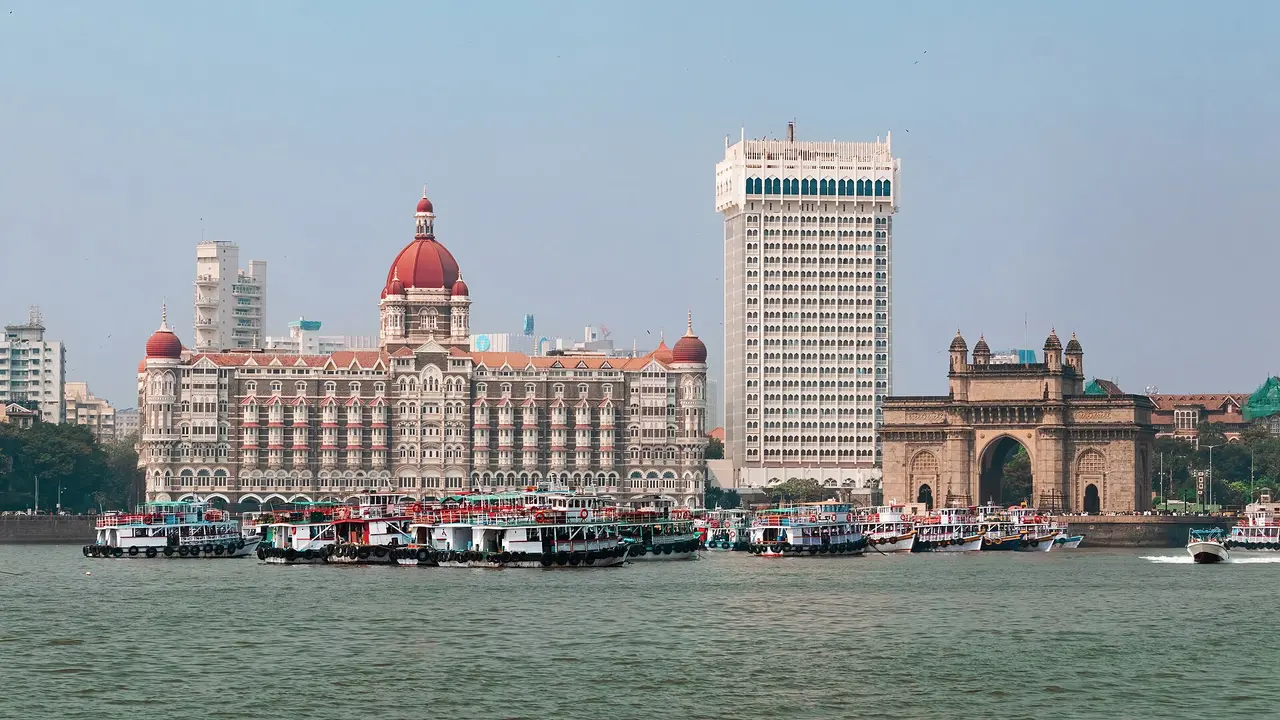
At the tip of the peninsula, the Gateway of India, a yellow basalt arch completed in 1924, faces the harbour and the Taj Mahal Palace hotel. Entry is free, but crowds are dense in the evening and at weekends. Behind it, Colaba Causeway unrolls its shops, street stalls and historic cafés such as Leopold. The district is the most convenient base for a first stay, and also the priciest: a mid-range hotel night often exceeds 150 dollars. The nearby CSMVS museum deserves two hours.

Elephanta, the island of cave temples

One hour by ferry from the Gateway of India, Elephanta Island shelters Shiva shrines carved into the rock between the 5th and 7th centuries, including the famous Trimurti, a six-metre, three-faced bust of Shiva. The UNESCO site costs 600 rupees for foreign visitors, plus the ferry. It closes on Mondays, and crossings are often suspended during the monsoon. Take the first morning boat and carry water: a staircase of more than a hundred steps leads up to the caves.

Malabar Hill, Dhobi Ghat and Haji Ali

High on Malabar Hill, the sacred Banganga tank, ringed by temples and stone steps, offers unexpected calm. Lower down, Mani Bhavan preserves the house where Gandhi stayed. From the Mahalaxmi bridge you can watch the hundreds of washing pens of Dhobi Ghat, where launderers wash the city's linen by hand. The Haji Ali mosque, set on an islet, is reached on foot along a causeway that is walkable at low tide: check the tide tables before you go.

Dharavi, Bandra and the northern city

Dharavi, often described as Asia's largest slum, is above all a hive of recycling, pottery and leather workshops. Visit with a local organisation that reinvests its profits, and do not photograph residents. Further north, Bandra charms with the mural-covered Portuguese villas of Chapel Road, Mount Mary church and the Bandstand promenade. To go further, the Buddhist Kanheri Caves hide in the forest of Sanjay Gandhi National Park, which is closed on Mondays.

Seasons, monsoon and budget

The dry season, from November to February, is best: about 31 °C in the afternoon and no rain in January, according to our cross-checked data. From June to September the monsoon pours more than 700 mm in July and causes severe flooding, according to France Diplomatie. Mumbai is the most expensive city in India: allow about 29 euros a day as a backpacker, 105 euros in comfort, and a return flight from Paris of around 590 euros outside school holidays. A simple meal costs under 5 euros, according to Numbeo.

Sample itineraries

Three routes built around the time you actually have.
3daysRecommended

Mumbai in 3 days: from the Victorian Fort to Bandra

  1. Day 1: the Fort, CSMT and the Gateway of India
  2. Day 2: Malabar Hill, Dhobi Ghat and Haji Ali
  3. Day 3: Dharavi and Bandra

Best for: The most balanced stay for a first visit: the colonial south, then Malabar Hill and the Haji Ali mosque, and finally the lively northern districts with Dharavi and Bandra. Elephanta is left out to keep time for the city itself.

How much it costs

Per person per day, excluding international travel.
Budget
29 €/ day
1 586 € for 2 people, 7 days, return flights included
Accommodation
11 €
Food
9 €
Local transport
3 €
Sights and activities
6 €
Comfort
105 €/ day
2 650 € for 2 people, 7 days, return flights included
Accommodation
55 €
Food
25 €
Local transport
10 €
Sights and activities
15 €
Premium
315 €/ day
5 590 € for 2 people, 7 days, return flights included
Accommodation
170 €
Food
70 €
Local transport
35 €
Sights and activities
40 €
Prices checked: Relevé octobre 2026. Repas, transports et taxi : Numbeo Mumbai, mise à jour du 6 octobre 2026 (repas bon marché 4,61 €, dîner de milieu de gamme pour deux 18,43 €, bière locale 2,30 €, ticket de transport local 0,18 €, taxi 0,28 € de prise en charge puis 0,28 €/km). Hébergement : Mumbai est la ville la plus chère d'Inde ; lit en auberge autour de 1 040 INR la nuit (moyenne des auberges relevée par les comparateurs Expedia/Trip.com), hôtel de milieu de gamme 120 à 165 $ la nuit et hôtels de luxe dès 380 à 400 $ (hotelierschoice.com, guide budget Mumbai, mars 2026). Activités : grottes d'Elephanta 600 INR pour les étrangers plus ferry depuis la porte de l'Inde environ 260 INR A/R, musée CSMVS 700 INR avec audioguide. Vol A/R Paris-Mumbai estimé à 590 € par personne hors vacances scolaires (liligo : moyenne des 3 derniers mois 595 € ; ou-et-quand.net : moyenne de septembre 562 €, décembre 818 € ; seul vol direct Air France, environ 9 h 30). Hébergement par nuit et par personne : lit en dortoir pour backpacker, chambre double partagée à deux pour comfort et premium. weekTwoPax = 7 jours x 2 personnes + 2 vols.

Getting there

Airports serving Mumbai, from main hubs to secondary ones.
  • AGRAgra Airport / Agra Air Force StationAgraSecondary
  • AGXAgatti AirportAgattiSecondary
  • AHAMaa Mahamaya AirportAmbikapurSecondary
  • AJLLengpui AirportAizawlSecondary
  • AKDAkola AirportAkolaSecondary
  • AYJMaharshi Valmiki International AirportFaizabadSecondary

Entry, health and safety

For FR travellers

Entry requirements

Visa required

Visa obligatoire pour l'Inde, y compris pour un séjour touristique à Mumbai. Les Français demandent un e-visa touristique en ligne sur indianvisaonline.gov.in, entre 4 et 120 jours avant le départ (4 à 30 jours pour le visa de 30 jours) : validité de 30 jours, 1 an ou 5 ans, ces deux dernières formules étant limitées à 180 jours par an et à 90 jours par séjour. Depuis le 1er octobre 2025, chaque voyageur étranger doit aussi remplir en ligne l'e-Arrival Card dans les 72 heures précédant le départ.

Stay allowed for up to 90 days.

Passport valid for 6 months beyond your return date.

Health

Required: Aucun vaccin obligatoire en provenance directe de France. Fièvre jaune exigée pour les voyageurs arrivant d'une zone d'endémie amarile.

Advised: Mise à jour du DTP, hépatites A et B, fièvre typhoïde ; selon la durée et les conditions du séjour : méningite ACWY, rage et encéphalite japonaise.

Dengue et chikungunya transmis dans le Maharashtra, paludisme en recul dans les grandes villes mais avec un risque accru pendant la mousson de juin à septembre ; leptospirose présente, à surveiller après les inondations. Ne boire que de l'eau en bouteille ou des boissons capsulées. Pollution de l'air élevée en hiver et autour de Diwali. Les pluies de mousson peuvent provoquer des inondations très importantes à Bombay, et la côte est exposée aux cyclones d'avril à décembre, avec un pic de mai à novembre. Passeport valable au moins 6 mois après la fin de validité du visa, avec deux pages vierges.

Safety

Increased caution

Emergency

112

Checked in octobre 2026 against the official source. Entry rules change: check the official source before you travel, it alone is authoritative.

Practical information for Mumbai

Visa

An e-visa is required, applied for at indianvisaonline.gov.in, plus the e-Arrival Card within 72 hours before departure, according to France Diplomatie.

Currency

The Indian rupee (INR). QR code payments are everywhere, but keep cash for taxis, ferries and street stalls.

Transport

Local transport ticket around 0.18 euros and taxis at 0.28 euros per kilometre (Numbeo, October 2026). Avoid suburban trains at rush hour.

Typical prices

Cheap meal 4.61 euros, dinner for two 18.43 euros, local beer 2.30 euros (Numbeo, October 2026).

Health

Bottled water only; dengue and chikungunya occur in Maharashtra, with higher risk during the monsoon. Protect yourself from mosquitoes.

Monday closures

The Elephanta Caves and Sanjay Gandhi National Park close on Mondays: plan them for another day.

Mumbai in pictures

Photo credits : iMahesh, CC BY-SA 4.0, Wikimedia Commons ; Joe Ravi, CC BY-SA 3.0, Wikimedia Commons ; Dr Vikramjit Kakati, CC BY-SA 4.0, Wikimedia Commons ; Vyacheslav Argenberg, CC BY 4.0, Wikimedia Commons

Frequently asked questions about Mumbai

How many days do you need to visit Mumbai?
Two days are enough for the Fort, CSMT station, Colaba and Elephanta Island. Three days let you add Malabar Hill, Dhobi Ghat, Haji Ali, then Dharavi and Bandra. With four days, explore the old city bazaars and the Kanheri Caves.
What is the best time to visit Mumbai?
November to February: dry skies, about 31 °C in the afternoon and cooler nights. December is the busiest and most expensive month. Avoid June to September, when the monsoon regularly floods the streets and disrupts the ferries.
Do you need a visa to visit Mumbai?
Yes, French citizens need a visa for India, usually an e-Tourist visa applied for online 4 to 120 days before departure. The passport must remain valid for six months after the visa expires, according to France Diplomatie.
Is Mumbai expensive?
It is India's most expensive city, especially for accommodation: a mid-range hotel often costs 120 to 165 dollars a night. Allow about 29 euros a day per person as a backpacker and 105 euros in comfort. Street food remains very cheap.
How do you get to the Elephanta Caves?
Ferries leave the Gateway of India roughly every half hour and take an hour. The site costs 600 rupees for foreign visitors. It closes on Mondays, and boats can be suspended during the monsoon or in rough seas.
Is Mumbai safe?
France Diplomatie places India under heightened vigilance, with no advised-against zone around Mumbai. The practical risks are pickpocketing on crowded trains, tourist scams and monsoon flooding. Women travelling alone should stay careful at night.
Can you visit Dharavi respectfully?
Yes, by going with a local organisation that employs residents and puts part of its income into social projects. Tours focus on the workshops and the district's economy. Photographing residents should be avoided.

Plan your trip to Mumbai

Build your day-by-day itinerary and manage budget, bookings and packing in PlanTripNow.
Aperçu de l'application PlanTripNow