Skip to content

Visit Beijing : what to see, when to go and how to plan

Beijing reads like a life-size history book: the yellow roofs of the Forbidden City, the altars of the Temple of Heaven, the courtyard homes of the hutongs where people sip tea, and the Great Wall snaking along the ridges north of the city. A dense, demanding but unforgettable capital.

At a glance

Visa
None
Tourist stay of up to 30 days
7-day budget
€686
Per person, comfort profile, excluding international flights.

Why visit Beijing?

Beijing, capital of the People's Republic of China, holds the great imperial sites of the Ming and Qing dynasties, including the UNESCO-listed Forbidden City and Temple of Heaven. The Great Wall is reachable on a day trip. Allow four to five days, ideally in April, May, September or October.

When to visit Beijing

Temperatures, rainfall and crowds month by month, to pick your window.
When to visit Beijing
MonthTemperaturesRainCrowdsVerdict
January-9 to 2 °C2 dVery quietDry cold, -9 °C at night and often blue skies: empty sites and frozen Shichahai lakes for skating, but heating-related pollution peaks.
February-6 to 6 °C2 dModerateChinese New Year temple fairs, but packed trains and some restaurants closed during the holiday week.
March0 to 13 °C3 dQuietA thaw to 13 °C and few visitors, but sand-laden winds from the northwest can veil the city on some days.
April8 to 21 °C5 dBusyCrab apple and magnolia blossom at the Summer Palace around 21 °C: one of the two best windows, with a few sandy days still possible.
May14 to 27 °C6 dBusy27 °C and bright skies, ideal for the Wall, as long as you avoid the Golden Week holiday in early May.
June19 to 31 °C10 dModerateAlready 31 °C in the afternoon: visit early, as storms become more frequent towards the end of the month.
July22 to 32 °C13 dPackedThe wettest month, hot and muggy, with Chinese school holidays and the most expensive flights of the year.
August21 to 31 °C11 dPackedFrequent storms and summer crowds at the Forbidden City, whose tickets sell out fast: book as soon as sales open.
September15 to 27 °C8 dBusyThe best month: drier air, 27 °C and often clear skies over the Wall before the National Day rush.
October7 to 19 °C5 dPackedRed leaves in the Fragrant Hills and 19 °C, but the week of 1 to 7 October makes sites and trains exhausting.
November-1 to 10 °C3 dQuietGolden ginkgos in early November then the first frosts; city heating starts in mid-November and pollution rises again.
December-7 to 4 °C2 dVery quietThe quietest month: 4 °C, dry skies and easy bookings, but check the air quality index every morning.
Source: Normales 1991-2020 de climatestotravel.com (Beijing), relevé novembre 2026 : températures minimales, maximales et moyennes, jours de pluie avec au moins 1 mm. Ville continentale sans façade maritime : pas de température de la mer. Niveau de prix croisé avec les médianes mensuelles Kayak du vol Paris-Pékin (janvier le moins cher, juillet le plus cher, relevé novembre 2026) et les congés chinois (Nouvel An, Golden Week de mai, fête nationale du 1er au 7 octobre).

Beijing's must-sees

Twelve places to understand the Chinese capital, from Ming palaces to contemporary art galleries.

Forbidden City

Imperial palace of the Ming and Qing dynasties, a vast complex of courtyards and halls to book online several days before your visit.

Temple of Heaven

Sacred complex where the emperor prayed for good harvests, crowned by a round hall with a triple roof of blue tiles, set in a large park.

Mutianyu

Restored, wooded section of the Great Wall with a cable car and toboggan, less crowded than Badaling and easy as a day trip.

Summer Palace

Imperial residence on the shores of Kunming Lake, with its long painted corridor, hilltop pagoda and marble boat.

Jingshan Park

Man-made hill facing the north gate of the Forbidden City, offering the finest overall view of the palace's golden roofs.

Yonghegong

Lama Temple still in active use, with clouds of incense and a giant Maitreya statue carved from a single sandalwood trunk.

Drum Tower

Imperial timekeeping tower north of the hutongs, with drum performances at set times from the upper floor.

Beihai Park

Former imperial garden around a lake, topped by the White Dagoba, where you can hire rowing boats in summer and skate in winter.

National Museum

Huge museum on Tiananmen Square tracing Chinese history, free with a passport booking and closed on Mondays.

Ming Tombs

Burial ground of the Ming emperors at the foot of the hills, with a sacred way lined by stone animals and officials.

Bird's Nest

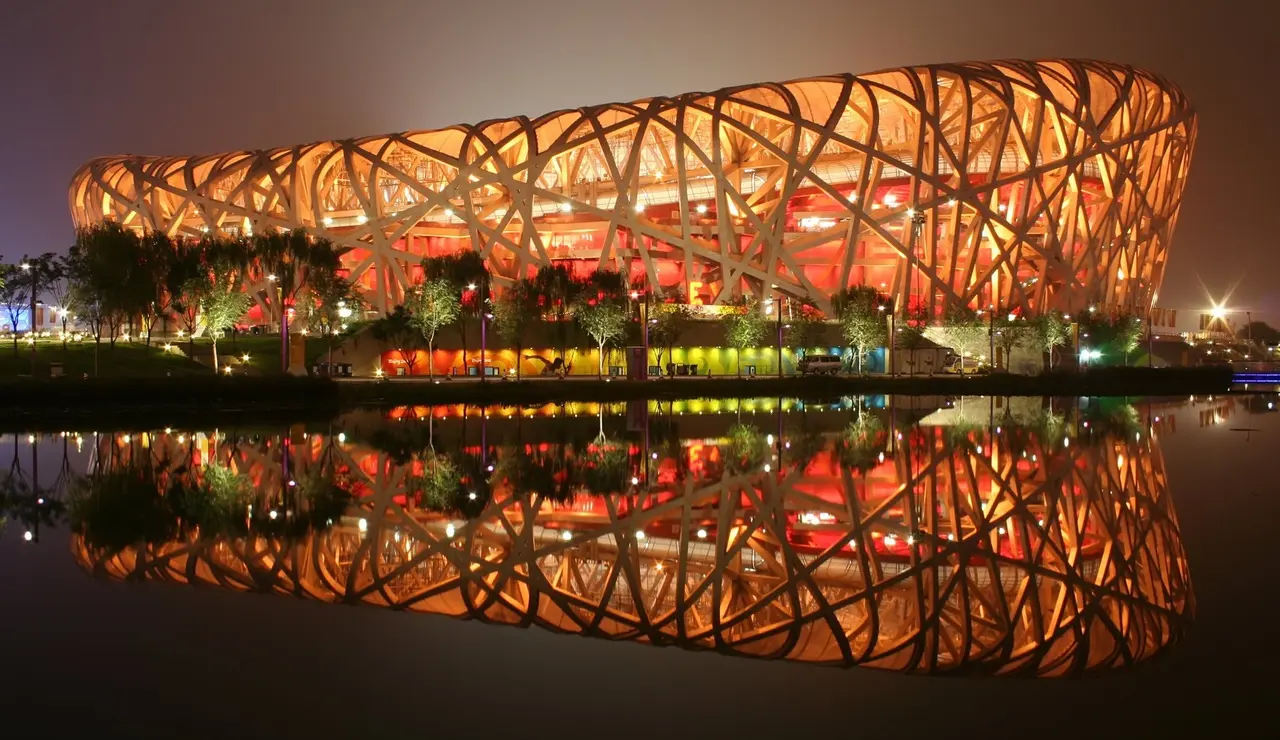
Olympic stadium with an interwoven steel structure, emblem of the 2008 Games, best seen lit up at night in the Olympic Park.

Guijie street

Restaurant street open late, lit by red lanterns and known for spicy crayfish and Sichuan-style hotpot.

What to see in Beijing?

The imperial axis, from Tiananmen to Jingshan

The historic heart is laid out along a north-south axis several kilometres long. From Tiananmen Square, where security checks are done passport in hand, you pass through the Gate of Heavenly Peace into the Forbidden City, which closes on Mondays except public holidays. Tickets are booked online in your own name, often several days ahead in high season. Allow at least half a day inside, then leave by the north gate and climb the hill in Jingshan Park: a fifteen-minute walk up gives the full view over the palace's golden roofs.

The hutongs of Shichahai and Gulou

North of the Forbidden City, the Shichahai lakes and the districts around the Drum Tower and Bell Tower keep the finest network of hutongs, lanes lined with siheyuan, homes built around a square courtyard. Busy Nanluoguxiang is paralleled by much quieter alleys. Rent a bike or walk for three to four hours in the late afternoon, when residents come out to play cards and the bars light up along Houhai lake. It is also the best area to sleep in a traditional courtyard turned guesthouse.

The south and the Temple of Heaven

South of Tiananmen Square, the Qianmen district mixes a restored shopping street with authentic lanes such as Dashilan, where century-old pharmacies and silk shops survive. A little further east, the Temple of Heaven park covers nearly 270 hectares around the Hall of Prayer for Good Harvests. Arrive at opening, around 6 am, to watch retirees practise tai chi, dancing and group singing before the tour groups arrive. Two to three hours are enough, and the combined ticket covers the main buildings.

The northwest: Summer Palace and universities

Around fifteen kilometres northwest of the centre, the Summer Palace spreads its pavilions, long painted corridor and Longevity Hill around Kunming Lake. It takes about an hour by metro line 4. Give it half a day, crossing the lake by boat in summer. Nearby, the ruins of the Old Summer Palace, burned in 1860 by Anglo-French troops, still hold a few carved stone columns. The university district of Haidian, home to Tsinghua and Peking University, rounds off a day away from the crowds of the centre.

The Great Wall on a day trip

Several sections can be visited in a day from Beijing. Badaling, about an hour by train, is the most accessible but also the most crowded. Mutianyu, around 70 km away, restored and wooded, takes an hour and a half to two hours by road and has a cable car and a toboggan ride down. Further out, Jinshanling offers a wilder stretch for hikers, keeping to the sections open to the public. Leave early, allow a full day and avoid weekends and the week of 1 to 7 October, when crowds become exhausting.

The Lama Temple and the east of the city

East of the hutongs, the Lama Temple, Yonghegong, is Beijing's largest Tibetan Buddhist monastery, still active, with an 18-metre Maitreya statue carved from a single sandalwood trunk. The Confucius Temple and the former Imperial Academy stand just opposite, across the street. Allow two hours for both. Further southeast, the Guomao business district and its modern towers, including the CCTV building, show another face of the capital, best seen in the evening.

798, the Olympic Park and contemporary Beijing

In the northeast, the former Dashanzi factory complex, known as 798, houses galleries, studios and cafes in 1950s brick halls. Half a day is enough, preferably on a weekday, as many spaces close on Mondays. The Olympic Park, to the north, brings together the Bird's Nest stadium and the Water Cube, built for the 2008 Games and reused for the 2022 Winter Games. The site is best enjoyed lit up, an hour after nightfall, and is easy to combine with 798 by metro.

Peking duck and northern cooking

Beijing gave its name to Peking duck, carved at the table and rolled in thin pancakes with spring onion and sweet sauce: book for dinner at the well-known houses, which are often full. Local cooking also means jiaozi dumplings, zhajiangmian noodles and mutton hotpot, ideal in winter. Guijie street, in the east, lines up hundreds of restaurants open late into the night. For those heading on to the coast, the high-speed train reaches Shanghai and its Bund waterfront in just over four hours.

How much it costs

Per person per day, excluding international travel.
Budget
35 €/ day
2 290 € for 2 people, 7 days, return flights included
Accommodation
12 €
Food
12 €
Local transport
3 €
Sights and activities
8 €
Comfort
98 €/ day
3 172 € for 2 people, 7 days, return flights included
Accommodation
40 €
Food
30 €
Local transport
8 €
Sights and activities
20 €
Premium
260 €/ day
5 440 € for 2 people, 7 days, return flights included
Accommodation
105 €
Food
75 €
Local transport
30 €
Sights and activities
50 €
Prices checked: Relevé novembre 2026. Repas et transports : Numbeo Pékin, mise à jour du 8 novembre 2026, 125 contributeurs (repas bon marché 4,02 €, dîner de milieu de gamme pour deux 26,78 €, bière pression 1,07 €, ticket de métro 0,54 €, taxi 1,74 € de prise en charge puis 0,31 €/km). Hébergement : Travel of China, coûts de voyage en Chine mis à jour le 11 novembre 2025, source de 2025 et non officielle (dortoir 8 à 15 $, hôtel de milieu de gamme à Pékin 70 à 120 $ la nuit, hôtel de luxe 180 à 300 $). Sites et métro : Wander in China, budget de voyage en Chine publié le 15 juillet 2026 (métro 3 à 8 ¥, Cité interdite environ 8,50 $, Grande Muraille 6 à 10 $ plus 15 à 20 $ de téléphérique ou luge). Taux BCE du 9 novembre 2026 : 1 € = 7,4689 ¥. Montants convertis en euros et arrondis. Vol A/R Paris-Pékin estimé à 900 € par personne hors vacances scolaires (Kayak, relevé novembre 2026 : moyenne 1 007 €, fourchette courante 849 à 1 222 €, de 828 € en janvier à 1 227 € en juillet, vol direct d'environ 10 h 30). Prix plus élevés au Nouvel An chinois, pendant la Golden Week de mai et la semaine de la fête nationale début octobre. Hébergement par nuit et par personne : lit en dortoir pour backpacker, chambre double partagée à deux pour comfort et premium. weekTwoPax = 7 jours x 2 personnes + 2 vols.

Getting there

Airports serving Beijing, from main hubs to secondary ones.
  • AATAltay Xuedu AirportAltaySecondary
  • ACXXingyi Wanfenglin AirportXingyiSecondary
  • AEBBaise (Bose) Bama AirportBaiseSecondary
  • AHJHongyuan AirportNgawaSecondary
  • AKUAksu Hongqipo AirportAksuSecondary
  • AOGAnshan Teng'ao Airport / Anshan Air BaseAnshanSecondary

Entry, health and safety

For FR travellers

Entry requirements

No visa for a tourist stay

Les titulaires d'un passeport ordinaire français sont exemptés de visa pour un séjour de 30 jours maximum au titre du tourisme, du commerce, d'une visite familiale, d'un échange ou d'un transit, mesure en vigueur jusqu'au 31 décembre 2026. Les passeports d'urgence et de service en sont exclus, et tout autre motif ou séjour plus long exige un visa. L'enregistrement auprès de la police est obligatoire dans les 24 heures suivant l'arrivée, sous peine d'amende ; les hôtels s'en chargent pour leurs clients.

Stay allowed for up to 30 days.

Passport valid for 6 months beyond your return date.

Health

Required: Fièvre jaune uniquement pour les voyageurs en provenance d'une zone d'endémie, y compris après un transit de plus de 12 heures dans un aéroport d'un pays concerné.

Advised: Vaccinations du calendrier français à jour ; selon la durée et les conditions du séjour : hépatite A, fièvre typhoïde, encéphalite japonaise, rage (surtout pour les jeunes enfants).

Pékin connaît régulièrement des pics de pollution de l'air pouvant dépasser un indice de qualité de l'air de 300 : consultez l'indice avant de sortir, limitez l'activité en extérieur lors des pics et envisagez un masque FFP2 si vous êtes sensible. Recrudescence des cas de rage en Chine : grande prudence avec les animaux errants. La région de Pékin figure parmi les zones sismiques du pays. Seuls les sites officiellement ouverts au tourisme peuvent être visités, les tronçons non restaurés de la Grande Muraille sont interdits. Pékin est en vigilance normale, seul le Xinjiang étant en vigilance renforcée.

Safety

Normal precautions

Emergency

110 (police), 120 (secours médicaux), 119 (pompiers)

Checked in novembre 2026 against the official source. Entry rules change: check the official source before you travel, it alone is authoritative.

Practical information for Beijing

Visa

Visa exemption for French citizens for up to 30 days, in force until 31 December 2026, passport valid six months after exit (France Diplomatie).

Name-based bookings

The Forbidden City, National Museum and Tiananmen Square are booked online in the traveller's name, with passport number, shown again at the entrance.

Monday closures

The Forbidden City and the National Museum close on Mondays except public holidays: plan the Temple of Heaven or the Wall that day.

Air pollution

Frequent peaks in winter; check the air quality index each morning and bring filter masks if you are sensitive (France Diplomatie).

Sandstorms

In spring, especially March and April, sand-laden winds from the northwest can veil the city for a day.

Airports

Capital in the northeast and Daxing in the south, both linked to the metro by an express line; check which airport is on your ticket.

Mobile payment

Alipay and WeChat Pay accept foreign cards and cover almost everything, from the metro to street stalls; keep a little cash in yuan.

Security checks

Every metro station and the approaches to Tiananmen require an X-ray check: carry your passport at all times.

Tap water

Not drinkable: use bottled water or the kettles provided in hotel rooms.

Emergencies

110 for police, 120 for medical help, 119 for the fire brigade.

Beijing in pictures

Photo credits : Peter23, CC BY-SA 3.0, Wikimedia Commons ; G41rn8, CC BY-SA 4.0, Wikimedia Commons ; Lucas Vandroux, CC BY 2.0, Wikimedia Commons ; CEphoto, Uwe Aranas, CC BY-SA 3.0, Wikimedia Commons ; Reinhold Möller Ermell, CC BY-SA 4.0, Wikimedia Commons

Frequently asked questions about Beijing

Which section of the Great Wall should you visit from Beijing?
Mutianyu is the best compromise: restored, wooded, less crowded than Badaling, with a cable car and toboggan, about two hours by road. Badaling is the easiest by train but very busy. Jinshanling suits hikers looking for a wilder section and open views.
How do foreigners book the Forbidden City?
Tickets are name-based and booked online, on the museum's official site or through WeChat mini-programs, using your passport number. In high season, book a week ahead. On the day, show the same passport at the south entrance, the Meridian Gate.
How many days do you need for Beijing and the Great Wall?
Four days is a good minimum: one for the Forbidden City and Jingshan, one for the Temple of Heaven and the hutongs, one for the Great Wall, one for the Summer Palace. A fifth day lets you add the Lama Temple, 798 and the Ming Tombs.
Where should you stay in Beijing on a first visit?
The Dongcheng district, around Wangfujing or the Gulou hutongs, puts you on foot or a few stops from the Forbidden City and the Shichahai lakes. Courtyard guesthouses offer charm, while the large hotels of Wangfujing offer more comfort and quiet.
Is Beijing very polluted in winter?
Air quality has improved, but peaks remain frequent from November to February, when coal heating runs across northern China. France Diplomatie reports index readings that can exceed 300. Vulnerable travellers should avoid this period or bring filter masks.
What is the difference between the Summer Palace and the Old Summer Palace?
The Summer Palace, Yiheyuan, is a restored imperial park on Kunming Lake. The Old Summer Palace, Yuanmingyuan, was looted and burned in 1860 by French and British troops: only ruins of European-style pavilions remain in a landscaped park.
How do you get from Daxing airport to central Beijing?
The Daxing Airport Express reaches Caoqiao station, on metro line 10, in about twenty minutes, then the metro serves the centre. Taxis are possible, but the road journey of around fifty kilometres often takes more than an hour at peak times.
Can you combine Beijing and Hong Kong on one trip?
Yes: a high-speed train links Beijing to West Kowloon station in a day's travel, and flights are frequent. Note that Hong Kong has its own entry rules and currency: returning to the mainland counts as a new entry into China.
Where can you eat good Peking duck in Beijing?
Historic houses such as Quanjude or Bianyifang, and newer places like Da Dong, carve the duck at the table. Book for dinner, especially at weekends. A whole duck is easily shared between three or four people, with pancakes, spring onion and sweet sauce.

Plan your trip to Beijing

Build your day-by-day itinerary and manage budget, bookings and packing in PlanTripNow.
Aperçu de l'application PlanTripNow