Skip to content

Visiting Petra : routes, how long to stay and visitor tips

A canyon over a kilometre long opening onto a carved facade, then hundreds of tombs cut into pink rock, stairways up to the Monastery and trails to the high places: Petra is explored on foot, from dawn to sunset. Two full days cover the essentials without rushing.

Why does Petra deserve two days?

Petra is the caravan city carved by the Nabataeans into the sandstone cliffs of southern Jordan, listed as a UNESCO World Heritage Site in 1985. The site stretches far beyond the famous Treasury: one day covers the centre and a second the high trails, including the climb to the Monastery.

Petra's must-sees

Carved facades, temples and lookouts, from the canyon floor up to the ridges.

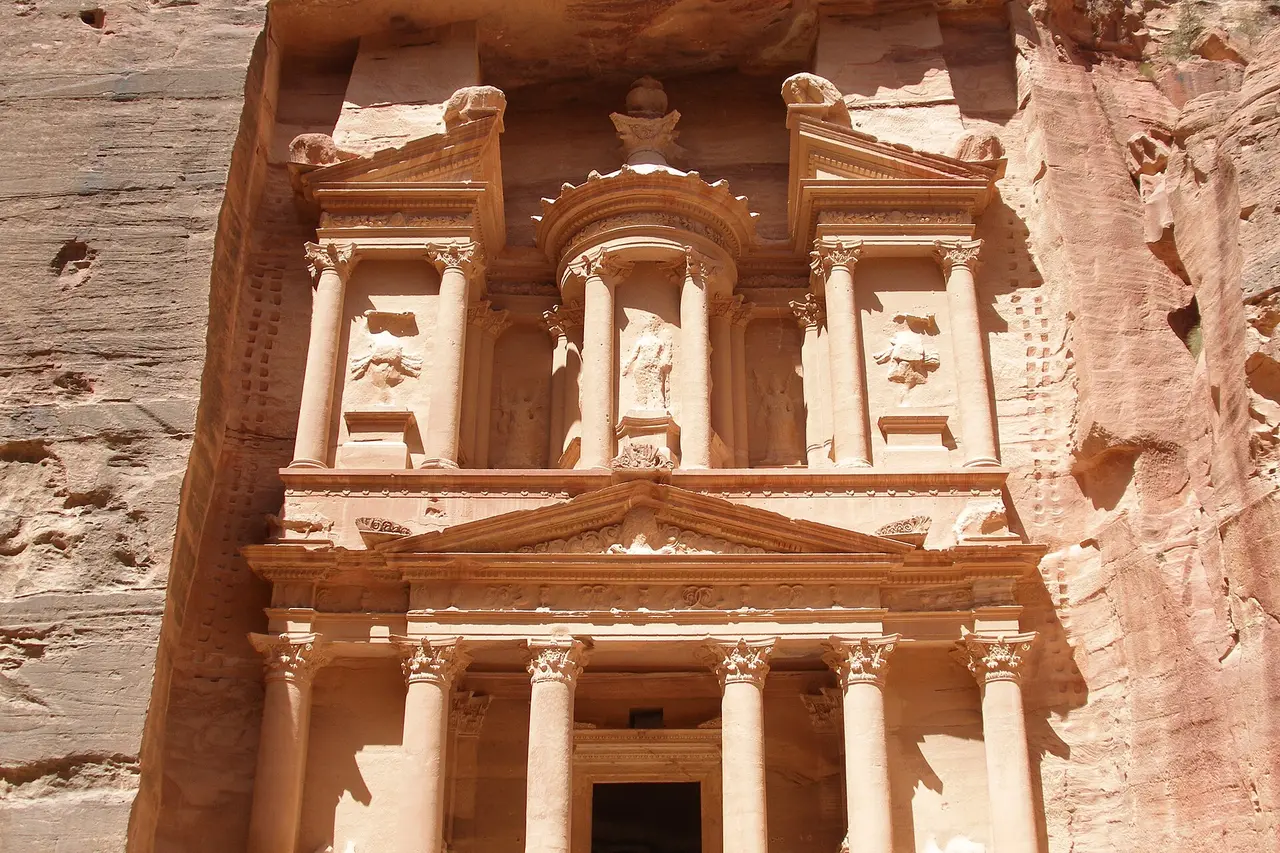
Al-Khazneh

The Treasury, a monumental facade carved into the cliff where the Siq opens out. Its colour shifts with the light, warmest in mid-morning when the sun reaches it.

Ad Deir

The Monastery, the largest facade on the site, perched at the top of around 800 steps. Opposite, several lookouts survey the mountains out to the Arabah valley.

Royal Tombs

A row of great tombs on the flank of Jabal al-Khubtha, including the Urn Tomb and the Palace Tomb, at their best in the late afternoon.

High Place of Sacrifice

A Nabataean ceremonial platform at the top of a carved stairway, with altars and a 360-degree view over the city centre and surrounding mountains.

Nabataean Theatre

Cut into the rock and later enlarged in Roman times, it could seat several thousand spectators, slicing through older tombs in the process.

Qasr al-Bint

One of Petra's rare free-standing temples, dedicated to a major Nabataean deity, at the end of the colonnaded street and the foot of the Monastery stairs.

Great Temple

A vast colonnaded complex over several terraces, excavated from the 1990s onwards, which shows how wealthy the caravan city once was.

How to explore Petra, area by area?

From the entrance to the Siq

The visitor centre stands at the edge of the town of Wadi Musa. From the gate, a path of about 800 metres passes the first block tombs of Bab al-Siq before entering the Siq, a natural cleft about 1.2 km long whose walls reach nearly 80 metres in places. The channels cut by the Nabataeans to carry water are still visible. Allow 30 to 40 minutes on foot to the Treasury. Enter at opening time, around 6 am: the light is soft and the canyon almost empty before the tour groups arrive, around 9 am.

The Street of Facades and the city centre

Beyond the Treasury, the canyon widens onto the Street of Facades, a row of carved tombs leading to the theatre. Further on, the Roman-era colonnaded street crosses the former urban centre, lined by the Great Temple and the remains of a Byzantine church whose mosaics are protected under a shelter. This fairly flat area takes three to four hours with visits. It ends at the foot of Qasr al-Bint, where the Monastery stairs begin: the logical place for a lunch break, with refreshment stalls on hand.

The high trails

The finest viewpoints require climbing. The ascent to the Monastery has around 800 steps cut into the rock, 45 minutes to an hour of effort, best done in the morning or late afternoon outside summer. The High Place of Sacrifice trail starts near the theatre and comes down through Wadi Farasa, a two-to-three-hour loop. The Al-Khubtha trail, above the Royal Tombs, offers a bird's-eye view of the Treasury. A full day will take you about ten kilometres there and back from the entrance.

Siq al-Barid and the northern trail

About fifteen minutes' drive north of Wadi Musa, Siq al-Barid, nicknamed Little Petra, repeats the great city's layout in miniature: a narrow gorge lined with carved rooms, one of which still bears Nabataean frescoes of vines and birds. Entry is free and an hour is enough. From there, a trail reaches the Monastery from behind in three to four hours of walking through the mountains: a fine way to arrive in Petra from above, provided you set off early with a guide and plenty of water.

Wadi Musa and Petra by Night

Wadi Musa, clinging to the hillside at over 1,000 metres, gathers hotels, restaurants and cash machines. Staying in the lower part, near the visitor centre, saves taxi rides at dawn. Three evenings a week, usually Monday, Wednesday and Thursday, Petra by Night lights the Siq and the Treasury forecourt with hundreds of candles for about two hours. The show has a separate ticket, not included in the Jordan Pass. Evenings are cool from October to April: bring a warm layer.

When to come and how many days to plan

March to May and September to November offer the best walking conditions. In July and August, heat often exceeds 30 °C on poorly shaded trails. Winter is cool, sometimes freezing in the morning, and rare storms can trigger flash floods in the canyons: the Siq is then closed. Plan two days of visiting at least, three for the long hikes. The Jordan Pass, bought before arrival, includes site entry. Petra combines with the Wadi Rum desert and the Dead Sea on a one-week loop around Jordan.

Getting there

Airports serving Petra, from main hubs to secondary ones.
  • ADJMarka International (Amman Civil) AirportAmmanMain
  • AMMQueen Alia International AirportAmmanMain
  • AQJKing Hussein International AirportAqabaMain

Practical information for Petra

Jordan Pass

Bought online before arrival, it includes entry to Petra for one to three days and waives the visa fee for stays of at least three nights in Jordan.

Opening hours

Opens around 6 am, closes at sunset, earlier in winter. Tickets are personal and checked at the gate.

Safety

Petra lies in a heightened vigilance zone according to French travel advice. Since July 2026, missiles and drones have flown over the region: follow instructions during alerts and check travel advice before leaving.

Flash floods

In stormy weather, from autumn to spring, the Siq and canyons may close without notice. Never enter a wadi under a threatening sky.

Donkeys and horses

Animals are offered for the Monastery climb. Turn down any that look exhausted or injured, and walk if you are able to.

Water and heat

Carry at least two litres of water per person, a hat and good shoes: shade is rare and the steps uneven.

Cash

Jordanian dinars are handy for refreshment stalls and guides. Cash machines are in Wadi Musa, not inside the site.

Petra in pictures

Photo credits : Vyacheslav Argenberg, CC BY 4.0, Wikimedia Commons ; Diego Delso, CC BY-SA 3.0, Wikimedia Commons ; Bernard Gagnon, CC BY-SA 3.0, Wikimedia Commons ; Freedom's Falcon, CC BY-SA 4.0, Wikimedia Commons

Frequently asked questions about Petra

Is one day in Petra enough to see the Treasury and the Monastery?
It can be done by starting at opening time and walking until sunset, but the day is exhausting. Two days let you spend the first on the Siq and the centre and the second on the Monastery and the High Place of Sacrifice, with breaks during the hottest hours.
How long does it take to climb to Petra's Monastery?
Allow 45 minutes to an hour to climb the roughly 800 steps from Qasr al-Bint, plus about an hour and a half of walking from the entrance. Go early in the morning or late in the afternoon, when the facade is lit and the heat eases.
Is Petra by Night worth it?
Yes if you are staying in Wadi Musa: walking through the candlelit Siq to the Treasury is a unique experience. The show runs three evenings a week on a separate ticket and draws crowds: reach the entrance early to enjoy the canyon before everyone else.
Where can you see the Treasury from above?
Two trails lead to lookouts above the Treasury: the Al-Khubtha trail, starting near the Royal Tombs, and a path from Wadi Farasa. Allow one to two hours of climbing. Viewpoints run by local vendors sometimes expect a small tip.
Is the Jordan Pass worth it for Petra?
Almost always for travellers who need a visa and stay at least three nights in Jordan: it covers the visa fee and entry to Petra, as well as Wadi Rum and Jerash. Buy it before departure, as it is not sold at the airport.
Can you visit Petra in summer?
Yes, if you adapt your pace: enter at 6 am, rest in the shade or at the hotel between 11 am and 3 pm, and return in the late afternoon. Dry heat often exceeds 30 °C and the climbs are exposed to the sun. Spring and autumn remain far more comfortable.
How do you get to Petra from Amman?
Via the Desert Highway, about three hours' drive, or on the JETT bus, which runs a daily service. French travel advice warns against driving this road at night. The slower King's Highway passes through Madaba, Kerak and Dana and makes a fine journey in itself.
Do you need a guide to visit Petra?
Not for the main route, which is well marked. A licensed guide, available at the visitor centre, adds a great deal on Nabataean history, and is recommended for quieter trails such as the path linking Little Petra to the Monastery from behind.
How long should you allow for Little Petra?
One hour is enough to walk through the Siq al-Barid gorge and see the painted room. Entry is free, about fifteen minutes' drive from Wadi Musa. Come in the late afternoon after the main city, or in the morning if you continue on the trail to the Monastery.

Plan your trip to Petra

Build your day-by-day itinerary and manage budget, bookings and packing in PlanTripNow.
Aperçu de l'application PlanTripNow