Skip to content

Visit Samarkand : Registan, mausoleums and the Silk Road

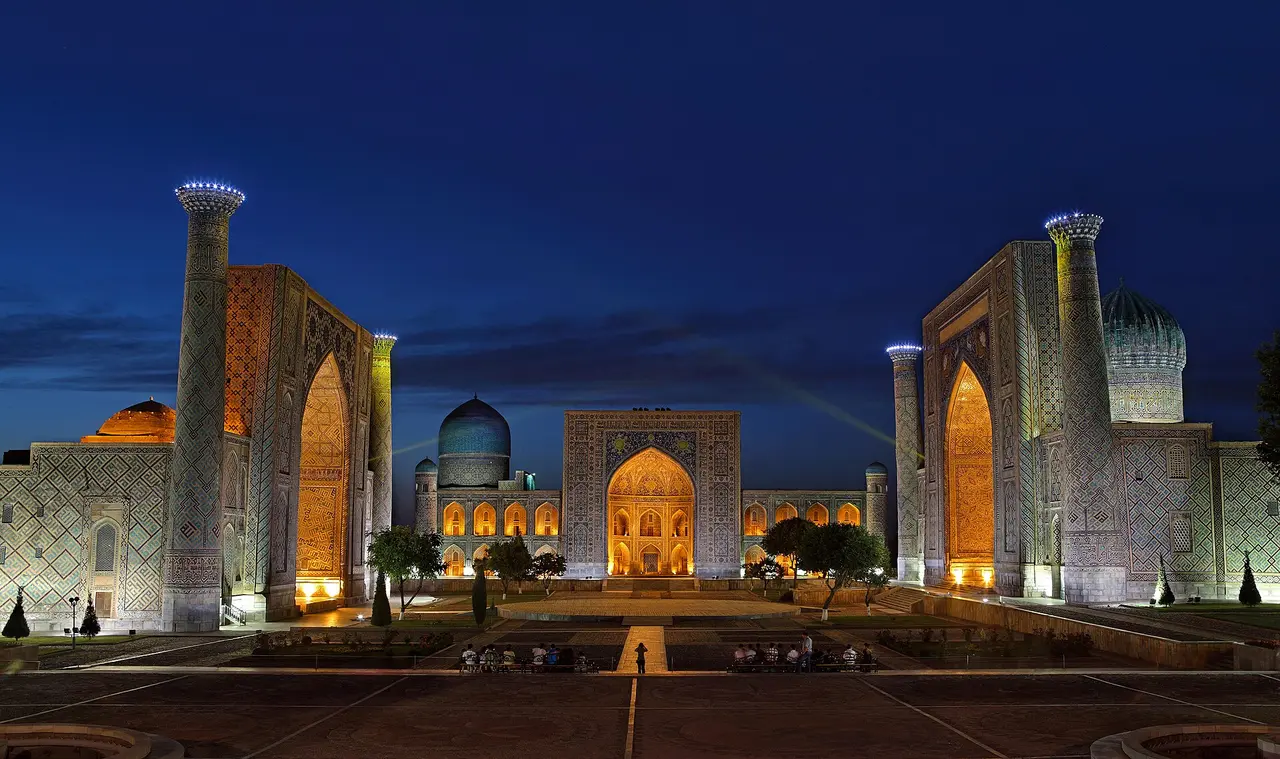
Three tile-covered madrasas facing each other on the Registan, an avenue of blue mausoleums at Shah-i-Zinda, Tamerlane's tomb beneath its ribbed dome and the Siab bazaar piled high with round loaves: Samarkand is explored on foot over three days, early in the morning and late in the afternoon.

Why visit Samarkand?

Samarkand was the capital of Tamerlane's empire in the late 14th century, and its Timurid monuments rank among the high points of Islamic architecture. The city has been a UNESCO World Heritage Site since 2001 as "Samarkand, Crossroad of Cultures". High-speed trains link it to Tashkent in just over two hours.

Samarkand's must-sees

The Timurid monuments are concentrated within two kilometres of the Registan.

Ulugh Beg Madrasa

The oldest of the three Registan madrasas, completed around 1420 by Tamerlane's astronomer grandson, its facade covered in star patterns.

Sher-Dor Madrasa

Facing the first, it shows lions chasing deer beneath a sun with a human face, a rare figurative motif in Islamic art.

Tilya-Kori Madrasa

The third building on the Registan, it houses a mosque whose inner dome is entirely covered in gilding, restored in the 20th century.

Gur-e-Amir Mausoleum

Tamerlane's tomb beneath a ribbed turquoise dome, with a dark jade tombstone and a richly gilded interior.

Shah-i-Zinda Necropolis

A street of blue ceramic mausoleums climbed by a stairway, holding the finest collection of Timurid tilework in the city.

Bibi-Khanym Mosque

Built by Tamerlane after his Indian campaign at the end of the 14th century, one of the largest mosques of the Islamic world in its time.

Siab Bazaar

Covered market next to Bibi-Khanym, known for Samarkand's round loaves, dried fruit, spices and halva.

Ulugh Beg Observatory

Remains of a 15th-century observatory where the great buried sextant survives, with a small museum on Ulugh Beg's astronomical work.

Afrasiab Museum

It holds the 7th-century wall paintings uncovered on the site of the ancient city, including the famous procession of ambassadors.

Mausoleum of Daniel

A shrine with a very long tomb attributed to the prophet Daniel, revered by several faiths, on a hill above the Siab river.

What to discover in Samarkand, district by district?

The Registan and the Tashkent Street promenade

The monumental core comes down to one square and one street. Around the Registan stand three madrasas built between the 15th and 17th centuries, and the pedestrian promenade heading northeast links it, in fifteen minutes on foot, to the Bibi-Khanym mosque and the Siab bazaar. That is your first morning. The Registan stays open into the evening and its facades are lit after dark: come back a second time at sunset, when the low light brings out the mosaics. Avoid midday in summer, when the shadeless square often goes above 35 °C.

Shah-i-Zinda and the Afrasiab hills

Northeast of the bazaar, the Shah-i-Zinda necropolis lines up 14th and 15th-century mausoleums covered in carved ceramics over a few hundred metres. It is an active pilgrimage site: cover shoulders and knees and keep a low profile during prayers. Just above lie the Afrasiab hills, site of the ancient city destroyed by the Mongols in 1220. The site museum holds 7th-century wall paintings showing a procession of ambassadors. Allow half a day for the whole area, plus an hour for the Ulugh Beg observatory, a little further along the same road.

The Gur-e-Amir quarter and the old town

Ten minutes on foot southwest of the Registan, the Gur-e-Amir mausoleum holds the tomb of Tamerlane and several of his descendants, including Ulugh Beg. Its gilded interior takes thirty to forty minutes. Around it, the residential old town keeps its narrow lanes and courtyard houses, largely ignored by tourist maps. An hour's stroll between Gur-e-Amir and the back of the Registan gives a glimpse of daily life: neighbourhood bakeries, small mosques, children playing in the street. This is also where many family-run guesthouses are found.

The Russian town and its shady avenues

West of the historic centre, the town built by the Tsarist administration from the late 19th century has wide avenues lined with plane trees, brick administrative buildings and parks. The contrast with the Timurid city is striking, just twenty minutes away on foot. This is the area for cafes, modern restaurants and chain hotels, quieter in the evening. The central boulevard, Universitetskiy, makes a pleasant late-afternoon walk. If you stay here, plan on a taxi or fifteen to twenty-five minutes on foot to reach the Registan.

Crafts: silk paper and carpets

Samarkand was one of the first papermaking centres outside China, from the 8th century onwards. At Konigil, about ten kilometres east, a workshop has revived mulberry paper production in a water mill, a one to two-hour visit best combined with a break by the river. In town, hand-knotted carpet workshops can be visited freely and show every step, from plant dyeing to knotting. Prices are negotiable: bargaining is part of buying, especially in the shops set up inside the madrasas.

The new tourist districts

East of the city, a large tourist complex built in the early 2020s brings together hotels, a congress centre and a recreated "eternal city" with workshops and shows. It is about twenty minutes by taxi from the Registan. Modern and carefully designed, it suits travellers looking for recent hotels and evening walks along the canals, but it is no substitute for the historic city. For a first stay of three nights, sleep near the centre and keep one evening for this area if time allows.

Day trips from Samarkand

Shahrisabz, Tamerlane's birthplace and home to the ruins of the Ak-Saray palace, is about two hours away by road over the Takhtakaracha pass, spectacular in spring. The mountain road can close in winter, which means a longer detour. To the east, the Tajik border is only an hour's drive away. Bukhara is less than two hours by high-speed train, making it the natural next stop on a tour of Uzbekistan. For a full visit, three days on site is enough, four with a day trip.

Getting there

Airports serving Samarkand, from main hubs to secondary ones.
  • BHKBukhara International AirportBukharaMain
  • NCUNukus International AirportNukusMain
  • NMANamangan International AirportNamanganMain
  • SKDSamarkand International AirportSamarkandMain
  • TASTashkent International AirportTashkentMain
  • UGCUrgench International AirportUrgenchMain

Practical info for Samarkand

Afrosiyob train

About 2 h 10 from Tashkent and under 2 h to Bukhara; book as soon as sales open in spring and autumn

Monument tickets

Separate paid entry for each major site (Registan, Shah-i-Zinda, Gur-e-Amir): carry cash in sum

Dress at Shah-i-Zinda

Active pilgrimage site: shoulders and knees covered, headscarf appreciated for women

Languages spoken

Uzbek is official, but Tajik is widely spoken in Samarkand and Russian remains useful

Registration

Handled by each place you stay, keep the slips until you leave the country

Taxis

Ride-hailing apps work in the city, easier than haggling on the street

Tap water

Not drinkable, bottled water everywhere

Plugs

220 V, type C and F sockets as in continental Europe

Time zone

UTC+5, no daylight saving time

Samarkand in pictures

Photo credits : Kraftabbas, CC BY-SA 4.0, Wikimedia Commons ; Bgag, CC0, Wikimedia Commons ; Petar Milošević, CC BY-SA 4.0, Wikimedia Commons

Frequently asked questions about Samarkand

How many days do you need in Samarkand?
Three full days let you see the Registan, Shah-i-Zinda, Gur-e-Amir, Bibi-Khanym and the bazaar without rushing, keeping the hottest hours for museums. Add a day for Shahrisabz or the Konigil paper mill. Two days are enough if you keep moving.
Can you see the Registan lit up at night?
Yes, the facades of the three madrasas are lit at nightfall and the square remains accessible from the promenade in the evening. Sound and light shows are held on certain dates, especially in high season. Sunset, just before the lights come on, is still the best moment for photos.
Samarkand or Bukhara: which one if you are short on time?
Samarkand impresses with the scale of its Timurid monuments, Bukhara with the coherence of its pedestrian old centre. They are less than two hours apart by train: even on a short trip it is better to combine them, with three nights in Samarkand and two in Bukhara.
How do you get from Tashkent to Samarkand?
The easiest option is the Afrosiyob high-speed train, about two hours, with several daily departures from Tashkent's central station. Slower conventional trains and shared taxis also run. There are domestic flights too, but once boarding time is counted, the train remains more practical.
Is Samarkand silk paper really made of silk?
No, the name is misleading: traditional Samarkand paper is made from the bark of the mulberry tree, whose leaves feed silkworms. Its smooth, glossy surface explains the name. You can watch it being made at the Konigil workshop on the edge of town.
What is the weather like in Samarkand in spring and summer?
April, May, September and October are the ideal months, with mild days and cool nights. In July and August, afternoon heat often goes above 35 °C, so visit early. Winter is cold, sometimes snowy, but the city is then almost empty of visitors.
Where should you stay in Samarkand to do everything on foot?
Guesthouses in the old town, between Gur-e-Amir and the Registan, put the main monuments less than fifteen minutes away on foot. Hotels in the Russian town are quieter but need a taxi or a longer walk. The recent tourist complex to the east is too far out for a first visit.
Is photography allowed inside the monuments?
Yes in most madrasas and mausoleums. In active places of prayer, such as some Shah-i-Zinda mausoleums, avoid photographing worshippers and respect moments of prayer. Drones are strictly regulated in Uzbekistan: check the rules before bringing one.

Plan your trip to Samarkand

Build your day-by-day itinerary and manage budget, bookings and packing in PlanTripNow.
Aperçu de l'application PlanTripNow