Skip to content

Visiting San Francisco : what to see, when to go and how many days to plan

Between the bay and the ocean, San Francisco fits on a peninsula about 11 kilometres across, which makes it easy to explore on foot, by cable car and by bus. Three days cover the essentials, a fourth lets you cross the Golden Gate to the redwoods.

At a glance

Visa
None
Tourist stay of up to 90 days
7-day budget
€1,736
Per person, comfort profile, excluding international flights.
Recommended length
3 days
For a first trip, without rushing.

Why visit San Francisco?

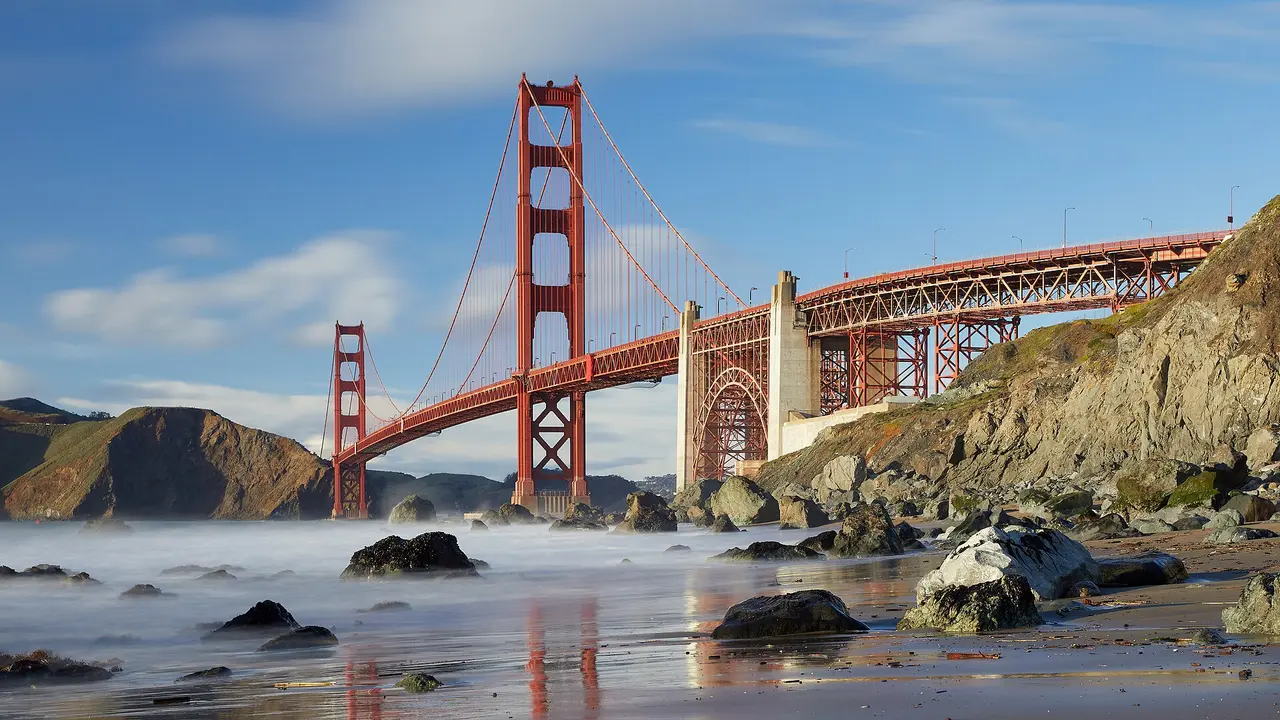
San Francisco packs into a compact area one of the most photographed bridges in the world, an island prison turned museum, districts with a strong identity such as Chinatown, the Mission or Castro, and wild landscapes on the city's doorstep. Its climate is unusual: mild all year, but grey and cool in summer because of the fog, and at its best in September and October.

When to visit San Francisco

Temperatures, rainfall and crowds month by month, to pick your window.
When to visit San Francisco
MonthTemperaturesRainCrowdsVerdict
January8 to 14 °C11 dQuietThe heart of the rainy season, in bursts; hotels at their cheapest and short lines for Alcatraz, with bright days between showers.
February9 to 16 °C11 dQuietStill rainy but mild; Chinese New Year and its big parade liven up Chinatown, and the hills turn green.
March9 to 17 °C11 dModerateLast rains and first blooms in Golden Gate Park; the American spring break fills the Alcatraz ferries.
April10 to 17 °C7 dModerateSkies clearing, a fresh wind on the bridge; a good compromise before the summer fog rolls in.
May11 to 18 °C4 dBusyHardly any rain left, but fog starts wrapping the Golden Gate late in the day; crowds are rising.
June12 to 19 °C2 dPackedStart of the tourist summer and Pride in late June, but the Pacific fog cools the city: pack a fleece.
July12 to 19 °C1 dPackedThe busiest month and one of the greyest: the bridge often vanishes in the mist, book Alcatraz weeks ahead.
August13 to 20 °C1 dPackedStill fog in the mornings and evenings, summer crowds; inland areas (Napa) are much warmer.
September13 to 21 °C1 dBusySan Francisco's true summer: sunshine, fog in retreat, the sea at its warmest; big conventions send hotel prices soaring.
October12 to 21 °C4 dModerateClear, mild days and music festivals in Golden Gate Park; the best month to see the bridge free of fog.
November10 to 18 °C8 dQuietRain returns late in the month, a calmer city; smoke from California wildfires can occasionally haze the sky.
December8 to 15 °C12 dQuietCool and damp, Union Square decorations and an open-air ice rink; prices only climb back for the holidays.
Source: Normales 1991-2020 de la station Downtown San Francisco (NOAA, via Wikipedia, Climate of San Francisco, relevé octobre 2026) : moyennes et minimales relevées, maximales déduites (2 x moyenne - minimale). Jours de pluie : jours avec au moins 0,25 mm, arrondis. Température de mer : moyennes mensuelles de climatestotravel.com pour la côte de San Francisco. Affluence et prix estimés d'après les vacances scolaires américaines et le calendrier des grands salons (Dreamforce en septembre-octobre).

San Francisco's must-sees

Ten places that make a first visit, from the waterfront to the Marin redwoods.

Golden Gate Bridge

2.7 km on foot or by bike, views from Crissy Field or Battery Spencer; frequent fog in summer.

Alcatraz

Ferry from Pier 33, cellhouse audio tour; book weeks ahead in high season.

Powell-Hyde cable car

The most spectacular line, from Union Square to the bay via Russian Hill, 9 dollars a ride.

Chinatown

The Dragon Gate, Grant Avenue and temple alleys, the oldest Chinatown in North America.

Lombard Street

Eight flower-lined hairpin bends on Russian Hill, best walked down by the side stairs.

Painted Ladies

Colourful Victorian houses on Alamo Square, facing the skyline, at sunset.

Ferry Building

Food hall at the foot of Market Street, farmers market on Tuesday, Thursday and Saturday.

Mission murals

Balmy Alley and Clarion Alley, hundreds of murals on walls and garage doors.

Lands End

Coastal trail above the Pacific to the Sutro Baths ruins, with a view of the bridge.

Muir Woods

Coast redwood forest 30 minutes north, parking or shuttle reservation required.

What to discover in San Francisco?

The Golden Gate and the Presidio

The bridge, opened in 1937, is crossed on foot or by bike over 2.7 kilometres, on the east side for pedestrians. The best view is from Crissy Field to the south, or from Battery Spencer to the north, on the Marin side. The Presidio, a former military base turned park, links the bridge to the Marina district through wooded trails. Beware of the summer fog, which often hides the deck in the afternoon: aim for a morning in September or October.

Alcatraz and the waterfront

The only authorised ferry to Alcatraz leaves from Pier 33; tickets, named and sold by the single official concessioner, sell out weeks ahead in summer. The cellhouse audio tour, narrated by former guards and inmates, needs at least two hours on the island. Back on shore, the Embarcadero leads from the Pier 39 sea lions to the Ferry Building, a food hall that hosts a farmers market three times a week.

Cable cars, Nob Hill and Russian Hill

The three cable car lines still running, Powell-Hyde, Powell-Mason and California, are rolling historic landmarks. The Powell-Hyde line is the most spectacular: it climbs Nob Hill then Russian Hill and dives toward the bay facing Alcatraz. Hop off at Lombard Street, with its eight flower-lined bends. A ride costs 9 dollars; the Muni visitor pass includes cable cars and pays off from the second ride.

Chinatown and North Beach

The oldest Chinatown in North America opens through the Dragon Gate on Grant Avenue; the parallel alleys, Waverly Place or Ross Alley, keep temples, herbalists and a fortune cookie factory. Just north, North Beach, the Italian quarter and cradle of the Beat Generation, lines up cafés, the City Lights bookstore and the stairs climbing to Coit Tower. Both are covered on foot in half a day.

The Mission, Castro and Haight-Ashbury

The Mission, the Latino district, is known for its murals, from Balmy Alley to Clarion Alley, and for its giant burritos, a local speciality. Dolores Park next door works as a huge terrace at weekends. Neighbouring Castro remains a memorial place of the LGBT movement and of Harvey Milk. Further northwest, Haight-Ashbury keeps the imprint of the 1967 Summer of Love, with its thrift stores, record shops and Victorian facades.

Golden Gate Park and the Pacific coast

Larger than Central Park, Golden Gate Park stretches five kilometres to the ocean: the Japanese Tea Garden, the de Young museum, the California Academy of Sciences with its living roof and planetarium. At the end, Ocean Beach is too cold and rough for swimming, but the Lands End trail follows the cliffs to the Sutro Baths ruins, with the Golden Gate in view from the west.

Beyond the bay: Marin, Muir Woods and wine valleys

The ferry to Sausalito, a village of houseboats, gives the finest view of the skyline. Muir Woods, half an hour north, protects coast redwoods over 70 metres tall; parking or shuttle must be booked. The Napa and Sonoma vineyards are an hour and a half away by road. To extend the trip, California unrolls its coast to the south and its national parks to the east.

Sample itineraries

Three routes built around the time you actually have.
3daysRecommended

San Francisco in 3 days: districts, parks and the Mission

  1. Day 1: Alcatraz and Fisherman's Wharf
  2. Day 2: Golden Gate Park, Ocean Beach and Lands End
  3. Day 3: the Mission, Castro and the Painted Ladies

Best for: Three days for a relaxed first visit: the waterfront and Alcatraz, a green day between Golden Gate Park and the ocean, then the Mission and Castro, their murals and taquerias. Balanced pace, Muni with the visitor pass.

How much it costs

Per person per day, excluding international travel.
Budget
101 €/ day
2 794 € for 2 people, 7 days, return flights included
Accommodation
50 €
Food
33 €
Local transport
6 €
Sights and activities
12 €
Comfort
248 €/ day
4 852 € for 2 people, 7 days, return flights included
Accommodation
130 €
Food
68 €
Local transport
15 €
Sights and activities
35 €
Premium
565 €/ day
9 290 € for 2 people, 7 days, return flights included
Accommodation
300 €
Food
140 €
Local transport
45 €
Sights and activities
80 €
Prices checked: Relevé octobre 2026, montants USD convertis à 1 USD = 0,92 EUR. Hébergement : jetsetteralerts.com (coût d'un séjour à San Francisco 2026) et nomadotravel.app (dortoir 41-85 USD, mai 2026) ; tarif moyen des hôtels de Union Square autour de 300 USD la nuit (relevés hotelscombined, été 2026), plus environ 14 % de taxe hôtelière ; par nuit et par personne : dortoir pour backpacker, chambre double partagée à deux pour comfort et premium. Repas : jetsetteralerts.com (41-81 USD par jour en petit budget, 83-150 USD en milieu de gamme). Transports : grille SFMTA en vigueur (trajet Muni 2,85 USD sans contact, cable car 9 USD, Visitor Passport 3 jours 35 USD et 7 jours 47 USD). Activités : Alcatraz environ 48 USD, SFMOMA environ 30 USD, pont du Golden Gate et parc gratuits. Vol A/R Paris-San Francisco en économie hors vacances scolaires : environ 690 EUR par personne (ou-et-quand.net : moyenne 706 EUR en octobre, 660 EUR en novembre ; liligo.fr : environ 650 EUR en vol direct).

Getting there

Airports serving San Francisco, from main hubs to secondary ones.
  • ABELehigh Valley International AirportAllentown/BethlehemSecondary
  • ABIAbilene Regional AirportAbileneSecondary
  • ABLAmbler AirportAmblerSecondary
  • ABRAberdeen Regional AirportAberdeenSecondary
  • ABYSouthwest Georgia Regional AirportAlbanySecondary
  • ACKNantucket Memorial AirportNantucketSecondary

Entry, health and safety

For FR travellers

Entry requirements

No visa for a tourist stay

Pas de visa pour un séjour touristique ou d'affaires de 90 jours maximum (programme d'exemption de visa), avec un passeport électronique ou biométrique. Autorisation électronique ESTA obligatoire avant l'embarquement, 40 dollars depuis le 30 septembre 2025, valable 2 ans, à demander au moins 72 heures avant le départ sur le site officiel esta.cbp.dhs.gov.

Stay allowed for up to 90 days.

Health

Advised: Mise à jour des vaccinations recommandées en France, notamment diphtérie, tétanos, poliomyélite, coqueluche et rougeole.

Passeport devant couvrir la durée du séjour (6 mois de validité conseillés par précaution). Soins excellents mais très coûteux, sans accord de sécurité sociale franco-américain : assurance couvrant tous les frais médicaux indispensable. La source signale à San Francisco des bris de vitre très fréquents pour voler les sacs laissés dans les voitures, déconseille le quartier du Tenderloin en famille en raison d'une forte consommation de drogue dans la rue, et rappelle le risque sismique et les incendies de forêt en Californie.

Safety

Normal precautions

Emergency

911

Checked in octobre 2026 against the official source. Entry rules change: check the official source before you travel, it alone is authoritative.

Practical information for San Francisco

Best time

September and October, the warmest and clearest months. Summer is cool and often foggy, winter rainy in bursts.

Clothing

Pack layers and a windbreaker all year: the fog can drop the temperature by several degrees within an hour.

Transport

Muni (bus, streetcar, cable car) at 2.85 dollars contactless; 1, 3 or 7-day visitor pass at 15, 35 and 47 dollars, cable cars included.

From the airport

BART links SFO to downtown in about thirty minutes; taxis and rideshares cost much more depending on traffic.

Car

Useless in the city. Leave nothing visible in a parked car: smashed windows to steal bags are very common.

Tipping

18 to 22 % in restaurants, 1 to 2 dollars per drink at the bar; some restaurants add a health surcharge to the bill.

Area to avoid

The Tenderloin, between Union Square and the Civic Center, concentrates street drug use: go around it, especially with children.

ESTA

Electronic authorisation required for French travellers, 40 dollars, valid two years.

Plug and voltage

Type A and B sockets, 120 V: an adapter is needed, plus dual-voltage chargers and devices.

San Francisco in pictures

Photo credits : Frank Schulenburg, CC BY-SA 4.0, Wikimedia Commons ; Bernard Gagnon, CC BY-SA 3.0, Wikimedia Commons ; Photograph: Radomianin, Public domain, Wikimedia Commons ; © Pierre André, CC BY-SA 4.0, Wikimedia Commons

Frequently asked questions about San Francisco

How many days do you need to visit San Francisco?
Three days cover Alcatraz and the waterfront, the Golden Gate, Chinatown and the Mission. A fourth day lets you cross the bridge to Muir Woods and Sausalito, or give a full day to Golden Gate Park and the Pacific coast.
Why is San Francisco so cool in summer?
Warm inland air draws in the fog formed over the cold Pacific, which pours through the Golden Gate from June to August. Highs rarely exceed 20 degrees. September and October, when the fog retreats, are the warmest months of the year.
How do you book a visit to Alcatraz?
Only through the official National Park Service concessioner, departing from Pier 33. Allow about 48 dollars per adult, audio tour included. In summer and during holidays, slots sell out several weeks ahead; beware of resellers charging much more.
Can you walk across the Golden Gate?
Yes, free of charge, on the east sidewalk, open to pedestrians during the day. The crossing is 2.7 kilometres, about 45 minutes one way. You can come back by bus or carry on to Sausalito by bike and return by ferry, a very popular loop.
Is the Muni visitor pass worth it?
Yes as soon as you ride the cable car: a single ride costs 9 dollars, while the one-day pass costs 15 and covers buses, streetcars, Muni Metro and cable cars. Over three days, the 35-dollar pass saves paying for every boarding.
Is San Francisco a safe city?
The tourist districts are busy without major trouble, but car break-ins are very common: leave nothing in sight. The Tenderloin, near Union Square, concentrates street drug use; go around it, especially at night and with children.
Where to stay in San Francisco?
Union Square is handy for transport but borders the Tenderloin. Fisherman's Wharf suits families, North Beach and Nob Hill offer more charm, the Marina more calm. Prices climb sharply during the big conventions of September and October.
Do you need to rent a car to visit San Francisco?
Not for the city itself: parking is scarce and expensive, the streets are steep and public transport works well. A car becomes useful for Napa, Sonoma or the coastal road south. In that case, rent it only on the day you leave.
Can you swim in San Francisco?
Rarely: the water hovers between 12 and 14 degrees and the currents at Ocean Beach are dangerous. Baker Beach and China Beach are better for a picnic and a sunset over the bridge than for swimming. Pleasant beaches lie further south along the coast.

Plan your trip to San Francisco

Build your day-by-day itinerary and manage budget, bookings and packing in PlanTripNow.
Aperçu de l'application PlanTripNow