Skip to content

Siem Reap , gateway to Angkor: temples, Tonlé Sap lake and town life

A few kilometres from the centre, more than fifty Khmer temples can be visited on a single ticket, from Angkor Wat at sunrise to the roots of Ta Prohm. Further out, the carved river of Kbal Spean, Beng Mealea in the jungle and the stilt houses of Tonlé Sap round off the stay.

At a glance

Visa
Required
Tourist stay of up to 30 days
7-day budget
€441
Per person, comfort profile, excluding international flights.
Recommended length
3 days
For a first trip, without rushing.

Why stay in Siem Reap?

Siem Reap is the town in north-west Cambodia that gives access to the Angkor archaeological park, capital of the Khmer Empire from the 9th to the 15th century and a UNESCO World Heritage Site since 1992. People stay here to visit the temples at dawn, by tuk-tuk or bike, and to reach Tonlé Sap lake. The best time to go is November to February.

When to visit Siem Reap

Temperatures, rainfall and crowds month by month, to pick your window.
When to visit Siem Reap
MonthTemperaturesRainCrowdsVerdict
January20 to 32 °C2 dPackedDry season and 20 °C mornings: the best time for Angkor, but crowds by the moat from 5 am.
February22 to 34 °C1 dBusyHardly any rain, 33 °C in the afternoon; Lunar New Year on 6 February 2027, flights around €990.
March24 to 35 °C3 dModerate35 °C: temples at sunrise, pool at noon; around the 21st the sun rises over the central tower.
April25 to 36 °C8 dModerateThe hottest month, 36 °C: Khmer New Year in mid-April, Angkor full of Cambodian families.
May25 to 35 °C17 dQuietThe rains return, showers often short: moats and rice fields turn green, temples almost empty.
June25 to 34 °C18 dQuietNear-daily showers and the year's priciest flights, €1,038 median: poor value for money.
July25 to 33 °C18 dQuietThe cheapest flights, €665 median: rain in the afternoon, mornings free for Ta Prohm and the Bayon.
August25 to 32 °C18 dModerateMonsoon in place but only 32 °C: European holidays, yet Angkor stays quieter than in winter.
September25 to 32 °C17 dVery quietThe wettest month, 288 mm: muddy tracks to Beng Mealea, the Tonlé Sap swollen by the flood.
October25 to 32 °C15 dQuietEnd of the monsoon, still 200 mm: stilt villages surrounded by water, country roads sometimes flooded.
November23 to 31 °C6 dBusyThe rains stop, the countryside stays green: high season begins, a good compromise for Angkor.
December21 to 31 °C2 dPackedThe coolest month, 31 °C by day and 21 °C at night: ideal for the grand circuit, hotels full at Christmas.
Source: Températures (moyennes des maxima et minima quotidiens, moyenne journalière), cumuls et jours de pluie : moyennes 1997-2010 de la station de Siem Reap publiées par le Deutscher Wetterdienst, reprises dans le tableau climatique de Wikipédia (relevé du 10 octobre 2026) ; il n'existe pas de normales 1991-2020 publiées pour cette station, d'où une série plus courte. Ville à l'intérieur des terres : pas de température de la mer (le Tonlé Sap est un lac). Saison des pluies de juin à novembre selon France Diplomatie (fiche sécurité du 21 septembre 2026). Prix : vols A/R Paris-Siem Reap sur Kayak (juillet le mois le moins cher à 665 € en médiane, juin 1 038 € et février 992 € les plus chers), relevé du 10 octobre 2026. Nouvel An lunaire 2027 le 6 février, Nouvel An khmer à la mi-avril. Affluence : estimation éditoriale.

Five moments not to miss in Siem Reap

Beyond the great temples, five experiences that stay with you.

Srah Srang at first light

The royal pool facing Banteay Kdei, far calmer than Angkor Wat at dawn for watching day break over the water.

Angkor Wat's bas-relief galleries

Hundreds of metres of carved scenes, from the Churning of the Sea of Milk to Khmer armies on the march, followed clockwise.

Sunset at Pre Rup

A brick temple-mountain with views over the rice fields, less crowded than Phnom Bakheng at dusk.

Preah Khan in the shade

A row of doorways and half-ruined corridors, ideal in the hot hours thanks to the surrounding forest.

Angkor National Museum

Statues, lintels and models to understand the empire's history before heading out, with a hall of a thousand Buddhas.

How to plan Angkor from Siem Reap?

A town built around a site

Siem Reap had 245,494 inhabitants at the 2019 census, making it the country's second city, but everything here revolves around Angkor. The centre stretches along the Siem Reap river, with its hotels, restaurants and tuk-tuk stands; the archaeological park begins north of town, a few minutes' drive away. This is not a museum town: you sleep here, eat here and leave every morning before dawn. Allow at least two full days, three to add Tonlé Sap, four for the outlying temples.

Angkor Pass: which ticket to choose

The ticket is sold on the official Angkor Enterprise website, through its app or at the ticket office, and is checked at the entrance of each temple. Three options in October 2026: 37 USD for one day, 62 USD for three days to use within a week, 72 USD for seven days to use within a month. Children under 12 enter free on showing their passport. The park opens at 5 am and closes at 6.30 pm. Kbal Spean (5 USD) and Beng Mealea (10 USD) need a separate ticket. From two days of visits, the three-day pass is better value.

Angkor Wat at sunrise

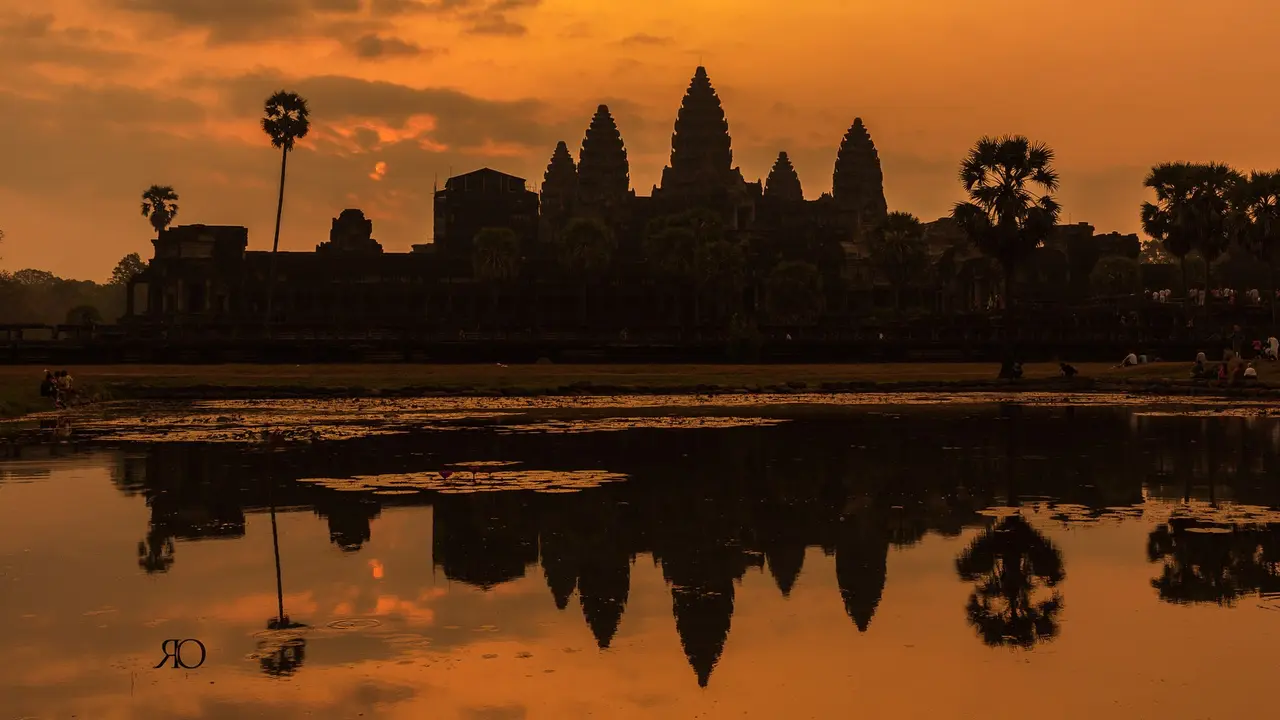
This is every visitor's rendezvous. Arrive around 5 am, cross the causeway over the moat and stand by the north pond to watch the five towers stand out against the sky. Built in the 12th century under Suryavarman II and dedicated to Vishnu, the temple faces west, which puts the light behind it in the morning. Bring a head torch for the causeway, still dark at opening. At the equinoxes, around 21 March and 21 September, the sun rises right above the central tower. Stay on after the groups leave, around 7 am, to walk the bas-relief galleries almost alone.

Angkor Thom and the faces of the Bayon

The empire's last capital, founded by Jayavarman VII at the end of the 12th century, Angkor Thom is enclosed by a twelve-kilometre wall pierced by monumental gates. The south gate, approached between two rows of giants pulling a serpent, is the most photographed. At the centre, the Bayon raises more than two hundred serene faces carved on its towers, best seen in the morning when the low light deepens the features. A few steps away, do not miss the Baphuon and its huge reclining Buddha, the Terrace of the Elephants and the Terrace of the Leper King. Allow half a day.

Ta Prohm, the temple left to the trees

A Buddhist monastery built by Jayavarman VII to honour his mother, Ta Prohm was deliberately left as archaeologists found it, overrun by silk-cotton and strangler fig trees. Their roots grip the galleries and lift the paving stones, a setting made famous by the cinema. Walkways channel the visit and protect the fragile walls. The temple fills up by mid-morning: come at opening or late in the afternoon, when the forest shade cools the air. An hour is enough, but the morning light is worth the early start. Wear closed shoes: the root-lifted slabs are slippery after rain.

Small circuit, grand circuit: two loops by tuk-tuk

The park is organised along two historic routes. The small circuit links Angkor Wat, Angkor Thom, Ta Keo, Ta Prohm and Banteay Kdei, with the Srah Srang royal pool opposite. The grand circuit extends the loop to Preah Khan, the sacred pool of Neak Pean, Ta Som and the East Mebon, then Pre Rup, where you watch the sun set over the countryside. A day-hire tuk-tuk costs 20 to 25 USD for the first, 25 to 30 USD for the second. Agree the price and departure time with the driver the day before. An electric bike, slower, suits travellers who dislike fixed schedules.

Banteay Srei, pink sandstone lace

Some thirty kilometres north-east of town, Banteay Srei, consecrated in 967, is tiny compared with Angkor Wat but the most finely carved temple in the whole region. Its pink sandstone allowed pediments, female deities and scrollwork to be chiselled with rare precision, hence its nickname, the citadel of women. It is included in the Angkor Pass. Groups arrive from mid-morning: aim for opening time or late afternoon, when the stone turns orange. It combines easily with Kbal Spean, further north, and Banteay Samré on the way back.

Kbal Spean and Phnom Kulen, the sacred heights

At the foot of the Kulen hills, Kbal Spean has to be earned: a forest climb leads to a river whose bed and rocks were carved with hundreds of lingas and deities in the 11th century. The ticket costs 5 USD, and the water flowing over the carvings looks best at the end of the rainy season. Stay on the marked trail. 48 kilometres from Siem Reap, Phnom Kulen, the sacred mountain where the Khmer Empire is said to have been born, has a large reclining Buddha, a waterfall and submerged lingas; access is not covered by the Angkor Pass and is paid separately.

Beng Mealea and the Roluos group

Beng Mealea, east of town, is a vast 12th-century temple reclaimed by the forest: collapsed towers, moss-covered galleries, piles of sandstone blocks that you skirt on wooden walkways. The separate ticket costs 10 USD and the site opens at 6 am; going early lets you explore it before the coaches. On the way back, the Roluos group brings together the oldest temples in the area, Preah Ko, Bakong and Lolei, built at the end of the 9th century, before the capital moved to Angkor. Allow a full day for both.

Tonlé Sap and its stilt villages

South of town lies Tonlé Sap, the largest freshwater lake in Southeast Asia. During the monsoon, the Mekong flood reverses the flow of its river and the lake multiplies in size, drowning forests and rice fields. Villages have adapted: houses perched on stilts several metres high at Kompong Phluk, floating homes at Chong Kneas, whose official boat can be booked on the Angkor Enterprise website. Count on 20 to 25 USD for a trip. The sight is most striking from August to November, when the water rises to the floorboards; in the dry season, the stilts look enormous.

In town: Old Market, museum and Phare circus

In the evening, Siem Reap changes pace. The Old Market, Psar Chas, sells spices, dried fish, silks and souvenirs; the Angkor National Museum helps put kings and styles in order before or after your visits. The Phare circus, a company trained by a Cambodian arts school, stages acrobatics and theatre shows, from 18 to 38 USD a seat. Pub Street, a pedestrian street of bars and restaurants, concentrates the tourist nightlife and the highest prices: one drink on a terrace is enough, Khmer cooking is better found along the river.

Dry season or monsoon: when to come

The dry season, from November to April, is the most popular. December and January bring the coolest mornings, around 20 °C before sunrise and 31 °C in the afternoon, but also crowds and the highest hotel prices. The heat then climbs to 36 °C in April. From May to October, the monsoon brings 17 to 18 days of rain a month and up to 288 mm in September, often as afternoon showers: the temples are quieter and the vegetation vivid. July is the cheapest month to fly, 665 euros median from Paris.

Getting to Siem Reap and budget on the spot

There is no direct flight from Paris: connections are mostly in Ho Chi Minh City, in Vietnam, in Singapore or in Bangkok, for 867 euros return on average over a year. The new Siem Reap-Angkor international airport, opened in 2023, lies far east of the centre: plan on the shuttle or a taxi, booked with your hotel before arrival. On the spot, the US dollar is used everywhere, with riel given as change. Count on about 30 euros per person per day as a backpacker, 63 euros in comfort and 220 euros at the top end, Angkor Pass and tuk-tuk included.

Thai border and landmines: what to know

Since the 2025 clashes and despite the ceasefire of 27 December 2025, the French foreign ministry formally advises against the whole 30 km strip along the border with Thailand. This rules out Preah Vihear temple, Banteay Chhmar and the land border crossings; Angkor, Banteay Srei, Kbal Spean, Beng Mealea and Tonlé Sap remain outside this zone. Cambodia still has landmines and unexploded ordnance that are rarely marked: do not leave the paths around isolated temples and never pick up metal objects. In town at night, prefer a tuk-tuk booked through your hotel.

Sample itineraries

Three routes built around the time you actually have.
3daysRecommended

Siem Reap in 3 days: small circuit, grand circuit and the Tonlé Sap

  1. Small circuit: Angkor Wat, the Bayon, Ta Prohm
  2. Grand circuit: Preah Khan, Neak Pean, Pre Rup
  3. Tonlé Sap stilt villages and Phare circus

Best for: The classic plan, built around the two loops of the Angkor park, then a day away from the temples on Tonlé Sap lake. A day-hire tuk-tuk is enough (20 to 30 USD depending on the circuit). 3-day pass, valid for a week.

How much it costs

Per person per day, excluding international travel.
Budget
30 €/ day
2 160 € for 2 people, 7 days, return flights included
Accommodation
7 €
Food
8 €
Local transport
6 €
Sights and activities
9 €
Comfort
63 €/ day
2 622 € for 2 people, 7 days, return flights included
Accommodation
18 €
Food
18 €
Local transport
11 €
Sights and activities
16 €
Premium
220 €/ day
4 820 € for 2 people, 7 days, return flights included
Accommodation
116 €
Food
54 €
Local transport
20 €
Sights and activities
30 €
Prices checked: Relevé du 10 octobre 2026, prix hors haute saison (décembre-janvier et vacances de février plus chers). Les prix au Cambodge s'affichent en dollars US : conversion au taux de référence BCE du 9 octobre 2026 (1 € = 1,1206 USD). Activités : tarifs officiels Angkor Enterprise (angkorenterprise.gov.kh, consulté le 10 octobre 2026) : Angkor Pass 1 jour 37 USD, 3 jours 62 USD (valable 7 jours), 7 jours 72 USD (valable 30 jours), Beng Mealea 10 USD, Kbal Spean 5 USD, Koh Ker 15 USD, gratuit pour les moins de 12 ans. Repas : Numbeo pour Siem Reap (252 relevés de 24 contributeurs, mis à jour le 26 septembre 2026) : repas simple 2,50 USD, dîner pour deux en restaurant de gamme moyenne 24 USD, bière pression 1 USD. Hébergement, location de tuk-tuk à la journée (20 à 25 USD petit circuit, 25 à 30 USD grand circuit), bateau sur le Tonlé Sap (20 à 25 USD), cirque Phare (18 à 38 USD) et tables haut de gamme : guide budget de travelguidestip.com (site non officiel, publié en avril 2026 mais prix vérifiés en février 2025, donc à confirmer) : dortoir 5 à 12 USD, hôtel 3 étoiles 25 à 60 USD, 5 étoiles 150 à 400 USD la nuit, déjeuner haut de gamme 12 à 18 USD, dîner gastronomique 25 à 40 USD. Les postes transport et repas du profil premium sont des estimations éditoriales. Vol A/R Paris-Siem Reap avec escale (pas de vol direct, escales fréquentes Hô Chi Minh-Ville, Singapour, Bangkok) estimé à 870 € par personne (Kayak, relevé du 10 octobre 2026 : prix moyen 867 € sur 12 mois, fourchette habituelle 777 à 1 011 €). Hébergement par nuit et par personne : dortoir pour le profil routard, chambre double partagée à deux pour les autres ; tuk-tuk partagé à deux. weekTwoPax = 7 jours x 2 personnes + 2 vols.

Getting there

Airports serving Siem Reap, from main hubs to secondary ones.
  • DSYDara Sakor International AirportTa NounMain
  • KOSSihanouk International AirportPreah SihanoukMain
  • KTITecho International AirportPhnom PenhMain
  • PNHPhnom Penh International AirportPhnom PenhMain
  • SAISiem Reap-Angkor International AirportSiem ReapMain
  • BBMBattambang AirportBattambangSecondary

Entry, health and safety

For FR travellers

Entry requirements

Visa required

Visa obligatoire pour tout séjour. Visa touristique (type T) à demander en ligne avant le départ sur le portail officiel evisa.gov.kh, auprès de l'ambassade du Cambodge, ou à l'arrivée à l'aéroport international de Siem Reap-Angkor ; le tarif varie de quelques dollars selon la méthode, prévoir des dollars US en espèces à l'arrivée. Séjour de 30 jours, prolongeable une seule fois d'un mois à l'immigration de l'aéroport de Phnom Penh. Formulaire gratuit Cambodia e-Arrival obligatoire pour toute arrivée par avion depuis le 1er septembre 2024, même avec un visa. Passeport valable au moins six mois après la fin du visa demandé. Dépassement de séjour : 10 USD par jour de retard.

Stay allowed for up to 30 days.

Passport valid for 6 months beyond your return date.

Health

Required: Fièvre jaune uniquement pour les voyageurs en provenance d'une zone d'endémie.

Advised: Vaccinations du calendrier français à jour (diphtérie, tétanos, poliomyélite, coqueluche, rougeole) ; selon la durée et les conditions du séjour, hépatite A, fièvre typhoïde, hépatite B, rage, encéphalite japonaise, chikungunya et dengue, BCG pour les enfants de moins de 15 ans en séjour long.

Dengue présente partout, pic de juin à novembre, sans traitement curatif : se protéger des piqûres et éviter les anti-inflammatoires en cas de fièvre. Paludisme limité à certaines zones forestières. Rage endémique en ville comme à la campagne (Institut Pasteur à Phnom Penh et Battambang). Hausse des cas de rougeole signalée depuis mars 2026. Eau en bouteille ou rendue potable. Assurance hospitalisation et rapatriement obligatoire. Sécurité : déplacements formellement déconseillés jusqu'à 30 km de la frontière thaïlandaise (cessez-le-feu du 27 décembre 2025, situation fragile), ce qui exclut notamment le temple de Preah Vihear, Banteay Chhmar, Anlong Veng et les postes-frontières ; Angkor, Kbal Spean, Beng Mealea et le Tonlé Sap sont hors de cette zone. Mines et munitions non explosées encore présentes et rarement signalées : ne pas quitter les chemins principaux à la campagne ni autour des temples isolés, ne ramasser aucun objet métallique. Prudence la nuit à Siem Reap (tuk-tuk, moto-taxi), risque de soumission chimique dans les bars ; jupes et shorts au-dessus du genou refusés à Angkor Wat. Saison des pluies de juin à novembre : orages et crues soudaines. Fiches France Diplomatie mises à jour le 21 septembre 2026 ; mines et tenue : FCDO britannique (gov.uk), consulté le 10 octobre 2026.

Safety

Increased caution

Emergency

117 (police), ambassade de France à Phnom Penh +855 23 260 010

Checked in octobre 2026 against the official source. Entry rules change: check the official source before you travel, it alone is authoritative.

Practical information for Siem Reap

Angkor Pass

37 USD for 1 day, 62 USD for 3 days (valid 7 days), 72 USD for 7 days (valid 30 days), official prices in October 2026.

Park opening hours

5 am to 6.30 pm for the Angkor park; Beng Mealea and Kbal Spean 6 am to 6.30 pm.

Separate tickets

Kbal Spean 5 USD, Beng Mealea 10 USD; Phnom Kulen and the Tonlé Sap boat paid separately.

Children

Free entry for under-12s, passport to show if checked.

Dress code

Knees covered: skirts and shorts above the knee may be refused at Angkor Wat.

Day-hire tuk-tuk

20 to 25 USD for the small circuit, 25 to 30 USD for the grand circuit and Banteay Srei, price agreed before setting off.

Currency

US dollars accepted everywhere, Cambodian riel given for small change; bring clean banknotes.

Entering Cambodia

Visa required (e-visa on evisa.gov.kh or on arrival) plus the free Cambodia e-Arrival form for air arrivals.

Siem Reap in pictures

Photo credits : Reinhard Onasch, CC BY-SA 3.0, Wikimedia Commons ; Marcin Konsek, CC BY-SA 4.0, Wikimedia Commons ; lumoplank, CC0, Wikimedia Commons ; Olaf Tausch, CC BY 3.0, Wikimedia Commons

Frequently asked questions about Siem Reap

How many days do you need for Angkor?
Two days let you see Angkor Wat, the Bayon and Ta Prohm at the best times. With three days, add the grand circuit and Tonlé Sap; with four, Banteay Srei, Kbal Spean and Beng Mealea. The three-day pass, at 62 USD, covers most stays.
Do you need a guide to visit the Angkor temples?
No, the park can be visited freely by tuk-tuk or bike, and the main temples are well signposted. A licensed guide does, however, add a great deal when reading the bas-reliefs of Angkor Wat and the Bayon, and when timing visits to avoid the crowds.
When can you see sunrise over Angkor Wat?
Every day, as the park opens at 5 am. The sight is finest from November to March, under clear skies. At the equinoxes, around 21 March and 21 September, the sun rises exactly above the central tower, which draws even bigger crowds.
Can you travel overland to Thailand from Siem Reap?
Not at the moment: the French foreign ministry formally advises against the 30 km strip along the Thai border, crossings included, despite the December 2025 ceasefire. To continue to Thailand, fly from Siem Reap-Angkor airport instead.
Is Siem Reap a safe town?
Mostly yes, but take care at night on foot or on motorbike taxis, and in bars where drink-spiking cases are reported. Off the beaten track, landmines may remain: stay on the paths around isolated temples.
What budget for a week in Siem Reap?
Excluding flights, count on about 30 euros per person per day as a backpacker, 63 euros in comfort and 220 euros at the top end, Angkor Pass and tuk-tuk included. With two flights from Paris, a week for two comes to about 2,600 euros in comfort.

Plan your trip to Siem Reap

Build your day-by-day itinerary and manage budget, bookings and packing in PlanTripNow.
Aperçu de l'application PlanTripNow