Skip to content

Vancouver between the Pacific and the mountains: seawall, rainforest, Whistler and Victoria

In Vancouver, the rainforest starts at the end of downtown streets. You cycle around Stanley Park, cross False Creek by aquabus for lunch on Granville Island, then head up to the North Shore peaks. Further afield, Whistler and Victoria are within reach for a day trip.

At a glance

Visa
None
Tourist stay of up to 180 days
7-day budget
€1,414
Per person, comfort profile, excluding international flights.
Recommended length
4 days
For a first trip, without rushing.

Is Vancouver on Vancouver Island?

No. Despite its name, the city of Vancouver is on the mainland, on the Strait of Georgia in south-western British Columbia, the westernmost province of Canada. Vancouver Island lies opposite: it is home to Victoria, the provincial capital, a 1 hr 35 min ferry crossing from Tsawwassen to Swartz Bay.

When to visit Vancouver

Temperatures, rainfall and crowds month by month, to pick your window.
When to visit Vancouver
MonthTemperaturesRainCrowdsVerdict
January1 to 7 °C20 dQuietDrizzle almost every other day in town, but fresh snow on Grouse Mountain and in Whistler: a month for skiers rather than strollers.
February2 to 8 °C16 dQuietMild for Canada, rarely below freezing, with low downtown hotel rates; ideal for combining museums, Granville Island and a day on the slopes.
March3 to 10 °C18 dQuietThe first cherry blossoms in residential streets, showers still frequent: a light rain jacket is enough for the seawall.
April6 to 13 °C15 dModerateCherry blossoms at their peak and spring skiing still possible in Whistler: ski one day and cycle around Stanley Park the next.
May9 to 17 °C13 dModerateLonger days, drying trails on the North Shore and kayaking on False Creek getting going again: an excellent compromise before summer.
June12 to 20 °C12 dBusyThe Alaska cruise season is in full swing and evenings stay light late; a few grey days remain and prices rise sharply.
July14 to 22 °C6 dPackedThe driest month, packed beaches at Kitsilano and English Bay, fireworks over the bay: book early, and keep an eye on wildfire smoke.
August14 to 22 °C6 dPackedNear-guaranteed sunshine and a superb Sea-to-Sky Highway, but hotel prices peak and some days can be hazy with smoke from inland wildfires.
September11 to 19 °C9 dBusyOur favourite month: still dry and mild, smaller crowds after Labour Day, and salmon running up North Shore rivers late in the month.
October7 to 14 °C15 dModerateThe rains return from mid-October and the Capilano forests turn autumn colours; hotels become more affordable.
November4 to 9 °C20 dVery quietThe wettest month of the year with short days: this is low season, best for lovers of museums, restaurants and low prices.
December1 to 7 °C21 dModerateRain in town, but the Capilano light displays and the opening of the Whistler slopes; the holidays push prices back up.
Source: Normales 1991-2020 de la station Richmond / aéroport international de Vancouver (Environnement et Changement climatique Canada, identifiant climatologique 1108447), via le tableau de l'article Wikipedia Climate of Vancouver. rainDays = jours de précipitations >= 0,2 mm. Températures de la mer : moyennes mensuelles de seatemperature.org pour Vancouver (agrégateur non officiel, eaux du détroit de Géorgie ; les plages abritées comme English Bay peuvent être un peu plus chaudes en été). Relevé octobre 2026.

Five must-sees in Vancouver

From the seawall to the canyon, the places that best capture a city between sea and forest.

Stanley Park seawall

Around ten kilometres of waterfront path circling the great forest park, by rental bike or on foot, with the Brockton Point totem poles on the way.

Granville Island Public Market

The city's tastiest covered market, between fishmongers and craftspeople, best reached by aquabus across False Creek to arrive on the quayside.

Gastown's cobbled streets

The city's birthplace, with brick warehouses, a steam clock and its best cocktail bars, a few steps from Waterfront Station.

Capilano Suspension Bridge

A 137 m walkway strung 70 m above the river, extended by treetop trails through the Douglas firs of the North Shore.

Museum of Anthropology

On the University of British Columbia campus, a great glass hall of totem poles and works by Northwest Coast peoples.

What to see in Vancouver?

Stanley Park and the seawall

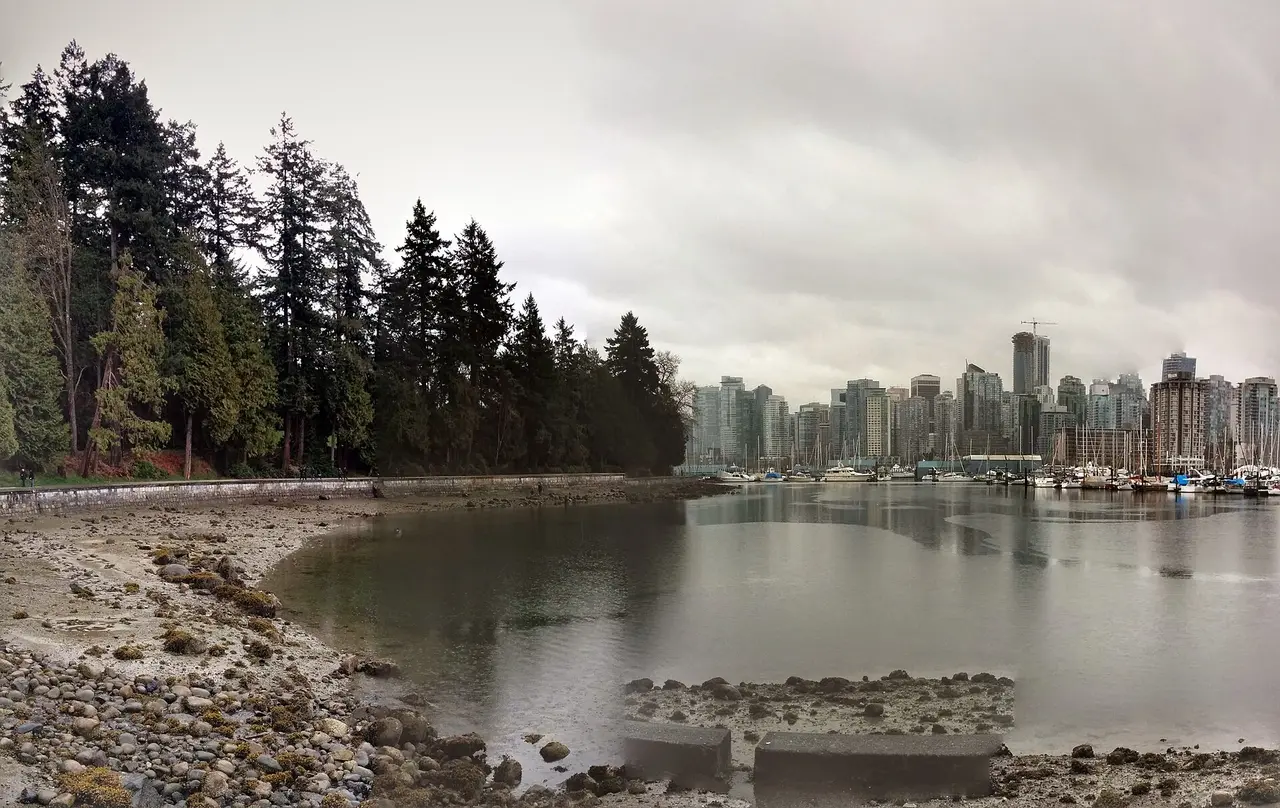
Larger than Central Park, Stanley Park covers more than 400 hectares of cedar and Douglas fir forest at the tip of the downtown peninsula. Its seawall, a waterfront path of around ten kilometres, loops around it at sea level: cyclists ride one way and pedestrians have their own lane. Along the way you pass the Brockton Point totem poles, Lions Gate Bridge, Siwash Rock and the beaches of Third Beach and Second Beach. Rent a bike near Denman Street and set off in the morning, before the summer weekend crowds.

Gastown, where the city was born

Vancouver was born here, around a saloon opened in 1867 by a talkative sailor nicknamed Gassy Jack, whose statue stands on Maple Tree Square. The brick warehouses of Water Street, rebuilt after the 1886 fire, now house designer boutiques, cocktail bars and some of the city's most inventive restaurants. The steam clock whistles every quarter hour in front of the cameras. Nearby, Waterfront Station, the former terminus of the transcontinental railway, serves the SeaBus to the North Shore and the Canada Line to the airport.

Chinatown and Strathcona

Vancouver's Chinatown, one of the largest in North America, keeps its old signs, herbalists and Pender Street bakeries. Its jewel is the Dr. Sun Yat-Sen Classical Chinese Garden, designed on the principles of the scholars' gardens of Suzhou: pavilions, rockeries and jade-green pools. Just east, Strathcona lines up colourful wooden houses that are among the oldest in the city. The neighbouring Downtown Eastside has severe poverty and supervised consumption sites: stay alert in the evening and avoid lingering there without a purpose.

Granville Island and False Creek

Beneath the Granville Bridge, a former industrial zone has become the city's liveliest neighbourhood. The Public Market brings together fishmongers, bakers and fruit stalls from the Okanagan Valley; around it are glassblowing and pottery studios, a brewery, theatres and working boatyards. The best way in is by water, aboard the little aquabuses and ferries that criss-cross False Creek. The inlet can also be explored by rental kayak, past marinas, float homes and the towers of Yaletown, with an hour or two enough for a gentle loop.

Kitsilano, the beaches and the Museum of Anthropology

West of False Creek, Kitsilano has kept the laid-back spirit of its hippie years: outdoor shops and cafes on West 4th Avenue, a beach facing the mountains and a saltwater pool open in summer. The road then runs past Jericho, Locarno and Spanish Banks, beaches for low-tide picnics. At the tip of the point, on the University of British Columbia campus, the Museum of Anthropology displays totem poles and works by Northwest Coast peoples, including Bill Reid, in a great glass hall. Pacific Spirit forest surrounds the campus.

The North Shore: Capilano, Grouse Mountain and Lynn Canyon

The SeaBus crosses the harbour to Lonsdale Quay and its market, the gateway to North Vancouver. The Capilano Suspension Bridge, 137 m long and 70 m above the river, continues into walkways through the treetops; entry is paid, while the smaller Lynn Canyon bridge is free. Grouse Mountain towers over the city: the Skyride runs all year, or you can hike the Grouse Grind, nearly 3 km with more than 850 m of climb, open only in the warmer months. In winter, you can ski at night facing the city lights.

To Whistler on the Sea-to-Sky Highway

To the north, Highway 99 follows the Howe Sound fjord as the Sea-to-Sky Highway: allow about two hours from downtown to Whistler, not counting stops. They are worth it: Shannon Falls, the Sea to Sky Gondola above Squamish and the granite wall of the Stawamus Chief, a playground for climbers. Whistler, which hosted the alpine events of the 2010 Olympic Games, is one of North America's largest ski resorts in winter and a mountain biking and hiking area in summer. Winter tyres are mandatory from October to April.

Victoria and Vancouver Island by ferry

BC Ferries sail from Tsawwassen, south of the metro area, to Swartz Bay in a 1 hr 35 min crossing, weaving between the Gulf Islands where orcas and seals are sometimes spotted. Victoria, the provincial capital, is explored on foot around its Inner Harbour: the parliament lit up at night, the Royal BC Museum, the Empress hotel and the Butchart Gardens north of town. As a day trip from Vancouver the round trip is long; better to stay a night, or take a floatplane from Coal Harbour to save time. Further on, the island's west coast leads to Tofino.

Sample itineraries

Three routes built around the time you actually have.
4daysRecommended

Vancouver in 4 days: the seawall, kayaking on False Creek and the Sea-to-Sky Highway to Whistler

  1. Stanley Park, Coal Harbour and the West End
  2. Kayaking on False Creek, Granville Island and Kitsilano
  3. Sea-to-Sky Highway, Squamish and Whistler
  4. Museum of Anthropology, UBC and Main Street

Best for: The most complete stay for a first trip, focused on water and mountains: Stanley Park, a day of kayaking and beaches, the scenic drive to Whistler, then Indigenous art at the Museum of Anthropology. Best from May to September.

How much it costs

Per person per day, excluding international travel.
Budget
75 €/ day
2 650 € for 2 people, 7 days, return flights included
Accommodation
25 €
Food
30 €
Local transport
8 €
Sights and activities
12 €
Comfort
202 €/ day
4 428 € for 2 people, 7 days, return flights included
Accommodation
95 €
Food
60 €
Local transport
12 €
Sights and activities
35 €
Premium
385 €/ day
6 990 € for 2 people, 7 days, return flights included
Accommodation
150 €
Food
115 €
Local transport
35 €
Sights and activities
85 €
Prices checked: Relevé du 11 octobre 2026, hors pic estival. Hébergement : lits en dortoir affichés de 14 à 28 EUR dans six auberges centrales sur Hostelworld (relevé du 11 octobre 2026, avant taxes) ; moyennes hôtels 3 étoiles (183 EUR la chambre) et 4 étoiles (245 EUR) de combien-coute.net (agrégateur non officiel, prix collectés en octobre 2026, fourchettes très larges ; moyenne auberge de 124 EUR jugée incohérente avec les prix en dortoir et non retenue). Repas : combien-coute.net, octobre 2026 (déjeuner 16 EUR, dîner 3 plats 31 EUR par personne, hors pourboire de 15 à 20 %). Transport : grille officielle TransLink consultée le 11 octobre 2026 (trajet 1 zone 3,50 CAD en espèces ou sans contact, 2,85 CAD sur carte Compass ; DayPass 12,55 CAD ; supplément de 6,50 CAD au départ de l'aéroport par la Canada Line). Change : 1 EUR = 1,5942 CAD (taux de référence BCE du 9 octobre 2026). Vol : aller-retour Paris-Vancouver, prix habituels de 656 à 1 015 EUR et moyenne sur 12 mois de 817 EUR selon KAYAK (agrégateur, page consultée le 11 octobre 2026 sans date de mise à jour explicite ; février le moins cher vers 483 EUR, juillet le plus cher vers 1 002 EUR), retenu 800 EUR par personne, soit 1 600 EUR pour deux. Les taxes de vente (TPS et TVP de Colombie-Britannique) s'ajoutent aux prix affichés. Hébergement par personne : lit en dortoir pour backpacker, chambre double partagée à deux pour comfort et premium. Activités : estimation propre, non sourcée ligne à ligne.

Getting there

Airports serving Vancouver, from main hubs to secondary ones.
  • KESKelsey AirportKelseySecondary
  • PIWPikwitonei AirportPikwitoneiSecondary
  • QBCBella Coola AirportBella CoolaSecondary
  • WPCPincher Creek AirportPincher CreekSecondary
  • XKSKasabonika AirportKasabonikaSecondary
  • XQUQualicum Beach AirportQualicum BeachSecondary

Entry, health and safety

For FR travellers

Entry requirements

No visa for a tourist stay

Pas de visa pour un séjour touristique ou d'affaires de moins de six mois. L'autorisation de voyage électronique (AVE, 7 CAD sur le site officiel du gouvernement du Canada, valable cinq ans et liée au passeport) est obligatoire pour arriver en avion à Vancouver ; elle n'est pas exigée en arrivant par la route ou par la mer, par exemple depuis Seattle ou en fin de croisière. Le passeport doit être valide pendant tout le séjour, sans durée minimale supplémentaire.

Stay allowed for up to 180 days.

Health

Advised: Vaccinations du calendrier français à jour, en particulier diphtérie, tétanos, poliomyélite, coqueluche et rougeole.

Tiques porteuses de la maladie de Lyme en forêt et en milieu rural, quelques cas de virus du Nil occidental (se protéger des moustiques). Assurance couvrant frais médicaux, hospitalisation et rapatriement indispensable, avec des correspondants dans l'ouest du Canada : les frais sont élevés et se règlent avant la sortie de l'hôpital. Vigilance normale sur tout le Canada ; vols de passeports et d'effets personnels signalés à Vancouver, violences liées aux gangs surtout en périphérie (Surrey). Feux de forêt fréquents d'avril à septembre en Colombie-Britannique, notamment autour de Whistler et sur l'île de Vancouver : suivre les consignes d'évacuation et de fermeture. Activité sismique élevée dans la région de Vancouver.

Safety

Normal precautions

Emergency

911

Checked in octobre 2026 against the official source. Entry rules change: check the official source before you travel, it alone is authoritative.

Before you go to Vancouver

Public transport

TransLink buses, SkyTrain and SeaBus: CAD 3.50 per Zone 1 trip by contactless bank card, CAD 2.85 with a Compass Card, CAD 12.55 for a DayPass.

From the airport

The Canada Line links the airport to downtown and Waterfront Station; a CAD 6.50 AddFare applies to journeys starting at the airport stations.

Rain

From November to January it rains around twenty days a month: a rain jacket and waterproof shoes beat an umbrella in the ocean wind.

Taxes and tipping

Sales taxes are added to displayed prices at the till; in restaurants, a tip of 15 to 20% is expected for table service.

Currency

Canadian dollar (CAD); EUR 1 = CAD 1.5942 at the ECB reference rate of 9 October 2026. Contactless cards are accepted almost everywhere.

Time difference

Pacific Time: 9 hours behind Paris for most of the year.

Wildfires

From April to September, British Columbia wildfires can close roads or trails towards Whistler and Vancouver Island: check provincial alerts before setting off.

Vancouver in pictures

Photo credits : Jc1599, CC BY 4.0, Wikimedia Commons ; Markus Säynevirta, CC BY-SA 4.0, Wikimedia Commons ; Xicotencatl, CC BY-SA 4.0, Wikimedia Commons ; Dietmar Rabich, CC BY-SA 4.0, Wikimedia Commons ; Rollan Budi, CC BY-SA 2.0, Wikimedia Commons

Vancouver: your questions before you go

How many days do you need to visit Vancouver?
Two days are enough for Stanley Park, Gastown, Chinatown and Granville Island. With three days you can add the North Shore and a day in Victoria; with four, a day of kayaking and beaches and the Sea-to-Sky Highway to Whistler.
Does it really rain all the time in Vancouver?
No, but winter is very wet: from November to January there are around twenty rainy days a month, with mild temperatures that rarely drop below freezing. July and August, by contrast, are dry and sunny, with about six days of rain.
When is the best time to visit Vancouver?
June to September for sunshine, the seawall and the Sea-to-Sky Highway, with September the pick for being quieter. July and August are the most expensive. From December to March the city is rainy, but snow falls on Grouse Mountain and Whistler.
How much does a week in Vancouver cost?
For two people including the flight from Paris, allow about 2,650 euros in hostel dorms, 4,400 euros in a 3-star hotel and nearly 7,000 euros in a 4-star. Accommodation is the biggest expense, especially in summer.
Can you combine Vancouver with Seattle?
Yes, the two cities are close and linked by road, train or bus. Seattle requires an ESTA to enter the United States, separate from the Canadian eTA, which is not needed to return to Canada by land.
Do you need an authorisation to enter Canada?
French citizens do not need a visa for a tourist stay of under six months, but the eTA, CAD 7 on the official Government of Canada website, is required to arrive by air. The passport must be valid for the whole stay.

Plan your trip to Vancouver

Build your day-by-day itinerary and manage budget, bookings and packing in PlanTripNow.
Aperçu de l'application PlanTripNow