Skip to content

Visiting Wadi Rum : 4x4 tours and a night in the desert

Sandstone cliffs bursting from red sand, canyons engraved by caravan travellers, natural arches and total silence at nightfall: Wadi Rum is best experienced over one or two nights, combining a 4x4 tour, walking and a Bedouin camp.

What makes Wadi Rum unique?

Wadi Rum is a protected area of desert and sandstone mountains in southern Jordan, listed by UNESCO in 2011 as a mixed site, both natural and cultural. Its rock walls bear thousands of petroglyphs and ancient inscriptions, and its landscapes have served as a backdrop for many films.

Sites not to miss in Wadi Rum

Four stops that sum up the desert, between sculpted rock and human traces.

Seven Pillars of Wisdom

A fluted cliff facing the visitor centre, named after T. E. Lawrence's book. The site's first panorama, superb at the end of the day.

Khazali Canyon

A narrow cleft whose walls bear Thamudic and Nabataean inscriptions as well as petroglyphs of human figures and animals.

Burdah Rock Bridge

A natural arch perched high on a ridge, reached in an hour's climb with a guide. Wide views over the surrounding massifs.

Jabal Umm ad Dami

Jordan's highest peak, in the south of the desert. The non-technical climb offers a panorama towards the Saudi border at sunset.

How to explore Wadi Rum?

The visitor centre and Rum village

Every stay begins at the visitor centre, where you pay the protected area fee, included in the Jordan Pass. Rum village, about 7 km further on, is the meeting point with the Bedouin guides who run the excursions: driving in the desert is reserved for their vehicles. Arrive before noon to enjoy the afternoon on the sand. From Petra, allow about two hours by road; a tourist bus also links the two sites each morning depending on the season, to be checked locally.

The desert by 4x4

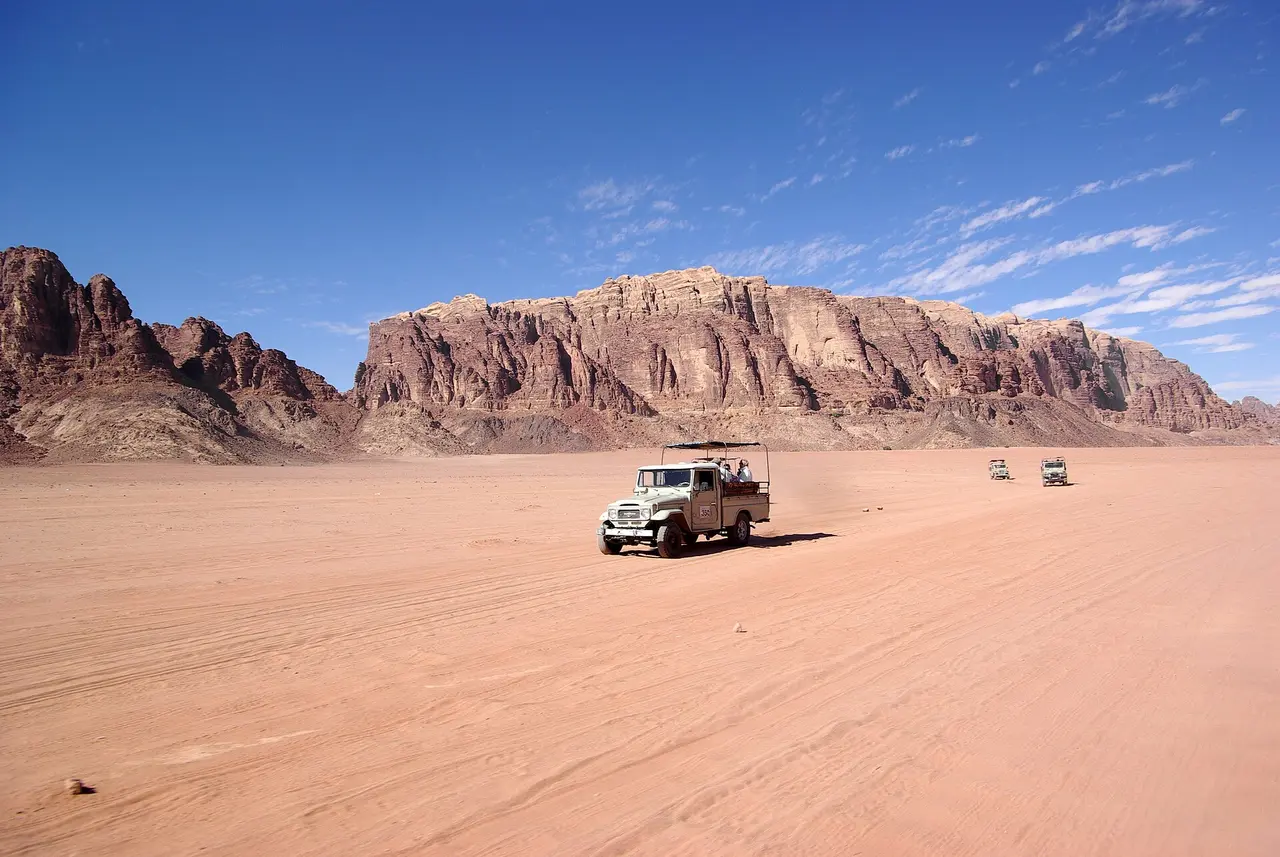
Tours in converted pick-ups last from two hours to a full day. Half a day covers the classics of the northern area: Lawrence's Spring, a red sand dune, a canyon with inscriptions and small rock bridges. A full day adds the more distant southern zones, with Burdah arch seen from below and the great sunset panoramas. Agree on the duration, the list of stops and whether a meal is included before setting off: rates vary widely from one camp to another.

Hiking and climbing

Wadi Rum ranks among the most renowned climbing and trekking terrains in the Middle East. The ascent of Jabal Umm ad Dami, Jordan's highest peak at about 1,850 metres, takes two to three hours there and back from a 4x4 drop-off near the Saudi border. Burdah bridge requires an hour's climb with a few easy scrambling passages. For these outings, as for multi-day crossings on foot or by camel, a local guide is essential: landmarks are scarce, and so is water.

Camp nights and seasons

Sleeping on site is the main draw: Bedouin tents, solid-walled rooms or transparent domes for stargazing, with dinner often a zarb cooked under the sand. March to May and October to November are ideal. In summer, temperatures frequently exceed 35 °C in the afternoon; in winter, nights can drop close to 0 °C. One night is enough for a first taste, two for hiking. The desert fits naturally into a loop around southern Jordan, between Petra and the Dead Sea.

Getting there

Airports serving Wadi Rum, from main hubs to secondary ones.
  • ADJMarka International (Amman Civil) AirportAmmanMain
  • AMMQueen Alia International AirportAmmanMain
  • AQJKing Hussein International AirportAqabaMain

Practical information for Wadi Rum

Entry and guides

Tickets at the visitor centre, included in the Jordan Pass. Excursions run with local Bedouin guides; book your camp ahead to fix the price.

Safety

Wadi Rum is under heightened vigilance, but the city of Aqaba and its surroundings have been advised against except for essential travel since July 2026: arrive via Petra or Amman rather than Aqaba airport.

Cold nights

From November to March, pack a fleece, a hat and warm clothes: the gap between afternoon and night temperatures is very marked.

Mobile signal

Coverage is patchy depending on the area. Download maps and tickets in advance and let someone know before heading into the desert.

Cash

Bring dinars: many camps and guides do not take cards, and withdrawing money on site is unreliable.

Ramadan

Camps stay open, but meal times and village life change. Avoid eating and drinking in public during the day in the village.

Wadi Rum in pictures

Photo credits : Berthold Werner, CC BY-SA 3.0, Wikimedia Commons ; Vyacheslav Argenberg, CC BY 4.0, Wikimedia Commons ; Niels Elgaard Larsen - (WT-en) Elgaard at English Wikivoyage, CC BY-SA 4.0, Wikimedia Commons

Frequently asked questions about Wadi Rum

Is one night in Wadi Rum enough?
Yes for a first taste: arrive around noon, take a 4x4 tour in the afternoon, watch the sunset, sleep at camp and catch the sunrise. Add a second night for a full-day tour, the climb to Burdah bridge or Jabal Umm ad Dami.
How do you choose a camp in Wadi Rum?
Camps range from simple Bedouin tents to domes with private bathrooms. Check the location, as some sit on the edge of the village, and what is included: transfer from Rum, dinner, tour. Recent reviews are more reliable than photos.
Can you drive a rental car into Wadi Rum?
Not beyond Rum village: the tracks are reserved for local guides' vehicles, and soft sand easily traps a regular car. Leave your vehicle in the village or camp car park, as the 4x4 transfer is usually arranged.
Which films were shot in Wadi Rum?
Lawrence of Arabia in the 1960s, then many science fiction productions, including The Martian and Dune, which used its red sands to stand in for other planets. Some guides offer tours around the filming locations.
Can Wadi Rum be done as a day trip from Petra?
Yes, about two hours by road separate the two sites, and a half-day tour is possible. But the desert truly reveals itself in the evening and at dawn: a night on site changes the experience completely. Leave Petra in the morning and head off the next day.
Is Wadi Rum's sky good for stargazing?
Yes, far from the cities, the sky is very dark. The best nights fall around the new moon, with no moonlight to wash out the Milky Way. Some camps set up telescopes or run observation sessions after dinner.

Plan your trip to Wadi Rum

Build your day-by-day itinerary and manage budget, bookings and packing in PlanTripNow.
Aperçu de l'application PlanTripNow