Skip to content

Visit Agra : what to see around the Taj Mahal in one or two days

Capital of the Mughal empire in the sixteenth and seventeenth centuries, Agra stretches along the Yamuna in Uttar Pradesh. The Taj Mahal faces Akbar's red sandstone fort, while inlaid marble tombs and the city of Fatehpur Sikri round off a short but rich stop.

At a glance

Visa
Required
Tourist stay of up to 90 days
7-day budget
€392
Per person, comfort profile, excluding international flights.

Why stop in Agra?

Agra is a city in Uttar Pradesh, about 200 km south-east of New Delhi, and one of the three stops on the Golden Triangle. It holds three UNESCO-listed sites: the Taj Mahal, Agra Fort and Fatehpur Sikri. One day is enough for the Taj and the fort, two to add Fatehpur Sikri.

When to visit Agra

Temperatures, rainfall and crowds month by month, to pick your window.
When to visit Agra
MonthTemperaturesRainCrowdsVerdict
January8 to 22 °C1 dBusyMild days but frequent dawn fog: the Taj can stay veiled until late morning.
February10 to 26 °C1 dBusyThe ideal month: 25 °C in the afternoon, the mists gone and the Taj Mahotsav at Shilpgram, near the east gate.
March15 to 32 °C1 dModerateDry skies and Holi in town; from mid-March the marble terrace heats up quickly after 11 am.
April21 to 38 °C1 dQuiet38 °C by day: the Taj at opening time, the fort before noon, then shelter in the shade until evening.
May25 to 42 °C2 dVery quietBest avoided: over 41 °C, and the Taj's marble terrace turns scorching by late morning.
June27 to 41 °C3 dVery quietThe hottest month, with 27 °C nights before the monsoon arrives: only the big hotels cut their rates.
July26 to 36 °C10 dQuietMonsoon showers and sticky heat; the Taj reflected in the full pools makes up for the grey skies.
August25 to 33 °C11 dQuietThe wettest month, over 200 mm: the Yamuna rises below the fort and hotels stay cheap.
September24 to 34 °C7 dQuietThe monsoon fades and the sky clears at times: a fair compromise for tight budgets.
October19 to 34 °C1 dBusyDry weather and 18 °C nights return; high season begins and the Taj Ganj hotels fill up.
November13 to 29 °C0 dPackedA rain-free month with golden light, but pollution peaks around Diwali: keep an eye on the air quality index.
December8 to 24 °C1 dPackedHoliday crowds and 8 °C mornings; from mid-December fog often delays trains from Delhi.
Source: Moyennes climatiques de climatestotravel.com (normales 1981-2010) recoupées avec weather2travel.com, moyenne des deux sources par mois arrondie au dixième, relevé du 9 novembre 2026 ; température moyenne = moyenne du minimum et du maximum. Jours de pluie : jours avec au moins 1 mm de précipitations. Ville de l'intérieur, sur la Yamuna, sans température de mer. Mousson de juillet à septembre ; affluence et prix estimés d'après la haute saison touristique d'octobre à mars, le brouillard d'hiver de mi-décembre à janvier, le Taj Mahotsav de février et la fermeture du Taj Mahal le vendredi.

Five visits not to miss in Agra

Five Mughal monuments, three of them UNESCO-listed, that fit into two well-planned days.

Taj Mahal

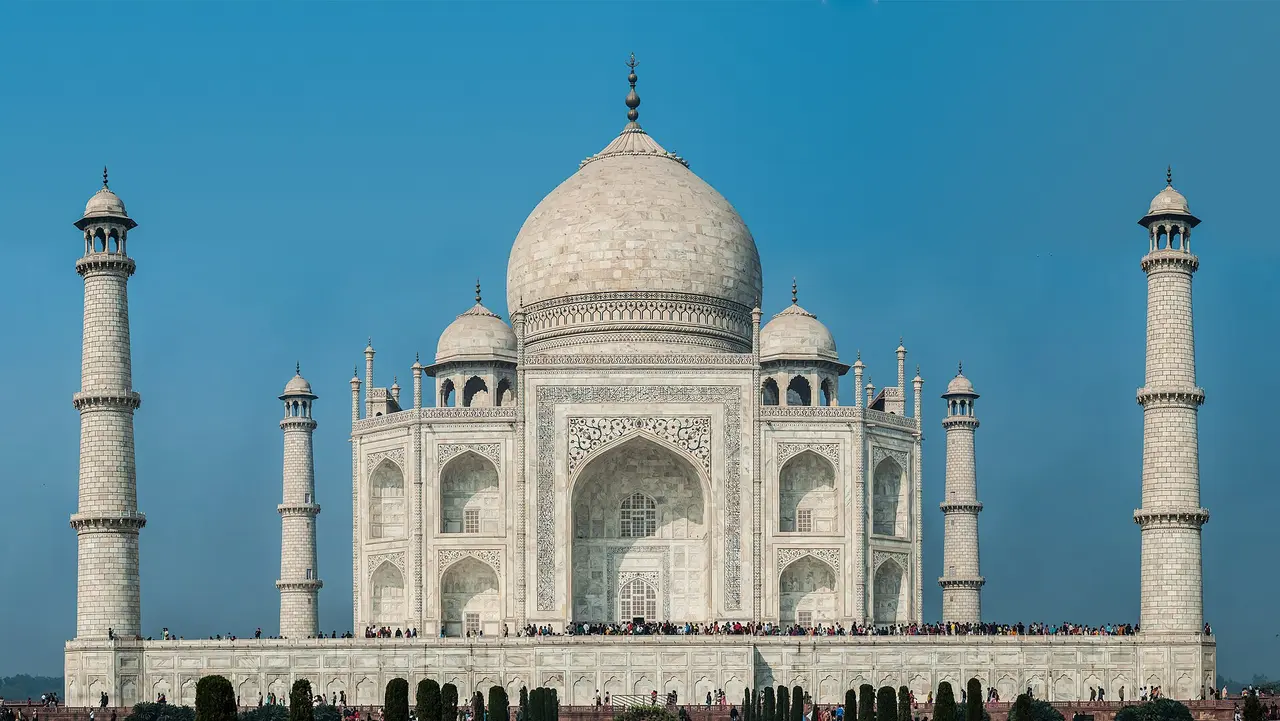
A white marble mausoleum built by Shah Jahan for his wife Mumtaz Mahal, UNESCO-listed in 1983, best seen at opening time when the stone takes on a pinkish glow.

Agra Fort

A red sandstone fortress rebuilt by Akbar from 1565, where Shah Jahan spent his last years as a captive, gazing at the Taj from the Musamman Burj pavilion.

Itimad-ud-Daulah

Nicknamed the Baby Taj, this 1620s tomb on the Yamuna foreshadows the Taj with its marble inlaid with semi-precious stones, set in a far quieter garden.

Fatehpur Sikri

Akbar's short-lived capital, built in the 1570s west of Agra, with its great mosque, red sandstone palaces and the monumental Buland Darwaza gateway.

Akbar's Tomb

The emperor's mausoleum at Sikandra, on the northern edge of the city, blending red sandstone and marble in a vast garden roamed by antelope and deer.

What to discover in Agra?

Taj Ganj, the quarter at the foot of the mausoleum

South of the Taj Mahal, Taj Ganj grew out of the building site itself: its lanes housed the craftsmen who raised the mausoleum from 1632 onwards. Today they are packed with guesthouses, rooftop restaurants and marble inlay workshops, the parchin kari inherited from the Mughals. Staying here puts you at the east or west gate at opening time, half an hour before sunrise, when the marble turns pink and the crowds are still thin. Petrol and diesel vehicles are banned within 500 metres of the monument: the last stretch is on foot, by electric shuttle or by buggy.

The east bank of the Yamuna, tombs and gardens

Opposite the Taj, the left bank of the Yamuna takes half a day, by rickshaw across the road bridge. The tomb of Itimad-ud-Daulah, completed around 1628 for the father of Empress Nur Jahan, was the first in Agra to use white marble inlaid with semi-precious stones. A little further north, Chini ka Rauza keeps fragments of Persian-style glazed tilework. End at the Mehtab Bagh garden, aligned on the axis of the mausoleum: at sunset the Taj appears across the water, without the crush of the main terrace.

One day or two, between Delhi and Jaipur

Agra is under two hours from New Delhi on the Gatimaan Express train, or about three hours by road on the Yamuna Expressway. Many travellers do it as a day trip, but a night in town lets you see the Taj at dawn and again at sunset. With a second day, head for Fatehpur Sikri, some forty kilometres west, on the road to the Pink City. Eastwards, an overnight train takes you to the ghats of Varanasi, the other great stop in northern India.

How much it costs

Per person per day, excluding international travel.
Budget
19 €/ day
1 606 € for 2 people, 7 days, return flights included
Accommodation
5 €
Food
7 €
Local transport
2 €
Sights and activities
5 €
Comfort
56 €/ day
2 124 € for 2 people, 7 days, return flights included
Accommodation
24 €
Food
14 €
Local transport
8 €
Sights and activities
10 €
Premium
145 €/ day
3 370 € for 2 people, 7 days, return flights included
Accommodation
60 €
Food
35 €
Local transport
22 €
Sights and activities
28 €
Prices checked: Relevé du 9 novembre 2026, haute saison. Taux de référence BCE du 9 novembre 2026 : 1 € = 105,14 INR. Repas, transports et taxi : Numbeo Agra, mise à jour du 8 novembre 2026, 311 relevés de 17 contributeurs sur 12 mois, échantillon modeste (repas bon marché 2,86 €, dîner de milieu de gamme pour deux 14,28 €, ticket de transport local 0,14 €, taxi 0,29 € de prise en charge puis 0,19 €/km). Hébergement : lits en dortoir de 3 à 7 € dans les auberges de Taj Ganj (Hostelworld, prix d'appel relevés le 9 novembre 2026) ; hôtels relevés par HotelsCombined (mise à jour du 5 novembre 2026) : 3 étoiles à 25 £, 4 étoiles entre 38 et 51 £ la nuit, l'Oberoi Amarvilas à 571 £ ; ces comparateurs ne sont pas des sources officielles. Monuments, tarifs étrangers officiels (tajmahal.gov.in, consulté le 9 novembre 2026) : Taj Mahal 1 100 INR + 200 INR pour le mausolée, fort d'Agra 650 INR, Fatehpur Sikri 610 INR, Itimad-ud-Daulah et tombeau d'Akbar 310 INR, Mehtab Bagh 300 INR, visite de nuit du Taj 750 INR. Activités premium (guide privé) et transport premium (voiture avec chauffeur, Fatehpur Sikri compris) : estimations calculées à partir de ces tarifs, sans source directe. Vol A/R Paris-New Delhi estimé à 670 € par personne (momondo, prix habituel 565 à 775 €, données du 8 novembre 2026, vols directs Air France et Air India) ; aucun vol direct Paris-Agra, l'accès final se fait en train ou par la route depuis Delhi. Hébergement par nuit et par personne : lit en dortoir pour backpacker, chambre double partagée à deux pour comfort et premium. weekTwoPax = 7 jours x 2 personnes + 2 vols.

Getting there

Airports serving Agra, from main hubs to secondary ones.
  • AGRAgra Airport / Agra Air Force StationAgraSecondary
  • AGXAgatti AirportAgattiSecondary
  • AHAMaa Mahamaya AirportAmbikapurSecondary
  • AJLLengpui AirportAizawlSecondary
  • AKDAkola AirportAkolaSecondary
  • AYJMaharshi Valmiki International AirportFaizabadSecondary

Entry, health and safety

For FR travellers

Entry requirements

Visa required

Visa obligatoire pour l'Inde, y compris pour une simple étape à Agra : un voyageur sans visa ou e-visa valide est refoulé. Les Français demandent un e-visa touristique sur indianvisaonline.gov.in, entre 4 et 120 jours avant le départ (4 à 30 jours pour le visa de 30 jours). Tarif officiel pour la France : 25 $ pour 30 jours de juillet à mars, 10 $ d'avril à juin, 40 $ pour 1 an et 200 $ pour 5 ans, plus 3 % de frais bancaires (grille consultée le 9 novembre 2026). Les visas de 1 et 5 ans sont limités à 90 jours par séjour et 180 jours par an civil. Depuis le 1er octobre 2025, l'e-Arrival Card se remplit en ligne dans les 72 heures avant le vol.

Stay allowed for up to 90 days.

Passport valid for 6 months beyond your return date.

Health

Required: Aucun vaccin obligatoire en provenance directe de France. Fièvre jaune exigée pour les voyageurs arrivant d'une zone d'endémie amarile.

Advised: Calendrier vaccinal à jour (diphtérie, tétanos, coqueluche, rougeole), hépatites A et B, fièvre typhoïde ; selon la durée et les conditions du séjour : méningite ACWY, rage, encéphalite japonaise, dengue et chikungunya.

Dengue présente en Inde, sans traitement curatif ; paludisme en recul dans les grandes villes mais jamais nul pendant la mousson, de juin à septembre : protection contre les moustiques indispensable. Rage très présente : consulter immédiatement après une morsure ou une griffure, même si la vaccination est à jour.Ne boire que de l'eau en bouteille ou capsulée. Pollution de l'air forte en hiver dans les villes du nord, avec des pics autour de Diwali : masque FFP2 lors des pics. Agra n'est pas en zone déconseillée ; France Diplomatie signale toutefois que la majorité des vols signalés à l'ambassade ont lieu dans les trains, notamment entre Agra, Varanasi et Calcutta : gardez vos bagages attachés. Passeport valable au moins 6 mois après la fin du visa, avec deux pages vierges.

Safety

Increased caution

Emergency

112

Checked in novembre 2026 against the official source. Entry rules change: check the official source before you travel, it alone is authoritative.

Practical information for Agra

Friday closure

The Taj Mahal is closed to visitors on Fridays, a day of prayer at the site's mosque. Agra Fort stays open: check the Archaeological Survey of India website before fixing your itinerary.

Taj opening hours

Opens half an hour before sunrise and closes half an hour before sunset. Queues grow from mid-morning.

Tickets

Foreign adult: INR 1,100, ASI and Agra Development Authority fees included, plus INR 200 to enter the main mausoleum. Free under 15, INR 50 off online. The electric shuttle is included with this ticket.

Banned items

Food, tobacco, lighters and large bags are refused at the Taj entrance; lockers are available near the gates. A small bottle of water is allowed.

Night viewing

Five nights a month, the full moon night and the two either side of it, except Fridays and during Ramadan. 30-minute slots between 8 pm and midnight, 50 people at most, booked on the ASI portal.

Winter fog

From mid-December to January, thick fog often hides the Taj at dawn and delays trains from Delhi: leave yourself some slack in the morning.

Inlaid marble

Taj Ganj workshops sell both genuine pieces and dyed-stone imitations: buy because you like it, never to resell, and avoid shops a guide steers you to.

Agra in pictures

Photo credits : Asitjain, CC BY-SA 3.0, Wikimedia Commons ; :en:Aks khandelwal ( talk | contribs ), Public domain, Wikimedia Commons ; Darshanadakane, CC BY-SA 3.0, Wikimedia Commons ; Philip Nalangan, CC BY 4.0, Wikimedia Commons ; Rohit Sharma, CC BY-SA 4.0, Wikimedia Commons ; Marcin Białek, CC BY-SA 3.0, Wikimedia Commons

Frequently asked questions about Agra

What to do in Agra if you arrive on a Friday, when the Taj Mahal is closed?
Spend the day at Agra Fort, the Baby Taj and Akbar's Tomb at Sikandra, then go to Mehtab Bagh in the late afternoon: the garden faces the Taj across the Yamuna. Keep the mausoleum itself for Saturday at opening time.
Taj Mahal at sunrise or sunset?
Sunrise, without hesitation: the gates open half an hour before the sun, crowds are still small and the marble shifts from grey to pink. Sunset is better enjoyed from Mehtab Bagh or a Taj Ganj rooftop, without going through security again.
Is the supplement to enter the Taj mausoleum worth it?
For a first visit, yes. It gives access to the central chamber, where the cenotaphs of Mumtaz Mahal and Shah Jahan lie behind a pierced marble screen. The actual graves are in a crypt closed to the public, just below.
Is a day trip to Agra from Delhi reasonable?
It can be done with the morning Gatimaan Express, which takes under two hours, but the day is short for both the Taj and the fort. A night in Taj Ganj spares you the dawn departure from Delhi and lets you see the mausoleum in two different lights.
How do you get to Fatehpur Sikri from Agra?
By taxi or car with driver, allow about an hour for some forty kilometres. The most efficient option is to stop there on the way to Jaipur, with your luggage in the car: two to three hours are enough for the mosque and the palaces.
What to eat in Agra besides petha?
Petha, a translucent ash gourd sweet, is the speciality people take home. In the morning, stalls serve bedai, a fried bread with potato curry, followed by jalebi. In the evening Mughlai cooking takes over, with its creamy curries and kebabs.
Is night viewing at the Taj Mahal worth it?
Its appeal is mostly rarity: five nights a month at best, in small groups and for half an hour. You view the Taj from a distance, without approaching the mausoleum. With a clear sky and a full moon the marble glows; in haze, it is hardly worth it.

Plan your trip to Agra

Build your day-by-day itinerary and manage budget, bookings and packing in PlanTripNow.
Aperçu de l'application PlanTripNow