Skip to content

Visit Berlin : what to see, when to go and what it costs

Split in two for twenty-eight years, Berlin tells the story of the twentieth century on every corner, from the Reichstag to Bernauer Strasse. Yet the German capital also means five UNESCO-listed museums, districts that come alive at night, lakes for summer swimming and prices that remain gentle.

At a glance

Visa
None
Tourist stay of up to 90 days
7-day budget
€1,071
Per person, comfort profile, excluding international flights.
Recommended length
3 days
For a first trip, without rushing.

Why visit Berlin?

Berlin is the capital and largest city of Germany, with about 3.9 million inhabitants. Divided by the Wall from 1961 to 1989, it keeps traces of the Cold War, UNESCO-listed Museum Island and an intense cultural life, on a smaller budget than Paris or London.

When to visit Berlin

Temperatures, rainfall and crowds month by month, to pick your window.
When to visit Berlin
MonthTemperaturesRainCrowdsVerdict
January-2 to 3 °C10 dVery quietGrey skies, two hours of sunshine a day and night frost: the month for Museum Island without queues and the cheapest hotels of the year.
February-2 to 5 °C8 dModerateStill cold, but the Berlinale fills cinemas and hotels around Potsdamer Platz for ten days in mid-February.
March0 to 9 °C9 dQuietA still-chilly end of winter; the ITB trade fair in early March pushes prices up for a week, the rest of the month stays quiet.
April4 to 15 °C6 dModerateThe driest month: cherry trees bloom along the former Wall strip, though Easter brings plenty of European visitors.
May8 to 20 °C8 dBusyBeer gardens open, long evenings and the Carnival of Cultures in Kreuzberg at Pentecost: one of the best periods, book early.
June12 to 23 °C9 dBusyDaylight until 10 pm, Fête de la Musique on the 21st and swimming in the Grunewald lakes; late-day thunderstorms are possible.
July14 to 25 °C9 dPackedPeak crowds and the wettest month by volume: short showers, packed Tempelhof and Spree banks, lodging at its priciest.
August14 to 25 °C8 dPackedStill very busy, with heat spikes in flats without air conditioning; the Long Night of Museums livens up the end of the month.
September10 to 20 °C8 dBusyIdeal mild weather for cycling, but the Berlin Marathon in late September saturates hotels for a weekend.
October6 to 14 °C8 dModerateGolden leaves in the Tiergarten and monuments lit up during the Festival of Lights; nights turn noticeably cooler.
November2 to 8 °C8 dQuietThe low point of the year, grey and short, except 9 November marking the fall of the Wall; Christmas markets open late in the month.
December-1 to 4 °C10 dBusyChristmas markets at Gendarmenmarkt and Charlottenburg, then New Year's Eve at the Brandenburg Gate: damp cold, rising prices.
Source: Moyennes mensuelles climatestotravel.com (Berlin : moyenne annuelle 9,8 °C, 535 mm, 1730 h de soleil), relevé octobre 2026, cohérentes avec les normales 1991-2020 de l'Umweltatlas Berlin. Jours de pluie = jours avec au moins 1 mm. Pas de température de mer : ville continentale, sans façade maritime.

Berlin's must-sees

Nine places to grasp the city, between memory and neighbourhood life.

Brandenburg Gate

Symbol of division then reunification, best seen at dawn when Pariser Platz is empty.

Reichstag dome

A spiral ramp above the Bundestag chamber, free but bookable online only.

Bernauer Strasse Memorial

The only stretch of Wall preserved with its death strip and watchtower.

East Side Gallery

1.3 kilometres of Wall covered in murals along the Spree, best explored on foot.

Neues Museum

The bust of Nefertiti and the Egyptian collections, on Museum Island.

Memorial to the Murdered Jews of Europe

2,711 concrete stelae to walk through, plus an underground information centre.

Tempelhofer Feld

The runways of the former airport, handed over to cyclists, picnics and kites.

Charlottenburg Palace

The baroque palace of the Prussian kings and its gardens, in the west of the city.

Sanssouci in Potsdam

Frederick the Great's summer palace and its vineyard terraces, under an hour away.

What to discover in Berlin?

From the Reichstag to Alexanderplatz

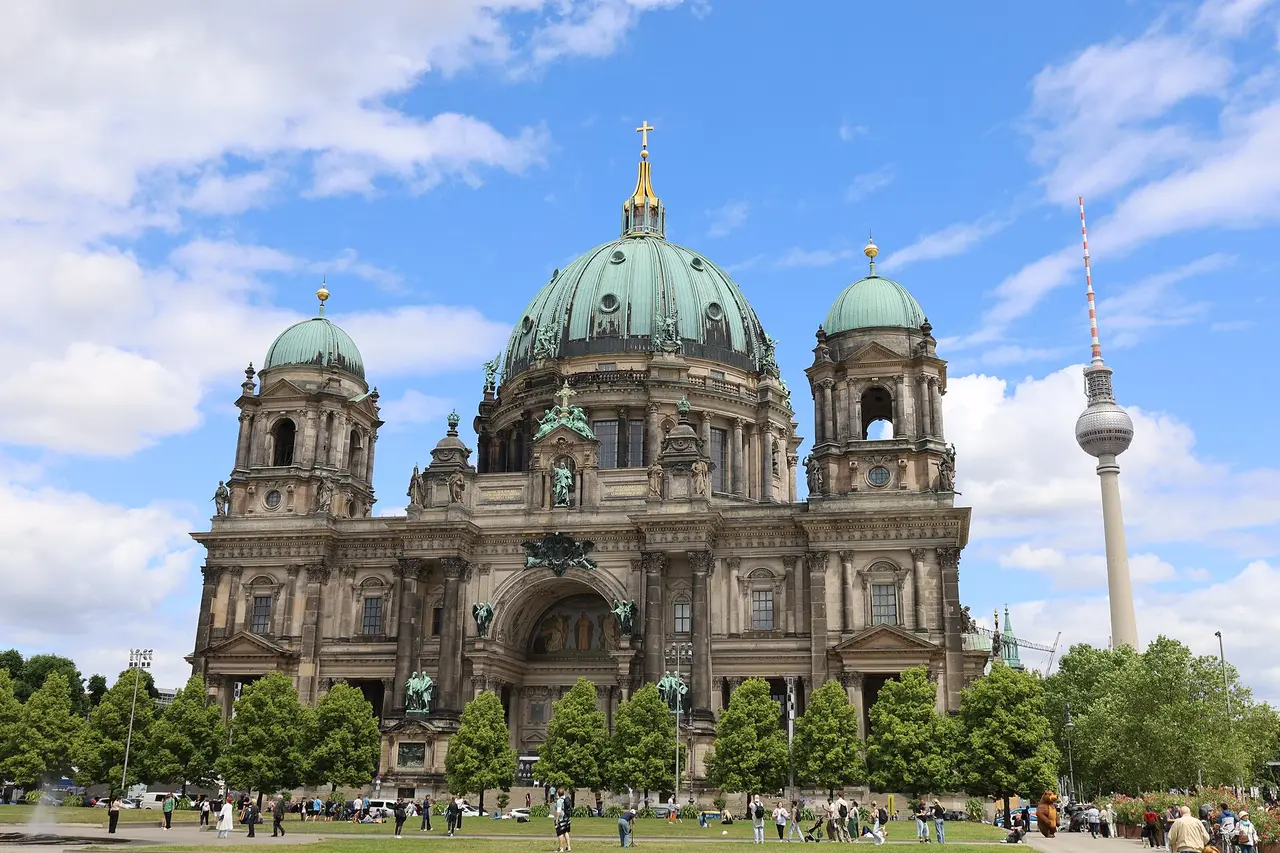
The historic axis can be walked in a single day. The Brandenburg Gate opens onto Unter den Linden, the linden-lined avenue flanked by embassies and Humboldt University. Close by, the Reichstag houses the Bundestag: its glass dome is free to visit, but only with an online booking, several days ahead in summer. The avenue then leads to the cathedral, Alexanderplatz and its 368-metre TV Tower, a legacy of East Berlin whose platform offers the best view over the city.

On the trail of the Wall

Only a few stretches of the Wall remain, but they are enough to grasp the division. The Bernauer Strasse Memorial preserves a complete death strip with its watchtower, and a documentation centre tells the story of the tunnel escapes. At Checkpoint Charlie, the rebuilt guardhouse draws crowds; the nearby, free Topography of Terror traces the Nazi apparatus on the former Gestapo site. Along the Spree, the East Side Gallery lines up 1.3 kilometres of murals painted in 1990 by artists from around the world.

Museum Island and the great collections

In the middle of the Spree, five museums form a World Heritage ensemble. The Neues Museum displays the bust of Nefertiti, the Altes Museum Greek and Roman antiquities, the Alte Nationalgalerie nineteenth-century painting. The Pergamon Museum remains largely closed for renovation: check before planning a day around it. A combined ticket covers several buildings, and half a day per museum is not excessive. Elsewhere, the Jewish Museum in Kreuzberg, designed by Daniel Libeskind, is worth the trip on its own.

Kreuzberg, Neukölln and Friedrichshain

The Berlin that goes out at night lives in the east and south. Kreuzberg mixes the Landwehr Canal, Turkish markets and neighbourhood bars; neighbouring Neukölln has taken over with its cafés and vintage shops. Between the two, former Tempelhof airport has become a vast park where people cycle on the runways. Friedrichshain, across the Spree, is home to the most famous clubs, with selective door policies and parties lasting until Monday morning.

The west: Charlottenburg and the Kurfürstendamm

Former West Berlin has kept a more upmarket feel. Charlottenburg Palace, the summer residence of the Prussian kings, opens onto a baroque garden extended by an English-style park. The Kurfürstendamm, a grand shopping avenue, starts at the Memorial Church, whose ruined spire was kept as it stood after the bombing. At the far end, the KaDeWe department store and its food hall deserve a detour, even if you buy nothing.

Lakes, forests and Potsdam

Berlin is a city of water and greenery: nearly a third of its area is covered by forests, parks or lakes. In summer, Berliners swim at the Wannsee or in the small Grunewald lakes, reachable by S-Bahn. The Teufelsberg, an artificial hill topped by a former American listening station, offers a striking panorama. Less than an hour away, Potsdam unfolds the gardens and palace of Sanssouci, once home to Frederick the Great, an easy day trip with an ABC zone ticket.

Sample itineraries

Three routes built around the time you actually have.
3daysRecommended

Berlin in 3 days: the centre, Kreuzberg and the palaces of Potsdam

  1. Day 1: from the Brandenburg Gate to Alexanderplatz
  2. Day 2: Kreuzberg, Neukölln and Tempelhof
  3. Day 3: day trip to Potsdam and Sanssouci

Best for: A route that blends the historic capital, neighbourhood life south of the Spree and an escape to the royal gardens of Potsdam, under an hour away by S-Bahn.

How much it costs

Per person per day, excluding international travel.
Budget
66 €/ day
1 164 € for 2 people, 7 days, return flights included
Accommodation
28 €
Food
22 €
Local transport
8 €
Sights and activities
8 €
Comfort
153 €/ day
2 382 € for 2 people, 7 days, return flights included
Accommodation
69 €
Food
48 €
Local transport
11 €
Sights and activities
25 €
Premium
325 €/ day
4 790 € for 2 people, 7 days, return flights included
Accommodation
150 €
Food
90 €
Local transport
30 €
Sights and activities
55 €
Prices checked: Relevé octobre 2026. Repas et taxis : Numbeo Berlin, mise à jour du 5 octobre 2026 (menu bon marché 15 €, dîner de milieu de gamme pour deux 70 €, bière 0,5 l 4,85 €, taxi 4,65 € de prise en charge puis 2,80 €/km). Transports : tarifs VBB au 1er janvier 2026 (ticket simple AB 4,00 €, carnet de 4 trajets 12,40 €, ticket 24 h AB 11,20 €). Hébergement : lit en dortoir de 22 à 35 € la nuit en 2026 (Hostelz, guide des auberges de Berlin) ; hôtel 3 étoiles à 138 € la nuit en moyenne (combien-coute.net d'après hotels.com, septembre 2026). Hébergement par personne : dortoir pour backpacker, chambre double partagée à deux pour comfort et premium. Vol A/R Paris-Berlin estimé à 120 € par personne hors juillet-août (Où et Quand 2026 : moyenne annuelle 119 €, 110 € en septembre, 95 € en février). Activités estimées d'après les tarifs d'entrée des musées et visites guidées ; plusieurs mémoriaux (Mur, Holocauste, coupole du Reichstag sur réservation) sont gratuits. Hors Berlinale, marathon et réveillon, où l'hébergement peut doubler.

Getting there

Airports serving Berlin, from main hubs to secondary ones.
  • BERBerlin Brandenburg AirportBerlinMain
  • BREBremen AirportBremenMain
  • CGNCologne Bonn AirportKölnMain
  • DRSDresden AirportDresdenMain
  • DTMDortmund AirportDortmundMain
  • DUSDüsseldorf AirportDüsseldorfMain

Entry, health and safety

For FR travellers

Entry requirements

No visa for a tourist stay

Libre circulation au sein de l'Union européenne : aucun visa. Entrée avec un passeport valide ou une carte nationale d'identité, ancienne ou nouvelle ; un passeport français périmé depuis moins de 5 ans est aussi accepté entre la France et l'Allemagne. Au-delà de 3 mois, déclaration de résidence obligatoire auprès de la mairie d'arrondissement (Bürgeramt).

Stay allowed for up to 90 days.

Health

Advised: Mise à jour des vaccinations du calendrier français (diphtérie, tétanos, poliomyélite, coqueluche, rougeole). L'encéphalite à tiques ne concerne surtout que les zones boisées du sud du pays, pas un séjour urbain à Berlin.

Depuis mai 2025, des contrôles d'identité peuvent avoir lieu à l'arrivée, y compris en avion et en train : gardez votre pièce d'identité sur vous. Vigilance normale, mais vols à la tire fréquents dans les zones touristiques, les gares centrales et les grands aéroports. Carte européenne d'assurance maladie recommandée. Ambassade de France : Pariser Platz 5, à côté de la porte de Brandebourg.

Safety

Normal precautions

Emergency

112

Checked in octobre 2026 against the official source. Entry rules change: check the official source before you travel, it alone is authoritative.

Practical information for Berlin

Currency

Euro. Cards are now accepted almost everywhere, but keep some cash for small cafés and markets.

Time zone

Central European Time, one hour ahead of London (UTC+1, UTC+2 in summer).

Transport

U-Bahn, S-Bahn, tram and bus: AB single ticket €4.00, 4-trip ticket €12.40, 24-hour ticket €11.20.

Airport

Berlin Brandenburg (BER), linked to the centre in about thirty minutes by regional train or S-Bahn, with an ABC ticket.

From Paris

About 1 h 45 direct flight, return around €120 outside summer; also reachable by ICE or night train.

Documents

EU citizens need an ID card or passport; identity checks at German borders have been in place since May 2025.

Sunday

Most shops close on Sundays: shop the day before, while museums and flea markets stay open.

Emergencies

112 for ambulance and fire, 110 for police.

Berlin in pictures

Photo credits : Roy Zuo, CC BY-SA 4.0, Wikimedia Commons ; א (Aleph) Creator: Johann Gottfried Schadow, CC BY-SA 2.5, Wikimedia Commons ; Ank Kumar, CC BY-SA 4.0, Wikimedia Commons ; Ввласенко, CC BY-SA 3.0, Wikimedia Commons ; Dietmar Rabich, CC BY-SA 4.0, Wikimedia Commons

Frequently asked questions about Berlin

How many days do you need to visit Berlin?
Two days are enough for the historic centre and the main Wall sites. With three days you add Kreuzberg and a day trip to Potsdam; with four, Charlottenburg and the Grunewald lakes, at a far more relaxed and comfortable pace.
When is the best time to visit Berlin?
May, June and September bring 19 to 23 °C in the daytime, open beer gardens and still reasonable crowds. July and August are the busiest and most expensive months, and winter remains cold and grey despite the Christmas markets.
How much does a trip to Berlin cost?
Allow about €66 a day per person staying in a dorm, €153 in comfort with a double room in a three-star hotel, and €325 for premium. For a week for two, add a return flight from Paris of about €120 per person.
Can you visit the Reichstag for free?
Yes, access to the dome and roof terrace is free, but you must book online with the Bundestag and show ID at the entrance. In summer, slots go several days ahead, so book as soon as your dates are set.
What is left of the Berlin Wall?
Only a few stretches: the Bernauer Strasse Memorial, the most complete, the mural-covered East Side Gallery and sections near the Topography of Terror. A double row of cobblestones also marks its former route through the streets of the centre.
Which transport ticket should you buy in Berlin?
For the city, zone AB is enough: single ticket €4.00, 24-hour ticket €11.20. Switch to zone ABC for BER airport and Potsdam. Always validate your ticket before boarding, as checks are frequent and fines are steep.
Is Berlin a safe city?
The alert level is normal. The main risk is pickpocketing in tourist areas, main stations, crowded transport and at major events. Keep your documents and payment cards separate and stay alert at night around certain stations.
Do you need a visa to visit Berlin?
Not for EU citizens: Germany is part of the European Union and the Schengen area. A valid ID card or passport is enough. Other nationalities should check Schengen rules before travelling, and keep their documents on them, as checks take place on arrival.

Plan your trip to Berlin

Build your day-by-day itinerary and manage budget, bookings and packing in PlanTripNow.
Aperçu de l'application PlanTripNow