Skip to content

Visiting Brussels : Grand-Place, Art Nouveau and neighbourhoods

A Gothic square trimmed with gold, Art Nouveau facades with flowing plant-like curves, comic-strip murals around street corners and cafés pouring gueuze as they have for generations: Brussels is best explored district by district, on foot and by tram. Allow two to three days for the essentials.

Why visit Brussels?

Brussels packs into a compact centre a Grand-Place listed by UNESCO since 1998, Victor Horta's Art Nouveau town houses, also listed, and major museums such as the Royal Museums of Fine Arts. Just 1 hr 20 from Paris by train, it is also the most convenient base for day trips to the Flemish cities.

Brussels must-sees

Monuments, museums and addresses that sum up the capital, most of them less than 20 minutes from the Grand-Place.

Grand-Place

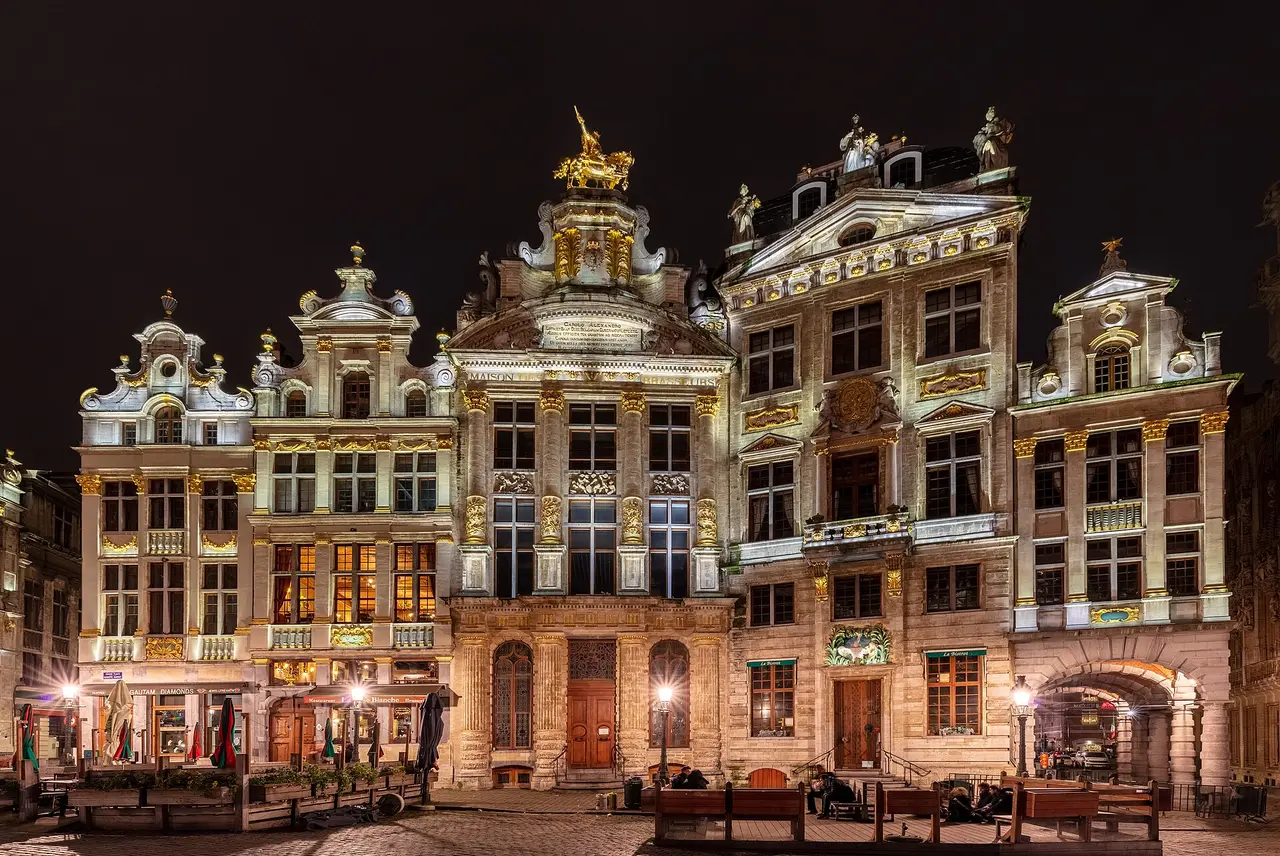
A Gothic town hall, gilded guild houses and the King's House form a UNESCO-listed ensemble, best seen by day and again once illuminated after nightfall.

Royal Saint-Hubert Galleries

A covered arcade opened in 1847, among the first in Europe, with chocolatiers, bookshops, a cinema and a theatre under a bright glass roof about 200 metres long.

Manneken Pis

A small bronze statue five minutes from the Grand-Place, regularly dressed in costumes donated from around the world, whose wardrobe is displayed at the nearby GardeRobe museum.

Atomium

A giant iron molecule built for the 1958 World's Fair, several of whose spheres are open to visitors, the highest offering a panorama over the whole city.

Magritte Museum

Part of the Royal Museums of Fine Arts, it holds a large collection of paintings, drawings and documents by the surrealist painter across several levels on Place Royale.

Horta Museum

Victor Horta's UNESCO-listed house and studio in Saint-Gilles, where staircase, skylight and furniture form one of the most accomplished showcases of Art Nouveau.

Belgian Comic Strip Center

Housed in a former textile store designed by Horta, it traces the history of Belgian comics, from Tintin to the Smurfs, with a well-stocked bookshop.

St Michael and St Gudula Cathedral

A large Gothic church with twin white towers, venue for royal weddings and funerals, whose 16th-century stained glass and Romanesque crypt are open to visitors.

Cantillon Brewery

A family brewery in Anderlecht making lambic, gueuze and kriek by spontaneous fermentation, with a self-guided tour of the vats and lofts followed by a tasting.

Parlamentarium

The European Parliament's free, interactive and multilingual visitor centre, explaining in one to two hours how the institutions work and how the Union was built.

What to see in Brussels, neighbourhood by neighbourhood?

The historic Pentagon and the Îlot Sacré

The heart of the city lies inside the Pentagon, the former line of the ramparts now replaced by the inner ring road. The Îlot Sacré, around the Grand-Place, is a web of narrow lanes, restaurants and the Toone puppet theatre. The Saint-Hubert galleries, opened in 1847, link the area to the cathedral in five minutes. Visit the Grand-Place twice: early in the morning, before 10 am, when it is almost empty, and after dark, when the guild houses are lit. Skip the tout-led restaurants on Rue des Bouchers, known for high prices and average food. This is the showcase of the capital of Belgium.

Mont des Arts and Coudenberg

On the hill rising towards Place Royale stand the major institutions: the Royal Museums of Fine Arts, with Bruegel, Rubens and the Magritte Museum, the Musical Instruments Museum in the former Old England department store and, beneath Place Royale, the archaeological remains of Coudenberg Palace. Allow at least half a day, and note that most of these museums close on Mondays. The Royal Palace opens its state rooms to the public only in summer, from late July to early September. The Mont des Arts garden offers one of the best free views of the town hall spire.

The Marolles and the Sablon

Two neighbouring worlds. The working-class Marolles host the Place du Jeu de Balle flea market every morning: arrive before 9 am if you are serious about bargain hunting, as the best pieces go early. A free public lift links the district to the forecourt of the Palace of Justice, with views as far as the Koekelberg basilica. The Sablon, just above, belongs to antique dealers and chocolatiers, with an antiques market on Saturdays and Sundays around the Notre-Dame du Sablon church. One morning is enough to walk between the two.

Saint-Gilles and Ixelles, the Art Nouveau quarter

South of the centre, 15 minutes by tram, these two municipalities hold a large share of the city's Art Nouveau facades. Victor Horta's house and studio, on Rue Américaine, can be visited with a timed booking and closes on Mondays. Strolling around Place Châtelain, Avenue Louise and the Ixelles ponds, you will spot sgraffito, wrought iron and stained glass still in place. In the evening, Place Flagey and its ocean-liner style former broadcasting building are the meeting point, while the African district of Matongé, near Porte de Namur, is ideal for a Congolese or Cameroonian dinner.

Sainte-Catherine and the Dansaert district

North-west of the Bourse, the old harbour basins filled in during the 19th century have become long esplanades lined with fish restaurants and stalls selling shrimp croquettes. Nearby Rue Antoine Dansaert gathers Belgian designer boutiques, bookshops and cafés. The Saint-Géry halls, a former covered market, are a landmark at aperitif time. It is a good area to stay: the Grand-Place is ten minutes away on foot, yet you stay clear of the tour group crowds. On Friday and Saturday nights, the terraces stay lively until late.

The European Quarter and the Cinquantenaire

Around the Schuman roundabout, on metro lines 1 and 5, stand the Berlaymont, seat of the Commission, and the European Parliament. The Parlamentarium and the House of European History are free and explain European integration in about two hours. Further east, the Cinquantenaire park and its great arch, completed in 1905, house three museums: Art & History, Autoworld and the Army Museum, whose terrace on top of the arch is open to visitors. On weekdays the area is busy and administrative; at weekends it becomes surprisingly quiet, perfect for the park.

Heysel and Laeken, the royal north

About 20 minutes from the centre on metro line 6, the Heysel plateau keeps the legacy of the 1958 World's Fair, including the 102-metre Atomium and the Mini-Europe miniature park. The neighbouring royal estate of Laeken is home to the Royal Greenhouses, a late 19th-century masterpiece of glass and iron, open to the public for only three weeks each spring, usually between April and May: watch for the dates and book as soon as they are announced. Allow half a day for the area, aiming for the Atomium at opening time.

Getting there

Airports serving Brussels, from main hubs to secondary ones.
  • BRUBrussels AirportZaventemMain
  • CRLBrussels South Charleroi AirportCharleroiMain
  • OSTOstend-Bruges International AirportOostendeMain
  • ANRAntwerp International Airport (Deurne)AntwerpSecondary
  • KJKKortrijk-Wevelgem International AirportWevelgemSecondary
  • LGGLiège AirportGrâce-HollogneSecondary

Practical information for Brussels

Arriving by train

Eurostar and TGV link Paris to Brussels-Midi in about 1 hr 20, and London in about 2 hours. The metro then reaches the centre in a few minutes.

Two airports

Brussels Airport, in Zaventem, is 15 to 20 minutes from Central Station by train. Charleroi, used by low-cost airlines, is about an hour away by shuttle bus.

Bilingual city

French and Dutch are both official: street and station names are shown in both languages. English is widely spoken.

Museum closing day

Most major museums close on Mondays. Plan that day around the neighbourhoods, markets and the Atomium, which opens daily.

Brussels Card

A 24, 48 or 72-hour pass covering a wide range of museums, with an optional transport add-on. Worth it from three or four visits a day.

Metro, tram and bus

The STIB network accepts contactless bank card payment directly at the validators, with no need to buy a ticket beforehand.

Driving and low emission zone

The whole Brussels region is a low emission zone: foreign-registered vehicles must be registered online before entering.

Restaurant tipping

Service is included in prices. Rounding up the bill or leaving a few euros for good service is appreciated but not expected.

Tap water

Safe to drink everywhere. Restaurants mostly serve bottled water, though, and a free jug of tap water is not always offered.

Power sockets

Type E, 230 V, as in France. Travellers from the UK or North America will need an adapter.

Sunday shopping

Most shops close on Sundays, except in the tourist centre. The Midi and Jeu de Balle markets liven up the morning instead.

Brussels in pictures

Photo credits : Diego Delso, CC BY-SA 4.0, Wikimedia Commons ; Trougnouf (Benoit Brummer), CC BY 4.0, Wikimedia Commons

Frequently asked questions about Brussels

Is the Manneken Pis really worth the detour?
The statue is small, about 55 cm, and often surrounded by crowds. It deserves five minutes on the way to the Grand-Place, ideally on a day when it wears one of its costumes. To understand the legend, the nearby GardeRobe MannekenPis museum displays part of its wardrobe.
Do you need to book the Horta Museum?
Yes. As the house is narrow, entry is by limited time slots and weekend places go quickly. Book online a few days ahead, remember it closes on Mondays and allow about an hour inside, followed by a stroll through the surrounding streets of Saint-Gilles.
Is a weekend in Brussels from Paris enough?
With a 1 hr 20 train ride to Brussels-Midi, two days cover the Grand-Place, the Mont des Arts, the Marolles and an Art Nouveau house. Add a third day for the Atomium, the Cinquantenaire or a trip to one of the Flemish cities.
When can you see the Grand-Place flower carpet?
The flower carpet, made of hundreds of thousands of begonias, covers the Grand-Place for a few days around 15 August, in even-numbered years only. The town hall balcony, for a fee, gives the best overall view of the design.
Where can you taste real gueuze in Brussels?
Gueuze is a blend of spontaneously fermented lambics unique to Brussels and the Senne valley. Cantillon Brewery, in Anderlecht, still makes it the traditional way and is open for visits. Several historic cafés in the centre also serve it.
Can you visit the Royal Palace in Brussels?
Yes, but only in summer: it opens its state rooms free of charge from late July, after the national day on 21 July, until early September. The rest of the year, you can only admire the facade and the Brussels Park opposite.
Which neighbourhood should you stay in?
Sainte-Catherine and Dansaert are central and lively without being overrun. The Sablon suits a quieter, more upmarket stay, while Ixelles and Saint-Gilles appeal to those wanting a lively area off the tourist trail, 15 minutes by tram from the Grand-Place.
Should you stay near Brussels-Midi when arriving by Eurostar?
There is no need: the metro reaches the centre in a few minutes. The Midi area is handy for a very early departure, but it is mainly functional and not very pleasant in the evening. Watch out for pickpockets in the busy station.
Can you visit Bruges or Ghent as a day trip from Brussels?
Yes, very easily: direct trains link Brussels to Ghent in about thirty minutes and to Bruges in about an hour, several times an hour. You can even combine both on a long day, starting with Bruges.

Plan your trip to Brussels

Build your day-by-day itinerary and manage budget, bookings and packing in PlanTripNow.
Aperçu de l'application PlanTripNow