Skip to content

Visit Budapest : what to see, when to go and what to budget

Split in two by the Danube, Budapest sets Castle Hill on the Buda side against the grand boulevards of Pest. You move from an Ottoman thermal bath to a ruin bar set in an abandoned building, on a budget that stays among the gentlest of Central Europe's capitals.

At a glance

Visa
None
Tourist stay of up to 90 days
7-day budget
€756
Per person, comfort profile, excluding international flights.
Recommended length
3 days
For a first trip, without rushing.

Why visit Budapest?

Budapest is the capital of Hungary, formed in 1873 by merging Buda, Óbuda and Pest. Its Danube banks, the Castle district and Andrássy Avenue are UNESCO World Heritage sites. The city has more than a hundred hot springs, hence its thermal baths, and a stay costs around €51 a day on a backpacker budget.

When to visit Budapest

Temperatures, rainfall and crowds month by month, to pick your window.
When to visit Budapest
MonthTemperaturesRainCrowdsVerdict
January-1 to 5 °C6 dVery quietFreezing nights and grey skies, but steaming open-air pools at Széchenyi and the year's lowest hotel rates.
February0 to 7 °C6 dQuietStill cold, with the Danube sometimes carrying ice; the Busójárás carnival in Mohács for the curious.
March4 to 12 °C6 dQuietThe thaw reopens the Margaret Island terraces, with the 15 March national holiday and its cockades.
April9 to 19 °C6 dModerateMild spring weather and the Buda hills in bloom, with prices climbing around Easter.
May13 to 23 °C8 dBusyOne of the best months for walking the riverbanks, despite a few late-afternoon thundery showers.
June16 to 27 °C7 dBusyLong evenings on the rooftops and museum night, as the heat settles over the plain.
July18 to 29 °C6 dPackedSpells above 30 °C and the Formula 1 Grand Prix at the Hungaroring: hotels snapped up, baths packed.
August18 to 29 °C6 dPackedSziget festival on Óbuda Island and the 20 August fireworks: a wild atmosphere and peak prices.
September13 to 23 °C6 dBusyAn ideal late summer: grape harvest and the wine festival at Buda Castle, with crowds clearly thinning.
October9 to 17 °C7 dModerateRusset Buda hills and golden light on Parliament, with prices easing after mid-October.
November4 to 11 °C7 dQuietFog over the Danube and short days, a quiet season until the Christmas markets open.
December0 to 5 °C7 dBusyChristmas markets on Vörösmarty tér and at the basilica, mulled wine and New Year push prices back up.
Source: Normales 1991-2020 de la station Budapest (OMM 12840, service météo hongrois HungaroMet), via le tableau climatique de Wikipédia, relevé octobre 2026. Jours de précipitations : jours avec au moins 1 mm. Ville continentale sans façade maritime : pas de température de mer.

Budapest's must-sees

Eight places that sum up both banks.

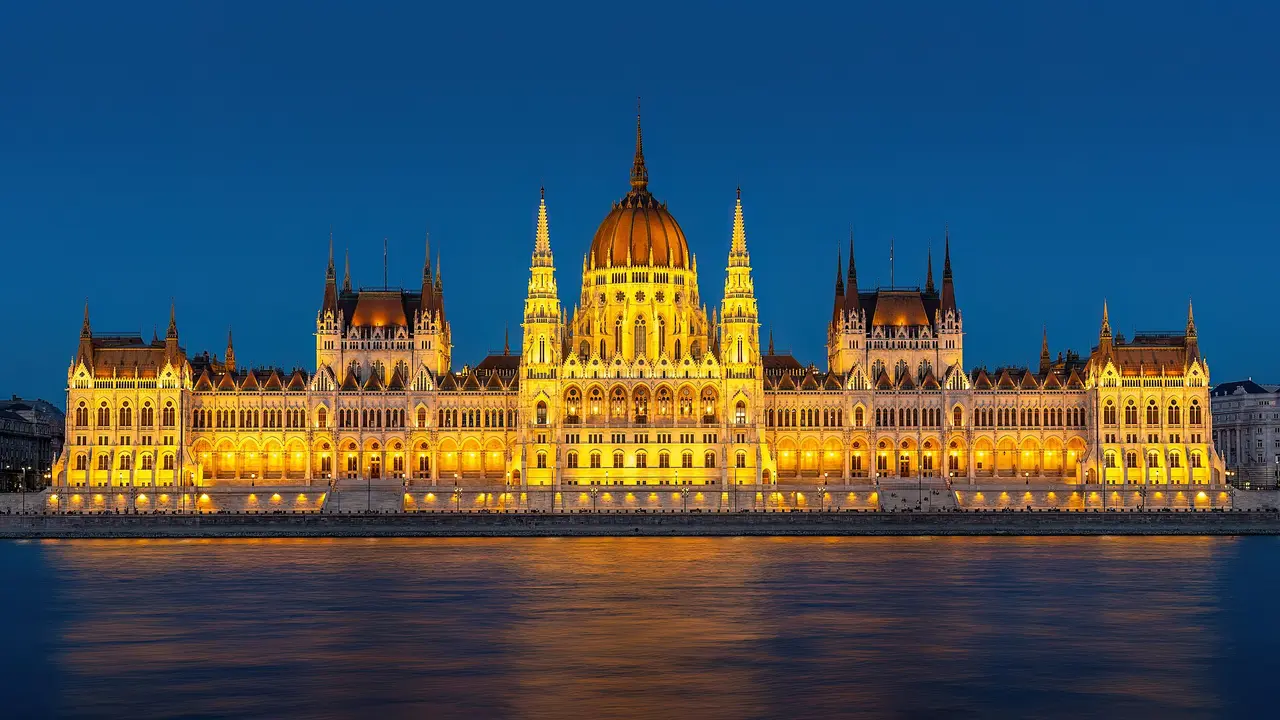
Hungarian Parliament

The country's largest building, neo-Gothic, visited with a guide on booking only.

Fishermen's Bastion

White terraces and turrets above Pest, best seen early in the morning.

Széchenyi Baths

Hot outdoor pools in the middle of City Park, open all year round.

Chain Bridge

The first permanent bridge between Buda and Pest, guarded by its stone lions.

Great Synagogue

Europe's largest synagogue, on Dohány Street in the heart of the Jewish quarter.

Great Market Hall

An iron roof over paprika, sausages and lángos on the ground floor.

Shoes on the Danube Bank

A memorial to the Jews shot on the embankment in 1944 and 1945, near Parliament.

House of Terror

A museum of the fascist and communist regimes on Andrássy Avenue.

What to discover in Budapest?

Buda, the hilly bank

On the west bank, Castle Hill holds medieval Budapest: Matthias Church with its glazed roof tiles, the white turrets of Fishermen's Bastion, and the royal palace that houses the National Gallery. Go up before 9 am, when the bastion terrace is still empty and free. Further south, Gellért Hill gives the widest view over the bridges and Parliament, best at the end of the day.

Pest and its grand avenues

The flat east bank is the nineteenth-century city. The neo-Gothic Parliament, completed in 1904, can only be visited with a guide on a slot booked online. St Stephen's Basilica lets you climb up under its dome, and Andrássy Avenue runs from the Opera to Heroes' Square above the oldest underground line in continental Europe. At night, the lit-up embankments are worth a walk on their own.

Thermal baths: picking yours

Széchenyi, in City Park, is the most spectacular, with outdoor pools steaming in winter; expect €25 to €35 to get in. Rudas, at the foot of Gellért Hill, keeps an octagonal pool from the Ottoman era. Lukács mostly draws locals. The Gellért Baths have been closed for works since October 2025 and will not reopen before 2028. Avoid Saturdays, bring swimwear and flip-flops, and book online to skip the queue.

The Jewish quarter and its ruin bars

The 7th district is home to the Dohány Street Great Synagogue, the largest in Europe, and its memorial garden. The same streets gave birth to ruin bars, set in derelict buildings furnished with odds and ends. Szimpla Kert, the best known, also hosts a farmers' market on Sunday mornings. Keep an eye on the bill: the French foreign ministry reports inflated tabs in some central bars.

Finding your way around

The BKK network of metro lines, trams and buses covers the whole city; a 24-hour pass costs about 2,500 forints, a little over €6. Tram 2, running along the Pest embankment, is a sightseeing ride in itself. You pay in forints, at roughly 400 forints to the euro, and cards are accepted almost everywhere. Avoid taxis hailed in the street and book through an app.

Day trips

Forty minutes away on the HÉV suburban train, Szentendre lines up colourful houses, Serbian churches and art museums. Visegrád, further north, looks down on the Danube Bend from its citadel. Without leaving the city, the Buda hills are reached by cog railway and then the Children's Railway, a forest line staffed by schoolchildren. Vienna, in Austria, is under three hours away by train to extend the trip.

Sample itineraries

Three routes built around the time you actually have.
3daysRecommended

Budapest in 3 days: Jewish quarter, City Park and Óbuda

  1. Day 1: Jewish quarter and ruin bars
  2. Day 2: Andrássy Avenue and Széchenyi Baths
  3. Day 3: Óbuda, Aquincum and Margaret Island

Best for: Three days that skip the castle tour in favour of neighbourhood life: synagogues and ruin bars in the 7th district, Széchenyi Baths and Andrássy Avenue, then the Roman ruins of Aquincum to the north. A more local stay, done by tram and on foot.

How much it costs

Per person per day, excluding international travel.
Budget
51 €/ day
1 014 € for 2 people, 7 days, return flights included
Accommodation
18 €
Food
18 €
Local transport
5 €
Sights and activities
10 €
Comfort
108 €/ day
1 812 € for 2 people, 7 days, return flights included
Accommodation
45 €
Food
35 €
Local transport
8 €
Sights and activities
20 €
Premium
260 €/ day
3 940 € for 2 people, 7 days, return flights included
Accommodation
130 €
Food
70 €
Local transport
20 €
Sights and activities
40 €
Prices checked: Relevé octobre 2026 (1 € = environ 400 HUF). Coûts locaux d'après budapest-trip.com, guide du budget quotidien 2026 (dortoir 12-18 €, hôtel 3 étoiles 35-55 € par personne en chambre double, 4 étoiles 55-90 €, dîner local 5-9 €, dîner avec vin 18-28 €, pass transport 24 h à 2 500 HUF soit 6,25 €, bains Széchenyi 25-35 €, visite du Parlement 15-20 €) et Radical Storage 2026 (backpacker 45-75 €/jour, milieu de gamme 90-160 €). Vol A/R Paris-Budapest estimé à 150 € par personne : liligo.fr, moyenne de 154 € sur les trois derniers mois, et ou-et-quand.net, 115 à 133 € en octobre-novembre, 168 € en août. Hébergement par nuit et par personne : lit en dortoir pour backpacker, chambre double partagée à deux pour comfort et premium. Hors haute saison (juillet-août, Grand Prix de F1, Sziget, décembre).

Getting there

Airports serving Budapest, from main hubs to secondary ones.
  • BUDBudapest Liszt Ferenc International AirportBudapestMain
  • DEBDebrecen International AirportDebrecenMain
  • PEVPécs-Pogány International AirportPécsMain
  • QGYGyőr-Pér AirportGyőrSecondary
  • SOBHévíz–Balaton AirportSármellékSecondary

Entry, health and safety

For FR travellers

Entry requirements

No visa for a tourist stay

Aucun visa. La Hongrie est membre de l'Union européenne et de l'espace Schengen : les Français entrent avec une carte nationale d'identité ou un passeport en cours de validité. Au-delà de trois mois, une carte de séjour doit être demandée auprès de l'Office national de l'immigration. Les CNI délivrées entre 2004 et 2013 et prolongées de cinq ans peuvent poser problème aux contrôles : un passeport valide est préférable.

Stay allowed for up to 90 days.

Health

Advised: Vaccinations du calendrier français à jour (diphtérie, tétanos, poliomyélite, coqueluche, rougeole) ; selon les conditions du séjour, hépatite A, rage (surtout pour les jeunes enfants en zone rurale) et encéphalite à tiques pour les séjours en zone rurale ou forestière.

Encéphalite à tiques et maladie de Lyme présentes dans les forêts, notamment autour du lac Balaton : vêtements couvrants et répulsif en randonnée. Penser à la carte européenne d'assurance maladie. À Budapest, vigilance contre les pickpockets dans les transports, sur les sites touristiques et dans les bains thermaux, ainsi que contre les additions disproportionnées dans certains bars du centre et les taxis non officiels. Ambassade de France : +36 1 374 11 00.

Safety

Normal precautions

Emergency

112

Checked in octobre 2026 against the official source. Entry rules change: check the official source before you travel, it alone is authoritative.

Practical information for Budapest

Currency

The Hungarian forint (HUF), about 400 HUF to €1; the euro is not the local currency.

Documents

Valid ID card or passport for EU citizens, Hungary being in the Schengen area.

Transport

BKK 24-hour pass at about 2,500 HUF, valid on metro, trams, buses and urban HÉV trains.

Daily budget

About €51 per person as a backpacker, €108 in comfort and €260 at the top end, excluding flights.

Flight from Paris

About 2 h 10 direct, around €150 return outside peak season.

Thermal baths

Swimwear required, flip-flops advised; Gellért closed for works until 2028 at least.

Emergencies

European number 112; French embassy on +36 1 374 11 00.

Budapest in pictures

Photo credits : Pierre Blaché, CC0, Wikimedia Commons ; Ermell, CC BY-SA 4.0, Wikimedia Commons ; Wilfredor, CC0, Wikimedia Commons ; Slyronit, CC BY-SA 4.0, Wikimedia Commons ; P. Hughes, CC BY 4.0, Wikimedia Commons

Frequently asked questions about Budapest

How many days should you spend in Budapest?
Two days are enough for Castle Hill, Parliament and one thermal bath. Three days add the Jewish quarter, Andrássy Avenue and Óbuda. With four days you can head out to Szentendre and the Danube Bend.
When is the best time to visit Budapest?
May, June and September bring 23 to 27 °C by day without the July and August crowds, when the Formula 1 Grand Prix and the Sziget festival push prices up. Winter is cold, around 5 °C, but ideal for the outdoor baths.
How much does a week in Budapest cost?
For two people, allow about €1,000 as backpackers, €1,800 in comfort and €3,900 at the top end, including a return flight from Paris. Daily spending is around €51 per person in a dorm and €108 in a mid-range hotel.
Which thermal bath should you choose in Budapest?
Széchenyi for its outdoor pools and atmosphere, Rudas for its Ottoman pool and rooftop terrace, Lukács for a more local feel. The Gellért Baths have been closed for a long renovation since October 2025, so do not plan on them before 2028.
Do you need a passport to visit Budapest?
Not if you hold a valid national ID card from an EU country, as Hungary is in the European Union and the Schengen area. The French foreign ministry still advises a passport if your ID card was extended by five years, to avoid trouble at checks.
Can you pay in euros in Budapest?
Some tourist shops accept euros, but at a poor rate. It is better to pay by card in forints, widely accepted, or withdraw from a bank ATM while declining the conversion the machine offers. Expect roughly 400 forints to the euro.
Is Budapest a safe city?
Yes, Hungary is rated normal vigilance and crime is low. The main risks are pickpockets on public transport and in the baths, inflated bills in some central bars and unlicensed taxis. Book your taxis through an app rather than in the street.
How do you get from the airport to central Budapest?
The 100E express bus links Liszt Ferenc airport to central Pest in around forty minutes, with a dedicated ticket. A taxi booked by app costs about €15 to €25 according to the budapest-trip.com guide, and stays handy late at night.

Plan your trip to Budapest

Build your day-by-day itinerary and manage budget, bookings and packing in PlanTripNow.
Aperçu de l'application PlanTripNow