Skip to content

Planning a trip to Cusco : altitude, Machu Picchu and the Sacred Valley

Inca walls beneath baroque churches, the cobbled lanes of San Blas, markets where you sip coca tea: Cusco is best discovered slowly, at 3,400 m. After two days of acclimatisation, the city opens the road to the Sacred Valley, the coloured peaks of Vinicunca and Machu Picchu.

At a glance

Visa
None
Tourist stay of up to 90 days
7-day budget
€588
Per person, comfort profile, excluding international flights.
Recommended length
3 days
For a first trip, without rushing.

Do you really have to go through Cusco for Machu Picchu?

In practice, yes: Cusco airport is where almost every Machu Picchu visitor arrives, before continuing through the Sacred Valley and taking the train from Ollantaytambo to Aguas Calientes. The former capital of the Inca Empire is a UNESCO World Heritage Site and deserves at least two days of its own.

When to visit Cusco

Temperatures, rainfall and crowds month by month, to pick your window.
When to visit Cusco
MonthTemperaturesRainCrowdsVerdict
January8 to 20 °C19 dQuietThe wettest month: showers almost every afternoon, muddy trails and frequently clouded views at Machu Picchu.
February8 to 20 °C15 dVery quietThe Inca Trail is closed all month and rain is frequent, but hotels are at their cheapest and ruins almost empty.
March8 to 20 °C13 dQuietThe rainy season winds down: the Sacred Valley is lush green, pack a poncho for the afternoons.
April6 to 21 °C9 dModerateDry weather returns and Holy Week fills the Plaza de Armas: book early if Easter falls in April.
May4 to 21 °C2 dBusyThe best compromise: clear skies, still-green countryside and Machu Picchu tickets easier to get than in July.
June2 to 21 °C1 dPackedInti Raymi on 24 June: the city is fully booked and prices soar, with nights close to 0 °C.
July1 to 20 °C1 dPackedThe driest month and the coldest nights, in peak season: book Machu Picchu tickets weeks ahead.
August3 to 21 °C2 dPackedStill packed with European summer holidays; freezing dawns on the road to Rainbow Mountain.
September5 to 22 °C5 dBusyMilder nights and thinning crowds after the summer holidays: a very good window for hiking.
October7 to 22 °C9 dModerateFirst late-day showers, but clear mornings for Sacsayhuamán and the Sacred Valley.
November8 to 22 °C13 dQuietThe warmest month by day, at the start of the rainy season: sightsee in the morning, prices drop.
December8 to 21 °C16 dModerateRegular rain, but the Christmas market on the Plaza de Armas and the year-end holidays fill the city.
Source: Normales 1991-2020 de Cusco d'après climatestotravel.com (minimales, maximales, moyennes, jours de pluie), relevé octobre 2026. Ville à environ 3 400 m d'altitude, sans mer : écart jour-nuit de 12 à 19 °C, saison des pluies de novembre à mars, saison sèche de mai à septembre. France Diplomatie (fiche Pérou du 21 septembre 2026) signale inondations et glissements de terrain dans les zones de montagne pendant la saison des pluies. Affluence et prix estimés d'après le calendrier local (Semaine sainte, Inti Raymi le 24 juin, fermeture annuelle du Chemin de l'Inca en février) et les vacances scolaires françaises.

Cusco's must-sees

From the Inca sites in town to the peaks of the cordillera, the reasons to make the trip.

Machu Picchu

The Inca citadel set between two peaks, reached by train then bus from Aguas Calientes, on a named, time-slotted ticket booked well in advance.

Qorikancha

The former Sun temple, whose perfectly cut Inca walls now support the Dominican convent of Santo Domingo, right in the heart of the city.

Sacsayhuamán

A fortress with zigzag walls built from giant blocks, overlooking the city and hosting the Inti Raymi re-enactment every 24 June.

Twelve-angled stone

A diorite block set into a wall on Hatunrumiyoc street, a symbol of Inca stonemasons' skill, a short walk from the cathedral.

Rainbow Mountain

The striped slopes of Vinicunca, at about 5,000 m, reached after a pre-dawn start and a gruelling hike best left to acclimatised travellers.

Pisac terraces

Stepped fields and a hilltop citadel above the village of Pisac, whose craft market marks the start of the descent into the Sacred Valley.

Ollantaytambo fortress

Monumental terraces and an unfinished temple above a still-inhabited Inca village, where most trains to Aguas Calientes depart.

Moray and Maras

Concentric farming circles dug into the plateau and thousands of salt pools worked in terraces since pre-Hispanic times.

San Pedro market

A large hall where lunch is a set menu for a few soles, between fruit juice counters, round loaves and stalls of Andean potatoes.

What to see in and around Cusco?

The first two days at 3,400 m

Most travellers fly into Cusco from Lima, at sea level, and feel the altitude as soon as they leave the plane: shortness of breath, headaches, restless sleep. France Diplomatie advises acclimatising gradually, drinking plenty and avoiding alcohol and heavy meals. Keep the first day for flat walking around the Plaza de Armas and save Rainbow Mountain, at about 5,000 m, for day three at the earliest. Sleeping first in the lower Sacred Valley is an effective alternative.

The Inca-colonial centre around the Plaza de Armas

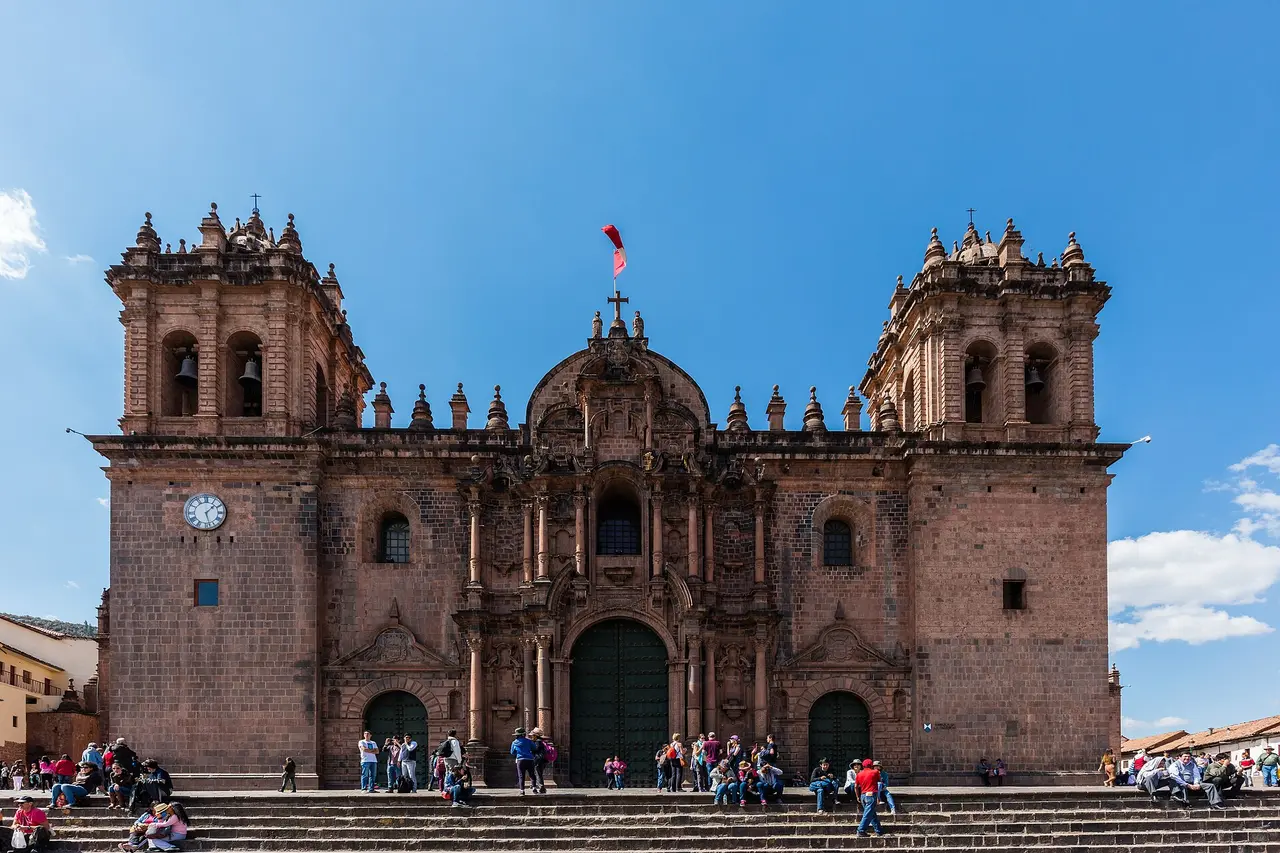
The Spanish built their churches on Inca foundations, and that blend is the heart of the city: the cathedral and the Compañía church facing each other on the Plaza de Armas, the Santo Domingo convent resting on the walls of the Sun temple, Hatunrumiyoc street and its blocks fitted without mortar. It all fits into half a day on foot. Ignore the touts on the square and take an official or app-booked taxi rather than hailing one in the street.

San Blas, the artisans' quarter

Five minutes from the Plaza de Armas, but a hundred or so steps higher, San Blas lines up altarpiece workshops, cafés and small guesthouses in lanes too narrow for cars. It is the most pleasant area to stay if you can handle the slopes, with dorm beds from €4 to €17 a night according to Hostelworld in October 2026. Climb to the viewpoint on San Blas square in late afternoon, when low light sweeps across the tiled roofs.

The hills of circuit I of the boleto turístico

Above the city, Sacsayhuamán, Q'enqo, Puka Pukara and Tambomachay make up circuit I of the boleto turístico. The full ticket, 130 soles for ten days, also covers the downtown museums and the Sacred Valley sites; the partial ticket for this circuit alone costs 70 soles. The easiest approach is to take a taxi up to Tambomachay and walk back down towards the city, allowing half a day. Qorikancha and the cathedral have their own tickets.

The Sacred Valley from Cusco

The Urubamba valley can be covered in a day from Cusco or, better, on the way down to Machu Picchu. Pisac and its terraces in the morning, Ollantaytambo and its fortress in the afternoon, or the loop across the Chinchero plateau, Moray and the Maras salt pans. The Inca sites are covered by circuit III of the boleto turístico, sold for 70 soles for two days as a partial ticket. Bring warm layers: the plateau stays cold in the morning even in the dry season.

Tickets, quotas and trains to the citadel

Entry to Machu Picchu is by named ticket, with a fixed circuit and entry time, bought online on the Ministry of Culture platform and shown with your passport. Daily quotas fill up weeks ahead from June to August. The train links Ollantaytambo to Aguas Calientes in 1 h 30 to 2 h according to PeruRail, then a bus climbs to the citadel. The site combines well with the rest of Peru's southern Andes: Lake Titicaca, Arequipa and the Colca Canyon.

When to go and how much to budget

The dry season, from May to September, brings clear skies but nights close to 0 °C in July; from November to March it rains almost every afternoon and the Inca Trail closes in February. Allow about €35 per person per day in hostels and set lunches, €84 in a 3-star hotel and €205 in upscale comfort, flights excluded. Cusco fits well into a longer journey across South America, between Bolivia and the Pacific coast.

Sample itineraries

Three routes built around the time you actually have.
3daysRecommended

Cusco in 3 days: the historic centre, Pisac, Ollantaytambo and Machu Picchu

  1. Day 1: the Plaza de Armas, Qorikancha and San Blas
  2. Day 2: Pisac, Ollantaytambo and the train to Aguas Calientes · 1 nights
  3. Day 3: Machu Picchu and back to Cusco

Best for: The most requested format: a day in town, a descent through the Sacred Valley and Machu Picchu on the morning of day three. The hilltop ruins above Cusco are left out. The Machu Picchu ticket, named and time-slotted, is booked before anything else.

How much it costs

Per person per day, excluding international travel.
Budget
35 €/ day
2 490 € for 2 people, 7 days, return flights included
Accommodation
9 €
Food
10 €
Local transport
2 €
Sights and activities
14 €
Comfort
84 €/ day
3 176 € for 2 people, 7 days, return flights included
Accommodation
31 €
Food
20 €
Local transport
8 €
Sights and activities
25 €
Premium
205 €/ day
4 870 € for 2 people, 7 days, return flights included
Accommodation
70 €
Food
50 €
Local transport
25 €
Sights and activities
60 €
Prices checked: Relevé octobre 2026. Taux Wise du 12 octobre 2026 : 1 € = 3,86 soles, 1 £ = 1,18 €. Repas et transports d'après Numbeo Cusco (mise à jour du 3 octobre 2026, échantillon réduit de 24 relevés : menu bon marché 1,82 €, dîner pour deux 18,24 €, bus 0,26 €, taxi 1,56 € puis 1,69 €/km). Dortoirs de 4 à 17 € la nuit, environ 9 € en moyenne (Hostelworld, octobre 2026). Hôtels : moyenne annuelle 52 £ la chambre en 3 étoiles, 99 £ en 4 étoiles, 142 £ en 5 étoiles (HotelsCombined, prix mis à jour le 9 octobre 2026). Activités lissées sur une semaine : Machu Picchu 152 soles plus 11 soles de redevance SERNANP depuis mai 2026, soit 163 soles (environ 42 €), d'après eltiempo.pe du 5 février 2026, source de presse non officielle à recouper sur tuboleto.cultura.pe ; boleto turístico intégral 130 soles, 10 jours (tarifaire officiel COSITUC, consulté octobre 2026) ; excursion Rainbow Mountain en groupe vers 49 USD (theonlyperuguide.com, novembre 2025, source plus ancienne et non officielle). Le train vers Aguas Calientes n'est pas inclus, faute de tarif officiel relevé. Vol A/R Paris-Cusco via Lima estimé à 1 000 € par personne (PartirOu, statistiques du 11 octobre 2026 : moyenne 1 180 €, plus bas 937 €, prix jugé attractif vers 950 €). Hébergement par nuit et par personne : lit en dortoir pour backpacker, chambre double partagée à deux pour comfort et premium. Prix hors juin-août et Inti Raymi ; sol sensible au change, budget à revérifier d'ici quelques mois.

Getting there

Airports serving Cusco, from main hubs to secondary ones.
  • AQPRodríguez Ballón International AirportArequipaMain
  • CIXCapitán FAP José A. Quiñones González International AirportChiclayoMain
  • CUZAlejandro Velasco Astete International AirportCuscoMain
  • IQTCoronel FAP Francisco Secada Vignetta International AirportIquitosMain
  • JULInca Manco Capac International AirportJuliacaMain
  • LIMJorge Chávez International AirportLimaMain

Entry, health and safety

For FR travellers

Entry requirements

No visa for a tourist stay

Pas de visa pour un séjour touristique de moins de trois mois au Pérou. La durée accordée va de 1 à 90 jours sur une période de 183 jours ; un dépassement entraîne une amende de 4,40 soles par jour. Depuis le 29 mai 2023, les vols internationaux arrivant à Cusco ou Lima ne donnent plus lieu à un tampon : l'entrée est enregistrée dans le système électronique TAM. Par voie terrestre, le tampon reste obligatoire.

Stay allowed for up to 90 days.

Passport valid for 6 months beyond your return date.

Health

Advised: Être à jour du calendrier vaccinal français, rougeole comprise (hausse des cas signalée en mars 2026). Fièvre jaune vivement recommandée pour l'Amazonie, à prévoir si le séjour à Cusco se prolonge vers la forêt. Selon la durée et les conditions : hépatites A et B, typhoïde, rage.

À environ 3 400 m, Cusco expose au mal aigu des montagnes : acclimatation progressive, pas plus de 400 m de dénivelé entre deux nuits au-dessus de 2 500 m, hydratation, pas d'alcool ni de repas copieux. En cas de symptômes, redescendre au moins sous 4 000 m et consulter. Haute altitude déconseillée aux enfants et contre-indiquée en cas de grossesse ou d'antécédents cardiaques, pulmonaires, neurologiques ou rénaux. Pas de paludisme au-dessus de 2 000 m, donc ni à Cusco ni au Machu Picchu. Pluies, inondations et glissements de terrain en saison humide dans la région de Cusco (alerte du 10 septembre 2026). Randonnées avec un guide expérimenté ; ne pas héler de taxi dans la rue, préférer les compagnies officielles ou les applications. Le VRAEM (centre du pays) et la frontière amazonienne avec la Colombie sont formellement déconseillés ; Abancay et la Cordillère Azul sont déconseillées sauf raison impérative.

Safety

Increased caution

Emergency

105

Checked in octobre 2026 against the official source. Entry rules change: check the official source before you travel, it alone is authoritative.

Practical information for Cusco

Altitude

About 3,400 m: 1 to 2 days of acclimatisation before any exertion

Machu Picchu ticket

Named, fixed circuit and time, passport required at the entrance

Boleto turístico

130 soles for the full ticket (10 days, 3 circuits), 70 soles per partial circuit

Coca tea

Served in most hotels, it does not replace a gradual ascent

Taxis

Official companies or apps, do not hail in the street

Rainy season

November to March, with landslide risk on the roads

Currency

Peruvian sol (PEN), about 3.86 soles to €1 in October 2026

Cusco in pictures

Photo credits : Diego Delso, CC BY-SA 4.0, Wikimedia Commons ; Ursula Paulina Uriarte Espejo, CC BY-SA 4.0, Wikimedia Commons ; Yifan Wang, CC BY 2.0, Wikimedia Commons

Frequently asked questions about Cusco

How long does it take to acclimatise in Cusco before Machu Picchu?
Allow at least one to two days at a slow pace before any exertion. Machu Picchu, at around 2,400 m, is lower than Cusco: you can go down to sleep in the Sacred Valley from day two, which makes adjusting easier before climbing back up.
Where do you buy Machu Picchu tickets and how far ahead?
On the Ministry of Culture's official platform, tuboleto.cultura.pe. Tickets are named and tied to a circuit and an entry time. From June to August, book several weeks ahead; tickets sold on the spot in Aguas Calientes are only valid for the following day.
Does Cusco's boleto turístico include Machu Picchu or Qorikancha?
No. The full boleto turístico, 130 soles for ten days, covers Sacsayhuamán, Sacred Valley sites such as Pisac, Ollantaytambo and Moray, and several museums. Machu Picchu, Qorikancha and the cathedral are paid separately.
Is Rainbow Mountain risky for altitude sickness?
It tops out around 5,000 m, well above Cusco. Only attempt it after two days of acclimatisation and with a guide. France Diplomatie advises descending to at least below 4,000 m as soon as serious symptoms appear, then seeing a doctor.
Is it better to sleep in Cusco or in the Sacred Valley?
Sleeping in Ollantaytambo or Urubamba, a few hundred metres lower, improves sleep and puts you closer to the train to Aguas Calientes. Cusco remains more practical for the city sites, restaurants and excursions to Vinicunca.
Can you visit Cusco during the rainy season?
Yes, with lower prices and fewer people, but it rains almost every afternoon from December to March. The Inca Trail closes in February and mountain roads can be cut by landslides: keep a spare day in your schedule.
Is the San Blas district a good place to stay?
Yes for its charm, cafés and relative calm, five minutes from the Plaza de Armas. But the lanes climb steeply: at 3,400 m, in the first days, stairs with luggage quickly leave you breathless. Travellers sensitive to altitude will prefer the lower part of the district.

Plan your trip to Cusco

Build your day-by-day itinerary and manage budget, bookings and packing in PlanTripNow.
Aperçu de l'application PlanTripNow