Skip to content

Visit Galle and its fort: things to do on the south coast

Behind bastions pounded by the swell, Galle hides Dutch lanes that are still lived in, 18th-century churches and cafés set in old warehouses. Stay overnight to enjoy the fort in peace, then head out to the coves of Unawatuna, the fishermen of Koggala and the whales of Mirissa.

At a glance

Visa
Required
Tourist stay of up to 30 days
7-day budget
€378
Per person, comfort profile, excluding international flights.

Why stay in Galle?

Galle is the main town on Sri Lanka's south coast, known for its fort, fortified by the Dutch in the 17th century and listed as a UNESCO World Heritage Site in 1988. The fort is still a lived-in, free and walkable district. The town is the base for Unawatuna, about 6 km away, and Mirissa, an hour's drive, ideally from December to April.

When to visit Galle

Temperatures, rainfall and crowds month by month, to pick your window.
When to visit Galle
MonthTemperaturesRainCrowdsVerdict
January23 to 30 °C7 dPackedDry season on the south coast and calm seas: the best time for the ramparts, swimming at Unawatuna and whale trips from Mirissa; the fort is very busy.
February24 to 31 °C6 dPackedThe driest month, under 6 rainy days: clear sunsets over Flag Rock and peak season for blue whale sightings offshore.
March25 to 32 °C7 dBusyStill dry but hotter, close to 32 °C in the afternoon: visit the fort early, as crowds start to thin out.
April25 to 31 °C12 dModerateThe sea is close to 30 °C, but thunderstorms return and rainfall doubles; Sinhala and Tamil New Year in mid-April closes many shops.
May26 to 30 °C17 dQuietThe south-west monsoon arrives with over 300 mm of rain: heavy swell, dangerous swimming and whale trips suspended; Vesak lights up the temples.
June26 to 29 °C17 dVery quietRain every other day and a rough ocean: the fort is visited between showers, and guesthouses slash their prices.
July25 to 29 °C15 dQuietShowers ease slightly but the sea stays rough; flights from Paris reach their yearly peak, around 970 euros.
August25 to 29 °C14 dQuietA relative lull and 29 °C at most, but swimming is still not advised; flights are expensive during the French summer holidays.
September25 to 29 °C17 dVery quietThe cheapest month to fly in, around 655 euros return, at the cost of heavier rain returning, 17 days on average.
October25 to 29 °C18 dQuietThe wettest month, close to 345 mm: heavy late-day downpours and rough seas, though the fort stays pleasant in the morning.
November24 to 30 °C15 dModerateStill 280 mm of rain, but the sky gradually clears and the first Mirissa boats head back out late in the month, depending on the swell.
December24 to 30 °C11 dPackedHigh season begins: increasingly dry weather, calming seas and fort hotels full over the holidays.
Source: Températures (maxima, minima, moyenne quotidienne) et jours de pluie (seuil 1 mm, arrondis) : normales 1991-2020 de la station de Galle publiées par la NOAA (normales climatiques OMM), reprises dans le tableau climatique de l'article Wikipédia « Galle » (consulté le 10 novembre 2026). Température de la mer : moyennes mensuelles sur 10 ans de seatemperature.info pour Galle (relevé du 10 novembre 2026). Prix : vols A/R Paris-Colombo sur Kayak (septembre le mois le moins cher à 655 € en médiane, août 980 €, juillet 971 €), relevé du 10 novembre 2026. Baleines : saison de novembre à avril selon les guides spécialisés. Affluence : estimation éditoriale.

Galle's must-sees

Five moments that sum up the town and its coast.

Sunset on Flag Rock

The bastion at the fort's southern tip, where people sit on the wall to watch the sun sink into the Indian Ocean.

Dutch Reformed Church

Completed in 1755, its floor is paved with the tombstones of Dutch settlers, their inscriptions still legible.

The fort lighthouse

The white lighthouse at the point, rebuilt in the 1930s, standing a few metres from the Meeran mosque.

Rumassala Japanese Pagoda

A white stupa built by Japanese monks on the hill, with views over the bay and the fort in the distance.

Blue whales offshore

Dawn boat trips from Mirissa harbour during the calm season, from December to April.

What to do in and around Galle?

Inside the fort, a colonial town still lived in

Founded by the Portuguese in the late 16th century, the trading post passed to the Dutch in 1640, who ringed it with bastions of coral and granite. Inside, the grid plan has barely changed: Church Street, Leyn Baan Street and Pedlar Street line up verandah houses, shops and cafés, along with the Reformed church completed in 1755 and the white mosque at the point. Unlike many sites in Sri Lanka, entry is free. Allow half a day to wander, and aim for the morning before 10 am: between noon and 3 pm, the heat reflected off the stone becomes oppressive.

Galle outside the walls: station, market and cricket ground

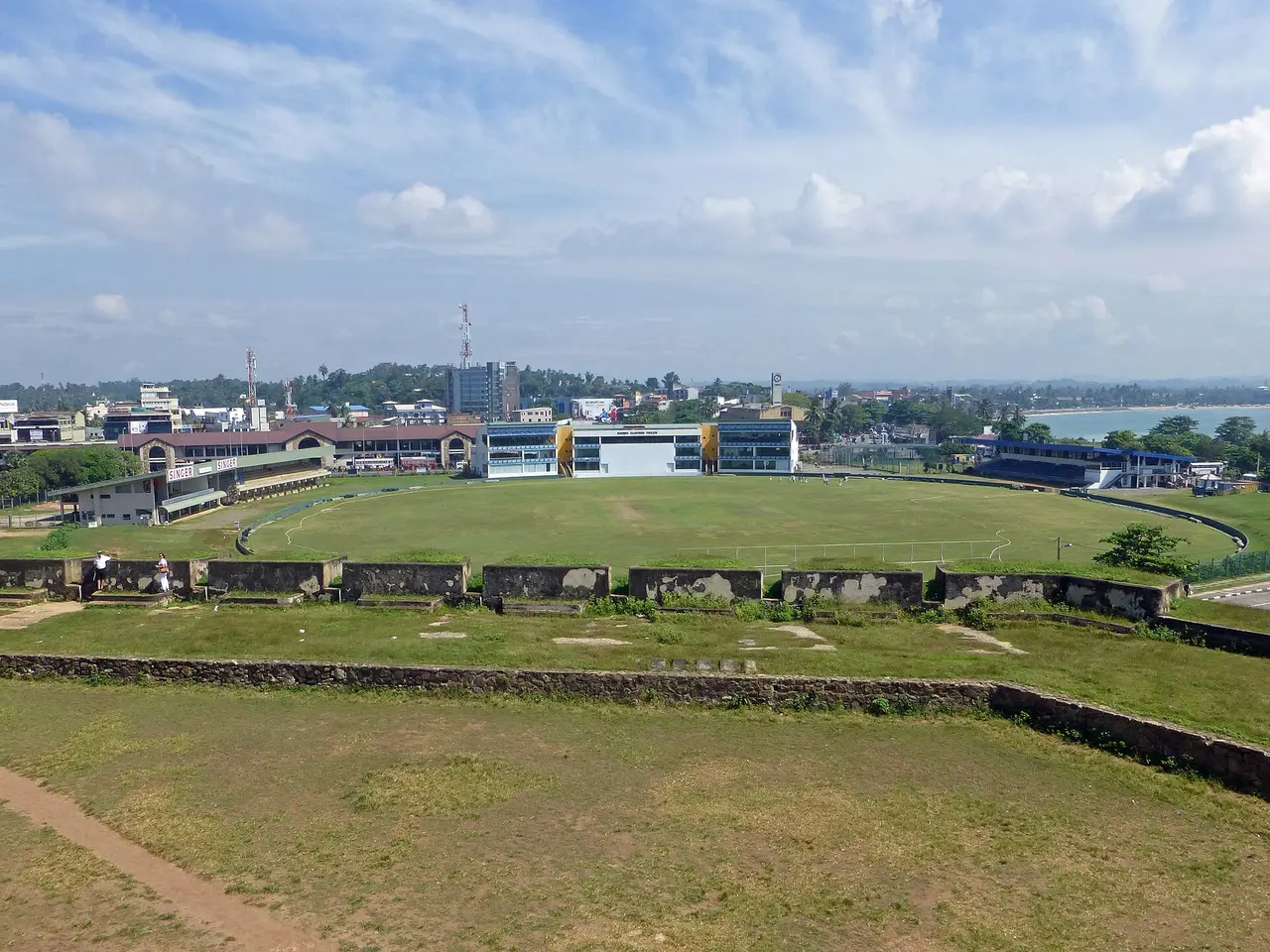
The modern town begins at the foot of the main gate, cut through by the British in the 19th century. This is where the coastal train and buses arrive, a few minutes' walk from the fort, and where the seafront fish market is busy early in the morning. The international cricket stadium, squeezed between the rampart and the bay, was devastated by the tsunami of 26 December 2004 and then rebuilt; a Test match can be watched from the bastions. From Colombo, the railway follows the ocean: just over 2 hours by express, up to 3 hours 40 on the slowest trains, or take the Southern Expressway by road.

Unawatuna, Jungle Beach and the sheltered bay

About 6 km south-east of the fort, Unawatuna fills a crescent cove sheltered by a reef, which makes it one of the safest beaches in the area for swimming in the dry season, from December to April. In the evening, restaurants set their tables on the sand. Skirting the wooded Rumassala hill, which Ramayana legend says fell from Hanuman's hands, a 20 to 30 minute trail leads to Jungle Beach, a small cove for snorkelling. Staying here rather than in the fort is often cheaper, 15 minutes away by tuk-tuk.

From Koggala to Mirissa along the coast road

Heading east, the coast road strings together fishing villages. Around Koggala, some fifteen kilometres away, a few men still perch on stilts planted in the waves, often posing for photos in exchange for a tip. Weligama, with its shallow bay, draws beginner surfers. Mirissa, about 35 km from Galle, is the departure port for boat trips to see blue whales and dolphins, from December to April; leave before 7 am, as the sea picks up later. From May to September, the south-west monsoon makes the coast rough and many operators suspend their trips.

How much it costs

Per person per day, excluding international travel.
Budget
28 €/ day
1 892 € for 2 people, 7 days, return flights included
Accommodation
12 €
Food
9 €
Local transport
2 €
Sights and activities
5 €
Comfort
54 €/ day
2 256 € for 2 people, 7 days, return flights included
Accommodation
19 €
Food
17 €
Local transport
6 €
Sights and activities
12 €
Premium
264 €/ day
5 196 € for 2 people, 7 days, return flights included
Accommodation
143 €
Food
45 €
Local transport
36 €
Sights and activities
40 €
Prices checked: Relevé du 10 novembre 2026. Roupie srilankaise et dollar convertis au taux ExchangeRate-API (open.er-api.com) du 10 novembre 2026 (1 € = 372,06 LKR ; 1 € = 1,12 USD), la BCE ne publiant pas de taux pour la roupie. Repas et transport : Numbeo Sri Lanka, moyenne nationale mise à jour le 10 novembre 2026 (1 431 relevés de 150 contributeurs sur 12 mois ; la page Galle de Numbeo n'a que 5 contributeurs et n'est pas utilisée) : repas bon marché 2,69 €, repas de milieu de gamme pour deux 18,82 €, bière locale 2,10 €, cappuccino 2,19 €, ticket de bus 0,16 €, taxi 0,35 € de prise en charge puis 0,30 € le km. Hébergement : hôtel 3 étoiles 38 € et 5 étoiles 286 € la nuit en moyenne à Galle selon combien-coute.net (mise à jour du 5 novembre 2026) ; lit en dortoir autour de 13 USD en moyenne selon Hostelz (agrégateur, prix non datés). Activités, sources non officielles : accès au fort et aux remparts gratuit, musée maritime national de 600 à 1 500 LKR selon les guides (pas de grille officielle trouvée), sortie baleines partagée depuis Mirissa de 25 à 80 USD par personne et sortie privée autour de 200 USD pour deux (annonces d'opérateurs et de plateformes, non datées). Voiture avec chauffeur pour le profil premium : environ 80 USD la journée (même base que la fiche Colombo, annonce non datée), partagée à deux. Vol A/R Paris-Colombo hors vacances scolaires estimé à 750 € par personne (Kayak, relevé du 10 novembre 2026 : fourchette habituelle 677 à 938 €, septembre 655 € en médiane, août 980 €), puis train ou route jusqu'à Galle. Hébergement par nuit et par personne : dortoir pour le routard, chambre double partagée à deux pour les autres. weekTwoPax = 7 jours x 2 personnes + 2 vols.

Getting there

Airports serving Galle, from main hubs to secondary ones.
  • CMBBandaranaike International Colombo AirportColomboMain
  • HRIMattala Rajapaksa International AirportMattalaMain
  • JAFJaffna International AirportJaffnaMain
  • RMLColombo Ratmalana International AirportColomboMain
  • ACJAnuradhapura AirportAnuradhapuraSecondary
  • ADPAmpara AirportAmparaSecondary

Entry, health and safety

For FR travellers

Entry requirements

Visa required

Autorisation électronique de voyage (ETA) obligatoire avant l'arrivée, à demander uniquement sur le site officiel eta.gov.lk/slvisa. Depuis le 25 mai 2026, elle est gratuite pour les Français (passeports ordinaires, de service et diplomatiques) pour un séjour touristique ou d'affaires de 30 jours. Passeport valable au moins six mois après la date d'entrée, billet de retour et justificatifs de ressources pour la durée du séjour. Transformer sur place un visa touristique en visa de résident est illégal et expose à l'expulsion.

Stay allowed for up to 30 days.

Passport valid for 6 months beyond your return date.

Health

Advised: Vaccinations du calendrier français à jour (diphtérie, tétanos, poliomyélite, coqueluche, rougeole) ; selon la durée et les conditions du séjour, hépatite A, fièvre typhoïde, hépatite B, tuberculose (enfants de moins de 15 ans), rage, chikungunya, dengue et encéphalite japonaise.

Dengue et chikungunya en circulation : se protéger des moustiques (répulsif, vêtements couvrants, moustiquaire) et éviter les anti-inflammatoires en cas de fièvre. Paludisme éliminé selon l'OMS depuis 2016. Eau en bouteille ou potable, éviter crudités et buffets froids. Assurance couvrant frais médicaux et rapatriement indispensable. Sécurité : tout le pays est en vigilance renforcée, sans zone déconseillée ; risque terroriste régional (attentats du 21 avril 2019). Sur la côte, des touristes se noient chaque année, notamment à Hikkaduwa, Mirissa ou Tangalle : baignade vivement déconseillée sur la côte ouest d'avril à novembre, privilégier les plages surveillées. Conduite risquée, voiture avec chauffeur conseillée, pas de route de nuit. Alerte météo du 2 novembre 2026 (cyclone) : suivre les bulletins locaux. Fiches France Diplomatie mises à jour le 27 septembre 2026 (alertes au 2 novembre 2026) ; numéros d'urgence relevés sur la fiche du gouvernement du Canada mise à jour le 2 novembre 2026.

Safety

Increased caution

Emergency

119 ou 118 (police), 110 (ambulance et pompiers), police touristique +94 11 242 1052, ambassade de France à Colombo +94 11 263 94 00

Checked in novembre 2026 against the official source. Entry rules change: check the official source before you travel, it alone is authoritative.

Practical information for Galle

ETA before departure

Electronic authorisation required for 30 days, free for French nationals since 25 May 2026, to be requested only on eta.gov.lk; passport valid for six months (France Diplomatie).

South-west monsoon

From May to September, rain and heavy swell on the south coast; the best window runs from December to April, with calm seas at Unawatuna and Mirissa.

From Colombo

Coastal train from Colombo Fort, 2 hr 07 min to 3 hr 40 min depending on the train (around ten departures a day), or the Southern Expressway by car with a driver.

Fort access

Free and open, on foot; the ramparts can be walked in under an hour, best early in the morning or late in the afternoon.

Swimming and currents

No swimming at the foot of the ramparts; in the monsoon, currents make the sea dangerous even at Unawatuna, so respect the red flags.

Dress in places of worship

Shoulders and knees covered, shoes and hats removed in Buddhist temples; never pose with your back to a Buddha statue for a photo.

Tap water

Not drinkable: use bottled or filtered water, and many guesthouses in the fort offer refill stations.

Power sockets

230 V, type D and G (British) sockets: a universal adapter is essential.

Dengue and emergencies

Dengue is present all year, so mosquito protection is advised; police emergency number: 119.

Galle in pictures

Photo credits : Ji-Elle, CC BY-SA 3.0, Wikimedia Commons ; Francisco Anzola from United States, CC BY 2.0, Wikimedia Commons ; Philip Nalangan, CC BY 4.0, Wikimedia Commons ; Ankur Panchbudhe from Pune, India, CC BY 2.0, Wikimedia Commons ; Bernard Gagnon, CC BY-SA 3.0, Wikimedia Commons

Frequently asked questions about Galle

Is it better to stay inside Galle Fort or in Unawatuna?
The fort offers the charm of Dutch houses and quiet lanes in the evening, but rooms cost more and there is no beach. Unawatuna is better for swimming. Many travellers combine two nights in the fort with a few nights on the beach.
Can you visit Galle as a day trip from Colombo?
Yes, with a morning express from Colombo Fort, a journey of just over 2 hours, or by car on the Southern Expressway. You will see the fort and ramparts, but a night there lets you enjoy the sunset and the lanes without the tour groups.
When should you go whale watching in Mirissa?
From December to April, when the north-east monsoon leaves the south coast calm. Boats leave Mirissa harbour around 6.30 or 7 am for several hours at sea. From May to September, the swell of the south-west monsoon makes trips rare and uncomfortable.
How long does it take to walk the Galle Fort ramparts?
Under an hour on foot is enough to loop the rampart walk, from Sun Bastion to the lighthouse via Flag Rock. Set off around 4.30 pm to finish at sunset, when local families settle on the walls.
Was Galle Fort hit by the 2004 tsunami?
The ramparts largely protected the old town on 26 December 2004, but the new town, the bus station and the cricket stadium outside the walls were devastated. They have since been rebuilt, and the stadium hosts international matches again.
Can you swim in Unawatuna during the monsoon?
It is not advisable from May to September: the south-west monsoon brings swell and currents, even in the reef-sheltered bay. If you travel at that time, favour Sri Lanka's east coast, which is then in its dry season.

Plan your trip to Galle

Build your day-by-day itinerary and manage budget, bookings and packing in PlanTripNow.
Aperçu de l'application PlanTripNow