Skip to content

Visit Ha Long Bay: which cruise should you choose?

Some 1,600 limestone islands and islets rise from the waters of the Gulf of Tonkin, among caves, lagoons and fishing villages. Ha Long is experienced on board, for one or two nights, by choosing your bay: the classic one, Lan Ha near Cat Ba or quiet Bai Tu Long.

At a glance

Visa
None
Tourist stay of up to 45 days
7-day budget
€490
Per person, comfort profile, excluding international flights.

Why visit Ha Long Bay?

Ha Long Bay, in Quang Ninh, northern Vietnam, has been listed by UNESCO since 1994 for its 1,600 or so limestone islands and islets. It is explored on a one or two-night cruise from Tuan Chau or Bai Chay, about 2.5 hours by road from Hanoi. The best periods are April to May and October to November.

When to visit Ha Long

Temperatures, rainfall and crowds month by month, to pick your window.
When to visit Ha Long
MonthTemperaturesRainCrowdsVerdict
January14 to 19 °C8 dModerateThe coolest month, 19 °C in the afternoon and 14 °C at night under often hazy skies: a sweater is essential on deck, but it is the cheapest month to fly.
February15 to 20 °C10 dModerateDrizzle and mist over the islets, water at 19 °C; Tet (6 February in 2027) fills the boats with Vietnamese families and pushes prices up.
March18 to 22 °C14 dModerateThe mistiest month, with frequent but light drizzle: a soft, hazy mood for photos, reduced visibility over the karsts.
April22 to 26 °C11 dBusySpring gradually clears the sky at around 26 °C, one of the best months to sail; local crowds around the 30 April holidays.
May25 to 30 °C12 dModerateSea at nearly 28 °C, much more sunshine and the first storms: a good compromise for kayaking and swimming at Ti Top or Quan Lan.
June26 to 32 °C16 dBusyStart of the storm season and Vietnamese school holidays: Bai Chay and Cat Ba beaches are packed, keep a spare day for your cruise.
July26 to 32 °C17 dBusyThe hottest month, sea at 30 °C and sudden storms; sailings suspended at every alert, flights from Paris at their peak, around 1,130 euros median.
August25 to 31 °C19 dModerateThe wettest month, over 400 mm, at the heart of typhoon season: take out cancellation insurance and keep your dates flexible.
September24 to 31 °C14 dQuietThe sea is still at 30 °C and the boats are less full, but the typhoon risk remains high: good rates for those willing to watch the forecast.
October22 to 29 °C9 dBusyThe rain clearly eases, with clear skies and a sea still warm at 28 °C: one of the best months for a two-night cruise.
November19 to 26 °C6 dPackedDry and bright, 25 °C in the afternoon: the season most in demand among foreign travellers, book your cruise early.
December15 to 22 °C5 dBusyThe driest month but already cool, 15 °C at dawn: good visibility over the islets, swimming only for the brave.
Source: Températures (moyennes des maxima et minima quotidiens, moyenne calculée comme leur demi-somme) et jours de pluie : normales de la station de Bai Chay publiées par l'Institut vietnamien des sciences et technologies du bâtiment, reprises dans l'article Wikipédia en vietnamien « Hạ Long (thành phố) » (relevé du 9 novembre 2026, période d'observation non précisée). Température de la mer : moyennes mensuelles sur 10 ans de seatemperature.info pour la baie d'Ha Long (satellite et mesures in situ, relevé du 9 novembre 2026). Prix : vols Paris-Hanoï sur Kayak (janvier le mois le moins cher à 746 € en médiane, juillet 1 126 € et août 1 107 €), relevé du 9 novembre 2026 ; Têt 2027 le 6 février. Saison des tempêtes et typhons de juin à octobre, sorties en mer suspendues par les autorités portuaires à chaque alerte. Affluence : estimation éditoriale.

Ha Long Bay's must-sees

The stops offered by most cruises, to pick according to your route.

Sung Sot cave

Surprise Cave, on Bo Hon island, links huge chambers of rock formations along a fitted walkway, one of the largest caves in the bay.

Ti Top island

A small beach and a viewpoint at the top of a few hundred steps; its name honours the Soviet cosmonaut Gherman Titov, who visited in 1962.

Luon lagoon

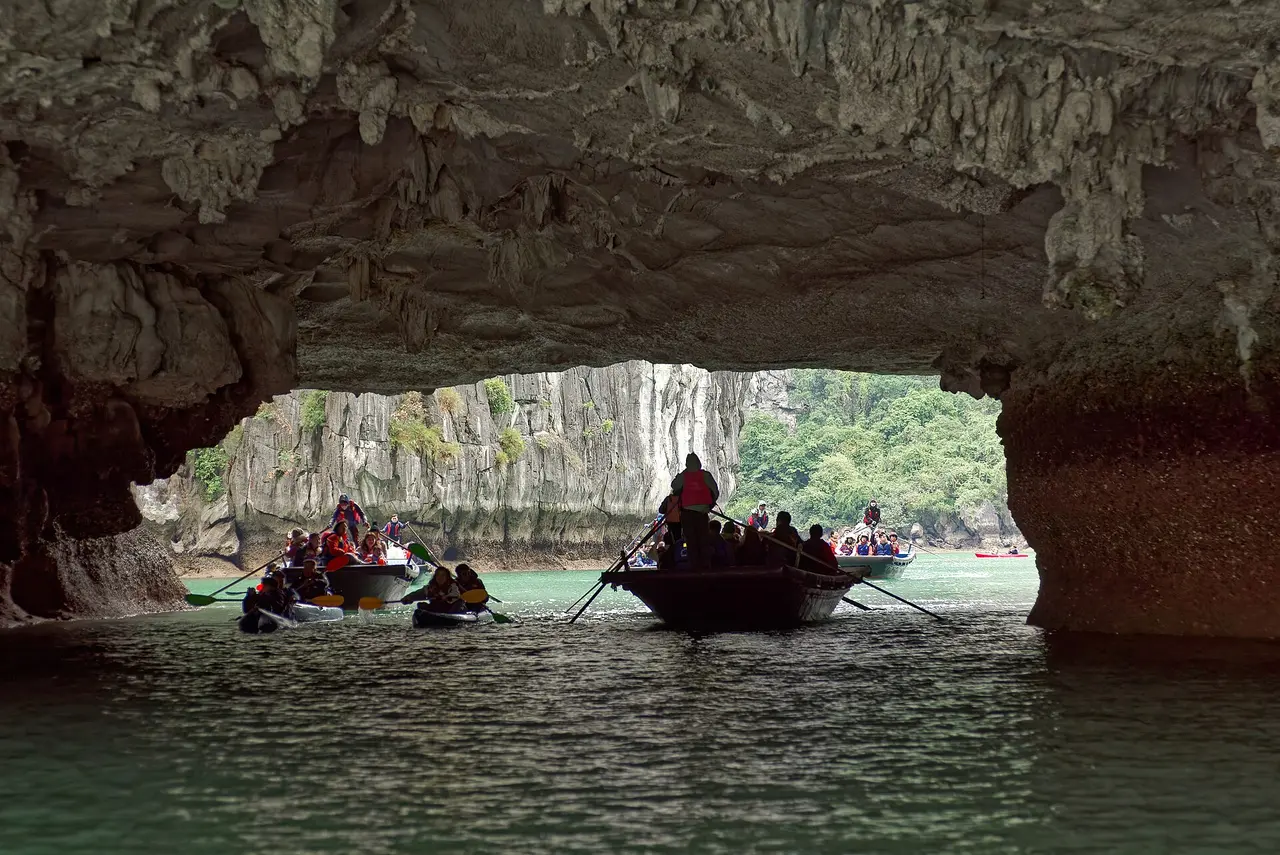
A low arch carved into the cliff opens onto an enclosed lagoon, crossed by kayak or rowing boat, a frequent stop on one-night cruises.

Cua Van village

Floating houses and fish farms explored by rowing boat with a local oarswoman; in 2014, more than 300 families from the bay's floating villages were rehoused on land.

What to see around Ha Long?

Bai Chay and Hon Gai, the two sides of the city

Ha Long stretches along both sides of the Cua Luc strait, crossed since 2006 by the Bai Chay cable-stayed bridge. To the west, Bai Chay gathers the hotels, the international cruise port and the Sun World park, whose cable car climbs Ba Deo hill. To the east, Hon Gai is the historic coal town: a market, everyday streets and the Quang Ninh Museum with its black glass facade. Allow 2.5 to 3 hours on the expressway from the capital, and a single night on land is enough: the point of the trip is on the water, not in town.

Lan Ha and Cat Ba, the Hai Phong side of the bay

South of the main bay, Lan Ha Bay continues the same limestone karsts but belongs to Hai Phong and Cat Ba island, added to the UNESCO site when it was extended in 2023. There are fewer boats, the small beaches are easier to reach and kayak routes between the lagoons are longer. Cat Ba has a national park created in 1986, home to the golden-headed langur, a critically endangered endemic primate. From Tuan Chau, a ferry reaches the island in about 45 minutes to an hour. Plan two nights to combine a cruise, a hike and a bike ride to Viet Hai village.

Bai Tu Long and Van Don, the quieter northeast

To the northeast, Bai Tu Long Bay lines up hundreds of similar islets, with far fewer boats than the main bay. Part of it is protected by Bai Tu Long National Park, created in 2001. Van Don, a special administrative zone since 2025, about fifty kilometres from Ha Long by expressway, has an international airport opened in 2018. From its port of Cai Rong, speedboats serve Quan Lan island and its pale sand beaches, where you can stay overnight. Choose this area for a two-night cruise away from the lines of boats, ideally from April to June or in October and November.

How much it costs

Per person per day, excluding international travel.
Budget
25 €/ day
1 950 € for 2 people, 7 days, return flights included
Accommodation
6 €
Food
9 €
Local transport
3 €
Sights and activities
7 €
Comfort
70 €/ day
2 580 € for 2 people, 7 days, return flights included
Accommodation
24 €
Food
20 €
Local transport
5 €
Sights and activities
21 €
Premium
187 €/ day
4 218 € for 2 people, 7 days, return flights included
Accommodation
55 €
Food
45 €
Local transport
15 €
Sights and activities
72 €
Prices checked: Relevé du 9 novembre 2026. La BCE ne publie pas de taux pour le dong : conversion au taux ExchangeRate-API du 9 novembre 2026 (1 € = 28 563 VND, soit 1 000 000 VND = 35,0 € ; 1 € = 1,115 USD). Croisières : vietnamtourism.com, guide « Combien coûte vraiment une croisière dans la baie d'Halong », mis à jour le 30 octobre 2026 (source commerciale, non officielle) : une nuit à bord par personne en cabine double de 1,5 à 2,5 millions de VND en économique, 2,5 à 4,5 millions en milieu de gamme, deux nuits de luxe de 12 à 18 millions, repas et droits d'entrée de la baie en principe compris, boissons et frais de port parfois en sus ; navette Hanoï-Ha Long environ 300 000 VND par personne. Croisière à la journée avec grotte Sung Sot et île Ti Top à partir de 45 USD (annonces Trip.com et TourRadar consultées le 9 novembre 2026). Hébergement à terre : lit en dortoir de 4 à 9 € (prix plancher de 14 auberges sur Hostelworld, page Ha Long consultée le 9 novembre 2026, prix non datés) ; hôtel 4 étoiles autour de 48 € la nuit (Halong Palace) et prix moyen constaté de 107 € la nuit la semaine précédente selon momondo (comparateur, valeurs très variables). Repas et transport : Numbeo n'a aucun relevé pour Ha Long sur 12 mois ; valeurs de Hanoï utilisées comme approximation (mise à jour du 6 novembre 2026, 1 130 relevés de 88 contributeurs : repas bon marché 1,84 €, repas de milieu de gamme pour deux 21,01 €, bière pression locale 1,05 €, taxi 0,84 € puis 0,53 € le km). Vol A/R Paris-Hanoï (aéroport le plus desservi pour Ha Long) hors vacances scolaires estimé à 800 € par personne (Kayak, relevé du 9 novembre 2026 : fourchette habituelle 730 à 1 114 €, moyenne 862 €, janvier 746 € en médiane, juillet-août au-delà de 1 100 €). Hébergement par nuit et par personne : dortoir pour le profil routard, chambre double partagée à deux pour les autres. Le poste activités répartit sur la semaine une croisière à la journée (routard), d'une nuit en milieu de gamme (confort) ou de deux nuits de luxe (premium) ; le poste transport inclut l'aller-retour depuis Hanoï. weekTwoPax = 7 jours x 2 personnes + 2 vols.

Getting there

Airports serving Ha Long, from main hubs to secondary ones.
  • CXRCam Ranh International Airport / Cam Ranh Air BaseNha Trang/nha Trang aiurportCam RanhMain
  • DADDa Nang International AirportDa NangMain
  • HANNoi Bai International AirportHanoiMain
  • HPHCat Bi International AirportHaiphongMain
  • LTHLong Thanh International Airport (Under Construction)Ho Chi Minh CityMain
  • PQCPhú Quốc International AirportPhu Quoc IslandMain

Entry, health and safety

For FR travellers

Entry requirements

No visa for a tourist stay

Exemption de visa depuis le 15 août 2023 pour tout séjour de 45 jours au plus, jours d'entrée et de sortie compris, quels que soient le type de passeport et l'objet du voyage. Au-delà, e-visa à demander avant le départ sur le portail national de l'immigration (jusqu'à 90 jours, entrées multiples). Exemption et visa ne sont ni prolongeables ni renouvelables sur place ; tout dépassement expose à des sanctions et doit être régularisé avant de quitter le pays. Passeport valable au moins six mois à la date d'entrée.

Stay allowed for up to 45 days.

Passport valid for 6 months beyond your return date.

Health

Advised: Vaccinations du calendrier français à jour, notamment contre la rougeole ; selon la durée et les conditions du séjour, hépatite A, fièvre typhoïde, hépatite B (séjours fréquents ou longs), rage, chikungunya, dengue et encéphalite japonaise (cas humains recensés dans les provinces du Nord).

Dengue transmise par les moustiques : se protéger, sans traitement curatif. Rage endémique : ne pas approcher les animaux errants. Alcool artisanal frelaté au méthanol signalé dans les provinces du Nord. Côté sécurité, tout le pays est en vigilance renforcée sans zone déconseillée. Dans la baie d'Ha Long, les contrôles des bateaux sont plus systématiques, mais France Diplomatie appelle à la prudence face aux croisières vendues à des prix anormalement bas. Tempêtes tropicales parfois violentes en été et à l'automne : les sorties en mer sont alors suspendues. Fiches France Diplomatie mises à jour le 15 septembre 2026.

Safety

Increased caution

Emergency

113 (police), ambassade de France à Hanoï +84 24 39 44 57 00

Checked in novembre 2026 against the official source. Entry rules change: check the official source before you travel, it alone is authoritative.

Practical information for Ha Long Bay

From Hanoi

About 170 km by expressway via Hai Phong, or 2.5 to 3 hours; most cruises include a shuttle from the Old Quarter.

Departure ports

Tuan Chau marina and Bai Chay international port for Ha Long Bay, Cai Rong port for Bai Tu Long, Cat Ba for Lan Ha.

Van Don airport

About fifty kilometres from Ha Long, it mainly handles domestic flights; check which routes are operating before booking.

Weather alerts

Port authorities suspend all sailings as soon as a storm or typhoon is forecast, mostly from June to October: keep a spare day.

Safety on board

Wear a life jacket on speedboats and kayaks; France Diplomatie advises caution with cruises sold far below market prices.

Extras on board

Drinks, massages and optional activities are usually charged on top of the package: carry dong in cash or check that cards are accepted.

Ha Long in pictures

Photo credits : Jakub Hałun, CC BY 4.0, Wikimedia Commons ; Mike Colvin from Manchester, UK, CC BY 2.0, Wikimedia Commons ; RG72, CC BY-SA 4.0, Wikimedia Commons ; Hoangkid, CC BY-SA 4.0, Wikimedia Commons

Frequently asked questions about Ha Long Bay

One or two nights on a Ha Long Bay cruise?
One night on board is enough for Sung Sot cave, Ti Top island, kayaking and sunrise over the islets. Two nights let you reach Lan Ha or Bai Tu Long, away from the day boats. Then head back through Hanoi to catch the night train to the rice terraces of Sapa.
Lan Ha or Bai Tu Long instead of classic Ha Long Bay?
The main bay has the best-known sites, the caves and Ti Top, but also most of the traffic. Lan Ha offers more beaches and kayaking, with Cat Ba nearby. Bai Tu Long, quieter still, suits a two-night cruise without the crowds.
Are Ha Long cruises cancelled during typhoons?
Yes: the authorities close the port to sailings as soon as a storm alert is issued, mostly between June and October. Reputable operators refund or reschedule. In July 2025, a sightseeing boat caught in a sudden storm capsized in the bay, which shows why these closures must be respected.
Is a day trip to Ha Long from Hanoi worth it?
It is doable but tiring: 5 to 6 hours of driving there and back for about 4 hours on the water, among the day boats. If your schedule allows, a night on board changes everything, with sunset and sunrise between the karsts.
Can you swim in Ha Long Bay?
Yes, mainly on the small beach of Ti Top island and on those of Cat Ba or Quan Lan. From the boat, swimming depends on authorised zones and the day's weather: ask your operator. The water is most pleasant from May to October.
Stay in Bai Chay or on Cat Ba island?
Bai Chay is convenient the night before a cruise leaving from Tuan Chau or the international port, but the district has little appeal in itself. Cat Ba suits independent travellers better: kayak trips in Lan Ha, hiking in the national park and a small harbour atmosphere.
Can you go kayaking in Ha Long Bay?
Yes, in designated areas such as Luon lagoon or around Cua Van village, usually included in one-night cruises. In Lan Ha Bay, routes are longer and more varied. Life jackets are provided and must be worn at all times on the water.
Why is Ha Long Bay so misty in winter?
From January to March, the northeast monsoon brings persistent drizzle and mist that blur the islets, with temperatures around 15 to 20 °C. The atmosphere has its charm for photos, but for clear skies, aim for April to May or October to November.
How do you spot a reliable Ha Long Bay cruise?
Check the exact route (bay, caves, anchorage), the number of passengers, life jackets in every cabin and the terms in case of weather cancellation. Be wary of prices well below the market: France Diplomatie advises caution with such offers.

Plan your trip to Ha Long

Build your day-by-day itinerary and manage budget, bookings and packing in PlanTripNow.
Aperçu de l'application PlanTripNow