Skip to content

Visiting Hamburg : port, Elbphilharmonie and neighbourhoods

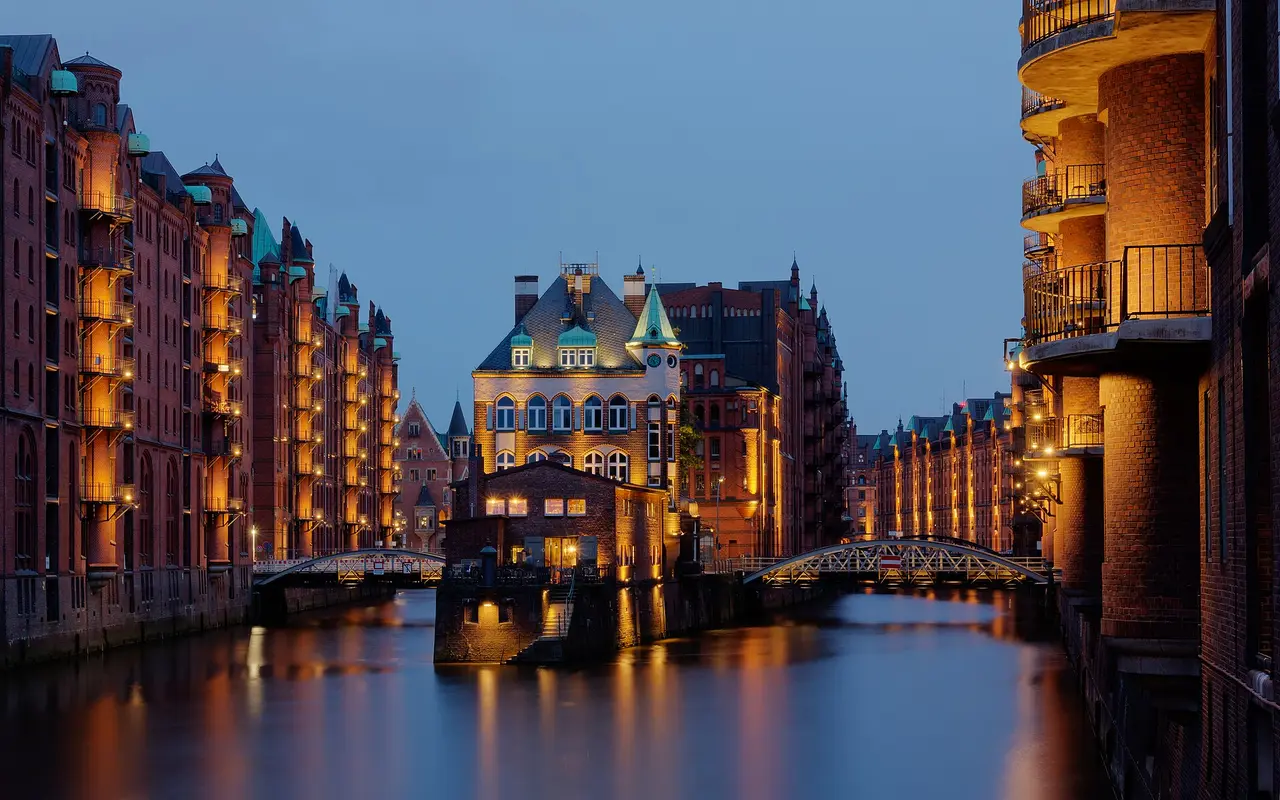
Brick warehouses rising from the water, a glass concert hall at the end of the quay, public ferries that double as a harbour cruise and two lakes in the city centre: Hamburg is best discovered from the Elbe. Three days cover the essentials, four add Blankenese and Lübeck.

Why visit Hamburg?

Hamburg, Germany's second city and the country's largest port, combines the UNESCO-listed Speicherstadt, the Elbphilharmonie and sharply contrasting neighbourhoods, from St. Pauli's nightlife to the villas of Blankenese. HVV ferries let you explore the port with an ordinary public transport ticket.

Hamburg's must-sees

Port architecture, museums and lively spots, nearly all linked by the U-Bahn, the S-Bahn or the Elbe ferries.

Elbphilharmonie

A concert hall set on top of a former brick warehouse. Its Plaza, a panoramic terrace 37 metres up, is open with a timed ticket, even without attending a concert.

Miniatur Wunderland

A huge model railway in the Speicherstadt, with entire countries recreated and thousands of trains. Allow three hours and book a time slot online.

St. Michael's Church

The Michel, the city's emblematic Baroque church, whose 132-metre tower offers a viewing platform over the port, the Alster and the copper rooftops.

Chilehaus

An Expressionist office building from 1924 in dark brick, its pointed corner evoking a ship's bow. The centrepiece of the UNESCO-listed Kontorhaus district.

Hamburg Rathaus

The 1897 neo-Renaissance city hall, seat of the city-state's parliament and government. Guided tours of the state rooms run several times a day.

Altona Fischmarkt

A Sunday dawn fish market with market criers, flowers and herring sandwiches. The neighbouring hall hosts a live band as the night winds down.

Old Elbe Tunnel

A 1911 tunnel about 426 metres long under the river, reached by giant lifts. Free for pedestrians and cyclists, with a view of the city from the far bank.

St. Nicholas Memorial

A neo-Gothic church tower left standing after the 1943 bombings. A lift climbs to a viewing platform, and the crypt holds an exhibition on the air war.

Kunsthalle

A major art museum near the main station, from old masters to contemporary art, with a fine German Romantic collection around Caspar David Friedrich.

Planten un Blomen

A central park with Japanese gardens and a tropical botanical garden. On summer evenings, free illuminated water and music shows take place around the lake.

International Maritime Museum

Nine floors in a former HafenCity warehouse devoted to three thousand years of seafaring: models, uniforms, instruments and old nautical charts.

What to see in Hamburg, neighbourhood by neighbourhood?

The Altstadt and the shores of the Binnenalster

The historic centre lies between the main station and the port. The neo-Renaissance city hall, completed in 1897 with more than six hundred rooms, can be visited on a guided tour. Just north, the Binnenalster is lined by the Jungfernstieg, where Alster boats leave for a loop of about an hour. The shopping streets of Mönckebergstraße and Spitalerstraße link it all to the station in ten minutes on foot. Allow half a day for this area, adding the ruins of St. Nicholas' Church, preserved as a memorial to the 1943 bombings.

Speicherstadt and HafenCity, the city on the water

Built from 1883 on oak piles, the Speicherstadt lines up its neo-Gothic red-brick warehouses along tidal canals. Together with the neighbouring Kontorhaus district, it was listed by UNESCO in 2015. To the south, HafenCity, a vast new district on former harbour basins, stretches as far as the Elbphilharmonie, opened in January 2017. Plan three to four hours combining the Speicherstadt bridges, a museum and the Magellan-Terrassen promenade. At dusk, the lit facades make the walk especially photogenic.

The port, from the Landungsbrücken to Finkenwerder

The Landungsbrücken, piers built in the early 20th century, are the starting point for harbour tours. The budget alternative is HVV ferry 62, covered by an ordinary transport ticket: it runs along the quays to Finkenwerder in about thirty minutes, stopping at Altona and Övelgönne. Right next door, the Old Elbe Tunnel, opened in 1911, runs under the river for pedestrians and cyclists. The largest port in Germany celebrates its anniversary every May with the Hafengeburtstag, drawing hundreds of ships and huge crowds.

St. Pauli and the Kiez

The Reeperbahn, about 930 metres long, packs in theatres, bars, music venues and adult establishments. It was in clubs in this district, such as the Indra and the Star-Club, that the Beatles played between 1960 and 1962; a square at the end of the street honours them. The nearby Herbertstraße is closed to minors and, by custom, to women. By day the area is calm and working-class, home to FC St. Pauli's stadium. At night, things really get going after 10 pm, especially from Thursday to Saturday.

Sternschanze and Karoviertel

North of St. Pauli, the Schanzenviertel is Hamburg's alternative district: crowded terraces on Schulterblatt, cafés, second-hand shops and the Rote Flora, a former theatre squatted since 1989. The neighbouring Karolinenviertel, around Marktstraße, gathers designers, vintage boutiques and record shops. Both areas take two to three hours to explore and are reached from Sternschanze station. The Rindermarkthalle food market, set in a former cattle hall, is handy for a quick lunch. It is the best area for a night out without the Reeperbahn atmosphere.

Altona, Ottensen and the Elbe beach

Danish and then independent until 1937, Altona has kept a distinct identity. On Sunday mornings the fish market runs there from 5 am to 9.30 am in summer, beside an auction hall dating from 1896. Ottensen, just to the north, is a former working-class district turned one of the liveliest in the city, with pedestrian streets and converted factories. Heading down to the river, the sandy beach at Övelgönne runs alongside passing container ships for over a kilometre. Allow half a day; swimming is discouraged because of currents and shipping traffic.

Blankenese and its stairways

About 25 minutes from the main station on S-Bahn line S1, Blankenese is the former fishing and sea captains' village clinging to the Elbe hillside. Its stairway quarter, the Treppenviertel, threads lanes and steps between white houses and gardens, with views of ships sailing upriver. A small bus nicknamed the mountain goat climbs the narrow streets. Allow half a day and good shoes, then head down to the beach and return by ferry 62 or on foot along the Elbe to Övelgönne.

The Außenalster and the residential districts

North of the Binnenalster opens the Außenalster, a lake of about 160 hectares circled by a path of nearly 7.5 km, to walk, cycle or run. Sailing boats, canoes and pedal boats can be hired from April to October. Its shores lead to the residential districts of Uhlenhorst, Winterhude and Eppendorf, with their white villas and canals. The Alster canals can also be explored by canoe from rental outlets in these districts, for an outing of about two hours. It is Hamburg's other face, greener and calmer than the port.

Getting there

Airports serving Hamburg, from main hubs to secondary ones.
  • BERBerlin Brandenburg AirportBerlinMain
  • BREBremen AirportBremenMain
  • CGNCologne Bonn AirportKölnMain
  • DRSDresden AirportDresdenMain
  • DTMDortmund AirportDortmundMain
  • DUSDüsseldorf AirportDüsseldorfMain

Practical information for Hamburg

Airport

Helmut Schmidt Airport in the north of the city, linked to the main station by S-Bahn S1 in about twenty-five minutes.

HVV transport

U-Bahn, S-Bahn, buses and harbour ferries share the same tickets. The monthly Deutschlandticket is valid, ferries included.

Culture and tourism tax

Charged per night in accommodation, the amount depends on the room rate.

Cash

Cards are spreading, but some bars, kiosks and Fischmarkt stalls take cash only: keep a few euros on you.

Sundays

Shops close on Sundays, except in stations, bakeries and a few neighbourhood stores. Museums stay open.

Bottle deposit

Pfand applies to bottles and cans: return them to supermarket machines to get your deposit back.

Elbphilharmonie Plaza

Free entry on the spot subject to availability, paid online booking to guarantee a slot, advisable at weekends.

Weather

Oceanic climate, windy and often drizzly. Summers stay mild, around 22 °C: a windproof jacket is useful all year.

Power sockets

Types C and F, 230 V, as in most of continental Europe.

Tap water

Safe and of good quality throughout the city.

Hamburg in pictures

Photo credits : Dietmar Rabich, CC BY-SA 4.0, Wikimedia Commons ; Axel Tschentscher, CC BY-SA 4.0, Wikimedia Commons ; Thomas Wolf , www.foto-tw.de, CC BY-SA 3.0 de, Wikimedia Commons

Frequently asked questions about Hamburg

Can you go up the Elbphilharmonie without a concert ticket?
Yes, the Plaza, a circular terrace 37 metres up, is open to the public with a free timed ticket collected on site, or a paid one booked online. You reach it on a long curved escalator. The view takes in the port, the Speicherstadt and the church spires of the centre.
Do you need to book Miniatur Wunderland?
It is strongly advised, especially at weekends and during German school holidays: entry works by time slot and the wait without a booking can be long. Allow at least three hours. Evening slots are often the quietest.
Does ferry 62 replace a harbour cruise?
Partly. Ferry 62 leaves the Landungsbrücken and runs along the quays to Finkenwerder on a simple HVV ticket, with fine views of the cranes and container ships. It does not enter the docks or the Speicherstadt canals, which are reserved for guided excursion boats.
What time should you go to the Altona Fischmarkt?
The market runs on Sundays from 5 am to 9.30 am from April to October, and from 7 am to 9.30 am the rest of the year. Arrive before 8 am for the market criers, or go straight there after a night in St. Pauli, as many locals do.
Is the Reeperbahn suitable for families?
During the day, yes: the street is busy but not excessive, and the Beatles square or the musical theatres are easy to visit. In the evening, the atmosphere turns festive and adult. The Herbertstraße, screened off by barriers, is closed to under-18s.
Is the Hamburg Card worth it?
It includes HVV transport, ferries included, plus discounts at many museums and boat tours. It pays off if you use public transport every day and visit several paid sights. If you already hold a Deutschlandticket, transport is covered and only the discounts matter.
Are three days enough for Hamburg?
Yes for the essentials: one day for the Altstadt, the Speicherstadt and HafenCity, a second for the port, St. Pauli and the Schanzenviertel, a third for Altona, Övelgönne and Blankenese. Add a day for Lübeck or for a boat trip on the Alster.
When is the Hafengeburtstag?
The port's birthday is celebrated every year over a long weekend in May, with a parade of ships, historic sailing vessels and fireworks along the Landungsbrücken. It is one of the largest harbour festivals in the world: book accommodation very early.
Can you visit Lübeck as a day trip from Hamburg?
Yes, regional trains link the two cities in about forty-five minutes and are covered by the Deutschlandticket. Lübeck's old town, on an island ringed by the river Trave, can be explored in a day, from the Holstentor gate to the merchants' houses.

Plan your trip to Hamburg

Build your day-by-day itinerary and manage budget, bookings and packing in PlanTripNow.
Aperçu de l'application PlanTripNow