Skip to content

Visit Jaipur , the Pink City: what to see, when to go and budget

Rajasthan's capital, Jaipur was laid out on a grid in 1727 and painted pink in 1876. Behind its walls come palaces, an astronomical observatory and craft bazaars one after another, while the Amber and Nahargarh forts watch over the city from the Aravalli ridge.

At a glance

Visa
Required
Tourist stay of up to 90 days
7-day budget
€399
Per person, comfort profile, excluding international flights.
Recommended length
3 days
For a first trip, without rushing.

Why visit Jaipur?

Jaipur is the capital of Rajasthan, in north-west India, and the third stop on the Golden Triangle with Delhi and Agra. It has three UNESCO-listed sites: the walled city, the Jantar Mantar observatory and Amber Fort. Allow three days; the composite monument ticket costs 1,700 rupees.

When to visit Jaipur

Temperatures, rainfall and crowds month by month, to pick your window.
When to visit Jaipur
MonthTemperaturesRainCrowdsVerdict
January8 to 23 °C1 dPackedPeak crowds: kites on 14 January and the literature festival, but nights drop close to 8 °C.
February11 to 26 °C1 dBusyThe best month: 26 °C in the afternoon, dry skies and golden light on the pink facades.
March16 to 32 °C1 dModerateHoli and Gangaur colour the old city; the heat builds quickly after mid-March.
April22 to 37 °C1 dQuietAlready 37 °C: visit Amber and Nahargarh forts at opening time, then an air-conditioned rest.
May26 to 41 °C2 dVery quietBest avoided: over 40 °C by day, and the stone ramparts turn into furnaces.
June27 to 40 °C4 dVery quiet27 °C nights and heavy pre-monsoon heat; only the palace hotels slash their room rates.
July26 to 35 °C10 dQuietThe monsoon brings short downpours; the Aravalli hills turn green again around Jaigarh.
August25 to 33 °C10 dQuietThe wettest month, over 200 mm, but the Teej procession livens up the old city.
September24 to 34 °C4 dQuietA humid end to the monsoon with hotels still cheap: a fair bet for tight budgets.
October20 to 34 °C1 dModerateSkies dry out again with 20 °C nights; rates climb as Diwali approaches.
November14 to 30 °C0 dBusyBazaars lit up for Diwali and highs of 30 °C: the other ideal month, so book early.
December9 to 25 °C0 dPackedMild 25 °C days and chilly mornings; palace hotels are fully booked between Christmas and New Year.
Source: Moyennes climatiques 1991-2020 de climatestotravel.com recoupées avec weather2travel.com, moyenne des deux sources par mois arrondie au dixième, relevé octobre 2026. Jours de pluie : jours avec au moins 1 mm de précipitations. Ville de l'intérieur, sans température de mer. Mousson de juillet à septembre ; affluence et prix estimés d'après la haute saison hôtelière d'octobre à mars et les fêtes locales (cerfs-volants de Makar Sankranti, festival de littérature en janvier, Holi, Teej, Diwali).

Jaipur's must-sees

Eleven places, from the old city walls to the hill forts, to fill three busy days.

Hawa Mahal

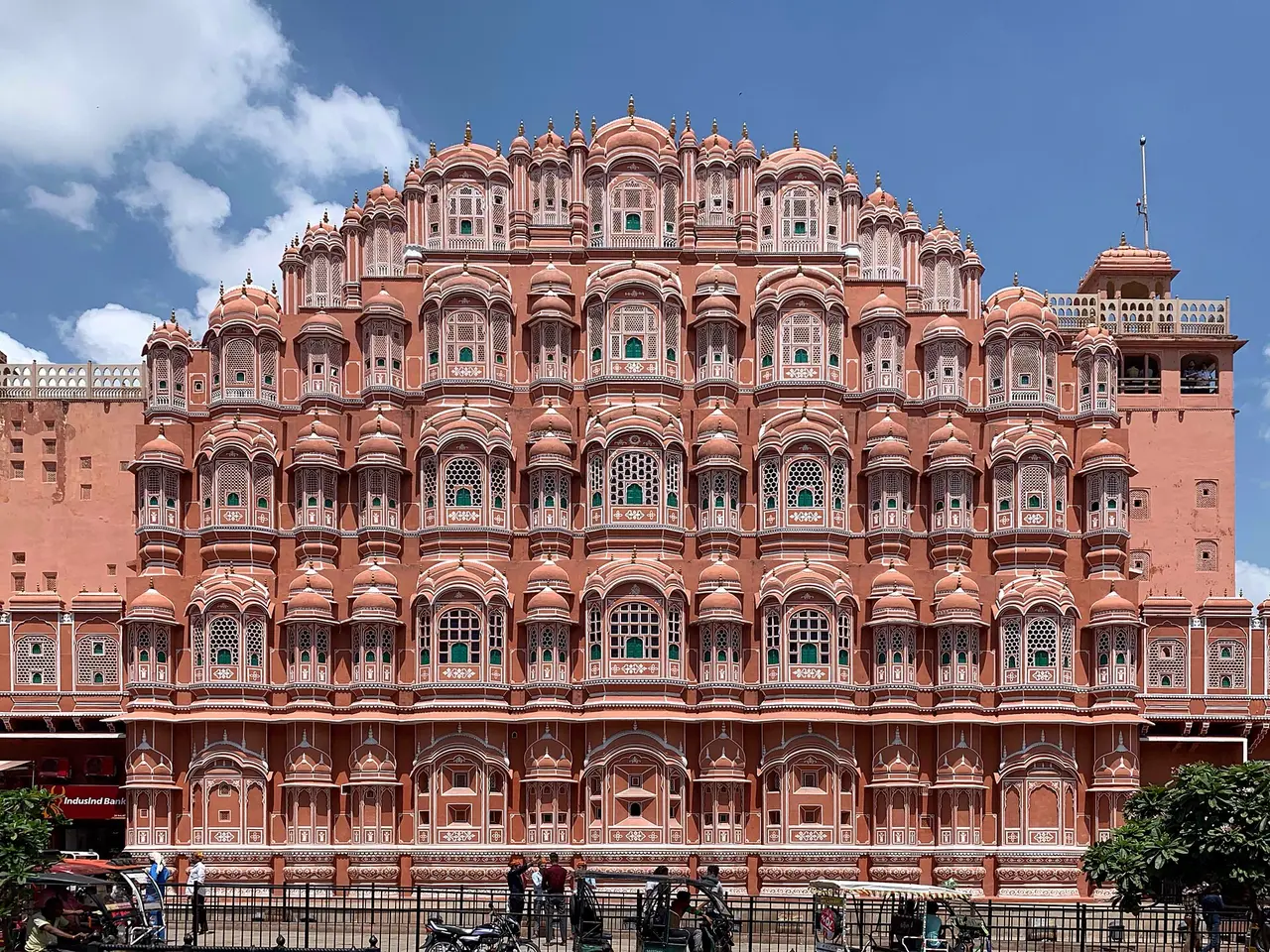
The Palace of Winds, built in 1799, a pink sandstone facade pierced with hundreds of latticed windows, best photographed at sunrise when the light hits it head-on.

City Palace

A royal residence still partly lived in, with successive courtyards, gates painted with peacocks and collections of costumes, weapons and miniature paintings.

Jantar Mantar

A UNESCO-listed stone astronomical observatory, where a giant sundial has told local time to within a few seconds since the eighteenth century.

Amber Fort

The former Kachwaha capital clinging to its hill above Maota Lake, famous for the Sheesh Mahal, a hall lined entirely with tiny mirrors.

Jaigarh Fort

A military fortress overlooking Amber, linked to it by a rampart walkway, and home to the huge Jaivana cannon cast on site in the eighteenth century.

Nahargarh Fort

A 1734 stronghold on the ridge, where locals gather at sunset, with the Madhavendra Bhawan palace and its suites for the queens.

Jal Mahal

A palace set in the middle of Man Sagar Lake, closed to visitors but superb from the lakeside promenade, especially early in the morning or at dusk.

Panna Meena ka Kund

A stepwell below Amber whose criss-crossing stairs form a striking geometric pattern, easy to combine with the fort on the same morning.

Albert Hall Museum

An 1887 Indo-Saracenic palace in the heart of Ram Niwas Garden, rich in miniatures, carpets and textiles, worth seeing again at night when it is lit up.

Galta Ji Temple

A cluster of temples and sacred tanks in a rocky valley east of the city, home to macaques and at its most peaceful late in the day.

Patrika Gate

A monumental gateway at Jawahar Circle whose arcades are painted with scenes and motifs from Rajasthan's regions, free to enter and highly photogenic.

What to discover in Jaipur?

A new city of 1727, painted pink in 1876

Jaipur is one of India's earliest planned cities: Maharaja Sawai Jai Singh II founded it in 1727 on a grid plan, divided into large blocks and enclosed by walls pierced with gates. In 1876 his descendant Ram Singh II had the facades painted pink to welcome the Prince of Wales, a colour kept in the old city ever since. The whole ensemble has been on the UNESCO list since 2019. To grasp the plan, climb at dawn to the terrace of a café facing the Hawa Mahal: the straight avenues run all the way to the hills.

The royal heart, between Tripolia and Badi Chaupar

The palace quarter fills the centre of the walled city. The City Palace, one wing of which is still the residence of the former royal family, unfolds its courtyards up to the Peacock Gate of Pitam Niwas Chowk. Next door, the Jantar Mantar observatory, completed in 1734 and UNESCO-listed in 2010, lines up some twenty stone instruments, including a sundial 27 metres high. On the street side, the latticed windows of the Hawa Mahal let the women of the court watch processions unseen. Half a day covers all three; the City Palace, run by the royal foundation, has its own ticket.

The Aravalli ridge and its three forts

To the north-east, a line of hills carries three fortresses. Amber, the Kachwaha capital before Jaipur was founded, blends red sandstone and white marble around the mirror-lined Sheesh Mahal; entry costs 1,000 rupees for a foreign visitor, according to the official Rajasthan portal. Just above, Jaigarh houses the Jaivana cannon. Closer to town, Nahargarh, built in 1734, offers the finest sunset view, with the Padao café set on its ramparts. Give the ridge a full day and reach Amber at opening time, ahead of the tour groups.

Bazaars: Johari jewels, Bapu textiles, Tripolia lacquer

The bazaars follow the city plan, each with its own speciality. Johari Bazaar gathers jewellers and gem cutters, Bapu Bazaar printed cottons and embroidered mojari slippers, Tripolia lac bangles and copperware. Bargain unhurriedly and pay on the spot: France's foreign ministry reports sellers in Rajasthan who offer to ship precious stones to France, followed by fraudulent card charges. Come in the late afternoon, when the heat eases and the stalls light up under the pink arcades.

Sanganer and Bagru, the block-printing villages

South of Jaipur, Sanganer and the village of Bagru keep woodblock textile printing alive. In Sanganer, paper mills also make handmade paper from cotton rags. Bagru is known for its plant dyes, including indigo, and for a clay-resist technique called dabu. Allow half a day to a full day by taxi, and book a beginner's workshop to print your own stole. In Amber, the Anokhi Museum, set in a restored haveli, traces the history of the craft before or after your visit to the fort.

Beyond the walls: MI Road, Raj Mandir and the modern city

South of the walls, the modern city is arranged around Ram Niwas Garden and the Albert Hall Museum, opened in 1887 and lit up every evening. MI Road is lined with sweet shops, cafés and long-established jewellers. The Raj Mandir cinema, opened in 1976 with its meringue-like decor, screens Bollywood films to an audience that cheers and whistles: a show is worth it even without understanding Hindi. Further south, Patrika Gate at Jawahar Circle spreads out its painted arcades. Allow a late afternoon and evening for this area, by rickshaw or ride-hailing, with Uber and Ola both available.

Jaipur on the Golden Triangle

With Delhi and Agra, Jaipur forms the Golden Triangle, the most travelled circuit in northern India. Many travellers spend only two nights here; three let you see the forts without rushing and keep an evening for Nahargarh. There is no direct flight from Paris: you arrive via New Delhi or a Gulf stopover, for around €670 return according to momondo in October 2026. With more time, continue to Udaipur and Jodhpur, or fly from Delhi to Nepal and the Himalayas.

Sample itineraries

Three routes built around the time you actually have.
3daysRecommended

Jaipur in 3 days: the old city, the Aravalli forts and Galta Ji

  1. Day 1: the walled Pink City
  2. Day 2: Amber, Jaigarh and Nahargarh
  3. Day 3: Albert Hall, Galta Ji and Patrika Gate

Best for: The right pace for a first visit: a full day in the Pink City, another along the ridge of the Amber, Jaigarh and Nahargarh forts, and a final one between the Albert Hall museum and the monkey temple of Galta Ji.

How much it costs

Per person per day, excluding international travel.
Budget
22 €/ day
1 648 € for 2 people, 7 days, return flights included
Accommodation
6 €
Food
8 €
Local transport
3 €
Sights and activities
5 €
Comfort
57 €/ day
2 138 € for 2 people, 7 days, return flights included
Accommodation
22 €
Food
15 €
Local transport
8 €
Sights and activities
12 €
Premium
142 €/ day
3 328 € for 2 people, 7 days, return flights included
Accommodation
55 €
Food
35 €
Local transport
22 €
Sights and activities
30 €
Prices checked: Relevé du 11 octobre 2026, hors haute saison de décembre-janvier. Taux de référence BCE du 1er octobre 2026 : 1 € = 108,83 INR (publié au BOE du 2 octobre 2026). Repas, transports et taxi : Numbeo Jaipur, mise à jour du 2 octobre 2026, 46 contributeurs sur 12 mois (repas bon marché 3,69 €, dîner de milieu de gamme pour deux 11,07 €, ticket de transport local 0,18 €, taxi 1,38 € de prise en charge puis 0,46 €/km). Hébergement : lits en dortoir de 6,30 à 6,70 € dans les auberges les plus courues (Hostelworld, relevé du 11 octobre 2026) ; hôtels 3 étoiles autour de 1 644 INR la nuit selon Skyscanner (page non datée) et environ 47 £ selon HotelsCombined (mise à jour du 11 octobre 2026), 5 étoiles autour de 8 620 INR (Skyscanner, non daté) : ces comparateurs ne sont pas des sources officielles. Monuments : billet composite à 1 700 INR pour un adulte étranger, fort d'Amber seul à 1 000 INR (portail officiel OBMS du gouvernement du Rajasthan, consulté le 11 octobre 2026). Activités premium (guide privé) et transport premium (taxi à la journée, environ 45 km) : estimations calculées à partir de ces tarifs, sans source directe. Vol A/R Paris-Jaipur via New Delhi estimé à 670 € par personne (momondo, moyenne 674 € via Delhi, fourchette habituelle 649 à 696 €, données du 9 octobre 2026 ; aucun vol direct). Hébergement par nuit et par personne : lit en dortoir pour backpacker, chambre double partagée à deux pour comfort et premium. weekTwoPax = 7 jours x 2 personnes + 2 vols.

Getting there

Airports serving Jaipur, from main hubs to secondary ones.
  • AGRAgra Airport / Agra Air Force StationAgraSecondary
  • AGXAgatti AirportAgattiSecondary
  • AHAMaa Mahamaya AirportAmbikapurSecondary
  • AJLLengpui AirportAizawlSecondary
  • AKDAkola AirportAkolaSecondary
  • AYJMaharshi Valmiki International AirportFaizabadSecondary

Entry, health and safety

For FR travellers

Entry requirements

Visa required

Visa obligatoire pour l'Inde, y compris pour un séjour touristique à Jaipur. Les Français demandent un e-visa touristique sur indianvisaonline.gov.in, entre 4 et 120 jours avant le départ (4 à 30 jours pour le visa de 30 jours). Tarif officiel pour la France : 25 $ pour 30 jours de juillet à mars, 10 $ d'avril à juin, 40 $ pour 1 an et 200 $ pour 5 ans, plus 3 % de frais bancaires (grille consultée le 11 octobre 2026). Les visas de 1 et 5 ans sont limités à 90 jours par séjour et 180 jours par an. Depuis le 1er octobre 2025, l'e-Arrival Card se remplit en ligne dans les 72 heures avant le vol.

Stay allowed for up to 90 days.

Passport valid for 6 months beyond your return date.

Health

Required: Aucun vaccin obligatoire en provenance directe de France. Fièvre jaune exigée pour les voyageurs arrivant d'une zone d'endémie amarile.

Advised: Mise à jour du DTP, hépatites A et B, fièvre typhoïde ; selon la durée et les conditions du séjour : méningite ACWY et rage, très présente en Inde.

Dengue présente en Inde, sans traitement curatif ; paludisme en recul dans les grandes villes mais jamais nul pendant la mousson : protection contre les moustiques indispensable. Ne boire que de l'eau en bouteille ou des boissons capsulées. Pollution de l'air élevée dans les grandes villes indiennes en hiver : masque FFP2 lors des pics. Au Rajasthan, France Diplomatie signale des vendeurs malintentionnés, notamment de bijoux et de pierres à expédier en France, avec des débits frauduleux sur carte. Les abords de la frontière indo-pakistanaise, à l'ouest du Rajasthan, sont déconseillés par France Diplomatie ; Jaipur se trouve dans l'est de l'État. Passeport valable au moins 6 mois après la fin du visa, avec deux pages vierges.

Safety

Increased caution

Emergency

112

Checked in octobre 2026 against the official source. Entry rules change: check the official source before you travel, it alone is authoritative.

Practical information for Jaipur

Composite ticket

1,700 rupees for a foreign adult, 800 for a student; Amber alone costs 1,000 rupees. It can be bought online on the Rajasthan government's OBMS portal (October 2026 rates).

City Palace

Run by the former royal family's foundation, it is not covered by the composite ticket: buy a separate ticket at the entrance.

Free days

Rajasthan's monuments are free on Rajasthan Diwas, 18 April, 18 May and 27 September, and all year for children under 7, according to the OBMS portal.

Gemstones

France's foreign ministry reports sellers in Rajasthan offering to ship jewellery and stones to France, followed by fraudulent charges: never buy anything "to resell".

Temple dress code

Shoulders and knees covered, shoes removed at shrine entrances, as at Galta Ji or the Birla temple.

Galta Ji monkeys

Keep food out of sight and stow glasses and phones: the valley's macaques are used to visitors and help themselves.

Exchange rate

€1 is worth about 108.8 rupees (ECB reference rate, 1 October 2026). Keep cash for rickshaws, bazaars and tips.

Rickshaws and taxis

Taxis charge €1.38 to start then €0.46/km (Numbeo, October 2026). Agree the rickshaw fare before getting in, or book through Uber or Ola.

May-June heat

Over 40 °C in the afternoon in May: visit the forts at opening time and keep midday for air-conditioned museums.

Water

Only sealed bottled or treated water, including for ice and street-pressed juices, according to France's foreign ministry.

Emergencies

Dial 112, India's single emergency number. The French embassy is in New Delhi.

Jaipur in pictures

Photo credits : Chainwit., CC BY-SA 4.0, Wikimedia Commons ; Jakub Hałun, CC BY-SA 4.0, Wikimedia Commons ; Arjuncm3, CC BY-SA 3.0, Wikimedia Commons

Frequently asked questions about Jaipur

Is the Jaipur composite ticket worth it?
Yes, as soon as you visit Amber and two other monuments. Amber Fort alone costs a foreigner 1,000 rupees, while the composite ticket costs 1,700 rupees and also covers sites such as the Hawa Mahal, Jantar Mantar, Nahargarh and the Albert Hall Museum. The City Palace is paid separately.
How do you catch the sunset at Nahargarh?
Go up by taxi or rickshaw along the ridge road in the late afternoon, at least an hour before sunset, so you can see the Madhavendra Bhawan palace first. The Padao café on the ramparts is the most popular viewpoint: on winter weekends, Jaipur families crowd in.
Two or three nights in Jaipur on a Golden Triangle tour?
Two nights are enough for Amber, Nahargarh and the old city at a brisk pace. Three nights leave time to add Jaigarh, the Albert Hall Museum and Galta Ji, or half a day with the Sanganer block printers. Beyond that, the rest of Rajasthan, Udaipur or Jodhpur, deserves your extra days more.
When can you see Jaipur's kites and festivals?
On 14 January, for Makar Sankranti, the old city's rooftops fill with kites; it is also the month of the literature festival. Teej livens up the streets during the monsoon, and Diwali lights up the bazaars in October or November. Avoid May and June, when afternoons top 40 °C.
What budget for a week in Jaipur?
Allow about €22 per person per day in hostels with street food, €57 in a three-star hotel and €142 in a palace hotel. With a return flight of around €670 from Paris via New Delhi, a week for two comes to roughly €1,650 on a backpacker budget and €2,140 in comfort.
Can you buy gemstones in Johari Bazaar with confidence?
Johari Bazaar remains the great jewellers' market, but buy for pleasure, never to resell. France's foreign ministry warns about sellers in Rajasthan who offer to ship gems to France: these deals end in fraudulent card charges. Pay on the spot and take your purchases with you.

Plan your trip to Jaipur

Build your day-by-day itinerary and manage budget, bookings and packing in PlanTripNow.
Aperçu de l'application PlanTripNow