Skip to content

Visiting Johannesburg : Soweto, museums and neighbourhoods

City of gold, of the struggle against apartheid and of street art, Johannesburg is explored neighbourhood by neighbourhood, by car or Uber rather than on foot. Two to three days cover Soweto, the major museums and Maboneng, one more adds the Cradle of Humankind or Pretoria.

Why visit Johannesburg?

Johannesburg is South Africa's largest city and the country's main air gateway. It gathers the essential memorial sites of apartheid, from the Apartheid Museum to Nelson Mandela's house in Soweto. The UNESCO-listed fossil site of the Cradle of Humankind lies less than an hour's drive away.

Johannesburg's must-sees

Memorial sites, museums and viewpoints, best linked by car or Uber rather than on foot.

Apartheid Museum

A chronological journey from racial segregation to the 1994 democracy, combining archives, films and installations. The city's most powerful visit, allow at least two hours.

Mandela House

The small brick house on Vilakazi Street where Nelson Mandela lived with his family before his imprisonment, now a museum tracing his life in Soweto.

Hector Pieterson Memorial

A museum and memorial dedicated to the Soweto students' uprising of 16 June 1976, brutally repressed, a few streets from Vilakazi Street.

Constitution Hill

A former prison turned memorial site and seat of the Constitutional Court. The cells of Number Four and the Women's Jail are visited with a guide.

Cradle of Humankind

A UNESCO-listed palaeontological site where some of the oldest hominid fossils were found. Sterkfontein Caves and the Maropeng visitor centre.

Arts on Main

A former Maboneng warehouse converted into studios, galleries and restaurants, known for its Sunday market and the murals on the surrounding streets.

Neighbourgoods Market

A Saturday morning market in a revamped Braamfontein car park: South African and international food stalls, local designers and a terrace with a view.

Carlton Centre

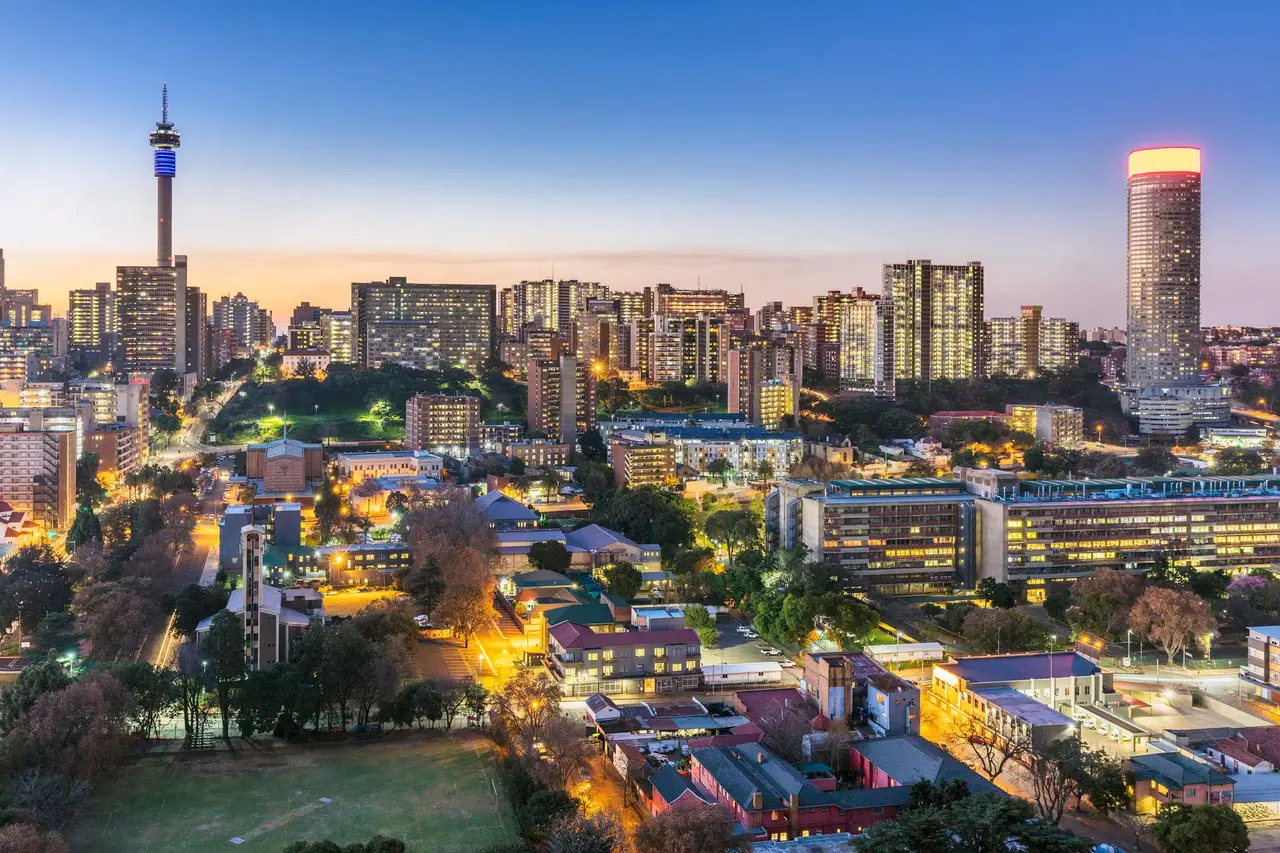
A 50-storey skyscraper in the heart of the historic centre. Its Top of Africa observation deck offers a panoramic view over the city and its mine dumps.

Melville Koppies

A nature reserve on a rocky ridge to the north-west, with marked trails and Iron Age remains. Guided walks on some Sundays, the best way to visit.

Orlando Towers

Two former power station cooling towers painted in bright murals in Soweto, now a landmark and a bungee jumping site between the two towers.

What to see in Johannesburg, neighbourhood by neighbourhood?

Soweto and Vilakazi Street

South-west of the centre, Soweto is the best-known township in South Africa and a must. Vilakazi Street is the only street in the world where two Nobel Peace Prize winners lived, Nelson Mandela and Desmond Tutu. Allow half a day to a full day for the Mandela House, the Hector Pieterson Memorial devoted to the 1976 student uprising and lunch in a local restaurant. The visit is best done with a guide who lives in the area, by bike or on foot, which also supports the local economy.

The city centre and Constitution Hill

The historic business district, long neglected, can be rediscovered with care and by day. Constitution Hill brings together the Old Fort prison, where Gandhi and Mandela were held, and the Constitutional Court built after 1994 with bricks from the former prison. Allow two to three hours with the guided tour. The Carlton Centre, long the tallest skyscraper in Africa, offers a view from its 50th floor. Avoid walking alone with a phone in hand and move between sites by Uber.

Maboneng and Braamfontein

East of the centre, Maboneng has turned old warehouses into galleries, cafés and workshops covered with murals; on Sundays, the Arts on Main market draws crowds and musicians. Braamfontein, at the foot of the University of the Witwatersrand, runs on student time: on Saturday mornings, the Neighbourgoods Market gathers street food and designers on a rooftop. Half a day per neighbourhood is enough. Both areas are lively by day and in the evening on their main streets, but their edges are much less so after dark.

Rosebank, Melville and the northern suburbs

The greener, safer residential suburbs in the north host most accommodation. Rosebank, served by the Gautrain, combines a shopping centre, art galleries and a Sunday rooftop market. Melville lines its 7th Street with bars, bookshops and small restaurants, a few minutes from the botanical garden and the Melville Koppies reserve. Sandton, the business district, is the most practical for a short stopover: the Gautrain station reaches the airport in about fifteen minutes.

The story of gold and apartheid

The city was born in 1886 from the discovery of the Witwatersrand gold reef, which turned it within a few decades into the country's economic capital. The Apartheid Museum, next to the Gold Reef City park, is the most powerful visit: allow at least two hours, and it is not recommended for young children. Your entry ticket randomly assigns you a skin colour, as under the racial classification regime. The converted former mining site also shows the other side of the gold rush.

Safety and getting around

Crime is high and the French Foreign Ministry calls for heightened vigilance in South Africa. Local rules are simple: do not walk at night, leave nothing visible in a car, keep windows up and doors locked at traffic lights, withdraw cash inside shopping centres. Public transport other than the Gautrain is poorly suited to visitors, and minibus taxis are best avoided. Uber and Bolt work well and remain affordable for all trips within the city, day or night.

Day trips and onward travel

The Cradle of Humankind, some fifty kilometres north-west, takes half a day with the Sterkfontein Caves and the Maropeng centre. Pretoria, the administrative capital, is about 40 minutes away by Gautrain. Pilanesberg, a malaria-free Big Five reserve, is roughly two and a half hours by road, Kruger National Park five hours. To continue, a flight of about two hours reaches Cape Town and Table Mountain, the natural next stop on a first trip.

Getting there

Airports serving Johannesburg, from main hubs to secondary ones.
  • AAMMalamala AirportMalamalaSecondary
  • AGZAggeneys AirportAggeneysSecondary
  • ALJAlexander Bay AirportAlexander BaySecondary
  • BIYBisho AirportBishoSecondary
  • FCBFicksburg Sentraoes AirportFicksburgSecondary
  • GCJGrand Central AirportMidrandSecondary

Practical information for Johannesburg

OR Tambo Airport

Africa's busiest airport, about 25 km east. The Gautrain reaches Sandton in about fifteen minutes, Rosebank and Park Station a little further on.

Gautrain

A fast train linking the airport, Sandton, Rosebank, the centre and Pretoria. Pay with a rechargeable Gautrain card or a contactless bank card at the gates.

Entry declaration

Since 1 July 2026, an online declaration (goods, currency) is required on entering and leaving the country, ideally within 24 hours before departure.

Passport

No visa for tourist stays under 90 days for French nationals, but two consecutive blank pages and at least 30 days of validity after departure are required.

Altitude

Around 1,750 metres: strong sun, cool nights in the southern winter (June to August) and a risk of early-morning frost.

Summer storms

From October to March, violent late-afternoon thunderstorms almost daily: schedule outdoor visits in the morning.

Water and power cuts

Localised water outages regularly affect some neighbourhoods. Hotels usually have tanks and generators, but it is worth checking.

Car guards

Informal attendants watch cars in car parks: a few rand on leaving is customary.

Tipping

10 to 15% in restaurants, rarely included; a small tip for petrol attendants too, who fill the tank for you.

Power sockets

Types M (three large round pins) and N, 230 V: an adapter is essential, as European ones are not always enough.

Johannesburg in pictures

Photo credits : Bertrand van der Berg, CC BY-SA 4.0, Wikimedia Commons ; Pia Andrews, CC BY 2.0, Wikimedia Commons ; Fata)(Morgana, CC BY 4.0, Wikimedia Commons ; Mihi tr, CC BY 4.0, Wikimedia Commons ; Francesco Bandarin, CC BY-SA 3.0 igo, Wikimedia Commons

Frequently asked questions about Johannesburg

Can you visit Soweto without a guide?
It is possible by Uber to Vilakazi Street, where the Mandela House, restaurants and the Hector Pieterson Memorial are concentrated. A guide who lives in Soweto, however, brings historical context, opens up less touristy areas and makes the visit more relaxed. Half-day bike tours are a good option.
Is the Apartheid Museum suitable for children?
The museum itself recommends visits from around 12 years old: some images of violence and repression are very harsh. With young children, favour the Mandela House in Soweto, which is more accessible, and keep the museum for the adults in the group.
Should you stay in Sandton or Rosebank?
Sandton is the most practical choice for a stopover thanks to the direct Gautrain to the airport, but it is a business district. Rosebank, also on the line, offers more restaurants and galleries and a nicer evening atmosphere, with a comparable level of safety.
Can you walk around Maboneng in the evening?
On Fox Street and around Arts on Main, there is real life in the early evening at weekends. Do not stray from lit, busy streets, and order an Uber to leave rather than walking back towards the centre.
How do you get to Pretoria from Johannesburg?
The Gautrain links Rosebank or Sandton to Pretoria station in about 40 minutes, with frequent departures. Once there, Uber serves the Union Buildings, the Voortrekker Monument and Freedom Park, which are too far apart to walk between.
Can you visit the Cradle of Humankind without a car?
Hardly: no public transport serves Maropeng or Sterkfontein. Rent a car, book a half-day tour or arrange a return Uber with waiting time. Guided tours of the Sterkfontein Caves leave at set times, so check the schedule before setting off.
Pilanesberg or Kruger from Johannesburg?
Pilanesberg, about two and a half hours away, can be done in a day and is outside the malaria zone. Kruger National Park, around five hours by road, deserves at least three nights on site. Short on time, Pilanesberg is the right compromise to see the Big Five.
Is Johannesburg worth a stopover or a real stay?
Two nights are enough for Soweto, the Apartheid Museum, Constitution Hill and a neighbourhood such as Maboneng. A third adds the Cradle of Humankind or Pretoria. Beyond that, it is better to move on to the national parks or the Cape region.
Do you need a 4x4 to drive around Johannesburg?
No: motorways and roads to Pretoria, Pilanesberg or Kruger are paved. Traffic drives on the left, an international driving permit is advised, and broken traffic lights are treated as a four-way stop. Avoid driving at night off the main roads.

Plan your trip to Johannesburg

Build your day-by-day itinerary and manage budget, bookings and packing in PlanTripNow.
Aperçu de l'application PlanTripNow