Skip to content

Visit Kathmandu : what to see, when to go and how many days to plan

At the bottom of a valley ringed by hills, Kathmandu packs seven UNESCO-listed zones within a few kilometres. Newar pagoda temples, Tibetan stupas, cremation ghats and spice bazaars sit side by side, before most travellers head off towards the trails of the Himalaya.

At a glance

Visa
Required
Tourist stay of up to 150 days
7-day budget
€315
Per person, comfort profile, excluding international flights.

Why visit Kathmandu?

Kathmandu is the capital of Nepal and the country's only major international air gateway, through Tribhuvan Airport. Its valley holds seven monument zones jointly inscribed by UNESCO in 1979, including the royal squares of Kathmandu, Patan and Bhaktapur. Three to four days are enough to see them without rushing.

When to visit Kathmandu

Temperatures, rainfall and crowds month by month, to pick your window.
When to visit Kathmandu
MonthTemperaturesRainCrowdsVerdict
January3 to 19 °C2 dQuietDry, sunny days around 19 °C, but nights close to freezing in guesthouses that are rarely heated; this is also the season of pollution peaks.
February5 to 22 °C3 dQuietA quiet, bright month; depending on the year, Losar livens up Boudha and Maha Shivaratri draws crowds of sadhus to Pashupatinath.
March9 to 26 °C4 dModerateSpring warmth and the first trek departures; dry haze often hides the peaks visible from the valley.
April12 to 29 °C7 dBusySpring high season, 28 °C in the afternoon; the Nepali New Year in mid-April launches Bisket Jatra and its chariots in Bhaktapur.
May16 to 29 °C12 dModerateHeavy heat and late-afternoon storms heralding the monsoon: visit the royal squares in the morning.
June19 to 30 °C17 dVery quietThe monsoon sets in: near-daily showers and muddy lanes, but almost empty temples and discounted rooms.
July20 to 29 °C23 dVery quietThe wettest month, close to 400 mm; roads to the rest of the country are often cut and domestic flights disrupted.
August20 to 29 °C23 dQuietStill deep in the monsoon, but the valley stays green and the Newar courtyards can be visited between showers.
September19 to 29 °C15 dModerateRain recedes late in the month and flights are at their cheapest; Indra Jatra parades the Kumari through the old town.
October14 to 27 °C4 dPackedClear skies, visible peaks and Dashain: the best month, but also the most expensive, with buses and hotels full.
November8 to 24 °C1 dPackedPractically rainless, with sharp light and Tihar lighting up the houses; Thamel overflows with trekkers.
December4 to 20 °C1 dModerateMild, dry afternoons and cold, hazy mornings; pollution rises again, so pack an FFP2 mask.
Source: Températures (moyennes des maxima, des minima et moyenne quotidienne) et jours de pluie (seuil 1 mm) : normales 1991-2020 de la station de l'aéroport Tribhuvan (1 337 m), reprises par Wikipedia d'après l'Organisation météorologique mondiale et le Department of Hydrology and Meteorology du Népal, relevé du 9 novembre 2026 ; jours de pluie arrondis. Ville enclavée : pas de température de la mer. Pollution de l'air : France Diplomatie, fiche santé Népal mise à jour le 15 septembre 2026 (niveaux parmi les plus élevés au monde, pics surtout en hiver). Prix : vols Paris-Katmandou sur Kayak, relevé du 9 novembre 2026 (septembre le mois le moins cher, 743 € en médiane ; octobre 1 011 € et décembre 1 003 € les plus chers). Dates des fêtes variables selon le calendrier lunaire. Affluence : estimation éditoriale.

Kathmandu's must-sees

Nine sites, all in the valley, to fill three or four days between royal squares, stupas and Hindu temples.

Hanuman Dhoka

Former royal palace on Kathmandu Durbar Square, surrounded by pagoda temples, carved courtyards and statues, including one of the monkey god Hanuman.

Kumari Ghar

Home of the Kumari, a young girl worshipped as a living goddess, who sometimes appears at the courtyard window; photographing her is strictly forbidden.

Swayambhunath

Hilltop stupa west of the city, full of monkeys, offering a view over the whole valley once you have climbed its long stairway.

Boudhanath Stupa

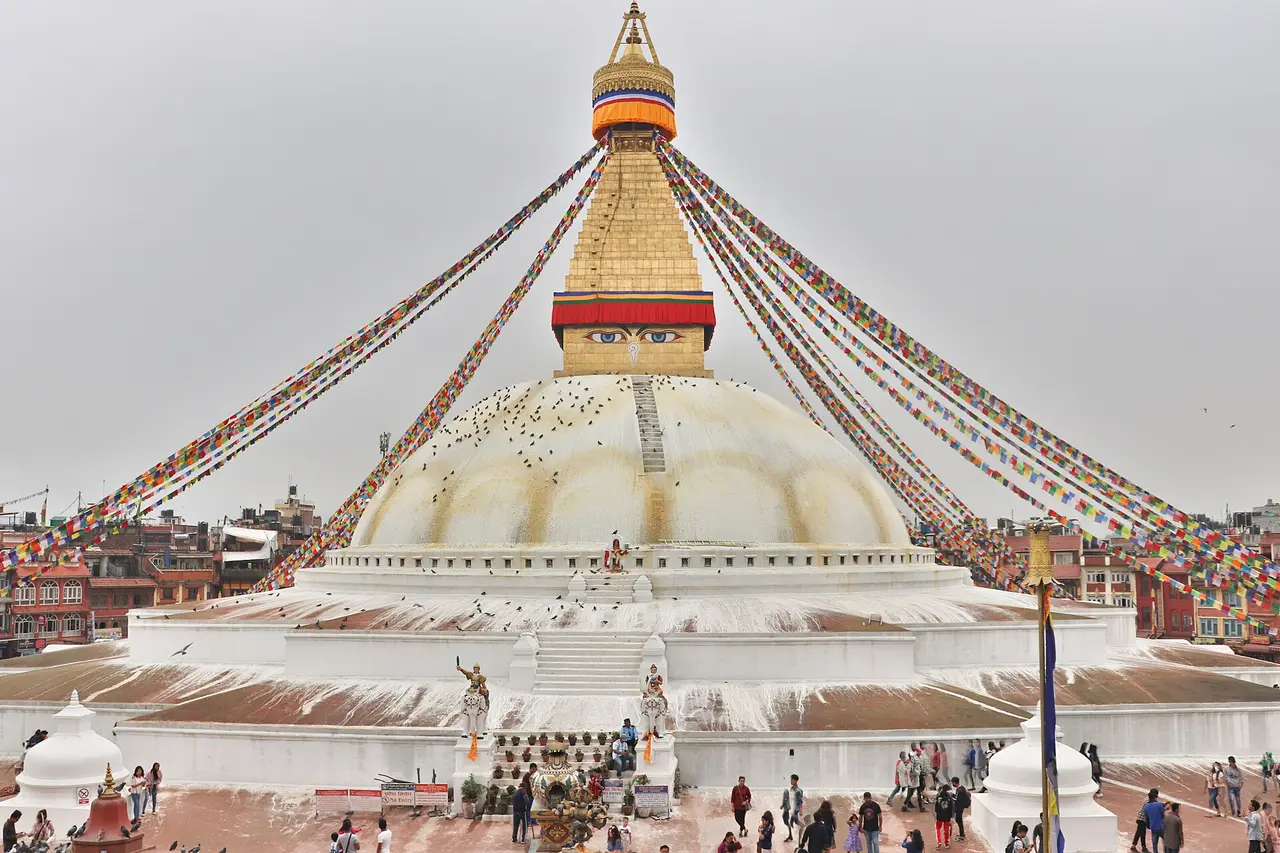
One of the largest stupas in the world, with Buddha's eyes painted on its golden tower, heart of the Tibetan community and its monasteries.

Pashupatinath

Great Shiva sanctuary on the Bagmati, with its cremation ghats and sadhus; entry to the main temple is reserved for Hindus.

Patan Durbar Square

Lalitpur's royal square lined with stone and wooden temples, including the Krishna Mandir, with the Patan Museum housed in the former palace.

Bhaktapur

Former royal city an hour's drive east, largely pedestrian, famous for the five-roofed Nyatapola temple and its potters' workshops.

Garden of Dreams

Restored neoclassical garden from the 1920s at the edge of Thamel, with pavilions, ponds and lawns, a calm refuge from the city's noise.

Changu Narayan

Vishnu temple perched above Bhaktapur, considered the oldest in Nepal, with a stone inscription dating back to the 5th century.

What to discover in Kathmandu?

Thamel and Freak Street, the travellers' districts

Thamel, north of the old town, gathers most of the capital's guesthouses, trekking agencies, gear shops and restaurants, about twenty minutes by taxi from the airport outside rush hour. It is the most practical base for a first stay, but also the district where the French foreign ministry reports scams aimed at tourists: compare agencies before booking a trek. Further south, Freak Street, or Jhochhen, keeps the memory of the 1970s hippie trail and is quieter. Plan a night here before and after any trip into the rest of Nepal.

The Newar old town, from Indra Chowk to Asan

Between Thamel and the royal square, a maze of lanes links market crossroads called tole, each with its own shrine. Asan, where six streets meet, has sold spices, rice and kitchenware for centuries; Indra Chowk lays out stalls of shawls and glass beads; Kel Tole shelters the Seto Machhendranath temple. The earthquake of 25 April 2015 brought down several central monuments, including the Kasthamandap pavilion and the Dharahara tower, both rebuilt since. Allow a morning on foot, starting early, before scooter traffic clogs the lanes.

The Bagmati riverbanks and Tibetan Boudha

To the east, the sacred Bagmati river runs past the Hindu complex of Pashupatinath, where cremations take place in the open on the ghats: the main temple is for Hindus only, but the opposite bank can be visited. Twenty minutes' walk away, Boudha is built around its great stupa and the monasteries founded by Tibetan refugees who arrived after 1959. Walk around the stupa clockwise, as pilgrims do, and come back late in the afternoon, when the kora is at its busiest. Half a day covers both sites.

Lalitpur, the bronze casters' city across the river

South of the Bagmati, Patan, officially Lalitpur, is a separate city that the urban sprawl has swallowed. Its royal square is the best preserved in the valley, and its former palace houses the Patan Museum, devoted to Nepalese religious art. The surrounding lanes still hide workshops casting bronze statues by the lost-wax method, and the Golden Temple, a 12th-century Buddhist monastery, sits in a nearby courtyard. A full day is not too much; many travellers sleep here to escape the noise of Thamel, twenty minutes away by taxi.

When to come: festivals, monsoon and air quality

October and November bring the clearest skies and coincide with Dashain, the great fifteen-day festival, then Tihar, the festival of lights: offices close and buses fill up, so book early. Indra Jatra, in September, parades the Kumari on her chariot through the old town. From December to February the sky stays dry but air pollution in the valley peaks, so bring a filtering mask; March to May, milder, opens the spring trekking season. From June to September the monsoon brings daily downpours and road closures towards the rest of the country.

A stopover, not an end: towards Pokhara, Everest or India

Few people see only the capital. The road to Pokhara and the Annapurna trails takes six to eight hours by tourist bus, against twenty-five minutes by plane. For Everest, flights to Lukla leave in high season from Ramechhap, four to five hours' drive away, not from Kathmandu itself. Many also combine Nepal with northern India: crossing the border at Sunauli, you reach the holy city of Varanasi in one to two days by road and train. Keep a night of margin before any international flight.

How much it costs

Per person per day, excluding international travel.
Budget
18 €/ day
1 952 € for 2 people, 7 days, return flights included
Accommodation
5 €
Food
7 €
Local transport
2 €
Sights and activities
4 €
Comfort
45 €/ day
2 330 € for 2 people, 7 days, return flights included
Accommodation
14 €
Food
15 €
Local transport
6 €
Sights and activities
10 €
Premium
157 €/ day
3 898 € for 2 people, 7 days, return flights included
Accommodation
62 €
Food
40 €
Local transport
20 €
Sights and activities
35 €
Prices checked: Relevé du 9 novembre 2026. Roupie népalaise convertie au taux officiel de la Nepal Rastra Bank du 9 novembre 2026 (1 € = 167,12 NPR à l'achat, 167,78 NPR à la vente) ; la BCE ne publie pas de taux pour la roupie népalaise. Repas et transport : Numbeo Katmandou, mise à jour du 6 novembre 2026, 1 045 relevés de 68 contributeurs sur 12 mois (repas bon marché 1,78 €, repas de milieu de gamme pour deux 19,31 €, bière locale 0,5 l 1,97 €, cappuccino 1,37 €, trajet en transport local 0,18 €, prise en charge taxi 1,49 € puis 1,07 € le km). Hébergement : lit en dortoir autour de 5 € (prix plancher médian de 24 auberges sur Hostelworld, page 2026 consultée le 9 novembre 2026, prix non datés) ; hôtel 3 étoiles 27 € et 5 étoiles 124 € la nuit en moyenne selon combien-coute.net (prix relevés en novembre 2026 sur des plateformes de réservation). Activités : droits d'entrée des étrangers relevés sur des sites d'agences et de guides 2026, non officiels et parfois contradictoires (place Durbar de Katmandou 1 000 NPR, Bhaktapur de 1 500 à 1 800 NPR selon les sources, Pashupatinath 500 à 1 000 NPR) ; le profil premium inclut guide et voiture privés, estimation éditoriale faute de grille officielle ; le vol panoramique au-dessus de l'Everest n'est pas compté. Vol A/R Paris-Katmandou hors vacances scolaires estimé à 850 € par personne (Kayak, relevé du 9 novembre 2026 : fourchette habituelle 770 à 1 085 €, moyenne annuelle 910 €, septembre 743 € en médiane, octobre et décembre au-delà de 1 000 € ; escales à Delhi, Doha, Istanbul ou Koweït). Hébergement par nuit et par personne : dortoir pour le profil routard, chambre double partagée à deux pour les autres. weekTwoPax = 7 jours x 2 personnes + 2 vols.

Getting there

Airports serving Kathmandu, from main hubs to secondary ones.
  • BWAGautam Buddha International AirportSiddharthanagarMain
  • KTMTribhuvan International AirportKathmanduMain
  • PHHPokhara International AirportPokharaMain
  • BIRBiratnagar AirportBiratnagarSecondary
  • JKRJanakpur AirportJanakpurSecondary
  • KEPNepalgunj AirportNepalgunjSecondary

Entry, health and safety

For FR travellers

Entry requirements

Visa required

Visa touristique obligatoire, à entrées multiples, muni de deux photos d'identité : à demander à l'ambassade du Népal à Paris avant le départ (tarifs affichés par l'ambassade : 30 € pour 15 jours, 50 € pour 30 jours, 125 € pour 90 jours) ou à obtenir à l'arrivée à l'aéroport Tribhuvan de Katmandou. Pour le visa à l'arrivée, France Diplomatie conseille de prévoir 200 USD ou l'équivalent en euros EN ESPÈCES, le paiement en ligne générant de longues files d'attente. Prolongeable sur place par périodes d'un mois, moyennant une taxe, jusqu'à 150 jours de séjour par année civile. Depuis 2026, hôtels, guesthouses, agences, compagnies aériennes et bureaux de change doivent enregistrer leurs clients étrangers dans une base de données gouvernementale.

Stay allowed for up to 150 days.

Passport valid for 6 months beyond your return date.

Health

Required: Fièvre jaune uniquement pour les voyageurs en provenance d'une zone d'endémie.

Advised: Vaccinations du calendrier français à jour (diphtérie, tétanos, poliomyélite, coqueluche, rougeole) ; selon la durée et les conditions du séjour, à discuter avec un médecin : hépatites A et B, typhoïde, rage, encéphalite japonaise.

Pollution de l'air de la vallée de Katmandou parmi les plus élevées au monde, avec des pics surtout en hiver : lors des pics, limiter les sorties et l'effort physique en extérieur, porter un masque filtrant N95, KN95 ou FFP2. Rage présente : consulter immédiatement après toute morsure ou griffure. Dengue (éviter les anti-inflammatoires en cas de fièvre) ; paludisme surtout présent dans le Teraï. Eau en bouteille capsulée ou rendue potable, fruits pelés, crudités à éviter. En trek au-delà de 2 500 m, pas plus de 400 m de dénivelé positif entre deux nuits ; guide agréé et carte TIMS obligatoires depuis le 31 mars 2023. Sécurité : tout le pays est en vigilance renforcée, sans zone déconseillée. À Thamel, arnaques fréquentes (proposition d'exporter bijoux ou or contre commission, suivie de chantage) et nombreux pickpockets ; éviter les agences qui démarchent à l'aéroport. Participation aux manifestations interdite aux étrangers. Risque sismique élevé ; de juin à octobre, la mousson peut couper routes, téléphone et internet plusieurs jours : laisser de la marge avant un vol international. Fiches France Diplomatie mises à jour le 15 septembre 2026.

Safety

Increased caution

Emergency

Ambassade de France à Katmandou +977 1 451 2332 (heures de bureau), urgence hors horaires +977 980 101 7201

Checked in novembre 2026 against the official source. Entry rules change: check the official source before you travel, it alone is authoritative.

Practical information for Kathmandu

Visa on arrival

Issued at Tribhuvan Airport against payment in cash dollars or euros, with passport photos; expect queues when flights from the Gulf land.

Royal square tickets

The squares of Kathmandu, Patan and Bhaktapur, as well as Swayambhunath, Boudhanath and Pashupatinath, each charge their own entry fee to foreigners, payable on site in rupees.

Direction of visit

Around stupas and prayer wheels, always walk clockwise, as pilgrims do.

Cremations at Pashupatinath

Watch from the east bank, stay discreet and avoid close-up photos of grieving families.

Air quality

Pollution among the highest in the world in the valley, peaking mainly in winter: an FFP2 filtering mask is advised, according to the French foreign ministry.

Taxis and apps

Agree on the fare before getting into a taxi; the Pathao app, which shows the fare in advance, and inDrive, where you offer your own price, both work in the valley.

Power sockets

230 V, type C, D and M sockets: a universal adapter is useful, and a power bank too for treks.

Time zone

UTC+5:45, one of the rare quarter-hour offsets: 3 h 45 ahead of Paris in summer, 4 h 45 in winter.

Kathmandu in pictures

Photo credits : Nabin K. Sapkota, CC BY-SA 4.0, Wikimedia Commons ; Rajesh Dhungana, CC BY-SA 4.0, Wikimedia Commons ; Ganesh Paudel, CC BY-SA 3.0, Wikimedia Commons ; shankar s. from Poona (pune), India, India, CC BY 2.0, Wikimedia Commons

Frequently asked questions about Kathmandu

How many days do you need in Kathmandu before a trek?
Three full days cover Durbar Square, Swayambhunath, Boudhanath, Pashupatinath and Patan, with Bhaktapur added if you stay a fourth day. In any case, keep a buffer night after the trek: domestic flights are often delayed by mountain weather.
Thamel or Patan: where to stay in Kathmandu?
Thamel is the most practical for a first stay, with trekking agencies, money changers and restaurants within walking distance. Patan suits a longer stay or a post-trek rest better: guesthouses in Newar houses, quiet evenings and the royal square nearby, twenty minutes by taxi from Thamel.
Can you see the Kumari in Kathmandu?
Yes, sometimes. The Kumari Ghar stands on Durbar Square and the girl appears briefly at the window of the inner courtyard, with no fixed schedule. All photography is forbidden while she appears. During Indra Jatra, in September, she is paraded on a chariot through the old town.
Can you watch the cremations at Pashupatinath?
You can watch them from the east bank of the Bagmati, opposite the ghats, with the foreigners' entry ticket. The main temple remains closed to non-Hindus. Wear covering clothes, keep your distance from families and do not point a telephoto lens at the deceased.
Did the 2015 earthquake destroy Kathmandu's temples?
The earthquake of 25 April 2015 brought down several monuments, including Kasthamandap and the Dharahara tower, and damaged all three royal squares. Most have since been rebuilt or restored. A few scaffoldings remain, but most of the valley can be visited normally.
Do you need a pollution mask in Kathmandu?
It is recommended, especially in winter and in traffic. The enclosed valley traps dust and fumes, and the French foreign ministry ranks its air pollution among the highest in the world. During peaks, limit outdoor exertion; FFP2 masks are easy to find in Thamel.
How do you get from Tribhuvan Airport to Thamel?
By taxi from the prepaid counter in the arrivals hall or through the Pathao app, for a ride of twenty minutes to an hour depending on traffic. Many Thamel guesthouses also offer a pickup if you give them your flight number when booking.
When can you experience Dashain and Tihar in Kathmandu?
Dashain usually falls in late September or October and lasts fifteen days, followed by Tihar, the festival of lights, in October or November, according to the lunar calendar. The city empties during Dashain, shops close and buses are fully booked: reserve transport and rooms well ahead.
Is the Everest mountain flight from Kathmandu worth it?
For non-trekkers, it is the only way to see Everest in a single morning. Nepalese airlines take off from Tribhuvan at dawn and follow the range for about an hour. Book a departure in October or November and keep a spare day, as weather cancellations are common.
Bhaktapur or Patan if you only have one day?
Bhaktapur, further away and largely pedestrian, gives the most complete picture of a Newar town, but its ticket is the most expensive in the valley. Patan, closer, combines with an afternoon in Kathmandu and has the best museums. With two days, do both.

Plan your trip to Kathmandu

Build your day-by-day itinerary and manage budget, bookings and packing in PlanTripNow.
Aperçu de l'application PlanTripNow