Skip to content

Visiting Luxor : what to see on both banks of the Nile

On the east bank, the columns of Karnak and Luxor Temple lit up at night. On the west bank, the painted tombs of the pharaohs cut into the Theban hills. In between, feluccas gliding along the Nile at sunset.

At a glance

Visa
Required
7-day budget
€630
Per person, comfort profile, excluding international flights.
Recommended length
3 days
For a first trip, without rushing.

How many days do you need in Luxor?

Three full days: one for the east bank (Karnak, Luxor Temple, the museum), one for the Valley of the Kings and Deir el-Bahari, and one for Medinet Habu, Deir el-Medina and the Valley of the Queens. It is the densest site in pharaonic Egypt, and two days means giving up half of the west bank.

When to visit Luxor

Temperatures, rainfall and crowds month by month, to pick your window.
When to visit Luxor
MonthTemperaturesRainCrowdsVerdict
January7 to 23 °C0 dBusy23 °C days ideal for the west bank, but 7 °C at dawn: bring a fleece for the balloon flight.
February9 to 25 °C0 dBusyDry skies and 25 °C afternoons: the Valley of the Kings stays pleasant until late morning, queues included.
March13 to 30 °C0 dBusyClose to 30 °C at midday: visit early, and balloon flights are sometimes cancelled when the wind picks up.
April18 to 35 °C0 dModerateTemperatures reach 35 °C: west bank at opening time, a break in the afternoon, Luxor Temple in the evening.
May22 to 39 °C0 dQuietNearly 40 °C in the afternoon and unventilated tombs: the tourist season winds down and prices fall.
June25 to 41 °C0 dVery quietA 41 °C furnace: near-empty sites and rock-bottom hotel rates, only for travellers who cope with heat.
July26 to 41 °C0 dVery quietThe hottest month: sightseeing limited to early morning, and even nights stay above 25 °C.
August26 to 41 °C0 dQuietStill 41 °C, though a few holidaying families arrive; hotel rates remain very low.
September23 to 39 °C0 dQuietHeat stays close to 40 °C: a good deal for anyone after empty temples and low prices.
October20 to 36 °C0 dModerateThe season restarts with mild 20 °C nights; afternoons still top 35 °C.
November13 to 29 °C0 dBusyOne of the best months: 29 °C days, cool mornings for the balloon flight, Nile cruises well booked.
December9 to 24 °C1 dPackedPeak crowds around Christmas: an ideal 24 °C, but book hotels and boats well in advance.
Source: Normales 1991-2020, station 62405 aéroport international de Louxor (Autorité météorologique égyptienne / normales OMM publiées par la NOAA), via le tableau climatique de Wikipédia « Luxor », relevé le 14 octobre 2026. Jours de pluie arrondis (moins d'un jour par mois sauf en décembre). Ville intérieure sur le Nil : pas de température de la mer. Affluence et prix estimés selon la haute saison touristique d'octobre à avril.

Luxor's must-see sites

Cult temples on one side of the river, tombs and mortuary temples on the other.

Karnak Temple

The largest religious complex of ancient Egypt, extended over two millennia, with its hypostyle hall of 134 giant columns covered in hieroglyphs.

Luxor Temple

In the heart of the city, this temple dedicated to Amun keeps one obelisk, its twin standing in Paris's Place de la Concorde, and can also be visited at night.

Valley of the Kings

The rock-cut tombs of the New Kingdom pharaohs, including those of Tutankhamun and Seti I, with corridors covered in still-vivid paintings.

Hatshepsut's Temple

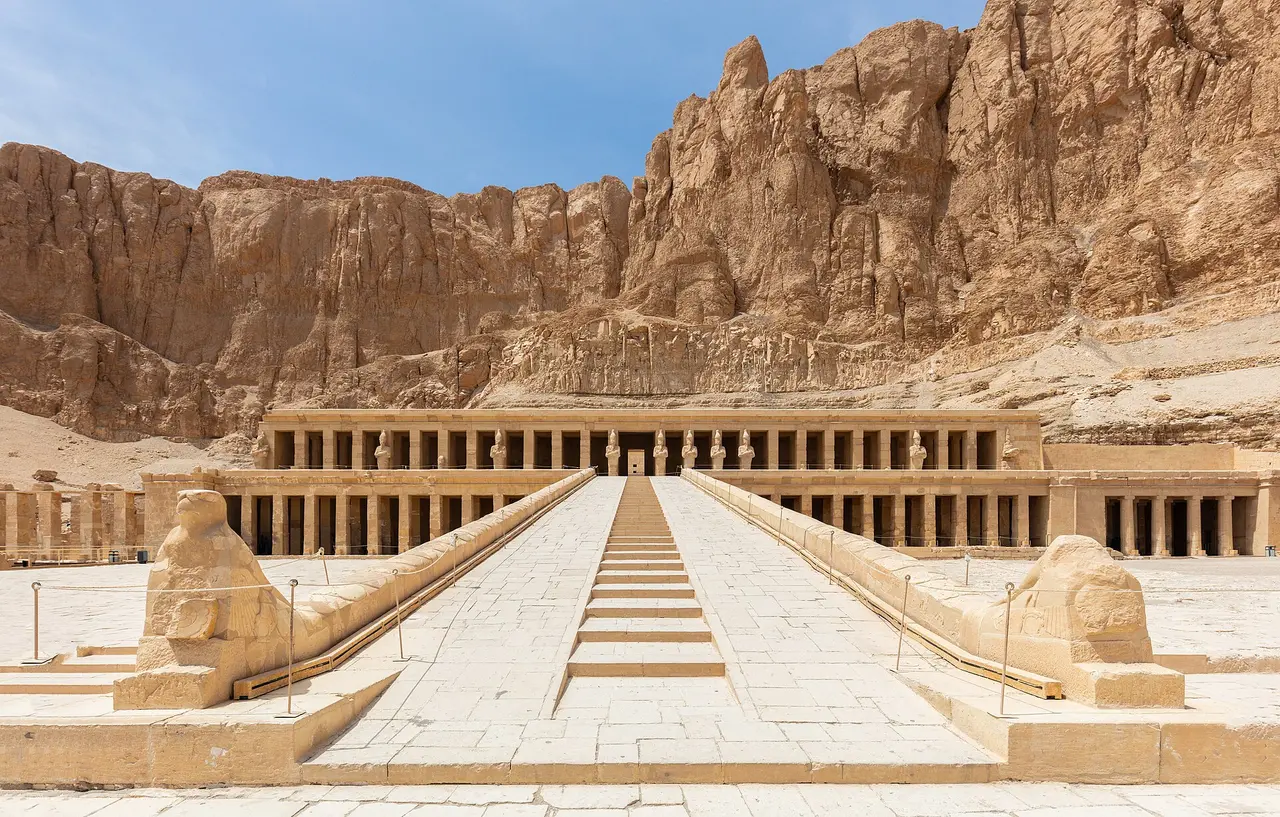
At Deir el-Bahari, three terraces set against the cliff celebrate the female pharaoh, in architecture that looks strikingly modern; go at opening time, before the heat.

Tomb of Nefertari

In the Valley of the Queens, the burial place of Ramesses II's wife holds some of the best-preserved paintings in Egypt, on a separate ticket.

Medinet Habu

The mortuary temple of Ramesses III, less crowded than its neighbours, keeps battle reliefs and remarkably well-preserved colours under its ceilings.

Deir el-Medina

The village of the craftsmen who dug the royal tombs, with their own burials painted with scenes of daily life and the afterlife.

Colossi of Memnon

Two seated statues of Amenhotep III, the only survivors of a vanished temple, standing beside the fields on the road to the west bank.

Luxor Museum

On the corniche, an airy museum displaying statues and objects found at Thebes, useful for understanding the sites before or after your visits.

How to plan your time in Luxor

The east bank, between the corniche and the souk

This is where you sleep, eat and visit the two great temples of ancient Thebes. The Avenue of Sphinxes, reopened in 2021, links Luxor Temple to Karnak over about 2.7 km: allow 40 minutes on foot, ideally late in the day. The corniche follows the Nile up to the museum, and the souk starts just behind the temple. Horse-drawn carriages wait everywhere: agree on the price and duration before climbing in, as haggling is part of the ride.

The west bank, from necropolises to villages

Facing the city lies the Theban necropolis: the Valleys of the Kings and Queens, mortuary temples and craftsmen's villages. You cross in a few minutes on the public ferry, which leaves near Luxor Temple, or over the bridge south of town. Once there, hire a taxi for the day rather than taking separate rides, as the sites are several kilometres apart. Some travellers prefer to stay on the west side, in quieter guesthouses, to be first in line at opening time.

Tickets, passes and extra-charge tombs

Each site sells its own ticket, and the Valley of the Kings works separately: the standard ticket covers three tombs of your choice. Tutankhamun and Seti I cost extra, the latter being one of the most expensive visits in the country. For three intensive days, the Luxor Pass, sold at ticket offices on presentation of your passport and a photo, bundles most of the city's sites. Check current prices on the ministry's official website, as they change often.

Living with the heat

Luxor is one of the hottest cities in Egypt: from June to August, afternoons regularly exceed 40 °C. The ideal season runs from October to April, with cool nights in December and January, when a fleece is welcome at dawn. Whatever the season, visit the west bank as soon as it opens around 6am, take a break in the hottest hours and save Luxor Temple for the evening, when it is floodlit. Carry at least two litres of water per person on the west bank, where shade is scarce.

Sunrise balloon flights: what to know

Flights take off from the west bank at sunrise, with hotel pick-up around 4.30am, and usually last 40 minutes to an hour over the temples and sugar cane fields. The activity is supervised by Egypt's civil aviation authority, which cancels flights when the wind picks up, as it did in March 2026. After the 2013 accident, which killed 19 people, checks were tightened. Book with a well-established operator and keep a spare day in your schedule.

Sailing up the Nile, arriving from Cairo

Luxor is about an hour's flight from Cairo, or one night on the sleeper train. It is also the classic starting point for cruises to Aswan: four nights going from Luxor to Aswan, three the other way, with stops at Edfu and Kom Ombo and a passage through the Esna lock. Dahabiyas, sailing boats with a handful of cabins, take about five days. France Diplomatie rules out driving at night outside towns: travel by road in daylight, with a driver.

Sample itineraries

Three routes built around the time you actually have.
3daysRecommended

Luxor in 3 days: east bank, Valley of the Kings and the lesser-known west bank

  1. Karnak, the Avenue of Sphinxes and Luxor Temple
  2. Sunrise balloon, Valley of the Kings and Deir el-Bahari
  3. Medinet Habu, Deir el-Medina and the Valley of the Queens

Best for: The benchmark stay for seeing Thebes without rushing: one day of temples on the east bank and two mornings on the west bank, one of them for the sites the cruises skip. Can be followed by a cruise to Aswan.

How much it costs

Per person per day, excluding international travel.
Budget
38 €/ day
1 092 € for 2 people, 7 days, return flights included
Accommodation
10 €
Food
9 €
Local transport
4 €
Sights and activities
15 €
Comfort
90 €/ day
2 180 € for 2 people, 7 days, return flights included
Accommodation
30 €
Food
20 €
Local transport
10 €
Sights and activities
30 €
Premium
280 €/ day
5 120 € for 2 people, 7 days, return flights included
Accommodation
120 €
Food
50 €
Local transport
30 €
Sights and activities
80 €
Prices checked: Relevé du 14 octobre 2026. Taux : environ 59 EGP pour 1 EUR (cours de vente des banques égyptiennes Banque Misr, Al Ahly, CIB publiés par Dostor le 9 octobre 2026 ; la BCE ne publie pas de cours EUR/EGP et le site de la Banque centrale d'Égypte n'était pas accessible). Hébergement et repas : agrégateurs non officiels, BudgetYourTrip (non daté, dortoir ~6 USD, hôtel ~30 USD, repas ~16 USD/jour) et Wego, juin 2026 (chambre petit budget dès 20 USD à Louxor, 50 EGP pour 1 USD). Activités : billets de sites de 450 à 750 EGP selon des guides 2026 non officiels (machupicchu.org, Wego), tarifs officiels du ministère du Tourisme et des Antiquités non consultables ; montgolfière de 85 à 120 USD selon les annonces de TourRadar, incluse au prorata en premium. Vol A/R Paris-Louxor : KAYAK, données des 12 derniers mois consultées le 14 octobre 2026 (médiane de décembre 281 EUR, moyenne 457 EUR, médiane d'octobre 602 EUR) ; retenu 280 EUR backpacker, 460 EUR comfort, 600 EUR premium par personne. Chambre double partagée à deux pour comfort et premium, lit en dortoir ou chambre simple partagée pour backpacker. Livre égyptienne soumise à une forte inflation : à revalider tous les 3 à 4 mois.

Getting there

Airports serving Luxor, from main hubs to secondary ones.
  • AACEl Arish International AirportEl ArishMain
  • ASWAswan International AirportAswanMain
  • ATZAsyut International AirportAsyutMain
  • CAICairo International AirportCairoMain
  • DBBEl Alamein International AirportEl AlameinMain
  • EESBerenice International Airport / Banas Cape Air BaseBerenice TroglodyticaMain

Entry, health and safety

For FR travellers

Entry requirements

Visa required

Visa obligatoire, de préférence obtenu à l'arrivée en Égypte (30 USD ou l'équivalent en euros pour une entrée simple, 60 USD pour des entrées multiples), payable exclusivement en espèces en devises à l'aéroport, ou demandé bien avant le départ auprès d'un consulat d'Égypte en France. Durée initiale d'un mois, prolongeable au bureau de l'immigration avec un passeport. Passeport ou carte d'identité valide au moins six mois après le retour, avec deux photos d'identité ; avec la carte d'identité seule, le visa ne peut pas être prolongé.

Passport valid for 6 months beyond your return date.

Health

Advised: Mise à jour du calendrier vaccinal (diphtérie, tétanos, polio, coqueluche, rougeole). Selon la durée et les conditions du séjour : hépatite A, fièvre typhoïde, méningite ACWY, rage (jeunes enfants, séjours ruraux), hépatite B.

Fièvre jaune exigée seulement en provenance d'une zone d'endémie. Dengue et Zika transmises par les moustiques : protection contre les piqûres, pas d'anti-inflammatoire en cas de fièvre. Eau en bouteille scellée uniquement (fièvre typhoïde). Chaleur extrême à Louxor de mai à septembre : s'hydrater et éviter les heures les plus chaudes. Après une morsure ou griffure, consulter sans délai un hôpital public. Hors des centres urbains et des sites touristiques, la circulation de nuit est formellement déconseillée, y compris en bus : excursions (Dendérah, liaison vers Assouan) à faire de jour.

Safety

Increased caution

Checked in octobre 2026 against the official source. Entry rules change: check the official source before you travel, it alone is authoritative.

Luxor practical information

Egyptian visa

Tourist visa required for French citizens, 30 USD on arrival at the airport or from a consulate; passport valid for six months

Airport

Luxor International Airport, east of the city, with daily flights from Cairo and a few seasonal direct links to Europe

Currency

Egyptian pound (EGP); keep small notes for tips, carriages and the ferry

Extra-charge tombs

Tutankhamun, Seti I and Nefertari are not included in the basic tickets for the Valley of the Kings and the Valley of the Queens

Photos in the tombs

Phone photos allowed without flash; tripods and professional equipment require a permit

Carriages and feluccas

Agree on price and duration before setting off; an hour's sunset felucca ride is negotiated directly on the corniche

Baksheesh

Guards who open a chamber or offer a photo expect a tip; politely decline if you do not want the service

Tap water

Not drinkable: sealed bottled water, including for brushing teeth, and caution with ice

Luxor in pictures

Photo credits : Diego Delso, CC BY-SA 4.0, Wikimedia Commons ; Vyacheslav Argenberg, CC BY 4.0, Wikimedia Commons ; Jorge Láscar from Melbourne, Australia, CC BY 2.0, Wikimedia Commons

Luxor FAQ

Does the Valley of the Kings ticket include Tutankhamun's tomb?
No. The standard ticket covers three tombs of your choice among those open that day. Tutankhamun and Seti I, considerably more expensive, are bought as extras at the same ticket office. The list of open tombs rotates regularly to protect the paintings.
Is the Luxor Pass worth it?
It pays off if you stay at least three days and plan to see Seti I or Nefertari, both included in the premium version. It is sold at the Karnak or west bank ticket offices with your passport and an ID photo, and paid in foreign currency. For a two-day visit limited to the main sites, single tickets are enough.
Is a hot air balloon ride over Luxor safe?
Flights are supervised by Egypt's civil aviation authority, which suspends them whenever the wind is too strong. Rules were tightened after the 2013 accident. Choose a well-established operator rather than the cheapest offer, and do not schedule the flight the day before you leave in case it is cancelled.
Luxor to Aswan cruise: which direction should you choose?
Starting in Luxor usually gives four nights on board versus three from Aswan, leaving more time for the stops at Edfu and Kom Ombo. Either way, plan at least two days in Luxor outside the cruise, as the boat's excursions only cover part of the west bank.
How do you get to Luxor's west bank?
The public ferry, which leaves near Luxor Temple, crosses in a few minutes for a few pounds. A private motorboat costs more but leaves whenever you want. By car you have to use the bridge south of town, which is why a taxi booked for the day on the other bank makes sense.
Can you visit Luxor in July or August?
Yes, but afternoon temperatures often exceed 40 °C. Pack your visits between opening around 6am and 11am, go back to the hotel in the hottest hours and head out in the evening for Luxor Temple. Hotel prices drop noticeably, and the sites are far less crowded.
Can you see Dendera on a day trip from Luxor?
Yes. The Temple of Hathor at Dendera, known for its astronomical ceiling, is about an hour and a half's drive north. Leave early with a driver and return before dark, as France Diplomatie advises never driving at night outside towns.

Plan your trip to Luxor

Build your day-by-day itinerary and manage budget, bookings and packing in PlanTripNow.
Aperçu de l'application PlanTripNow