Skip to content

Visiting Malacca : what to do in the historic Straits city

A red Dutch square, the remains of a Portuguese fortress, Chinese temples and Peranakan shophouses lining a river: Malacca tells six centuries of maritime trade. Two days are enough for its UNESCO-listed centre, ideally on weekdays.

Why visit Malacca?

Founded around 1400, the Malacca sultanate controlled one of the world's busiest straits before being taken by the Portuguese in 1511, then by the Dutch in 1641 and the British. Its historic centre has been UNESCO-listed since 2008, together with George Town, for this unique blend.

Malacca must-sees

Colonial landmarks, temples and museums, nearly all within fifteen minutes' walk of each other.

Stadthuys

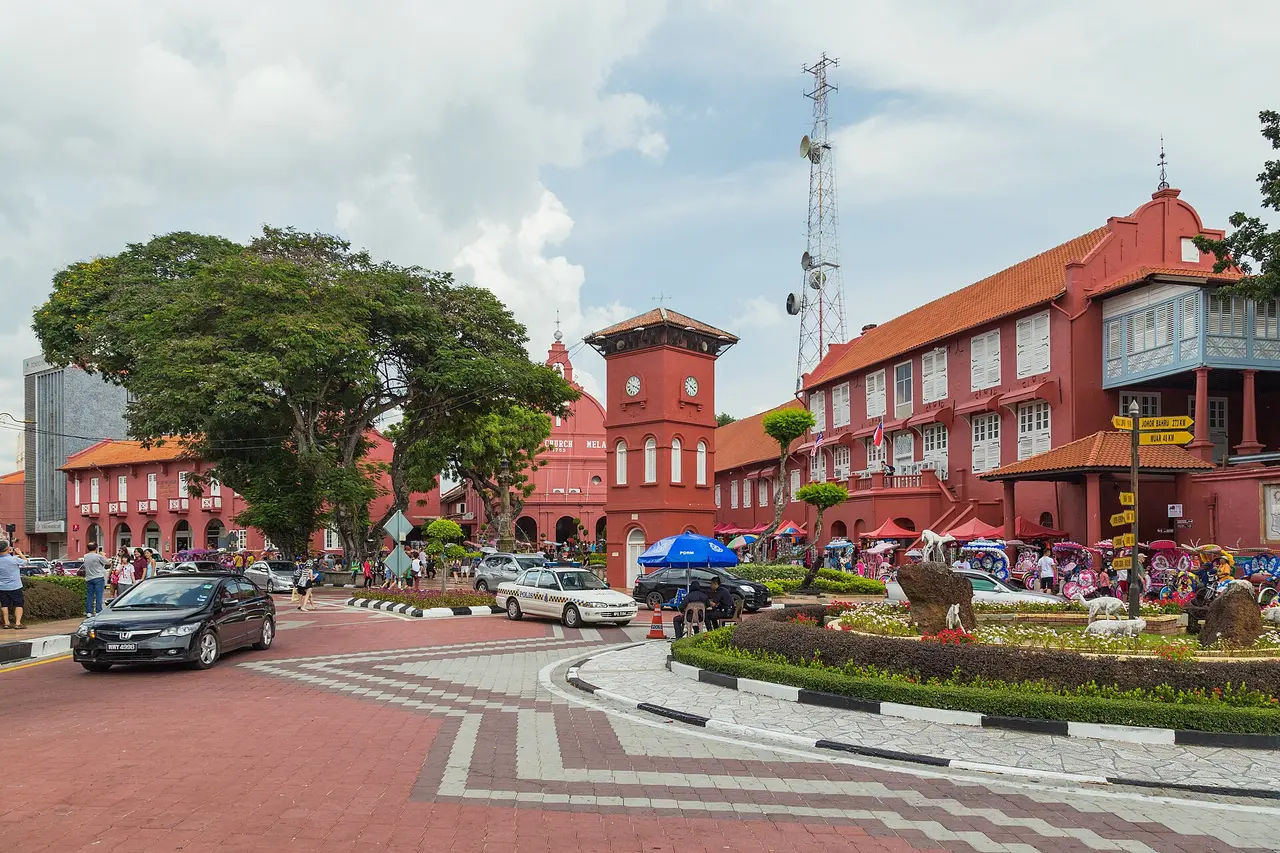
A mid-17th-century Dutch town hall painted red, considered one of the oldest Dutch buildings in Asia. It now houses a history museum.

Christ Church

An Anglican church completed by the Dutch in 1753, in red brick, with single-piece beams and old tombstones set into the floor.

Porta de Santiago

The only surviving gate of the Portuguese fortress A Famosa, built in 1511 and largely demolished by the British in the early 19th century.

Cheng Hoon Teng Temple

Founded in the 17th century, considered the oldest functioning Chinese temple in Malaysia, known for its woodwork, lacquer and carved roofs.

Baba Nyonya Museum

The still-furnished home of a wealthy Peranakan family on the former Heeren Street. A guided tour is recommended to understand this community's culture and rituals.

Jonker Street market

A night market from Friday to Sunday evening, with food stalls, crafts and antiques. Very busy: come at opening time to move around more easily.

Kampung Kling Mosque

An 18th-century mosque blending a Sumatran tiered roof, a pagoda-like minaret and ceramic tiles, open to visitors in modest dress.

What to see in Malacca, neighbourhood by neighbourhood?

St Paul's Hill and the colonial core

The historic centre sits on one bank of the river: the Dutch Square with its red buildings, St Paul's Hill and the museums at its foot. At the top, the ruins of a church built by the Portuguese in the 16th century overlook the strait, a ten-minute climb up shaded steps. The British razed most of the fortress in 1807; one gate remains. Allow half a day for all the monuments, best visited early in the morning or late in the afternoon, as the midday heat is intense.

Chinatown and Harmony Street

Across the bridge, the Chinese quarter lines up narrow, deep shophouses built by merchants between the 18th and early 20th centuries. Jalan Tokong, nicknamed Harmony Street, brings together a Chinese temple, a mosque and a Hindu temple within a few dozen metres, a sign of the communities living side by side. Jalan Tun Tan Cheng Lock, the former Heeren Street, keeps the finest mansions of wealthy Peranakan families. The area takes two to three hours on foot and remains the most pleasant place to stay.

The Malacca riverbanks

The river has been redeveloped into a walkway several kilometres long, lined with murals, cafés and restored old houses. A cruise of about 45 minutes runs upstream from the centre to more residential areas, at its most striking in the evening when the banks light up. On foot, the loop between the Dutch Square and Kampung Morten takes about an hour. It is the best way to escape the busy centre at weekends and spot monitor lizards basking on the banks.

Kampung Morten, a Malay village in town

About twenty minutes' walk north of the centre, along the river, Kampung Morten keeps traditional Malay stilt houses of painted wood, built from the 1920s onwards. Some welcome visitors, including Villa Sentosa, turned into a small family museum by its owners. The village is lived in: be discreet, dress modestly and avoid Friday prayer times. Allow an hour, ideally combined with the river cruise, which stops nearby.

The Portuguese Settlement and its community

South-east of the centre, about 3 kilometres away, the Portuguese Settlement is home to descendants of the Luso-Malays, some of whom still speak Kristang, a Portuguese-based creole. The area comes alive mainly in the evening and during the São Pedro festival in late June, with decorated boats and dancing. Seafront seafood restaurants serve dishes specific to this community, such as devil curry. Take a taxi or ride-hailing car, as the walk is unpleasant in the heat.

Peranakan cooking and night markets

Malacca is one of the capitals of Nyonya cuisine, born from the blending of Chinese merchants and Malay culture: coconut milk Nyonya laksa, ayam pongteh and colourful kuih. Chicken rice balls and cendol with gula melaka palm sugar are local specialities, as is satay celup, skewers dipped in a peanut sauce. The best places often open only for lunch and close once everything is sold. For a taste of flavours from all over Malaysia, the weekend night market remains the most convenient option.

Getting there

Airports serving Malacca, from main hubs to secondary ones.
  • BKIKota Kinabalu International AirportKota KinabaluMain
  • IPHSultan Azlan Shah AirportIpohMain
  • JHBSenai International AirportJohor BahruMain
  • KCHKuching International AirportKuchingMain
  • KULKuala Lumpur International AirportSepangMain
  • LGKLangkawi International AirportLangkawiMain

Practical information for Malacca

From Kuala Lumpur

About 2 hours by bus from TBS bus terminal or KLIA airport to Melaka Sentral bus station, north of town.

Train

No station in town: the nearest is on the main line, several dozen kilometres away, to be completed by taxi.

Weekends

Heavy crowds from Kuala Lumpur and Singapore: visit the monuments on weekdays, but stay a Friday or Saturday night for the night market.

Seasonal haze

Pollution episodes caused by regional forest fires, flagged by France Diplomatie in September 2026: check the air quality index.

Entering Malaysia

MDAC digital arrival card to be completed online in the days before arrival for most foreign travellers.

Places of worship

Shoulders and knees covered, shoes off in temples and mosques; robes lent at the entrance of some mosques.

Trishaws

Decorated pedicabs with sound systems around the Dutch Square: agree on price and duration before getting in.

Power sockets

Type G with three rectangular pins, 240 V: an adapter is needed.

Tap water

Treated but rarely drunk as is: prefer filtered or bottled water.

Tipping

Not expected; a 10% service charge often appears on the bill in air-conditioned restaurants.

Malacca in pictures

Photo credits : Marcin Konsek, CC BY-SA 4.0, Wikimedia Commons ; Philip Nalangan, CC BY 4.0, Wikimedia Commons ; CEphoto, Uwe Aranas, CC BY-SA 3.0, Wikimedia Commons

Frequently asked questions about Malacca

Can Malacca be done as a day trip from Kuala Lumpur?
It is possible, with about four hours of bus travel return, but you then only see the Dutch Square and Chinatown in the full heat. A night in town lets you enjoy riverside evenings and, at weekends, the night market.
Which days is the Jonker Street night market held?
Friday, Saturday and Sunday evenings, from late afternoon. The street is then closed to traffic and the crowd gets dense after dark, especially on Saturdays. Keep your belongings in front of you and come early to eat in peace.
Can you reach Singapore from Malacca by bus?
Yes, direct buses link Malacca to Singapore in several hours, depending on the wait at the Johor Bahru border posts, often long at weekends and during school holidays. Leave early in the morning and on a weekday to limit border congestion.
Is it worth climbing St Paul's Hill?
Yes, the climb takes only a few minutes via the staircase behind the Stadthuys. The church ruins hold Dutch tombstones propped against the walls, and the top offers a view over the town and the strait, nicer at the end of the day.
What typical food should you try in Malacca?
Chicken rice balls, satay celup, Nyonya laksa and cendol with gula melaka, the local palm sugar that also flavours many desserts. Peranakan restaurants in Chinatown serve ayam pongteh and tamarind fish, signature dishes of this cuisine.
Where to stay in Malacca to do everything on foot?
In Chinatown or along the river, near Jonker Street: most monuments are less than fifteen minutes' walk away. Several old shophouses have been turned into boutique hotels, but some are not soundproofed on market nights.
Is the Malacca River cruise worth it?
Yes for a first overview: in about 45 minutes it passes the murals, old houses and Kampung Morten. Choose an early evening departure, when the heat eases and the banks light up; the queue grows noticeably at weekends.
Are the tombstones in Christ Church original?
Yes, the church floor incorporates old Armenian and Dutch tombstones, and each ceiling beam is cut from a single piece. The church, still used for Anglican worship, holds Sunday services: visit outside service times.
What is the best season for Malacca?
The equatorial climate stays hot and humid all year, with frequent showers. February to April is often among the driest months. If possible, avoid Malaysian and Singaporean long holiday weekends, when hotels and roads are saturated.

Plan your trip to Malacca

Build your day-by-day itinerary and manage budget, bookings and packing in PlanTripNow.
Aperçu de l'application PlanTripNow