Skip to content

Visiting Melbourne : laneways, coffee and big stadiums

Melbourne does not reveal itself at a glance: you discover it by stepping into a tagged laneway, a hidden cafe or a basement bar. Add the NGV, the MCG, bohemian Fitzroy and the St Kilda penguins, then keep a day free for the Great Ocean Road.

At a glance

Visa
Required
Tourist stay of up to 90 days
7-day budget
€1,155
Per person, comfort profile, excluding international flights.
Recommended length
3 days
For a first trip, without rushing.

Why visit Melbourne?

The second city of Australia and capital of the state of Victoria, Melbourne spreads around the head of Port Phillip Bay, on both banks of the Yarra. It claims the world's largest tram network, the country's oldest public art gallery and the unofficial title of cultural capital of Oceania.

When to visit Melbourne

Temperatures, rainfall and crowds month by month, to pick your window.
When to visit Melbourne
MonthTemperaturesRainCrowdsVerdict
January15 to 26 °C6 dPackedAustralian Open, summer holidays and long evenings: the city lives outdoors, but central hotels charge their highest rates and a hot northerly can push the mercury past 40C.
February15 to 26 °C5 dModerateThe driest month and the warmest water in the bay: ideal for St Kilda and the Great Ocean Road once school is back. Keep an eye on bushfire warnings.
March13 to 24 °C6 dBusyA bright late summer, but the Albert Park Grand Prix and the comedy festival fill the hotels: book early or aim for the second half of the month.
April10 to 21 °C7 dModerateA mild 20C autumn, with Yarra Valley vines turning red and the harvest under way; the Easter holidays lift crowds for a few days.
May8 to 17 °C8 dQuietCool, often grey days, but the museums, cafes and music venues are in full swing and prices drop noticeably.
June6 to 15 °C9 dVery quietThe start of the southern winter at 14C: the cheapest season for a city best enjoyed indoors, between the NGV, laneway bars and AFL matches.
July6 to 14 °C8 dQuietThe coldest month, with frequent wind and showers; the July school holidays bring a little more life to the museums. The Great Ocean Road stays beautiful but windy.
August6 to 15 °C9 dVery quietStill a cool winter, though the days are getting longer, rates are at their lowest and the international film festival is on.
September7 to 17 °C10 dModerateEarly spring and the month with the most rainy days; the AFL Grand Final and the late-September school holidays push prices up at the end of the month.
October9 to 20 °C9 dQuietA 20C spring, gardens in bloom and changeable weather, the famous four seasons in one day: pack layers.
November11 to 22 °C8 dModerateA great time for walking and going out, but Melbourne Cup week in early November sends hotel prices soaring.
December13 to 24 °C6 dBusyEarly summer and packed terraces; the festive season and the start of the long holidays fill the Great Ocean Road and Phillip Island from Christmas onwards.
Source: Hémisphère sud : l'été austral va de décembre à février. Normales 1991-2020 de la station de Laverton (climatestotravel.com, relevé octobre 2026) pour les températures, les jours de pluie et la température de la mer dans la baie de Port Phillip. Affluence et prix : vacances scolaires du Victoria, Open d'Australie en janvier, Grand Prix de Formule 1 en mars, finale de l'AFL fin septembre et Melbourne Cup début novembre.

Melbourne's must-sees

Eight experiences that tell the city's story, from its laneways to its grandstands.

Hosier Lane

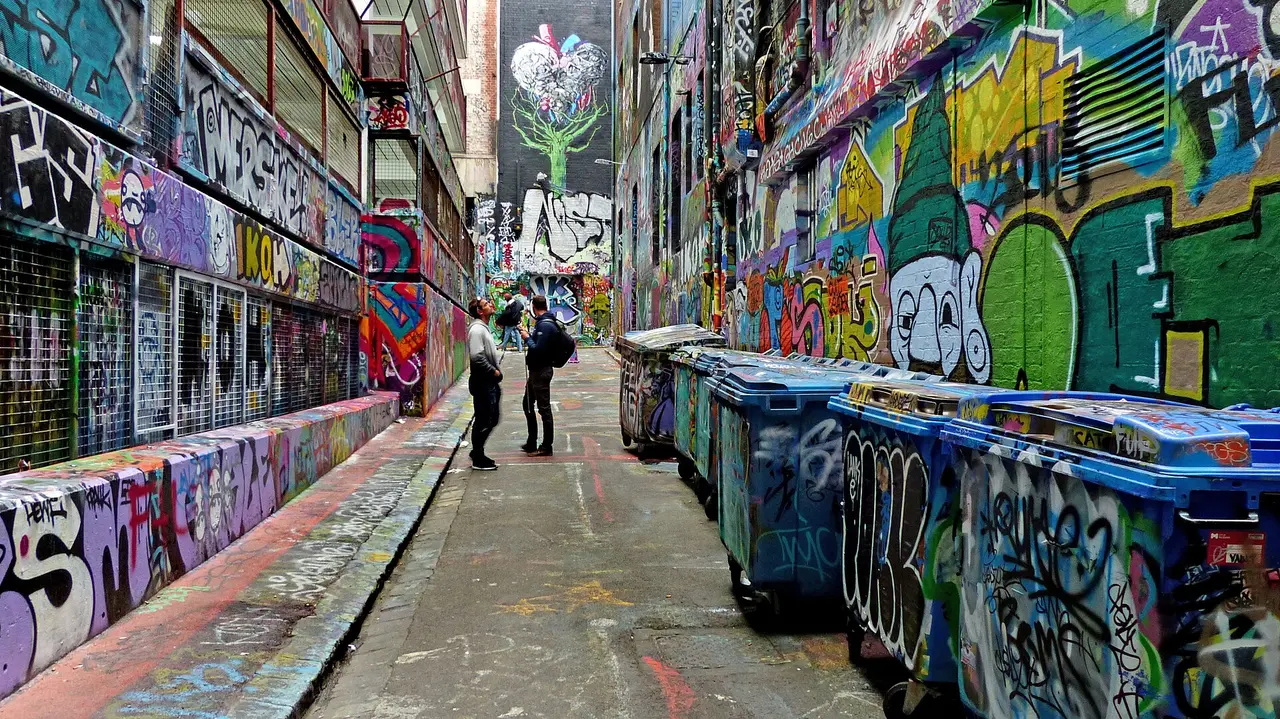
The city's most famous street art laneway, endlessly repainted, right opposite Federation Square.

Queen Victoria Market

Historic market halls, fresh produce and street food in the heart of the city since 1878; closed Mondays and Wednesdays.

NGV International

A free permanent collection and the stained-glass ceiling of the Great Hall, in Australia's oldest public gallery.

Brunswick Street

Fitzroy's main drag for vintage shops, cafes, live music and painted Victorian shopfronts.

Melbourne Cricket Ground

The temple of cricket and AFL, to tour with a guide or to experience on a match night.

Royal Botanic Gardens

Thirty-eight hectares of lawns and lakes beside the Yarra, with the Shrine of Remembrance close by.

Twelve Apostles

The iconic limestone stacks of the Great Ocean Road, at the end of a day on the coast road.

Penguin Parade

Hundreds of little penguins come ashore at sunset on a Phillip Island beach.

What to see in Melbourne, neighbourhood by neighbourhood?

The centre through its laneways and arcades

The grid of the city centre hides a second network of narrow lanes, the laneways, where most of the cafes and bars are found. Hosier Lane and AC/DC Lane are constantly repainted by graffiti artists, with the city's tacit blessing. Degraves Street and Centre Place are lined with espresso counters where people drink standing up, while the Block Arcade and Royal Arcade keep their Victorian mosaics and glass roofs. At night, look for stairs going down or up: many bars have no street sign.

Queen Victoria Market and the coffee religion

Open since 1878, Queen Victoria Market covers several blocks north of the centre, with its meat and fish halls, fruit stalls and vans selling bureks and hot doughnuts. It is closed on Mondays and Wednesdays. The market also tells the story of the Greek, Italian and Vietnamese immigrants who brought coffee culture to the city. A flat white costs around 5.80 AUD, and neighbourhood roasters are taken very seriously.

The arts bank: NGV, Federation Square and Southbank

South of Flinders Street Station, Federation Square brings together ACMI, the museum of the moving image, and the Ian Potter Centre, devoted to Australian and Aboriginal art. Across the Yarra, NGV International shows its permanent collection for free: European masters, Asian art and major paid temporary exhibitions. Lie down under the coloured glass ceiling of the Great Hall, a local ritual. The Arts Centre and its spire next door host opera, ballet and concerts.

Fitzroy, Collingwood and Brunswick, the bohemian north

A short tram ride from the centre, Fitzroy is the city's oldest suburb and its most creative. Brunswick Street is lined with vintage shops, bookshops and live music bars, Gertrude Street with designer boutiques, and Smith Street in Collingwood with giant murals and breweries. Further north, Brunswick and Sydney Road mix Lebanese grocers and record shops. On the way, Carlton Gardens surround the UNESCO-listed Royal Exhibition Building, close to the Italian cafes of Lygon Street.

St Kilda, the city by the bay

St Kilda is the closest beach to the centre, reached directly by tram. Its Esplanade, the century-old roller coaster of Luna Park and the cake shop windows of Acland Street make it the Sunday stroll, with a craft market along the seafront. The sheltered bay is fine for swimming in summer, though the water rarely tops 19C. At dusk, a small colony of little penguins returns to the pier breakwater.

A sporting capital, from the MCG to Melbourne Park

The Melbourne Cricket Ground, the MCG, holds close to a hundred thousand spectators and can be visited on a guided tour that includes the National Sports Museum. From April to September, an Australian rules football match, the AFL, is the best local immersion; the Grand Final is played in late September. In January the Australian Open tennis fills Melbourne Park, in March Formula 1 races around Albert Park lake, and in early November the Melbourne Cup stops the city for a horse race.

Three day trips: the coast, the penguins and the wine

The Great Ocean Road takes a very long day, or better a night on the coast: surf at Bells Beach, the Great Otway rainforest and the limestone stacks of the Twelve Apostles. Phillip Island is best visited in the afternoon for the sunset Penguin Parade, which must be booked. The closer Yarra Valley combines chardonnay and pinot noir wineries, Healesville Sanctuary and its platypus, and dawn hot-air balloon flights. Without a car, organised tours leave from the centre.

Sample itineraries

Three routes built around the time you actually have.
3daysRecommended

Melbourne in 3 days: the city, the Great Ocean Road and the MCG

  1. Laneways, arcades and Southbank
  2. The Great Ocean Road and the Twelve Apostles
  3. Botanic gardens, the MCG and Richmond

Best for: The most balanced stay for a first visit: a day in the centre, the big Great Ocean Road trip out to the Twelve Apostles, then a day of botanic gardens, the city's temple of sport and the Richmond and Fitzroy neighbourhoods.

How much it costs

Per person per day, excluding international travel.
Budget
70 €/ day
3 080 € for 2 people, 7 days, return flights included
Accommodation
25 €
Food
30 €
Local transport
7 €
Sights and activities
8 €
Comfort
165 €/ day
4 710 € for 2 people, 7 days, return flights included
Accommodation
70 €
Food
55 €
Local transport
10 €
Sights and activities
30 €
Premium
390 €/ day
8 660 € for 2 people, 7 days, return flights included
Accommodation
180 €
Food
100 €
Local transport
30 €
Sights and activities
80 €
Prices checked: Relevé du 13 octobre 2026. Conversion au taux de référence BCE du 12 octobre 2026 : 1 EUR = 1,6032 AUD. Repas et transports : Numbeo Melbourne, mise à jour du 13 octobre 2026, 225 contributeurs (repas bon marché 25 AUD soit 15,60 €, dîner de milieu de gamme pour deux 120 AUD soit 75 €, cappuccino 5,77 AUD, trajet en transport public 5,50 AUD, taxi 6,35 AUD de prise en charge puis 2 AUD/km) ; tram gratuit dans le centre (Free Tram Zone). Hébergement : lit en dortoir de 35 à 50 AUD selon hostelz.com (guide budget 2026, source non officielle) ; prix moyen d'une chambre d'hôtel de 261,74 AUD en janvier 2026 (CoStar, mois record dopé par l'Open d'Australie), d'où environ 220 AUD retenus hors événement pour une double de milieu de gamme partagée à deux (comfort) et environ 580 AUD pour un hôtel haut de gamme (premium, estimation). Vol A/R Paris-Melbourne avec escale, hors vacances scolaires : prix moyens 2026 de ou-et-quand.net de 1000 € en novembre, 1046 € en septembre et 1163 € en octobre (lus via les résultats de recherche, page non accessible directement) ; retenu 1050 € (backpacker), 1200 € (confort), 1600 € (premium, meilleure correspondance).

Getting there

Airports serving Melbourne, from main hubs to secondary ones.
  • ABXAlbury AirportEast AlburySecondary
  • ALHAlbany AirportAlbanySecondary
  • ARMArmidale AirportArmidaleSecondary
  • ARYArarat AirportAraratSecondary
  • ASPAlice Springs AirportAlice SpringsSecondary
  • AYQAyers Rock Connellan AirportYularaSecondary

Entry, health and safety

For FR travellers

Entry requirements

Visa required

Autorisation électronique eVisitor (sous-classe 651) à obtenir en ligne avant le départ, pour un séjour touristique, d'affaires ou familial de 3 mois maximum ; au-delà, visa visitor (sous-classe 600). Aucune vignette dans le passeport, confirmation par courriel. Une demande par personne, enfants compris, et voyager avec le passeport déclaré. Carte passager à remplir à l'arrivée ; importation de denrées alimentaires très strictement contrôlée.

Stay allowed for up to 90 days.

Health

Required: Fièvre jaune uniquement pour les voyageurs en provenance d'une zone d'endémie.

Advised: Mise à jour du calendrier vaccinal français (diphtérie, tétanos, poliomyélite, coqueluche, rougeole). Selon la durée et les conditions du séjour : dengue, encéphalite japonaise, chikungunya.

Aucun accord de couverture sociale entre la France et l'Australie : assurance couvrant frais médicaux et rapatriement impérative. Épisodes de forte dégradation de l'air à Melbourne possibles lors des feux de brousse : réduire alors les activités extérieures. Incendies fréquents en été dans le Victoria, suivre les consignes des autorités (ligne CFA 1800 226 226). Baignade uniquement entre les drapeaux, attention aux courants d'arrachement et aux requins sur les plages sans filets.

Safety

Normal precautions

Emergency

000

Checked in octobre 2026 against the official source. Entry rules change: check the official source before you travel, it alone is authoritative.

Practical information for Melbourne

Currency

Australian dollar (AUD): 1 EUR = 1.6032 AUD at the ECB rate of 12 October 2026. Contactless payment is accepted almost everywhere.

Trams

Free within the Free Tram Zone covering the centre and Docklands. Beyond it, trams, trains and buses are paid with the rechargeable myki card, tapped on when boarding.

From the airport

There is no train to Tullamarine airport: the SkyBus shuttle links the terminals to Southern Cross station, otherwise take a taxi or rideshare.

eVisitor

An electronic authorisation to apply for online before departure, one per traveller, children included, for stays of up to 3 months.

Emergencies and fires

Dial 000 for police, fire and ambulance. In summer, follow Victoria's bushfire warnings (CFA line 1800 226 226).

Melbourne in pictures

Photo credits : Bernard Spragg. NZ from Christchurch, New Zealand, CC0, Wikimedia Commons ; Dietmar Rabich, CC BY-SA 4.0, Wikimedia Commons

Frequently asked questions about Melbourne

How many days do you need in Melbourne?
Two days cover the laneways, the market, the NGV, Fitzroy and St Kilda. Allow three days to add the Great Ocean Road, and four for the Yarra Valley and Phillip Island. Each of the big day trips takes a full day.
When is the best time to visit Melbourne?
February and March are dry and warm, around 24 to 26C, with the warmest sea. October and November bring a mild but changeable spring. Winter, from June to August, is cool at around 14C, but it is the cheapest season.
How much does a week in Melbourne cost?
Allow about 70 euros per person per day in a hostel, 165 euros in comfort and 390 euros at the top end, excluding flights. With a return flight from Paris at around 1,050 to 1,200 euros, a week for two costs about 3,080 euros on a budget and 4,710 euros in comfort.
Melbourne or Sydney: which one to choose?
Sydney is all about its harbour, surf beaches and scenery. Melbourne is lived more indoors: museums, cafes, hidden bars, live music and major sporting events. On a first trip to Australia, many travellers combine both, linked by frequent domestic flights.
Can you swim in Melbourne?
Yes, in summer, on the sheltered bay beaches such as St Kilda, Elwood or Brighton, though the water stays cool at around 18 to 19C at best. The ocean surf beaches towards Torquay are more dangerous: always swim between the flags.
Do you need a car in Melbourne?
Not for the city, where trams and trains are enough and the centre is served for free. A car becomes useful for the Great Ocean Road, the Yarra Valley or Phillip Island, but organised tours leave the centre every day. Australians drive on the left.
What can you combine with a stay in Melbourne?
Sydney, Tasmania and Adelaide are a domestic flight away from Melbourne, as is the Great Barrier Reef further north. Many travellers also continue on to New Zealand, a few hours' flight away, to make the most of the long journey from Europe.

Plan your trip to Melbourne

Build your day-by-day itinerary and manage budget, bookings and packing in PlanTripNow.
Aperçu de l'application PlanTripNow