Skip to content

Visit Mexico City : neighbourhoods, museums, when to go, budget

Built on the ruins of Tenochtitlan, Mexico City blends the Templo Mayor, Rivera's murals and leafy neighbourhoods such as Roma and Coyoacán. You eat the country's best tacos for a few pesos, then head out to the Teotihuacan pyramids or the flower-lined canals of Xochimilco.

At a glance

Visa
None
Tourist stay of up to 180 days
7-day budget
€770
Per person, comfort profile, excluding international flights.
Recommended length
3 days
For a first trip, without rushing.

Why visit Mexico City?

Mexico City is the capital of Mexico, built more than 2,200 m above sea level on the former Aztec city of Tenochtitlan. Its historic centre and Xochimilco are UNESCO World Heritage sites, and the city is one of the richest on the continent for museums, with a street food scene famous worldwide.

When to visit Mexico City

Temperatures, rainfall and crowds month by month, to pick your window.
When to visit Mexico City
MonthTemperaturesRainCrowdsVerdict
January7 to 22 °C1 dModerateBlue skies and 22 °C in the afternoon, but 6 °C nights: pack a fleece.
February8 to 24 °C2 dQuietOne of the best weather-to-price ratios of the year, with no queues at the Chapultepec museums.
March10 to 26 °C3 dModeratePurple jacarandas bloom along the avenues; the equinox draws crowds to Teotihuacan.
April12 to 27 °C4 dBusyThe warmest month and a busy Holy Week: book early, as air pollution peaks.
May13 to 27 °C11 dQuietThe first late-afternoon storms arrive as visitors leave: sightsee in the morning.
June14 to 25 °C13 dQuietThe rainy season has set in, but mornings stay dry and hotels are cheap.
July13 to 24 °C17 dModerateA near-daily downpour around 5 pm and Paris flights at their summer-holiday peak.
August14 to 24 °C17 dModerateAs wet as July: carry an umbrella and an indoor plan B every afternoon.
September13 to 23 °C15 dQuietThe Independence cry on the night of the 15th sets the Zócalo alight, despite the rain.
October11 to 23 °C7 dModerateDry weather returns late in the month, as Day of the Dead altars fill the city.
November9 to 23 °C2 dBusyPacked in early November for Día de Muertos, then the clearest light of the year.
December7 to 22 °C2 dBusyGuadalupe pilgrims on the 12th and year-end holidays: peak prices and chilly evenings.
Source: Normales 1991-2020 de la station de l'aéroport international de Mexico d'après climatestotravel.com (minimales, maximales, moyennes, jours de pluie), recoupées avec weather2travel.com (maximales de 22 à 27 °C, saison des pluies de juin à septembre avec 15 à 20 jours de pluie), relevé octobre 2026. Ville à 2 240 m d'altitude, sans mer. Affluence et prix estimés d'après le calendrier local (Semaine sainte, Jour des morts, fêtes de fin d'année, pèlerinage de Guadalupe le 12 décembre) et les vacances scolaires françaises.

Mexico City highlights

Ten places to grasp the capital, from the Aztecs to Frida Kahlo.

Zócalo

One of the largest squares in the world, framed by the cathedral and the National Palace, with its giant flag raised every morning.

Templo Mayor

The foundations of Tenochtitlan's great Aztec temple, uncovered in 1978 right in the centre, and their museum devoted to the Mexica.

Palace of Fine Arts

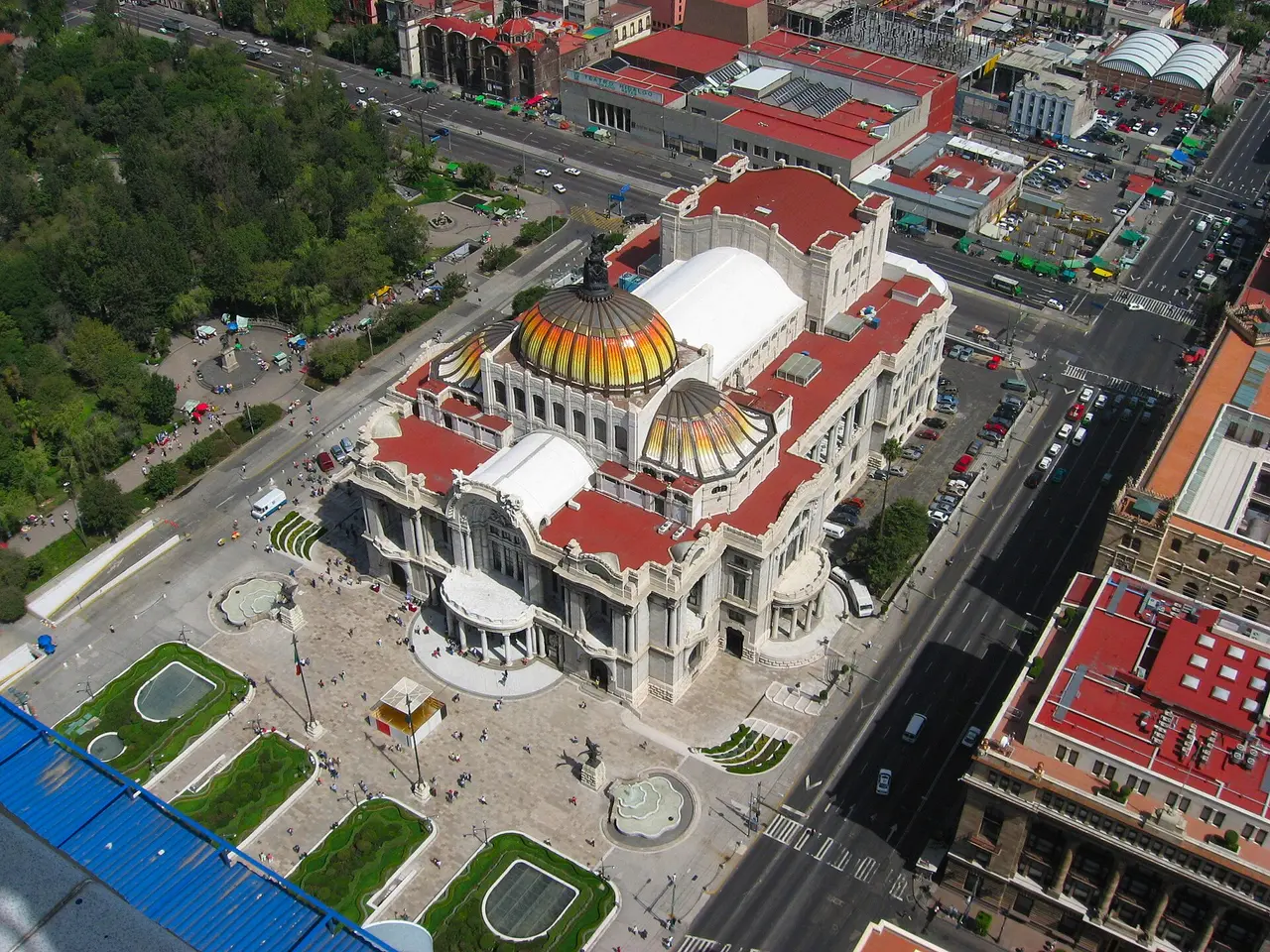
A white marble facade, an orange dome and murals by Rivera, Siqueiros and Orozco, at the eastern end of the Alameda Central.

Torre Latinoamericana

An observation deck atop a 1950s tower to take in the endless city, best at sunset.

National Museum of Anthropology

The Sun Stone and the Mexica, Maya and Olmec halls, in a modernist building opening onto a huge fountain column.

Chapultepec Castle

A former imperial residence on a hill in the park, with terraces, stained glass and a clear view down Paseo de la Reforma.

Casa Azul

The blue house where Frida Kahlo was born and lived, with her studio, dresses and garden, by reservation only.

Soumaya Museum

A silver facade of thousands of hexagons in Polanco, home to a large collection of Rodin sculptures, with free admission.

Teotihuacan pyramids

The Pyramid of the Sun and the Avenue of the Dead, a UNESCO-listed pre-Columbian city an hour north-east by bus.

Arena México

The temple of lucha libre, where masked wrestlers and a roaring crowd meet several nights a week, above all on Fridays.

What to discover in Mexico City?

The Centro Histórico around the Zócalo

The heart of the city fits into a square roughly one kilometre wide: the Zócalo, the Metropolitan Cathedral built from Aztec stones, the National Palace and the remains of the Templo Mayor, closed on Mondays. Pedestrian Madero Street links the square to the Alameda Central in a fifteen-minute walk. Visit this area by day: France Diplomatie advises against the neighbourhoods north and north-east of the Zócalo, such as Tepito and La Lagunilla, and recommends caution in the evening.

Chapultepec and Polanco

Chapultepec woods, larger than Central Park, hold the National Museum of Anthropology, the castle on its hill and several modern art museums. Allow three hours for the anthropology museum alone, where admission rose to 210 pesos for foreign visitors in 2026, and half a day for the rest of the park. To the north, Polanco lines up luxury shops, fine-dining restaurants and the silver-clad Soumaya Museum, which is free to enter. Most museums close on Mondays.

Roma and Condesa, where to stay

These two neighbouring districts, south-west of the centre, hold most of the accommodation travellers favour: Art Deco facades, avenues lined with jacarandas that bloom in March, cafés and covered markets such as Medellín. Parque México and Avenida Amsterdam are made for walking, and the Zócalo is twenty to thirty minutes away by metro or ride-hailing taxi. Dorm beds start at around 300 pesos a night, four-star hotels at about 115 to 150 dollars.

Coyoacán and San Ángel, the bohemian south

Around ten kilometres south of the centre, Coyoacán keeps its cobbled streets, shady squares and a market where you lunch on tostadas. Frida Kahlo's Casa Azul, closed on Mondays, can only be visited with a timed ticket booked online, sometimes several days ahead; the Trotsky house museum is a ten-minute walk away. On Saturdays, the Bazar Sábado in neighbouring San Ángel gathers craftspeople and painters. One day is enough for both districts.

Xochimilco and the lake country of the south

The last remnant of the lakes on which Tenochtitlan stood, Xochimilco is explored by trajinera, the painted boats rented by the hour from the Nativitas pier. Allow two hours on the water, between cultivated chinampas, grilled corn sellers and floating mariachi bands. The site is about 1 to 1.5 hours from the centre by metro, then the light rail from Tasqueña. At weekends the mood is festive and loud; on weekdays the canals are quieter.

Teotihuacan and day trips

About fifty kilometres north-east, Teotihuacan is an hour away by bus from the Autobuses del Norte terminal. You climb the Pyramid of the Sun and walk the Avenue of the Dead to the Pyramid of the Moon: arrive at opening time with a hat and water, as altitude and sun tire you quickly. Mexico City is also the gateway to the indigenous south of Chiapas or to Guadalajara and the state of Jalisco, the home of tequila.

Seasons, altitude and budget

The dry season, from November to April, brings clear skies and highs of 22 to 27 °C, but cool 6 °C nights in January. From June to September, a downpour falls almost every afternoon. Allow about €43 a day on a shoestring and €110 in comfort, excluding flights (Numbeo, October 2026). Many travellers combine the capital with the beaches of Cancún, about 2 h 15 away by plane, for a wider tour of the country.

Sample itineraries

Three routes built around the time you actually have.
3daysRecommended

Mexico City in 3 days: the historic centre, Teotihuacan and Coyoacán

  1. Day 1: the historic centre and Madero Street
  2. Day 2: the Teotihuacan pyramids
  3. Day 3: Coyoacán and the Casa Azul

Best for: The ideal format for a first visit: the historic centre, a day at the Teotihuacan pyramids and Frida Kahlo's neighbourhood. Chapultepec and Xochimilco are left out. The Teotihuacan day is done in the morning, before the afternoon storms of the rainy season.

How much it costs

Per person per day, excluding international travel.
Budget
43 €/ day
2 202 € for 2 people, 7 days, return flights included
Accommodation
17 €
Food
15 €
Local transport
3 €
Sights and activities
8 €
Comfort
110 €/ day
3 140 € for 2 people, 7 days, return flights included
Accommodation
50 €
Food
35 €
Local transport
10 €
Sights and activities
15 €
Premium
270 €/ day
5 380 € for 2 people, 7 days, return flights included
Accommodation
125 €
Food
75 €
Local transport
25 €
Sights and activities
45 €
Prices checked: Relevé octobre 2026 : repas et transports d'après Numbeo Mexico (mise à jour du 2 octobre 2026 : repas bon marché 9,94 €, dîner de milieu de gamme pour deux 44,71 €, ticket de métro 0,30 €, taxi 1,86 € de prise en charge puis 0,50 €/km). Dortoirs de 280 à 320 MXN la nuit à Roma et Condesa (hostelz.com, 2026). Hôtels 4 étoiles à Condesa de 115 à 156 USD la nuit, 5 étoiles autour de 270 USD (Travelocity, 2026). Entrée du Musée national d'anthropologie et de Teotihuacan à 210 MXN pour les visiteurs étrangers depuis le 1er janvier 2026 (chilango.com). Vol A/R Paris-Mexico estimé à 800 € par personne hors vacances scolaires (Où et Quand 2026 : moyenne 768 € en septembre, 799 € en novembre, 847 € en octobre, 1 009 € en décembre). Hébergement par nuit et par personne : lit en dortoir pour backpacker, chambre double partagée à deux pour comfort et premium. Prix hors fêtes de fin d'année et Semaine sainte ; peso mexicain fluctuant face à l'euro, montants à revérifier d'ici quelques mois.

Getting there

Airports serving Mexico City, from main hubs to secondary ones.
  • ACAGeneral Juan N. Álvarez International AirportAcapulcoMain
  • ACNCiudad Acuña International AirportCiudad AcuñaSecondary
  • CENCiudad Obregón International AirportCiudad ObregónSecondary
  • CLQLicenciado Miguel de la Madrid International AirportColimaSecondary
  • CMECiudad del Carmen International AirportCiudad del CarmenSecondary
  • CPEIngeniero Alberto Acuña Ongay International AirportCampecheSecondary

Entry, health and safety

For FR travellers

Entry requirements

No visa for a tourist stay

Pas de visa pour un séjour touristique de 180 jours maximum. À l'arrivée par avion, il faut pouvoir prouver la régularité du séjour avec le formulaire migratoire multiple électronique (FMMD) ; les justificatifs demandés sont détaillés par le consulat du Mexique.

Stay allowed for up to 180 days.

Health

Required: Fièvre jaune exigée uniquement pour les voyageurs en provenance d'une zone d'endémie.

Advised: Mise à jour diphtérie, tétanos, poliomyélite, coqueluche et rougeole (hausse des cas de rougeole signalée) ; selon la durée et les régions visitées : hépatites A et B, fièvre typhoïde, rage, chikungunya et dengue.

Mexico est en haute altitude : risque de mal aigu des montagnes, acclimatation progressive conseillée. Pollution atmosphérique : avis médical pour les personnes sensibles. Dengue en hausse dans le pays. Les hôpitaux refusent les patients sans garantie financière : assurance couvrant soins et rapatriement indispensable. Vigilance renforcée à Mexico ; les quartiers au nord et nord-est du Zócalo (Morelos, Tepito, Lagunilla, Rastro) sont déconseillés sauf raison impérative, tout comme les délégations Gustavo A. Madero et Iztapalapa les plus touchées par les homicides. Numéro d'urgence 911, ou 088.

Safety

Increased caution

Emergency

911

Checked in octobre 2026 against the official source. Entry rules change: check the official source before you travel, it alone is authoritative.

Practical information for Mexico City

From Benito Juárez airport

Metro line 5 from Terminal Aérea station, or an authorised taxi from the airport's prepaid desk; avoid taxis hailed in the street.

Metro

Tickets cost about €0.30 (Numbeo, October 2026), with cars reserved for women and children at rush hour.

Museum closures

Most museums and sites close on Mondays, including the anthropology museum, the Templo Mayor and the Casa Azul.

Admission in 2026

210 pesos for foreigners at the anthropology museum and Teotihuacan; free Sunday entry applies to residents only.

Altitude

Over 2,200 m: drink plenty, take it slowly on day one and limit alcohol on arrival.

Pollution

Frequent pollution peaks at the end of the dry season, in April and May: sensitive people should seek medical advice.

Water

Stick to bottled or filtered water, offered in most hotels.

Earthquakes

High seismic risk: locate the exits and follow instructions if the city's earthquake alert sounds.

Emergencies

Dial 911, or 088; hospitals require a financial guarantee, so travel insurance is essential.

Mexico City in pictures

Photo credits : Jeses, CC BY-SA 2.5, Wikimedia Commons ; Daniel Case, CC BY-SA 3.0, Wikimedia Commons ; ProtoplasmaKid, CC BY-SA 4.0, Wikimedia Commons ; Salvador alc, CC BY-SA 4.0, Wikimedia Commons ; Rebeccananonof, CC0, Wikimedia Commons ; Own work, CC BY-SA 4.0, Wikimedia Commons

Frequently asked questions about Mexico City

How many days do you need in Mexico City?
Three days cover the historic centre, a day at Teotihuacan and Coyoacán. With two days, you stick to the Zócalo and the anthropology museum; four days leave time to add Xochimilco, Roma and Condesa or a lucha libre night.
Roma or Condesa: where to stay in Mexico City?
The two districts sit side by side and are both popular. Condesa is greener and more residential, around Parque México; Roma is livelier, with more bars, cafés and galleries. Both are twenty to thirty minutes from the Zócalo by metro or ride-hailing taxi.
How do you get from Mexico City to the Teotihuacan pyramids?
Buses leave from the Autobuses del Norte terminal and reach the site in about an hour. Set off early to arrive at opening time, ahead of the heat and the tour groups. Admission costs 210 pesos for foreign visitors in 2026, and the site offers little shade.
Do you need to book Frida Kahlo's Casa Azul?
Yes. Tickets are sold online only, for a timed slot, and dates often sell out several days ahead, especially at weekends. The museum is closed on Mondays; combine the visit with the Coyoacán market and main square.
Will you feel the altitude when arriving in Mexico City?
Often, yes. The city lies above 2,200 m and France Diplomatie warns of a risk of acute mountain sickness. Breathlessness, headaches or restless sleep are common in the first days: drink plenty, limit alcohol and save strenuous outings for day two.
Which Mexico City neighbourhoods should you avoid?
France Diplomatie advises against the neighbourhoods north and north-east of the Zócalo, including Tepito, Morelos and La Lagunilla, unless essential. The Gustavo A. Madero and Iztapalapa boroughs are the worst hit by homicides. In the evening, use ride-hailing taxis rather than cabs hailed in the street.
What daily budget do you need in Mexico City?
About €43 a day with a dorm bed, street tacos and the metro, €110 in a mid-range hotel with restaurants and taxis, and €270 in an upscale hotel. Add a return flight from Paris of around €800 per person outside school holidays.
Where to experience Día de Muertos in Mexico City?
Celebrations peak on 1 and 2 November, with altars covered in cempasúchil marigolds across the city, a large parade in the centre and vigils in Coyoacán and Xochimilco. It is one of the busiest periods of the year: book accommodation several months ahead.

Plan your trip to Mexico City

Build your day-by-day itinerary and manage budget, bookings and packing in PlanTripNow.
Aperçu de l'application PlanTripNow