Skip to content

Visit Munich : what to see, when to go and what it costs

Royal city of the Wittelsbachs, Munich keeps palaces, baroque churches and some of the richest painting collections in Europe. People also come for its beer halls, beer gardens under the chestnut trees, the English Garden and the Alps, visible on clear days.

At a glance

Visa
None
Tourist stay of up to 90 days
7-day budget
€1,120
Per person, comfort profile, excluding international flights.
Recommended length
3 days
For a first trip, without rushing.

Why visit Munich?

Munich is the capital of Bavaria and Germany's third-largest city, with about 1.5 million inhabitants. It combines a compact historic centre, the Wittelsbach Residenz, the Pinakotheks and the Oktoberfest, and is a base for Ludwig II's castles and the Alpine lakes.

When to visit Munich

Temperatures, rainfall and crowds month by month, to pick your window.
When to visit Munich
MonthTemperaturesRainCrowdsVerdict
January-3 to 3 °C10 dQuietThe coldest month, with night frost and possible snow: the Pinakothek and the Residenz are quiet, and the Bavarian Alps are an hour away for skiing.
February-3 to 5 °C9 dQuietStill wintry, but carnival (Fasching) livens up the Viktualienmarkt on Shrove Tuesday; hotels among the cheapest of the year outside trade fairs.
March0 to 9 °C11 dQuietA damp, changeable end of winter and strong-beer (Starkbier) season in the breweries: few tourists, but terraces still closed.
April3 to 15 °C9 dModerateThe English Garden turns green and the Spring Festival sets up on the Theresienwiese; Easter brings crowds, keep a jumper for cool evenings.
May8 to 19 °C12 dBusyBeer gardens open and pleasant mild weather, but rainfall doubles compared with April: keep a museum plan for showery afternoons.
June11 to 22 °C12 dBusyLong evenings, the Eisbach surfers and the Tollwood festival in the Olympiapark; frequent late-day thunderstorms, typical of the pre-Alpine climate.
July13 to 24 °C13 dPackedThe warmest and wettest month: swimming in the Isar and the lakes, Neuschwanstein mobbed, book the castles well ahead.
August13 to 24 °C11 dBusyBavarian school holidays: the city loses some locals but not its visitors, and day trips to the Alpine lakes are busy at weekends.
September9 to 19 °C11 dPackedThe Oktoberfest begins in the second half of the month: a unique atmosphere, but hotels are full and at peak prices; the first fortnight remains ideal.
October5 to 14 °C10 dModerateThe Oktoberfest ends in the first days of the month, then calm returns: golden leaves in the English Garden and falling prices.
November1 to 7 °C10 dVery quietThe quietest month, grey and short; ideal for museums and beer halls, before the Christmas markets open at the end of the month.
December-2 to 4 °C12 dBusyThe Marienplatz Christmas market and mulled wine all over the old town: damp cold, often under grey skies, and weekend crowds.
Source: Moyennes mensuelles climatestotravel.com pour Munich (normales 1991-2020, station de l'ancien aéroport de Riem : moyenne annuelle 9,1 °C, 950 mm, 1850 h de soleil), relevé octobre 2026. Jours de pluie = jours avec précipitations. Pas de température de mer : ville continentale à 520 m d'altitude, au pied des Alpes.

Munich must-sees

Seven stops to understand the Bavarian capital.

Marienplatz

The heart of the old town, with the New Town Hall glockenspiel.

Residenz

The Wittelsbach palace, its state rooms and its Treasury.

Alte Pinakothek

Dürer, Rubens and the old masters, for one euro on Sundays.

English Garden

Miles of meadows, the Eisbach wave and the Chinese Tower.

Nymphenburg Palace

The baroque summer residence, its canal and its park pavilions.

Deutsches Museum

Aircraft, mines and physics experiments on an island in the Isar.

Dachau Memorial

The site of the first Nazi concentration camp, free, half an hour away by S-Bahn.

What to discover in Munich?

The old town around Marienplatz

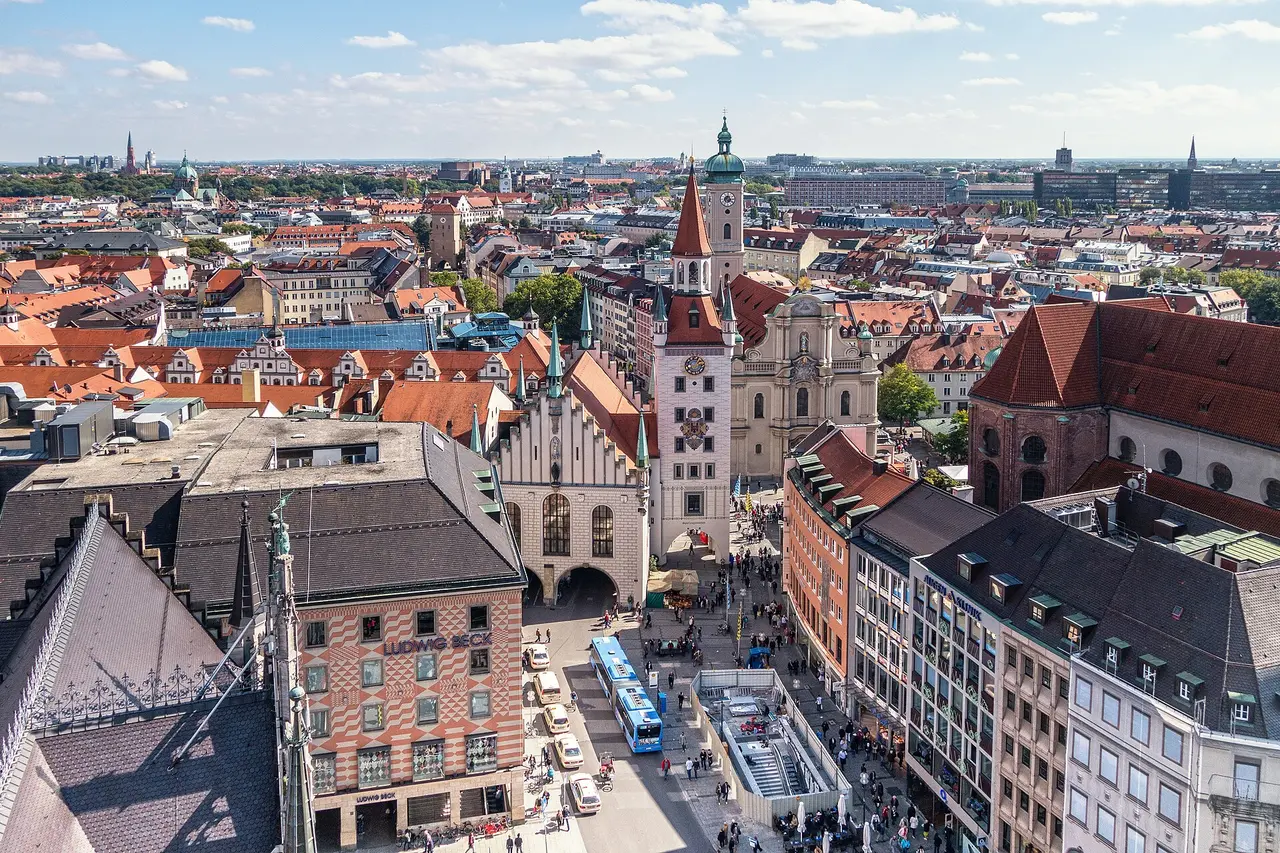
Everything starts on Marienplatz, dominated by the neo-Gothic facade of the New Town Hall and its glockenspiel, whose figures come to life at 11 am. The tower of St Peter's Church, reached by a narrow staircase, gives the best view over the rooftops and, when the foehn wind blows, of the Alps. Nearby, the Frauenkirche and its onion domes serve as a landmark, while the Viktualienmarkt lines up cheese and fruit stalls and small drinks stands. The tiny, fully baroque Asam Church hides on Sendlinger Strasse.

Royal Munich of the Wittelsbachs

For more than seven centuries the Wittelsbachs ruled Bavaria, and their city palace, the Residenz, still shows it: a string of state rooms, the Renaissance Antiquarium, the rococo Cuvilliés Theatre and a Treasury crowned with jewels. To the west, Nymphenburg Palace was the summer residence, with a vast park dotted with pavilions. To carry the story further, the castles of Ludwig II, Neuschwanstein first among them, make a day trip, to be booked well ahead in summer.

The Pinakotheks and the museum quarter

The Kunstareal, north of the centre, gathers a rare concentration of museums. The Alte Pinakothek shows Dürer, Rubens and the Flemish masters, the Pinakothek der Moderne twentieth-century art, design and architecture, and the Museum Brandhorst contemporary art. On Sundays, entry to several public collections costs just one euro. On an island in the Isar, the Deutsches Museum, one of the world's largest science and technology museums, deserves a full day with children.

Beer halls, beer gardens and the Oktoberfest

Beer is part of the landscape: the Hofbräuhaus and its vaulted halls, the large beer halls of the old town and above all the beer gardens, where you may bring your own picnic under the chestnut trees. The Oktoberfest, on the Theresienwiese from mid-September to early October, draws millions of visitors: entry to the tents is free, but hotels are full and their prices double. Outside that period, the Spring Festival on the same site offers a more local and relaxed version.

English Garden, the Isar and green escapes

Larger than Central Park, the English Garden stretches from the centre to the north of the city. You will come across the Eisbach surfers, a Chinese Tower ringed by a beer garden and lawns for summer sunbathing. The pebble banks of the Isar become urban beaches on fine days, and the 1972 Olympic Park is made for a stroll. Lake Starnberg and the Ammersee are reachable by S-Bahn in under an hour from the centre, for a swim or a boat trip.

Sample itineraries

Three routes built around the time you actually have.
3daysRecommended

Munich in 3 days: the centre, museums and Nymphenburg Palace

  1. Day 1: the old town and the Deutsches Museum
  2. Day 2: Kunstareal, Pinakotheks and Königsplatz
  3. Day 3: Nymphenburg, Olympic Park and BMW Welt

Best for: Three days balancing the old town, the museum quarter around Königsplatz and the west of the city, from Nymphenburg Palace to the Olympic Park.

How much it costs

Per person per day, excluding international travel.
Budget
72 €/ day
1 408 € for 2 people, 7 days, return flights included
Accommodation
30 €
Food
24 €
Local transport
10 €
Sights and activities
8 €
Comfort
160 €/ day
2 640 € for 2 people, 7 days, return flights included
Accommodation
73 €
Food
52 €
Local transport
10 €
Sights and activities
25 €
Premium
360 €/ day
5 440 € for 2 people, 7 days, return flights included
Accommodation
175 €
Food
95 €
Local transport
30 €
Sights and activities
60 €
Prices checked: Relevé octobre 2026. Repas et taxis : Numbeo Munich, mise à jour du 8 octobre 2026 (menu bon marché 16,25 €, dîner de milieu de gamme pour deux 80 €, bière 0,5 l 4,65 €, taxi 5,90 € de prise en charge puis 2,70 €/km). Transports : tarifs MVV au 1er janvier 2026 (ticket simple zone M 4,20 €, ticket journée zone M 10,10 €). Hébergement : lit en dortoir de 25 à 38 € la nuit (Radical Storage, guide des coûts 2026 ; Hostelz) ; hôtel 3 étoiles à 146 € la nuit et 5 étoiles à 527 € en moyenne (combien-coute.net, 28 septembre 2026), premium estimé sur un 4 étoiles supérieur autour de 350 € la chambre. Hébergement par personne : dortoir pour backpacker, chambre double partagée à deux pour comfort et premium. Vol A/R Paris-Munich estimé à 200 € par personne hors été (Où et Quand 2026 : 193 € en novembre, 221 € en décembre, 222 € en octobre). Activités estimées d'après les entrées de musées et châteaux. Hors Oktoberfest et grands salons, où l'hébergement peut doubler ou tripler.

Getting there

Airports serving Munich, from main hubs to secondary ones.
  • BERBerlin Brandenburg AirportBerlinMain
  • BREBremen AirportBremenMain
  • CGNCologne Bonn AirportKölnMain
  • DRSDresden AirportDresdenMain
  • DTMDortmund AirportDortmundMain
  • DUSDüsseldorf AirportDüsseldorfMain

Entry, health and safety

For FR travellers

Entry requirements

No visa for a tourist stay

Libre circulation au sein de l'Union européenne : aucun visa. Entrée avec un passeport valide ou une carte nationale d'identité, ancienne ou nouvelle ; un passeport français périmé depuis moins de 5 ans est aussi accepté entre la France et l'Allemagne. Au-delà de 3 mois, déclaration de résidence obligatoire auprès de la mairie (Meldebescheinigung).

Stay allowed for up to 90 days.

Health

Advised: Mise à jour des vaccinations du calendrier français (diphtérie, tétanos, poliomyélite, coqueluche, rougeole). Pour des randonnées en forêt ou dans les Alpes bavaroises au printemps et en été, demandez conseil à votre médecin sur l'encéphalite à tiques.

Depuis mai 2025, des contrôles d'identité ont lieu à toutes les frontières allemandes, y compris à l'aéroport et dans les trains : gardez votre pièce d'identité sur vous. Vigilance normale ; vols à la tire fréquents dans les zones touristiques, les gares, l'aéroport et les grands rassemblements comme l'Oktoberfest. Carte européenne d'assurance maladie recommandée. Un consulat général de France est installé à Munich.

Safety

Normal precautions

Emergency

112

Checked in octobre 2026 against the official source. Entry rules change: check the official source before you travel, it alone is authoritative.

Practical information for Munich

Currency

Euro. Cards work almost everywhere, but some beer halls and market stands still prefer cash.

Transport

MVV network: single ticket zone M €4.20, day ticket zone M €10.10 (2026 fares).

Airport

Franz Josef Strauss (MUC), about 40 minutes from the centre by S-Bahn on lines S1 and S8.

From Paris

About 1 h 30 by direct flight, return fares around €200 outside summer and the Oktoberfest; also reachable by train.

Documents

EU citizens need an ID card or passport; identity checks at German borders since May 2025.

Emergencies

112 for emergency services, 110 for the police.

Munich in pictures

Photo credits : designerpoint, CC0, Wikimedia Commons ; Carsten Steger, CC BY-SA 4.0, Wikimedia Commons ; Jakub Hałun, CC BY 4.0, Wikimedia Commons ; Dietmar Rabich, CC BY-SA 4.0, Wikimedia Commons

Frequently asked questions about Munich

How many days do you need to visit Munich?
Two days are enough for the old town, the Residenz and the English Garden. Three days let you add the Pinakotheks and Nymphenburg, and four days leave time for the Dachau memorial and Neuschwanstein Castle.
When is the best time to visit Munich?
May, June and the first half of September bring 19 to 22 °C by day and open beer gardens. July is the warmest month but also the stormiest, and the Oktoberfest period sends hotel prices soaring.
How much does a trip to Munich cost?
Allow about €72 per person per day in a dorm, €160 on a comfort budget with a double room in a three-star hotel, and €360 on a premium budget. Add a return flight from Paris of around €200 per person outside summer.
When is the Oktoberfest and should you book?
The festival takes place on the Theresienwiese from mid-September to the first days of October. Entry is free, but book accommodation several months ahead: hotels are full and their rates can double or even triple during those two weeks.
Can you visit Neuschwanstein from Munich in a day?
Yes, if you leave early: about two hours by regional train to Füssen, then a bus to Hohenschwangau. The castle can only be seen on a guided tour with a time slot, booked online, especially in summer when places go fast.
Do you need a visa to visit Munich?
EU citizens need no visa, as Germany is part of the European Union; a valid ID card or passport is enough. Other nationalities should check Schengen rules before travelling. Keep your documents on you, as identity checks take place on arrival.
Is Munich a safe city?
The security level is normal across Germany. The main risk is pickpocketing in the old town, stations, the airport and large gatherings such as the Oktoberfest. Do not keep your documents and means of payment in the same place.

Plan your trip to Munich

Build your day-by-day itinerary and manage budget, bookings and packing in PlanTripNow.
Aperçu de l'application PlanTripNow