Skip to content

Visit Prague : what to do, when to go and budget

Prague, the Czech capital set on both banks of the Vltava, brings together one of Europe's largest castle complexes, a UNESCO-listed historic centre and a beer culture like no other. Less than two hours by air from Paris, it is also one of the most affordable capitals on the continent.

At a glance

Visa
None
Tourist stay of up to 90 days
7-day budget
€875
Per person, comfort profile, excluding international flights.
Recommended length
2 days
For a first trip, without rushing.

Why visit Prague?

Prague is the capital of the Czech Republic, in Bohemia, crossed by the Vltava river. Its historic centre, UNESCO-listed since 1992, includes the Castle, Charles Bridge and the Old Town. It can be explored on foot in two to four days, and the currency is the Czech koruna.

When to visit Prague

Temperatures, rainfall and crowds month by month, to pick your window.
When to visit Prague
MonthTemperaturesRainCrowdsVerdict
January-4 to 2 °C6 dVery quietFrost at night, barely 2 °C in the afternoon and two hours of sun: hotels are at their cheapest and Charles Bridge almost empty.
February-3 to 4 °C6 dVery quietStill cold at around 4 °C, but museums and beer halls make up for the grey; it is the cheapest month.
March0 to 9 °C7 dQuietThe thaw arrives with 8 °C by day; bring a warm jacket, as the Castle gardens only reopen in April.
April4 to 14 °C6 dModerate14 °C, Petřín orchards in bloom and Easter markets: crowds return around the Easter weekend.
May8 to 19 °C9 dBusy19 °C, open terraces and the Prague Spring festival; a few showers, but it is one of the best times.
June12 to 23 °C10 dBusyLong evenings and 22 °C, but afternoon storms one day in three; book before summer.
July13 to 24 °C10 dPackedPeak crowds: 24 °C, packed Malá Strana lanes and hotels at their dearest of the year.
August13 to 24 °C9 dPackedAs warm as July and still very busy; aim for Charles Bridge before 8 am to see it without the crush.
September9 to 20 °C7 dBusyThe month to aim for: 19 °C, less rain than in summer and grape harvests in the Troja vineyards.
October5 to 14 °C7 dModerateGolden leaves on Petřín and 13 °C in the afternoon; rates drop and nights turn chilly.
November1 to 7 °C7 dQuietGrey and 6 °C, the quietest month before the holidays; Christmas markets open in late November.
December-2 to 3 °C6 dBusyOld Town Square Christmas markets and 3 °C: a unique atmosphere, but hotels are dear around New Year's Eve.
Source: Moyennes climatiques recoupées entre weather2travel.com et climatestotravel.com (station de l'aéroport Václav-Havel), moyenne des deux sources par mois, arrondie au dixième, relevé octobre 2026. Jours de pluie d'après climatestotravel.com (jours avec au moins 1 mm de précipitations). Ville continentale : pas de température de mer.

Prague highlights

Nine places to grasp the city, from the Castle to the outer districts.

St Vitus Cathedral

A Gothic cathedral at the heart of the Castle, with its stained glass and the tomb of St Wenceslas.

Golden Lane

A row of colourful little houses set against the Castle walls, where Kafka once lived.

Charles Bridge

A 15th-century Gothic bridge lined with thirty Baroque statues, best crossed before 8 am.

Astronomical clock

The medieval dial on the Old Town Hall, which comes to life every hour on the hour.

Týn Church

The twin Gothic spires that tower over Old Town Square.

Old Jewish Cemetery

Thousands of tombstones crowded under the trees of Josefov, over several layers of graves.

Strahov Library

Baroque halls with painted ceilings and wooden shelves, close to the Castle.

Vyšehrad ramparts

A fortress on a rock above the Vltava, quiet and free, with the artists' cemetery.

Dancing House

A 1990s building with wavy facades on the New Town embankment.

What is there to see in Prague?

Hradčany: the Castle and St Vitus Cathedral

On Hradčany hill, Prague Castle forms a small fortified town of royal palaces, St George's Basilica and the Gothic St Vitus Cathedral, whose stained glass includes a window by Mucha. The courtyards and gardens are free; the interiors circuit costs about 19 €, according to Radical Storage. Take tram 22 up rather than walking, arrive at opening for Golden Lane and its colourful little houses, then keep an hour for the Baroque library of Strahov Monastery, ten minutes away on foot.

Malá Strana and Charles Bridge

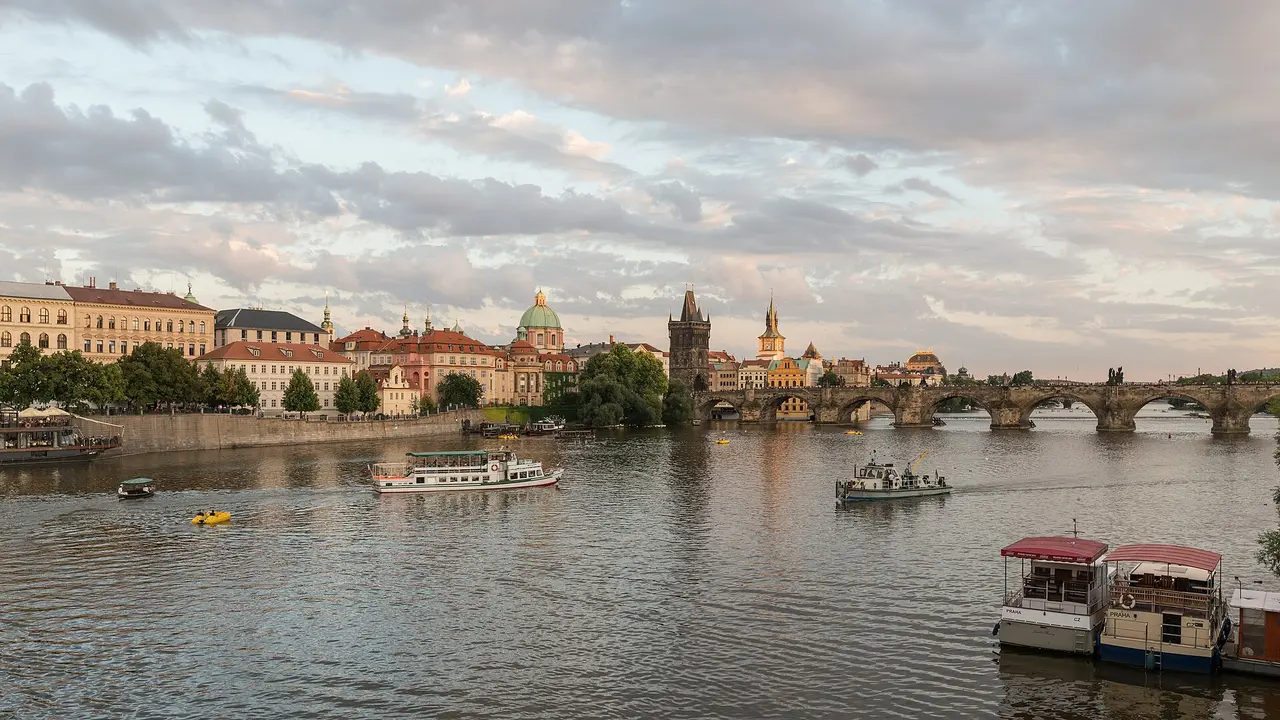
Below the Castle, Malá Strana, the Lesser Town, is a Baroque quarter of palaces, embassies and terraced gardens, crowned by the green dome of St Nicholas Church. Here you will find the Lennon Wall, covered in graffiti since the 1980s, and Kampa Island. Charles Bridge, completed in the early 15th century and lined with thirty statues, links the quarter to the Old Town. In summer it is packed from 10 am: cross it before 8 am, or after 10 pm once the musicians have gone.

Staré Město, the Old Town

Old Town Square is the historic heart: Gothic and Baroque houses, the spires of the Týn Church and the astronomical clock on the Town Hall, which comes to life every hour on the hour. Crowds gather in front of the dial; climb the Town Hall tower instead for the view over the rooftops. Around it, a maze of lanes leads to the Municipal House, an Art Nouveau gem where you can have coffee under the chandeliers. Skip the restaurants on the square, which cost twice as much as those in nearby streets.

Josefov, the former Jewish Quarter

Between the Old Town and the Vltava, Josefov preserves six synagogues and the Old Jewish Cemetery, where thousands of tombstones crowd over several layers of graves. The Jewish Museum groups them under a single ticket, except for the Old New Synagogue, Europe's oldest still in use, which has its own. The sites close on Saturdays and Jewish holidays: check the calendar before you go. The Pinkas Synagogue, its walls covered with the names of Czech Holocaust victims, calls for a quiet moment.

Vyšehrad, Vinohrady and Žižkov, the locals' Prague

South of the centre, the Vyšehrad fortress overlooks the Vltava from its rock, with the Basilica of Saints Peter and Paul and the cemetery where Dvořák and Smetana rest; the ramparts are free and almost empty. To the east, Vinohrady lines up Art Nouveau blocks, cafes and the Riegrovy sady beer garden, with a view of the Castle at sunset. Its earthier neighbour, Žižkov, claims one of the highest densities of bars in Europe and the TV tower climbed by babies sculpted by David Černý. A 24-hour pass at 140 koruna is enough to link these districts by tram.

Day trips: Kutná Hora and Karlštejn

About an hour by train from the main station, Kutná Hora, a former silver-mining town listed by UNESCO, combines St Barbara's Cathedral with the Sedlec Ossuary, decorated with tens of thousands of bones. Karlštejn, forty-five minutes away by regional train, is the Gothic castle built by Charles IV to house the crown jewels; the climb from the station takes twenty to thirty minutes and the guided tour should be booked. Each fills a day; leave early to be back before dinner.

Seasons, budget and atmosphere

Prague has a continental climate: about 2 °C in the afternoon in January and 24 °C in July and August, with six to ten rainy days a month according to our cross-checked figures. May and September, around 19 °C, are the best compromise; December draws crowds with its Christmas markets. Budget around 49 € per person per day as a backpacker and 125 € in comfort, plus a return flight from Paris of about 160 € outside school holidays, according to Kayak. A cheap meal runs to about 10 €, according to Numbeo.

Sample itineraries

Three routes built around the time you actually have.
2daysRecommended

Prague in 2 days: the Castle, Malá Strana and the Old Town

  1. Day 1: Prague Castle and Malá Strana
  2. Day 2: the Old Town and Josefov

Best for: The classic first stay, entirely on foot and by tram: the left bank and the Castle on day one, the Old Town and the Jewish Quarter on day two. It gives up the residential districts and day trips.

How much it costs

Per person per day, excluding international travel.
Budget
49 €/ day
1 006 € for 2 people, 7 days, return flights included
Accommodation
20 €
Food
16 €
Local transport
5 €
Sights and activities
8 €
Comfort
125 €/ day
2 070 € for 2 people, 7 days, return flights included
Accommodation
55 €
Food
40 €
Local transport
8 €
Sights and activities
22 €
Premium
270 €/ day
4 100 € for 2 people, 7 days, return flights included
Accommodation
110 €
Food
80 €
Local transport
30 €
Sights and activities
50 €
Prices checked: Relevé octobre 2026. Repas et taxi : Numbeo Prague, mise à jour du 5 octobre 2026 (repas bon marché 9,71 €, dîner de milieu de gamme pour deux 45,07 €, bière pression 2,83 €, taxi 2,46 € de prise en charge puis 1,43 €/km). Transports : tarif PID au 1er janvier 2026 (billet 30 min 36 CZK, 90 min 46 CZK, pass 24 h 140 CZK, pass 72 h 340 CZK via l'application Lítačka). Hébergement et activités : Radical Storage, guide des coûts de Prague 2026 (dortoir 15 à 30 €, hôtel de milieu de gamme 80 à 160 € la nuit, circuit intérieur du Château 19 €, menus du midi 8 à 11 €). Vol A/R Paris-Prague estimé à 160 € par personne hors vacances scolaires (Kayak : moyenne sur 12 mois 161 €, de 130 € en janvier à 198 € en décembre, vol direct d'environ 1 h 45). Hébergement par nuit et par personne : lit en dortoir pour backpacker, chambre double partagée à deux pour comfort et premium. weekTwoPax = 7 jours x 2 personnes + 2 vols.

Getting there

Airports serving Prague, from main hubs to secondary ones.
  • JCLČeské Budějovice South Bohemian AirportČeské BudějoviceMain
  • KLVKarlovy Vary AirportKarlovy VaryMain
  • OSRLeoš Janáček Airport OstravaMošnovMain
  • PEDPardubice AirportPardubiceMain
  • PRGVáclav Havel Airport PraguePragueMain
  • BRQBrno-Tuřany AirportBrnoSecondary

Entry, health and safety

For FR travellers

Entry requirements

No visa for a tourist stay

La République tchèque est membre de l'Union européenne et de l'espace Schengen : les Français entrent avec une carte nationale d'identité ou un passeport en cours de validité, sans visa. Pour un séjour de plus de 30 jours, une déclaration auprès de la police des étrangers est exigée dans les 30 jours suivant l'arrivée.

Stay allowed for up to 90 days.

Health

Advised: Mise à jour des vaccinations universelles (diphtérie, tétanos, poliomyélite, coqueluche, rougeole) ; selon les conditions du séjour, hépatites A et B, fièvre typhoïde et encéphalite à tiques pour les séjours en zone rurale ou boisée.

Un nombre important de cas d'hépatite A est enregistré dans le pays depuis l'automne 2025, et une hausse des cas de rougeole est signalée depuis le 13 mars 2026. Les vols à la tire sont fréquents dans le centre de Prague, aux abords des sites touristiques et dans les transports. Les titres de transport doivent être validés, les contrôles sont fréquents, et l'alcoolémie tolérée au volant est nulle. Les cartes d'identité françaises périmées mais prolongées de cinq ans sont acceptées : imprimez la notice multilingue.

Safety

Normal precautions

Emergency

112

Checked in octobre 2026 against the official source. Entry rules change: check the official source before you travel, it alone is authoritative.

Practical information for Prague

Currency

The Czech koruna (CZK), not the euro. Withdraw from cash machines and decline the conversion into euros offered by the terminal.

From the airport

Václav Havel Airport is linked to the metro by city bus on a 90-minute ticket; a taxi costs around 32 € (Radical Storage, 2026).

Public transport

30-minute ticket 36 CZK, 90-minute 46 CZK, 24-hour pass 140 CZK and 72-hour 340 CZK in the Lítačka app (PID fares 2026). Validate it: checks are frequent.

Typical prices

Cheap meal 9.71 €, draught beer 2.83 €, cappuccino 3.26 € (Numbeo, October 2026).

Pickpockets

Common in the centre, around tourist sites and on public transport, according to France Diplomatie: keep bags closed and wallets in front.

Power socket

Type E, 230 V, as in France: no adapter needed for French plugs.

Jewish Museum

Closed on Saturdays and Jewish holidays; a combined ticket covers most of the Josefov synagogues.

Prague in pictures

Photo credits : DXR, CC BY-SA 4.0, Wikimedia Commons ; Tadeáš Gregor, CC BY-SA 4.0, Wikimedia Commons ; Diego Delso, CC BY-SA 4.0, Wikimedia Commons ; Godot13, CC BY-SA 4.0, Wikimedia Commons

Frequently asked questions about Prague

How many days do you need to visit Prague?
Two days cover the Castle, Malá Strana, Charles Bridge and the Old Town. With three days, add Vyšehrad and the Vinohrady or Žižkov districts. Four days allow a train day trip to Kutná Hora or to Karlštejn Castle.
When is the best time to visit Prague?
May and September bring about 19 °C in the afternoon and fewer people than July and August, when the city is packed. December has the charm of the Christmas markets but temperatures close to zero. January and February are the cheapest months.
Do French citizens need a passport for Prague?
No: the Czech Republic is in the Schengen area, so a valid national ID card or passport is enough for French citizens. Beyond 30 days, registration with the foreign police is required, according to France Diplomatie.
Can you pay in euros in Prague?
Some tourist shops accept euros, but at a poor rate. The currency is the Czech koruna, and bank cards are accepted almost everywhere. Avoid exchange offices advertising zero commission, which often come with very low rates.
Is Prague an expensive city?
It remains affordable for a European capital: allow about 49 € per person per day as a backpacker and 125 € in comfort. A simple meal costs around 10 € and a draught beer under 3 €, according to Numbeo in October 2026.
How do you get from the airport to central Prague?
The cheapest way is the city bus to metro line A, on a 90-minute ticket at 46 koruna valid for the whole journey. A taxi comes to about 32 €. Allow 30 to 45 minutes depending on traffic and where you are staying.
Is Prague a safe city?
Yes, France Diplomatie rates it at normal vigilance. The main risk is pickpocketing around tourist sites and on public transport. The authorities also heavily penalise public drunkenness and damage to property.
What can you do in Prague when it rains?
Strahov Library, the Josefov synagogues, the National Museum and the Municipal House easily fill a day under cover. In the evening, a concert in a central church or a historic beer hall rounds off the programme without spending too long outdoors.

Plan your trip to Prague

Build your day-by-day itinerary and manage budget, bookings and packing in PlanTripNow.
Aperçu de l'application PlanTripNow