Skip to content

Visiting Rotorua : geysers, hot springs and Māori culture

A whiff of sulphur on arrival, plumes of steam in the middle of parks, geysers erupting several times a day and living Māori villages: Rotorua concentrates the volcanism of the North Island. Two full days cover the essentials, three with the lakes and the forest.

Why visit Rotorua?

Rotorua sits at the heart of the Taupō Volcanic Zone, the most active in New Zealand, and groups several major geothermal parks within 30 minutes of the centre. It is also the land of the Te Arawa iwi, the most accessible place in the country to discover Māori culture. The town is about three hours' drive from Auckland.

Rotorua's must-sees

Geysers, colourful springs and Māori culture, nearly all within 30 minutes of the centre.

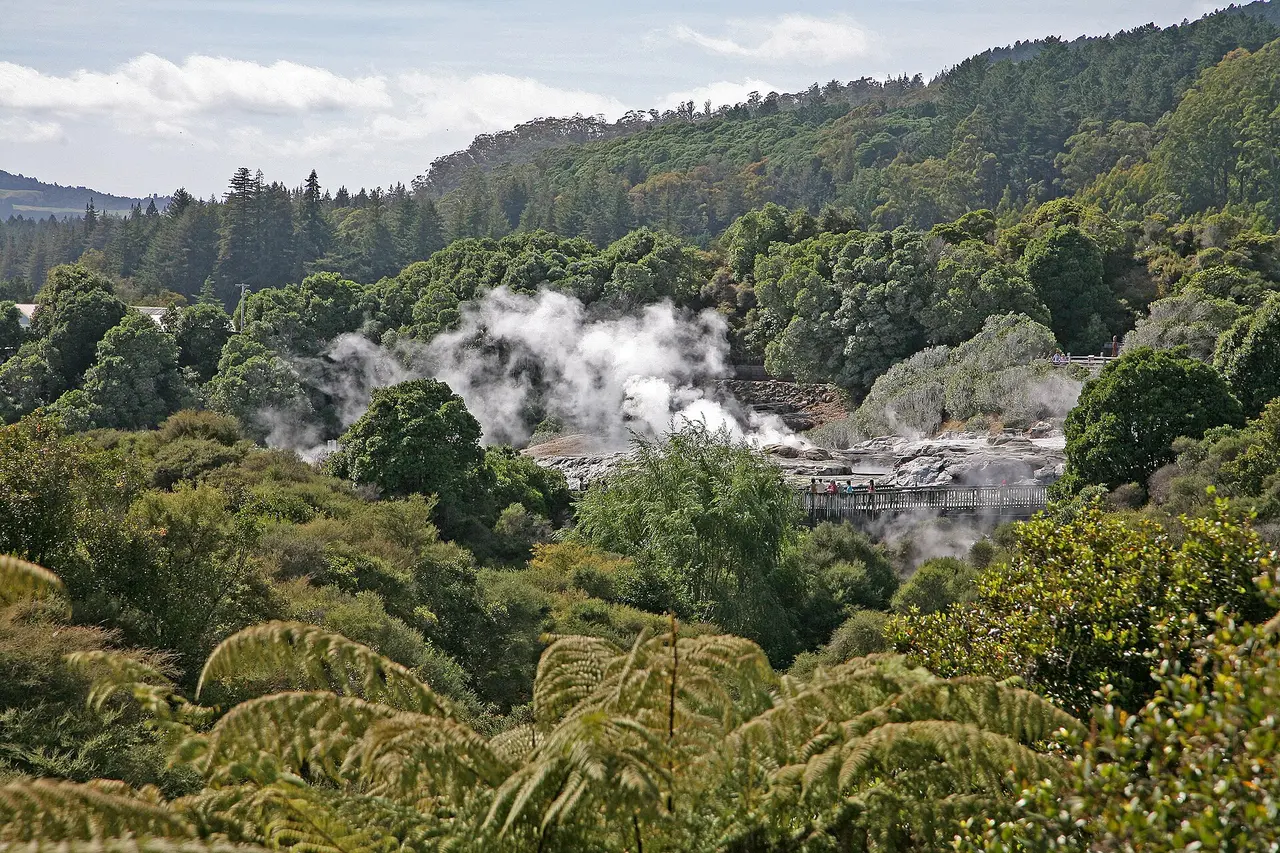
Pōhutu Geyser

The largest active geyser in the Southern Hemisphere, at Te Puia. It can shoot up to 30 m high, several times a day, and is also worth seeing lit up at night.

Champagne Pool

A bubbling hot spring at Wai-O-Tapu, ringed with orange mineral deposits, with water around 74 °C and constant steam on the surface.

Lady Knox Geyser

Set off every morning around 10:15 am by adding soap, it sends up a plume of water for long minutes. Arrive early to get a seat.

Whakarewarewa Village

An inhabited Māori village where guides, descendants of local families, show cooking in the springs and a performance of songs and haka.

Redwoods Treewalk

Suspended walkways between the redwoods of Whakarewarewa Forest, lit with lanterns at nightfall, for a stroll of about 40 minutes.

Polynesian Spa

Geothermal pools on the lakeshore, from acidic to alkaline waters, looking over Rotorua. Most pleasant at the end of the day, after a hike.

Waimangu Volcanic Valley

The world's youngest geothermal system, born in 1886: the steaming Frying Pan Lake, terraces and the milky blue Inferno Crater Lake.

Skyline Rotorua

A gondola up Mount Ngongotahā, with views of the lake and downhill luge tracks. An activity popular with families.

Kuirau Park

A free public park right in town, with mud pools, a steaming lake and hot foot baths, a few minutes' walk from the centre.

What to do in and around Rotorua?

The centre and the lakefront

The grid-plan town centre slopes down to Lake Rotorua, a collapsed crater of about 80 km². The Government Gardens, English-style grounds around the Tudor-style former bathhouse, face the Polynesian Spa, alkaline and acidic hot pools by the water. Kuirau Park, free to enter, shows mud pools and fumaroles five minutes from the main street. On Thursday evenings, a night market livens up Tutanekai Street. Allow half a day for this area, ideal on your arrival evening.

Whakarewarewa, the geyser valley

Three kilometres south of the centre, the Whakarewarewa valley holds two neighbouring sites. Te Puia is home to Pōhutu geyser, which erupts up to around twenty times a day, and the national Māori arts and crafts institute, where carvers and weavers can be seen at work. The living village of Whakarewarewa, home to Māori families, shows how they cook in hot springs and bathe in natural pools. Allow three hours for either site, a full day for both.

Wai-O-Tapu, Waimangu and Hell's Gate

To the south, the Taupō road leads in 30 minutes to Wai-O-Tapu, known for the orange and green Champagne Pool and the Lady Knox geyser, set off every morning around 10:15 am. Waimangu, born from the 1886 eruption of Mount Tarawera, is explored on a four-kilometre downhill trail to Lake Rotomahana, with a shuttle back. To the north-east, Hell's Gate offers mud baths and violent fumaroles. Pick two, not three: the landscapes are similar. Always stay on the paths, as the ground can give way near springs.

The redwoods and the Tarawera lakes

Five minutes from the centre, Whakarewarewa Forest, planted with Californian redwoods in the early 20th century, offers over 100 km of mountain bike trails and a suspended walkway through the trees, lit up at night. Further east, the Blue and Green lakes and then Lake Tarawera are 20 to 30 minutes' drive away. The Buried Village of Te Wairoa shows the remains of a settlement buried in the 1886 eruption. The region remains volcanically active: the deadly 2019 eruption of Whakaari, off the Bay of Plenty, ended visits to the island.

Māori evenings and onward travel

Cultural evenings, held nightly at Te Puia, Mitai or Tamaki, include a traditional welcome, haka, songs and a hāngī meal cooked in the ground: allow three to four hours, transfers included. Book the day before in the southern summer. Rotorua fits easily into a North Island loop: Auckland and its harbour are three hours north, Hobbiton about an hour away, Lake Taupō an hour south. Heading on to the South Island, New Zealand is best covered by combining road, ferry and domestic flights.

Getting there

Airports serving Rotorua, from main hubs to secondary ones.
  • AKLAuckland International AirportAucklandMain
  • CHCChristchurch International AirportChristchurchMain
  • WLGWellington International AirportWellingtonMain
  • ZQNQueenstown AirportQueenstownMain
  • ALRAlexandra AerodromeAlexandraSecondary
  • AMZArdmore AirportManurewaSecondary

Practical information for Rotorua

Sulphur smell

Hydrogen sulphide gives the town a rotten-egg smell, especially near geothermal parks. You get used to it within a day or two.

Geothermal safety

Stay on marked paths: the ground can be thin, with boiling water beneath a crust. Never leave a child unsupervised.

Jewellery and pools

Sulphurous water tarnishes silver: remove jewellery and watches before the Polynesian Spa or mud baths.

Entering New Zealand

NZeTA electronic authority and IVL tourist levy required for visa-waiver travellers, to be obtained before departure.

Getting there

About three hours' drive from Auckland, one hour from Taupō. Small regional airport about ten kilometres north-east.

Marae etiquette

On a marae, remove your shoes before entering the meeting house and follow your hosts' guidance during the pōwhiri.

Power sockets

Type I with two flat pins in a V, 230 V: an adapter is needed for European devices.

Tipping

Not customary in New Zealand; a small gesture is appreciated after a good cultural evening or guided tour.

Rotorua in pictures

Photo credits : W. Bulach, CC BY-SA 4.0, Wikimedia Commons ; Christian Mehlführer, User:Chmehl, CC BY 2.5, Wikimedia Commons ; Krzysztof Golik, CC BY-SA 4.0, Wikimedia Commons

Frequently asked questions about Rotorua

Te Puia or Whakarewarewa Village: which one to choose?
Te Puia offers the best view of Pōhutu geyser and the carving school, on a more developed route. The living village of Whakarewarewa is more intimate: you meet families who live on site. With only half a day, choose Te Puia for the geyser.
Should you arrive early at Wai-O-Tapu for the Lady Knox geyser?
Yes. The geyser is set off around 10:15 am, at a site separate from the main park, a few minutes' drive away. Arrive around 9:45 am for a good spot, then continue with the park trail, which takes about 75 minutes.
Can Rotorua be done as a day trip from Auckland?
It is possible, but with six hours of return driving you only have time for one geothermal site and a quick visit. One night allows a Māori evening and the hot pools, and two nights let you see Wai-O-Tapu and the redwood forest without rushing.
Can you swim in Lake Rotorua?
Yes, swimming is possible in summer, but the water is not warm except at rare spots near springs. For naturally hot water, head to developed pools, the Polynesian Spa or Kerosene Creek, south of town.
How long does a hāngī evening in Rotorua take?
Allow three to four hours, including the transfer from your hotel. The evening opens with a traditional welcome, continues with songs and haka, then the meal slow-cooked for hours in an earth oven. Special diets are catered for if you mention them.
Is Rotorua safe given the volcanic activity?
Yes for a standard stay: the geothermal parks are monitored and signposted. The risks come mainly from wandering off paths. Authorities constantly monitor the Taupō Volcanic Zone; check local alerts, especially since the Whakaari eruption in 2019.

Plan your trip to Rotorua

Build your day-by-day itinerary and manage budget, bookings and packing in PlanTripNow.
Aperçu de l'application PlanTripNow