Skip to content

Visiting Auckland : volcanoes, gulf islands and a wild coast

New Zealand's largest city and the gateway to almost every trip, Auckland deserves more than a one-night stopover. You climb extinct volcanoes in the middle of residential suburbs, catch a ferry to a wine island, then head out to the Piha surf. February remains the warmest and driest month.

At a glance

Visa
None
Tourist stay of up to 90 days
7-day budget
€1,036
Per person, comfort profile, excluding international flights.
Recommended length
3 days
For a first trip, without rushing.

Why stop over in Auckland?

Auckland, Tamaki Makaurau in Maori, is the largest city in New Zealand and its main international airport. It spreads across an isthmus between the Hauraki Gulf and the Tasman Sea, amid a field of some fifty volcanoes, so city, islands and surf beaches can be combined in two to four days.

When to visit Auckland

Temperatures, rainfall and crowds month by month, to pick your window.
When to visit Auckland
MonthTemperaturesRainCrowdsVerdict
January17 to 24 °C8 dPackedThe heart of summer and the long New Zealand holidays: Waiheke ferries full, Piha and Takapuna beaches busy, and the Auckland Anniversary regatta at the end of the month.
February17 to 24 °C7 dBusyThe warmest and driest month with the sea at 21C: ideal for swimming and the gulf islands once local families have gone home.
March16 to 23 °C8 dModerateA bright late summer with the sea still warm; harvest time on Waiheke and the Pasifika festival in the parks, without the January crush.
April13 to 20 °C11 dModerateA mild 20C autumn with more frequent showers; the Easter break fills the ferries and island accommodation for two weeks.
May11 to 18 °C12 dQuietA quiet, good-value shoulder season: volcanic cone walks on clear days and museums for the rainy ones.
June9 to 15 °C15 dVery quietA mild but damp start to winter, 15C in the afternoon and rain every other day; hotels at their cheapest, with Matariki marking the Maori new year.
July8 to 14 °C16 dQuietThe coolest and wettest month, though frost-free; the July school break brings some crowds back to indoor sights.
August9 to 15 °C15 dVery quietA still-rainy winter and a very quiet city: a good month for a budget stopover, with a raincoat and some museum days.
September10 to 16 °C13 dQuietEarly spring with wind and showers: the parks are in bloom but the sea stays at 15C, too cool for swimming.
October12 to 18 °C12 dModerateLengthening days and the first cruise calls; the early October school break and changeable weather call for flexibility.
November13 to 19 °C10 dModerateA great window before summer: 19C, pohutukawa trees starting to flower, and islands and beaches still quiet.
December15 to 22 °C9 dBusySummer sets in and pohutukawa trees turn the coast red; holidays start mid-December and New Year fireworks fly from the Sky Tower, so book early.
Source: Hémisphère sud : l'été austral va de décembre à février. Normales 1991-2020 de climatestotravel.com (températures, jours de précipitations, température de la mer dans le golfe d'Hauraki), relevé octobre 2026. Climat océanique humide : l'hiver (juin-août) est doux mais pluvieux plutôt que froid. Affluence et prix : vacances d'été néo-zélandaises (mi-décembre à fin janvier), congés scolaires d'avril, juillet et fin septembre-octobre, saison des croisières d'octobre à avril.

Auckland's must-sees

Nine visits between volcanoes, harbours and surf beaches.

Sky Tower

At 328 metres the tower dominates downtown; its glass-floored decks give the best reading of the city, set between two harbours and dozens of cones.

Maungawhau, Mt Eden

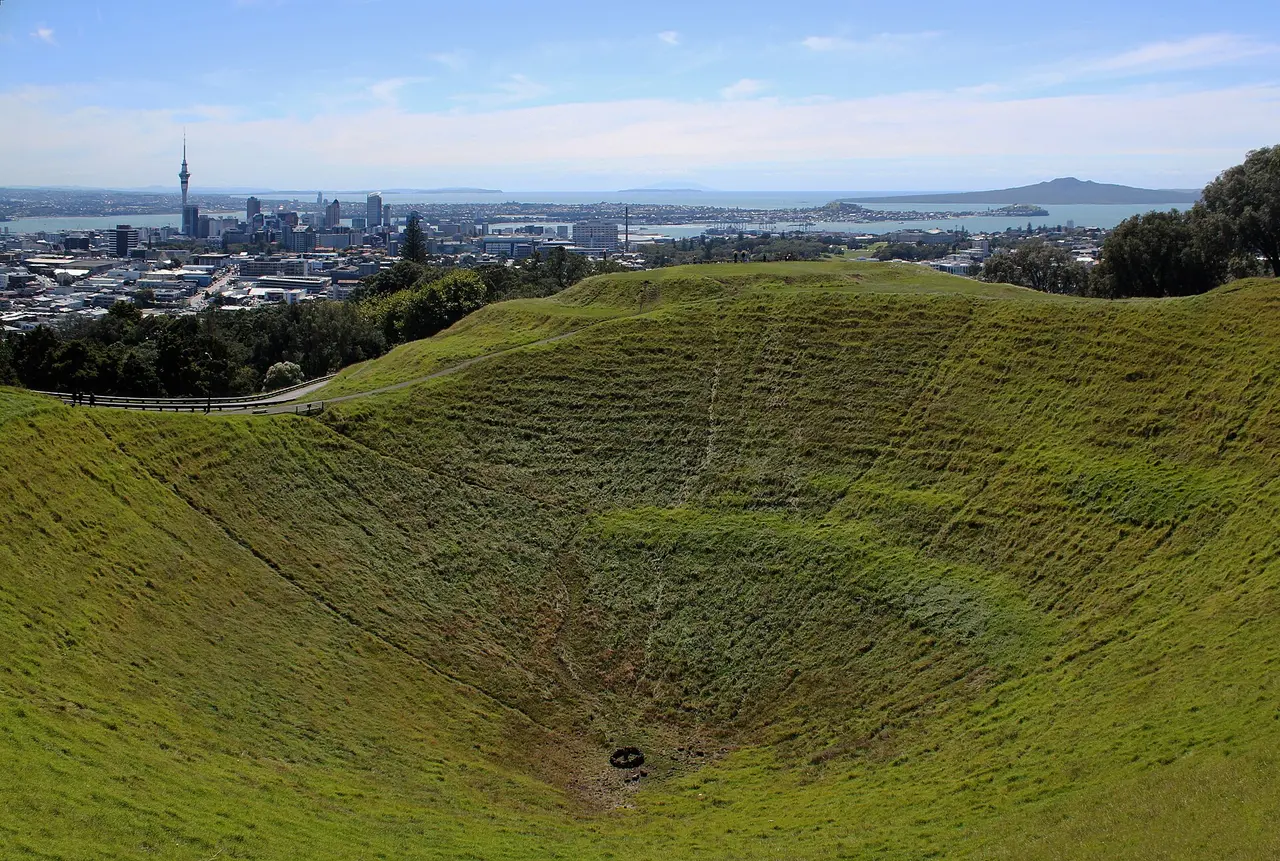
The highest cone on the isthmus, reachable on foot only, offers a 360-degree view around a grassy crater you must not step into.

Maungakiekie, One Tree Hill

A former Maori pa with visible terraces at the heart of Cornwall Park and its sheep, crowned by an obelisk and the grave of the city's founder.

Auckland War Memorial Museum

In the Domain park, its Maori and Pacific collections, including a great war canoe and a carved meeting house, are an essential introduction.

Rangitoto Island

The gulf's youngest volcano is climbed in a morning across lava fields and through lava caves; bring water, the island has no shops.

Waiheke wineries

Forty minutes away by ferry, the island lines up vineyards, the beaches of Oneroa and Onetangi and tables with a view, best on weekdays to avoid crowds.

Piha and Lion Rock

A black-sand beach pounded by Tasman swell, watched over by a lion-shaped rock; a guaranteed spectacle, with swimming only between the flags.

Devonport and North Head

A Victorian village on the North Shore, a few minutes away by ferry, with old military tunnels on the headland and a head-on view of the city.

Muriwai gannet colony

A gannet colony nests on the west coast cliffs, easy to watch up close from viewing platforms, mostly between August and March.

What to see in Auckland, neighbourhood by neighbourhood?

Britomart, the Viaduct and Wynyard Quarter

Downtown boils down to a waterfront strip about two kilometres long. Britomart, around the station and the ferry terminal, packs restored warehouses, shops and bars. To the west, Viaduct Harbour, built for the America's Cup, lines up yachts and terraces, then Wynyard Quarter carries the promenade on to the fish market and playgrounds on the old wharves. Allow half a day on foot, ideally late in the afternoon when the light drops over the harbour.

A city sitting on some fifty volcanoes

The Auckland volcanic field counts around fifty cones, craters and lava flows, several of them parks right in the city. The summits are closed to cars and take twenty to forty minutes to walk up. They are also former pa, fortified Maori villages whose terraces are still visible: stay on the paths and never walk down into the craters, which are considered tapu. Two summits are enough to understand the city, the rest reveal themselves as you explore the suburbs.

Ponsonby, Karangahape Road and Parnell

For eating and going out, three neighbourhoods share the honours. Ponsonby Road, west of downtown, lines up wooden villas, specialty cafes and restaurants for nearly two kilometres. Karangahape Road, known as K Road, keeps a more alternative edge with thrift shops, bars and an LGBT+ scene. Parnell, to the east, is one of the city's oldest suburbs, with Victorian houses and a rose garden, ten minutes' walk from the museum. One evening per neighbourhood is enough.

The Hauraki Gulf by ferry

From the Britomart terminal, a fleet of ferries serves the islands of the Hauraki Gulf Marine Park. Waiheke, about forty minutes away, draws visitors with its wineries and sheltered beaches; the visitor ferry costs around NZD 46 return off-peak. Rangitoto, the youngest volcano in the region, which rose from the sea about six centuries ago, can be climbed in a morning, with no shops at all on the island. Devonport, on the North Shore, is a few minutes away for a stroll through its Victorian village.

The west coast and the Waitakere Ranges

Some forty kilometres west, the coast changes completely: black-sand beaches, cliffs and Tasman Sea swell. Piha and its Lion Rock are about forty minutes' drive away, with Karekare and Muriwai to round off the day. The currents are fierce: swim only between the lifeguard flags, patrolled mainly in summer. On the way, the Waitakere Ranges forest protects kauri trees threatened by disease: some tracks remain closed and boot-cleaning stations mark the entrances. Bring a car, buses are scarce.

Tamaki Makaurau, a Maori and Pacific city

Auckland is often described as the largest Polynesian city in the world, with large Maori, Samoan, Tongan and Cook Islands communities. For a first introduction, the Maori and Pacific galleries of the Auckland War Memorial Museum deserve a good two hours. In March, the Pasifika festival gathers island food stalls and stages in a park in the west of the city; in June or July, Matariki, the Maori new year, is a public holiday marked by events across the region.

The gateway to New Zealand and the Pacific

The airport, south of the city, handles most long-haul flights into the country. Two to four nights are enough before heading south to the volcanoes of Rotorua, the Waitomo caves or the Hobbiton village, about two hours' drive away. Auckland is also a hub for the islands, with direct flights to Fiji or to New Caledonia, where French is spoken. After a flight of more than twenty hours from Paris, keep the first day light.

Sample itineraries

Three routes built around the time you actually have.
3daysRecommended

Auckland in 3 days: Maori culture, Rangitoto and the west coast

  1. Auckland Museum, the Domain, Parnell and Ponsonby
  2. Rangitoto and Devonport
  3. Piha and the Waitakere Ranges

Best for: A more outdoorsy stay built around the city's three faces: the Maori collections of the museum, the youngest volcano in the Hauraki Gulf and the black-sand beaches of the west coast. A rental car helps on the last day.

How much it costs

Per person per day, excluding international travel.
Budget
63 €/ day
3 180 € for 2 people, 7 days, return flights included
Accommodation
23 €
Food
23 €
Local transport
7 €
Sights and activities
10 €
Comfort
148 €/ day
4 670 € for 2 people, 7 days, return flights included
Accommodation
50 €
Food
53 €
Local transport
15 €
Sights and activities
30 €
Premium
310 €/ day
7 740 € for 2 people, 7 days, return flights included
Accommodation
100 €
Food
100 €
Local transport
35 €
Sights and activities
75 €
Prices checked: Relevé octobre 2026. Taux BCE du 12 octobre 2026 : 1 EUR = 1,9968 NZD. Repas et transports : Numbeo Auckland, mise à jour du 10 octobre 2026, 114 contributeurs (repas bon marché 25 NZD, dîner de milieu de gamme pour deux 120 NZD, trajet en transport public 4,50 NZD, taxi 4 NZD de prise en charge puis 3,50 NZD/km). Hébergement : fourchettes indicatives 2026 de goingnz.com (mise à jour juillet 2026, source non officielle) : lit en dortoir 30 à 55 NZD, motel 130 à 260 NZD, hôtel 4-5 étoiles 220 à 500 NZD, Auckland dans le haut de fourchette ; chambre double partagée à deux pour comfort et premium. Activités : Sky Tower 45 NZD en ligne (billetterie officielle), ferry Fullers360 pour Waiheke 46 NZD aller-retour hors pointe (avis Fullers d'octobre 2025, tarifs visiteurs inchangés en février 2026), le reste estimé ; volcans, plages et sentiers sont gratuits. Vol A/R Paris-Auckland avec escale, hors vacances scolaires : prix moyen 1141 € en novembre et 1209 € en septembre (ou-et-quand.net, pages 2026, agrégateur non officiel), retenu 1150 € (backpacker), 1300 € (confort), 1700 € (premium, meilleure correspondance). NZeTA et taxe IVL (117 à 123 NZD par personne) non comptées.

Getting there

Airports serving Auckland, from main hubs to secondary ones.
  • AKLAuckland International AirportAucklandMain
  • CHCChristchurch International AirportChristchurchMain
  • WLGWellington International AirportWellingtonMain
  • ZQNQueenstown AirportQueenstownMain
  • ALRAlexandra AerodromeAlexandraSecondary
  • AMZArdmore AirportManurewaSecondary

Entry, health and safety

For FR travellers

Entry requirements

No visa for a tourist stay

Pas de visa pour un séjour de moins de 90 jours, mais autorisation de voyage électronique NZeTA obligatoire avant le départ, y compris en simple transit à l'aéroport d'Auckland. Elle est valable deux ans et se demande avec la taxe de conservation et de tourisme IVL (17 NZD par l'application ou 23 NZD par le site d'Immigration New Zealand, plus 100 NZD d'IVL). À l'arrivée : passeport en cours de validité, billet de retour ou de continuation et preuve de moyens suffisants. Contrôle biosanitaire très strict : fruits, charcuterie, miel et produits frais interdits ou à déclarer, amende immédiate de 400 NZD en cas d'infraction. Les agents peuvent exiger l'accès aux appareils électroniques.

Stay allowed for up to 90 days.

Health

Advised: Aucun vaccin exigé. Être à jour du calendrier vaccinal français (diphtérie, tétanos, poliomyélite, coqueluche) et de la vaccination contre la rougeole.

Assurance couvrant frais médicaux et rapatriement impérative : le régime public ACC indemnise les accidents mais ne couvre ni les maladies ni le rapatriement. Médicaments dans leur emballage d'origine avec ordonnance en DCI, certains doivent être déclarés à l'arrivée. Zone sismique et côtes exposées aux alertes tsunami : repérer les consignes locales. Météo changeante en toute saison, prévoir un vêtement chaud et imperméable. Baignade dans les zones surveillées : forts courants sur les plages de la côte ouest comme Piha. Délinquance en hausse dans le centre-ville et près des sites touristiques, présence de gangs à Auckland qui visent rarement les étrangers ; ne rien laisser en vue dans les véhicules.

Safety

Normal precautions

Emergency

111

Checked in octobre 2026 against the official source. Entry rules change: check the official source before you travel, it alone is authoritative.

Practical information for Auckland

Currency

New Zealand dollar (NZD), around 2 NZD to 1 EUR in October 2026. Contactless cards are accepted almost everywhere, even for small amounts.

Public transport

Auckland Transport buses, trains and ferries are paid with an AT HOP card or a contactless bank card; a single trip costs around NZD 4.50.

Airport

The international airport lies south of the city; an express bus runs downtown, while taxis and rideshares cost far more.

Tipping

Not customary in New Zealand: service is included and the 15% GST is built into displayed prices.

Tap water

Safe to drink throughout the city; public fountains let you fill your bottle before heading out to the islands or volcanoes.

Power sockets

Type I with three flat pins, 230 V: European appliances need an adapter.

Biosecurity on arrival

Fruit, cured meats, honey and fresh produce are banned or must be declared, with an on-the-spot NZD 400 fine if you forget. Clean hiking boots and camping gear too.

Swimming

Calm beaches on the gulf side, such as Mission Bay or Takapuna; on the west coast, patrolled zones only, between the red and yellow flags.

Driving

Traffic drives on the left; a French licence is accepted with a translation or an international permit. Evening jams are common on the isthmus motorways.

Auckland in pictures

Photo credits : Avenue, CC BY-SA 3.0, Wikimedia Commons ; Daan Hoffmann / Auckland War Memorial Museum Tāmaki Paenga Hira, CC BY 2.0, Wikimedia Commons ; August Dominus, CC0, Wikimedia Commons ; Duncnbiscuit, CC BY-SA 4.0, Wikimedia Commons ; russellstreet, CC BY-SA 2.0, Wikimedia Commons

Frequently asked questions about Auckland

Can you walk down into the Mt Eden crater?
No. The Maungawhau crater is considered tapu, meaning sacred, by the Maori iwi who co-manage the city's volcanoes. You walk around it on the summit path, reachable on foot only, and stay on marked tracks to protect the terraces of the former pa.
Is a day trip to Waiheke enough?
Yes for a first visit: with a morning ferry and a late afternoon return, there is time to visit two wineries, swim at Oneroa or Onetangi and have lunch. In summer and at weekends, book both the ferry and your tables ahead.
How do you get to Piha without a car?
Public transport serves the west coast poorly. The easiest option is an organised day tour from downtown, which often combines Piha, the Waitakere Ranges and Muriwai. Otherwise, a one-day car rental is enough; the road is short but very winding.
Do you need an NZeTA for a simple connection in Auckland?
Yes. According to France Diplomatie, French travellers transiting through Auckland Airport must also hold an NZeTA. It is requested online or through the official Immigration New Zealand app before departure, with the IVL tourist levy for a stay.
Can Rangitoto be visited without a guide?
Yes. The summit track is well marked and takes a morning there and back from the wharf. The island has no drinking water or shops: bring water, a picnic, closed shoes and a torch for the lava caves, and check the time of the last ferry.
How many nights in Auckland before Rotorua or Hobbiton?
Two nights cover downtown, one volcano and Waiheke; three to four add Rangitoto and the west coast. Many travellers also keep a night in Auckland at the end of their trip, handier before an early return flight.
Where can you discover Maori culture in Auckland?
The Auckland War Memorial Museum holds the city's most complete Maori and Pacific collections, with cultural performances on some days. The volcanic summits, former pa, also tell this story, as do the Matariki celebrations in June or July.

Plan your trip to Auckland

Build your day-by-day itinerary and manage budget, bookings and packing in PlanTripNow.
Aperçu de l'application PlanTripNow