Skip to content

Visiting Zagreb : what to do in two or three days

A tiny funicular, a cannon fired every noon, glazed tile roofs and terraces packed at the first ray of sunshine: Zagreb is best explored on foot, from the Upper Town to the parks of the Green Horseshoe. Two days cover the centre, a third adds Medvednica or Plitvice.

Why visit Zagreb?

Zagreb is the capital and largest city of Croatia, with a compact historic centre split between the medieval Upper Town and the Austro-Hungarian Lower Town. It stands out for its café culture, original museums and Advent markets, among the most popular in Europe. It is also the inland gateway to the Plitvice Lakes.

Zagreb's must-sees

Landmarks, markets and curiosities, nearly all within a twenty-minute walk of Ban Jelačić Square.

St Mark's Church

Gradec church recognisable by its glazed tile roof showing the coats of arms of Croatia, Dalmatia, Slavonia and Zagreb. Best seen from the square, the interior rarely opens.

Lotrščak Tower

A 13th-century watchtower on the edge of the Upper Town. The Grič cannon is fired there every noon, and its lookout overlooks the rooftops of the Lower Town.

Zagreb Funicular

Opened in 1890, it links Ilica street to the Upper Town in under a minute. One of the shortest public funiculars in the world, paid with a dedicated ticket.

Dolac Market

The city's main market since the 1930s, on a terrace above Ban Jelačić Square. Fruit, vegetables, flowers and fresh cheese every morning, Sundays included.

Museum of Broken Relationships

A small Gradec museum displaying objects donated anonymously after a break-up, each with its story. An hour is enough, and emotion is often part of the visit.

Stone Gate

The last medieval gate of Gradec, turned into a chapel around an icon of the Virgin spared by a fire in 1731. Locals light candles there all day long.

Mirogoj Cemetery

A park cemetery with long ivy-covered arcades and green domes, designed by Hermann Bollé. Superb under snow or on All Saints' Day, when thousands of candles are lit.

Tkalčićeva Street

A pedestrian street lined with colourful houses, bars and terraces, laid over a former stream between Kaptol and Gradec. Lively from morning until late at night.

Strossmayer Gallery

A collection of European old masters, Italian in particular, housed in the palace of the Croatian Academy of Sciences and Arts on Zrinjevac square in the Green Horseshoe.

Plitvice Lakes

A UNESCO-listed national park about two hours south by bus. Sixteen cascading lakes linked by wooden boardwalks, best visited early in the morning in summer.

What to see in Zagreb, neighbourhood by neighbourhood?

Gornji Grad, the Upper Town

The Upper Town brings together Gradec and Kaptol, two rival settlements merged in the 19th century. You reach it from Ilica street by the funicular, running since 1890 and about sixty metres long, or by the stairs in five minutes. Cobbled lanes, gas lamps lit by hand every evening, baroque palaces and small museums fill half a day. Get to Lotrščak Tower before noon: the Grič cannon booms there every day at 12 pm. This is the historic heart of the capital of Croatia.

Kaptol, the cathedral and the market

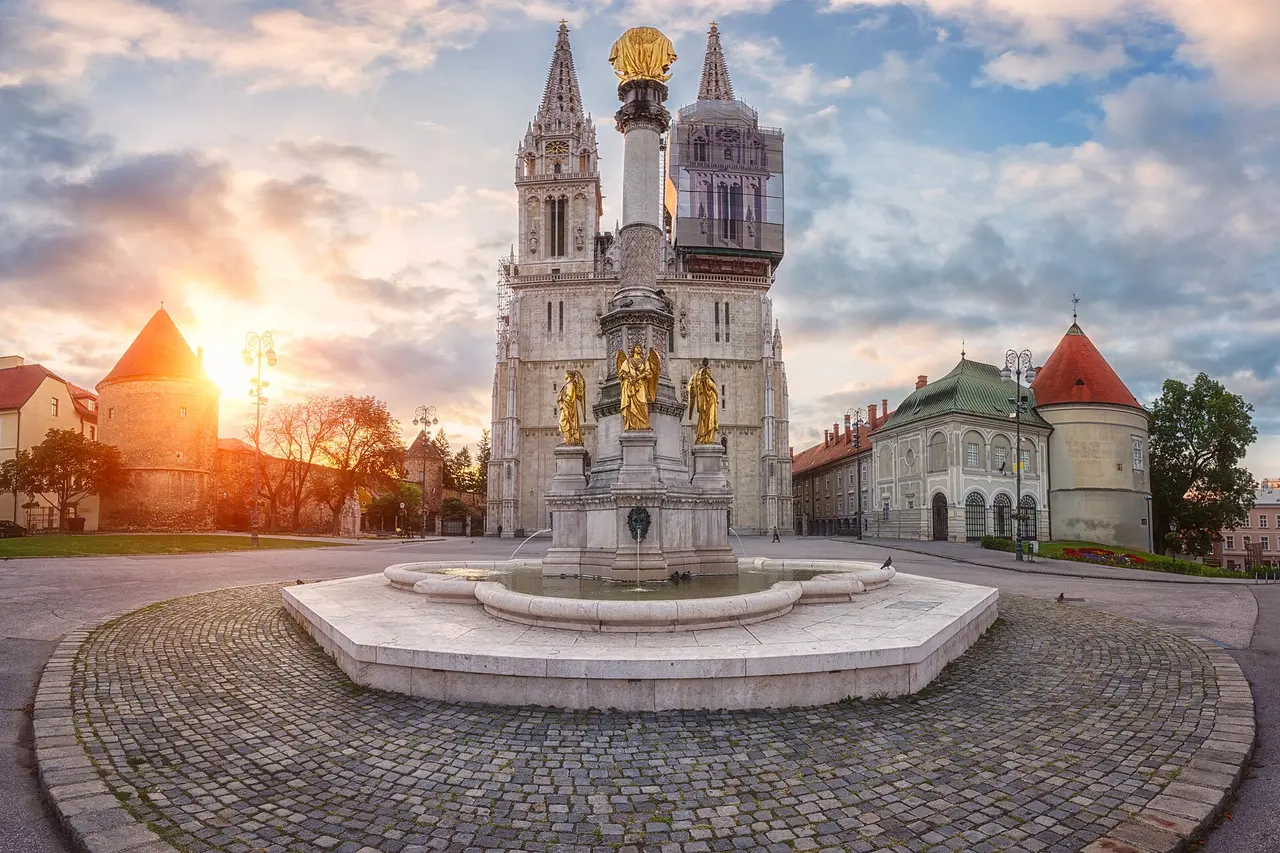
Kaptol is the bishop's hill. The neo-Gothic cathedral, damaged by the March 2020 earthquake, is still partly under scaffolding and access may be limited: check before going. Right next door, Dolac market spreads its red umbrellas every morning, with a covered hall for meat and cheese, including sir i vrhnje, fresh cheese with cream. Come between 8 and 11 am, as activity winds down by early afternoon. Tkalčićeva street, a former covered stream, then leads down to the bars and cafés.

Donji Grad and the Green Horseshoe

The Lower Town, laid out in the late 19th century, is organised around a U-shaped series of squares and gardens designed by urban planner Milan Lenuci, hence its nickname, the Green Horseshoe. The Croatian National Theatre, the Strossmayer Gallery, the Art Pavilion and the botanical garden punctuate the loop of about 2 km, a two-hour walk without visits. Ban Jelačić Square, the city's meeting point, links the Lower Town to the Upper Town. Most tram lines cross there.

Museums and café culture

Zagreb has surprising museums for a city its size: the Museum of Broken Relationships, the Croatian Museum of Naïve Art, the Mimara Museum and its eclectic collections, and the Nikola Tesla Technical Museum. Many close on Mondays, so plan accordingly. Between galleries, the city lives to the rhythm of the špica, the Saturday morning stroll when locals show themselves off on terraces around Bogovićeva street and Flower Square. A coffee can last an hour there without anyone rushing you.

Mirogoj and Maksimir

Twenty minutes by bus from the centre, Mirogoj cemetery is one of the city's calmest walks: neo-Renaissance arcades designed by Hermann Bollé, ivy-covered domes and graves of Croatian personalities. Allow an hour, entry is free. To the east, Maksimir Park, opened to the public in the late 18th century, spreads oak woods, lakes and pavilions over more than 300 hectares, along with the city zoo. The tram drops you at the entrance in a quarter of an hour from Ban Jelačić Square.

Medvednica and Lake Jarun

To the north, the Medvednica range peaks at Sljeme, just over 1,000 metres. It is a nature park, reached by bus then on foot, or by the cable car rebuilt and reopened in 2022. Marked trails, the medieval Zrinski mine and mountain inns make it a full day out, cool even in July. In winter, a small resort hosts alpine ski races. To the south-west, Lake Jarun serves as an urban beach in summer, with swimming, kayak hire and cycle paths all around the lake.

Advent and the seasons

From late November to early January, Advent transforms the centre: chalets on the squares, an ice rink in King Tomislav Park, concerts and mulled wine right up into the Upper Town. The market has been voted best Christmas market in Europe several times in an online poll, which draws crowds at weekends: go midweek instead. Summer is hot, often above 30 °C in July, and the city empties in August as locals head for the coast. May, June and September remain the most pleasant months for walking.

Getting there

Airports serving Zagreb, from main hubs to secondary ones.
  • DBVDubrovnik Ruđer Bošković AirportDubrovnikMain
  • PUYPula AirportPulaMain
  • RJKRijeka AirportRijekaMain
  • SPUSplit Saint Jerome AirportSplitMain
  • ZADZadar AirportZadarMain
  • ZAGZagreb Franjo Tuđman International AirportVelika GoricaMain

Practical information for Zagreb

Franjo Tuđman Airport

About 17 km south-east, linked to the main bus station by a shuttle in around thirty minutes. Taxis and ride-hailing apps are also available.

Currency and Schengen

Croatia uses the euro and has been part of the Schengen area since 1 January 2023: no checks at internal borders.

Trams and tickets

The ZET tram network covers the whole centre. Buy and validate your ticket before boarding or on board; inspections are frequent.

Sunday shopping

Since 2023, most shops close on Sundays, except on a limited number of Sundays per year. Dolac market still opens in the morning.

Museum closures

Many museums close on Mondays and shorten their hours on Sunday afternoons. Check before planning a cultural day.

Tap water

Safe and of good quality throughout the city, with public drinking fountains in the centre.

Tipping

Rounding up or leaving about 10% in restaurants is appreciated but not required; in cafés, people simply round up.

Power sockets

Types C and F, 230 V, the standard continental European plugs.

Tourist tax

A per-person, per-night tourist tax is collected by the accommodation, often already included in the displayed price.

Zagreb in pictures

Photo credits : Larisa Uhryn, CC BY-SA 4.0, Wikimedia Commons ; Paula Borkovic, CC BY-SA 4.0, Wikimedia Commons ; Diego Delso, CC BY-SA 3.0, Wikimedia Commons ; Rilegator, CC BY-SA 4.0, Wikimedia Commons

Frequently asked questions about Zagreb

Is Zagreb worth a stop before the Dalmatian coast?
Yes, two days are enough for the Upper Town, Dolac, the Green Horseshoe and Mirogoj. Zagreb offers a continental, Austro-Hungarian side the coast lacks, and prices are often gentler than in Split or Dubrovnik in high season.
How do you get from Zagreb to the Plitvice Lakes in a day?
Direct buses leave from the main bus station and take about two to two and a half hours. Catch the first departure, book your park entry slot online in summer and check the time of the last return bus before setting off.
What time is the cannon fired from Lotrščak Tower?
The Grič cannon fires every day at exactly noon from Lotrščak Tower, a tradition dating back to 1877. Stand on the Strossmayer promenade to hear it and enjoy the view over the Lower Town right afterwards.
Is Zagreb Cathedral open since the 2020 earthquake?
The March 2020 earthquake damaged the cathedral, and one of its spires had to be dismantled. Restoration work is ongoing and access to the interior may be restricted depending on progress: ask on site before planning your visit.
When are the Advent markets held in Zagreb?
They usually run from the last weekend of November to early January, on Ban Jelačić Square, Zrinjevac park, the Upper Town and around King Tomislav Park. Weekends are very busy, weekday evenings are more enjoyable.
What should you taste at Dolac market?
Sir i vrhnje, fresh cheese served with cream, seasonal fruit from Zagorje and štrukli, baked dough filled with cheese, to try in the surrounding restaurants. Produce sells out quickly: come before 10 am.
Can you get up to Sljeme without a car?
Yes. Public transport serves the lower station of the Medvednica cable car, reopened in 2022, which climbs close to the summit. Walkers can also follow the marked trails from the bus stops at the foot of the range, allowing two to three hours of climbing.
Where to stay in Zagreb to do everything on foot?
In the Lower Town, between the main railway station and Ban Jelačić Square: everything is walkable and trams cover the rest. The Upper Town is quieter at night but steeper, with fewer places to stay.
Is the Museum of Broken Relationships worth visiting?
Yes for an hour, especially on a rainy day. The objects are ordinary, but the texts beside them, translated into English, tell funny or heartbreaking stories. The museum is in the heart of the Upper Town, near St Mark's Church.

Plan your trip to Zagreb

Build your day-by-day itinerary and manage budget, bookings and packing in PlanTripNow.
Aperçu de l'application PlanTripNow