Skip to content

Travelling down the Draa Valley, from Ouarzazate to the dunes of Erg Chigaga

A road that follows Morocco's longest river, earthen kasbahs leaning against palm trees, a manuscript library on the edge of the desert, then the track to an erg you can only reach by 4x4 or camel: the Draa Valley is best travelled north to south, without hurrying.
  • 1 city

At a glance

Currency
Moroccan Dirham
Time difference
UTC+1
Visa
None
Tourist stay of up to 90 days
7-day budget
€658
Per person, comfort profile, excluding international flights.

What is the Draa Valley?

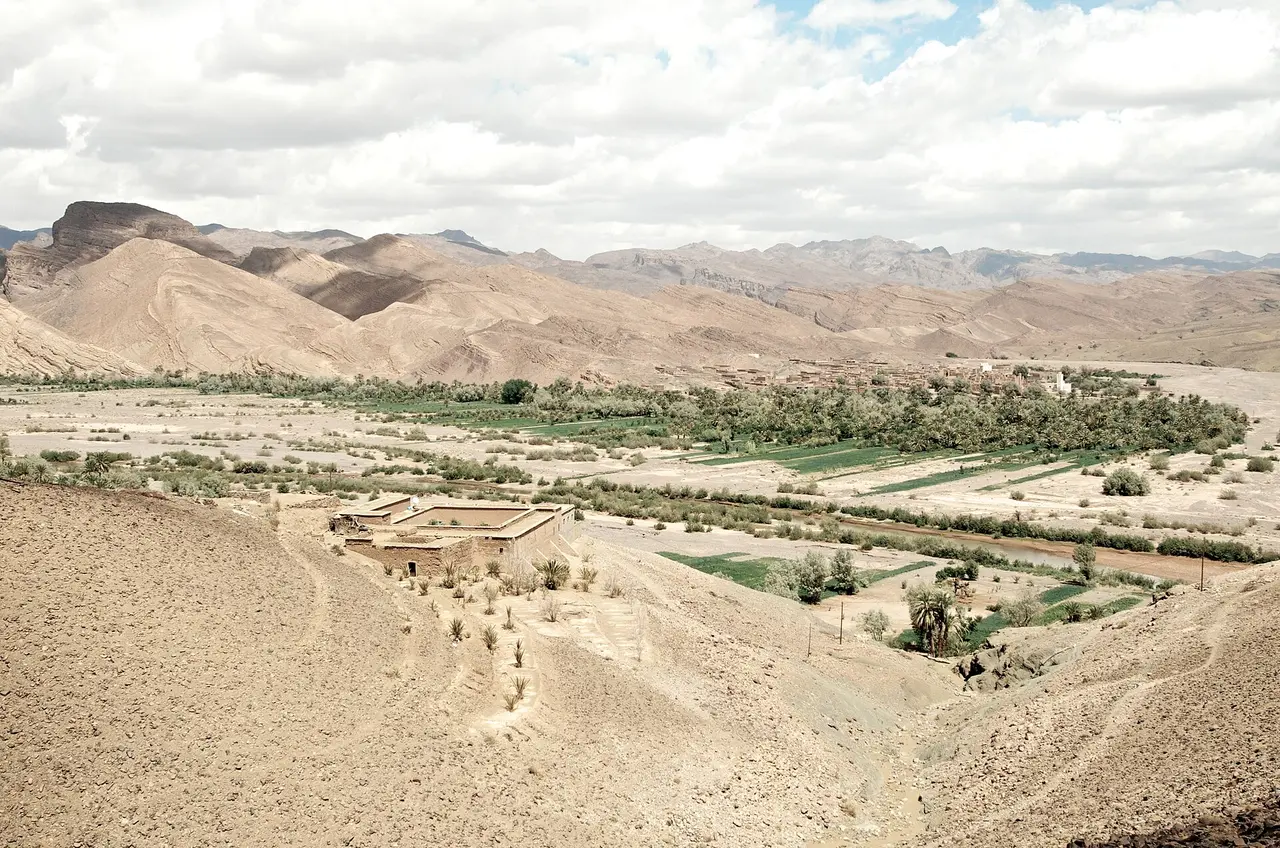
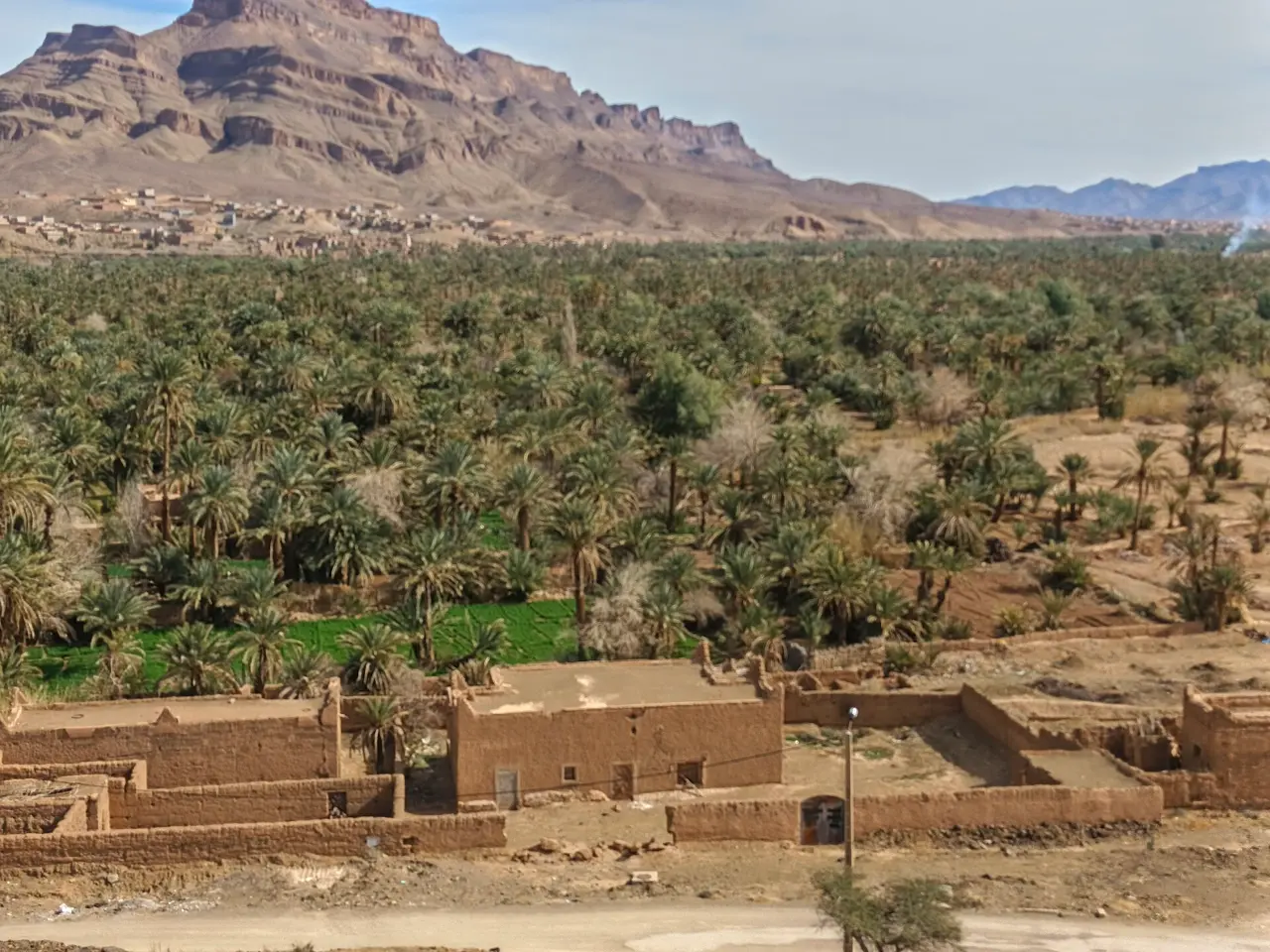
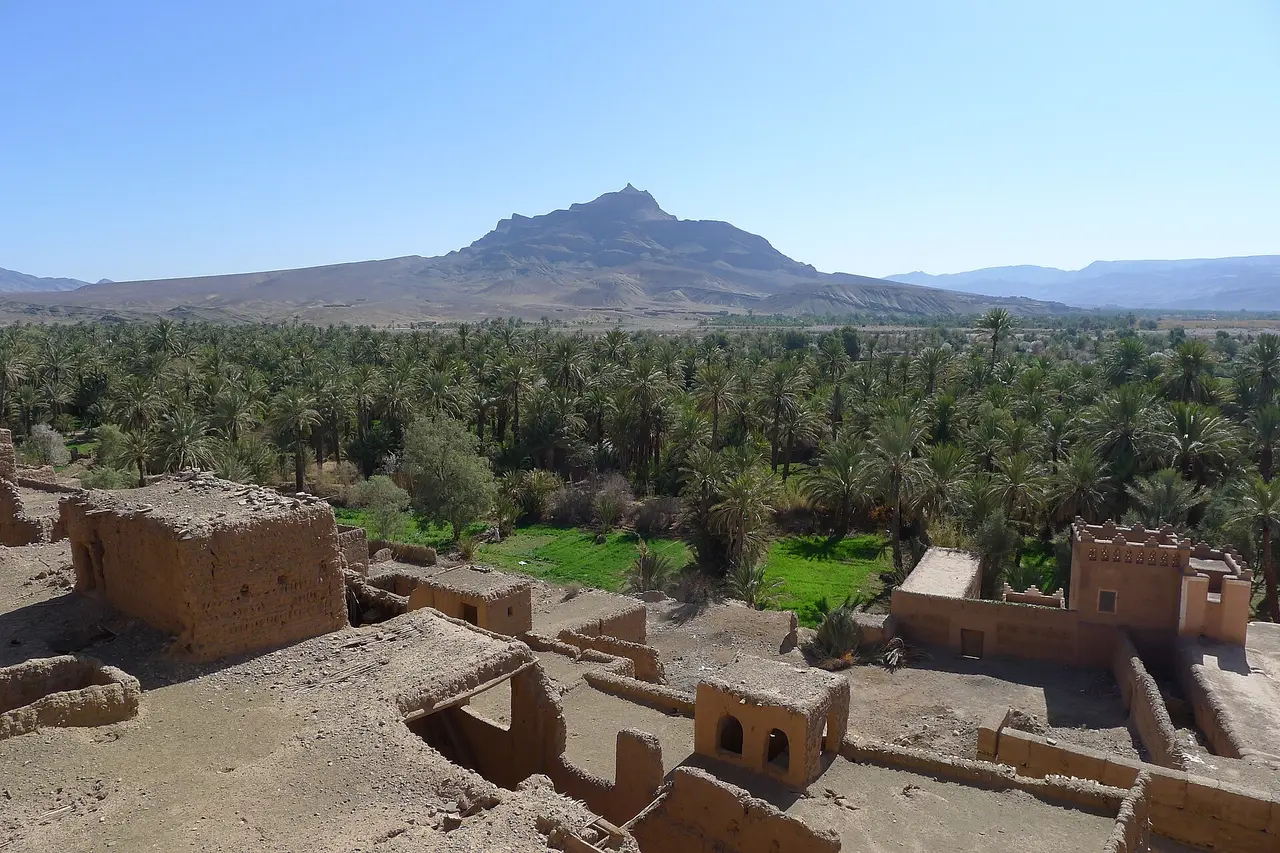
The Draa is born east of Ouarzazate where the Dadès and the Ouarzazate wadi meet, then heads south-east. Around 1100 km long, it is Morocco's longest river, yet it stays dry along most of its course. Its inhabited stretch, the middle Draa, strings irrigated oases between Agdz, Zagora and M'Hamid.

When to visit Draa Valley

Temperatures, rainfall and crowds month by month, to pick your window.
When to visit Draa Valley
MonthTemperaturesRainCrowdsVerdict
January4 to 21 °C1 dModerateSunny days around 20 degrees but near-freezing nights in desert camps: excellent for the palm groves and dunes, as long as you bring a proper sleeping bag.
February7 to 23 °C2 dModerateOne of the best months: mild days, crisp light on the ksour and still-cool nights in the dunes.
March10 to 26 °C2 dBusyIdeal temperatures, though sandstorms can blow; Erg Chigaga camps fill up, so book ahead.
April14 to 31 °C1 dBusyThe last comfortable month before the big heat: afternoons pass 30 degrees and desert nights become pleasant.
May17 to 36 °C1 dQuietThe heat sets in, 35 degrees in Zagora: go out early and late in the day, and take a siesta.
June21 to 41 °C1 dVery quietOver 40 degrees in the afternoon: the valley empties. Avoid unless you love extreme heat.
July26 to 44 °C1 dVery quietThe hottest month, around 44 degrees by day with nights staying above 25: not advisable for desert camping.
August25 to 43 °C3 dVery quietStill scorching, with isolated late-day storms that can flood the wadis: never cross a ford in spate.
September20 to 37 °C2 dQuietThe heat eases slowly, still 36 degrees in Zagora; the end of the month works for a first night in the dunes.
October15 to 31 °C2 dModerateTours resume: gentle warmth and pleasant nights under canvas.
November11 to 25 °C1 dModerateA very good month for the whole valley, Ouarzazate to M'Hamid: 25-degree days and few visitors outside long weekends.
December6 to 21 °C2 dBusyMild by day but cold at night; the year-end holidays push up prices and camp occupancy.
Source: Températures relevées pour Zagora (724 m), au cœur de la vallée : normales climate-data.org reprises par Wikipédia FR (page Zagora, révision du 13 mai 2026). Jours de pluie : normales NOAA 1991-2020 de l'aéroport d'Ouarzazate (Wikipédia EN, page Ouarzazate), en amont ; Zagora reçoit environ 61 mm par an contre 115 mm à Ouarzazate, les jours de pluie y sont donc plutôt surestimés. Ouarzazate et le col du Tizi n'Tinifift sont 3 à 5 degrés plus frais, M'Hamid (500 m) un peu plus chaud. Relevé le 4 novembre 2026.

The Draa Valley from north to south, stop by stop

From Ouarzazate to the Tinifift pass

The journey starts in Ouarzazate, whose international airport opens the road south. A few kilometres east of town, the Dadès and the Ouarzazate wadi merge in the Al Mansour Ad-Dahbi reservoir, built in 1971 to regulate the river. The road south then crosses Jebel Tifernine at the Tinifift pass, 1660 m up, before dropping down to the Agdz palm grove, laid along the floor of a bare, rocky valley.

Agdz, the caravan halt

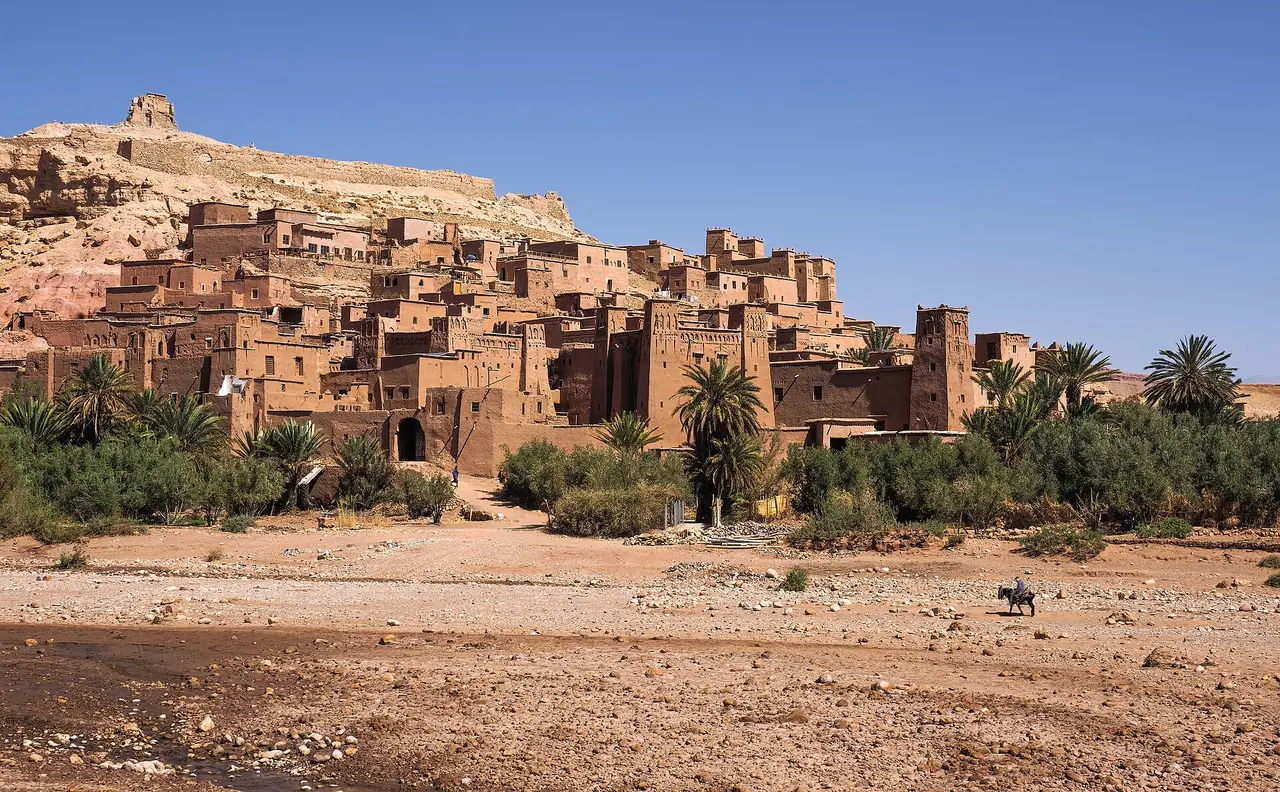
About 65 km south of Ouarzazate, Agdz spreads out below Jbel Kissane, a flat-topped mountain that serves as a landmark for the whole area. Its name means "place of rest" in Berber: the town was a stop on the old caravan route between Marrakech and Timbuktu, and long the capital of Mezguita, the northern part of the valley. The weekly market is held on Thursday, with Berber carpet shops along the main street. Scenes from Lawrence of Arabia were filmed in the surrounding area.

Tamnougalt, town of the caids

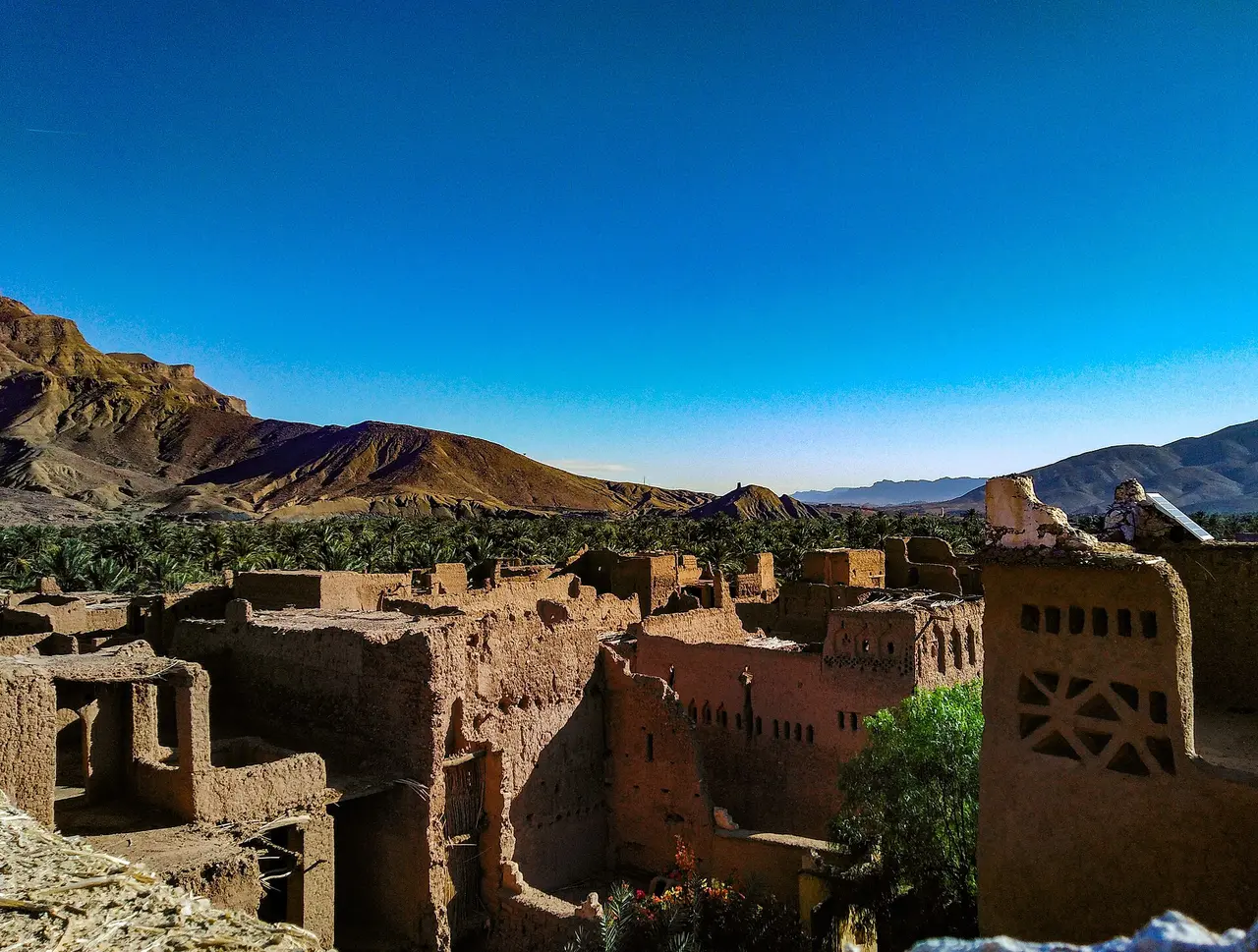
A few kilometres from Agdz, Tamnougalt combines a kasbah and a date palm oasis beneath the outline of Jbel Kissane, which closes the horizon to the north. Its name means "meeting point" in Tachelhit. Once the capital of Mezguita, the village was home to the area's caids, whose kasbah still overlooks the palm grove. Every year, in the first week of October, the Ellama moussem brings the neighbouring villages together for a festival that is both cultural and religious.

Zagora, below its mountain

Some 92 km further south, Zagora, at 724 m, is the provincial capital. The new town dates from the protectorate, but the oasis has been settled far longer: the Saadian expedition to Timbuktu set out from here in 1591. On Jbel Zagora stand the remains of an Almoravid fortress. The famous "Timbuktu 52 days" sign, which announced the journey time by camel, has been replaced by a mural. The weekly market takes place on Sunday in the town centre.

Tamegroute, manuscripts and green pottery

Some twenty kilometres from Zagora, Tamegroute gathers several interlinked ksour around the Naciria zawiya, founded in 1575. Its library owes much to Sidi Mohamed Ben Nacer, who brought back more than 4000 works from his travels in Africa and the Middle East. The village's other claim to fame is its green-glazed pottery: tagine dishes, bowls and tiles fired in kilns fed with palm fronds and dry wood. Stone tools found near Tamegroute point to human presence as far back as the Lower Palaeolithic.

M'Hamid El Ghizlane, at the end of the N9

Between Tagounite and M'Hamid, the Draa bends west and National Road 9 comes to an end, about 94 km after Zagora. At around 500 m, the oasis of M'Hamid, whose name is said to mean "plain of gazelles", is split between M'Hamid Bali, the old village, and M'Hamid Jdid, on either side of the wadi. A former trans-Saharan trading post, it is now the starting point for trips into the erg. The closed Algerian border lies a few dozen kilometres south: the strip along it is under heightened vigilance according to the French foreign ministry, so stay away.

Erg Chigaga and Iriqui National Park

Some fifty kilometres west of M'Hamid, Erg Chigaga stretches its dunes over about 40 km in length and 15 km in width. It can only be reached by 4x4, camel or on foot, which makes it far quieter than Erg Chebbi in the Merzouga desert. Further west, Iriqui National Park has protected an acacia steppe and Lake Iriqui since 1994; the lake is usually dry, but when it fills, flamingos and migrating birds stop over.

Cities to visit in Draa Valley

Featured destinations appear first.

How much it costs

Per person per day, excluding international travel.
Budget
54 €/ day
1 364 € for 2 people, 7 days, return flights included
Accommodation
15 €
Food
11 €
Local transport
6 €
Sights and activities
22 €
Comfort
94 €/ day
1 924 € for 2 people, 7 days, return flights included
Accommodation
26 €
Food
18 €
Local transport
20 €
Sights and activities
30 €
Premium
186 €/ day
3 212 € for 2 people, 7 days, return flights included
Accommodation
66 €
Food
38 €
Local transport
27 €
Sights and activities
55 €
Prices checked: Relevé le 4 novembre 2026, montants par personne et par jour, chambre double partagée à deux. Hébergement : prix par nuit affichés par Kayak pour Zagora (31 oct.-1er nov. 2026) : Dar Toda 30 EUR, Hotel Ourida 48 EUR, La Perle du Draa 56 EUR, Kasbah Sirocco 133 EUR. Repas : Numbeo Maroc, page pays (3748 relevés de 307 contributeurs sur 12 mois, mise à jour 2 novembre 2026) : repas simple 3,64 EUR, repas pour deux en restaurant moyen 22,74 EUR. Transport : Supratours Marrakech-Zagora 12 à 19 EUR (rome2rio, consulté le 4 novembre 2026) pour le profil routard ; location Kayak Ouarzazate, petite voiture environ 26 EUR par jour et voiture moyenne en aéroport environ 40 EUR par jour, plus carburant à 1,32 EUR le litre (Numbeo), partagées à deux. Activités : une sortie de 2 jours à l'Erg Chigaga dans la semaine, 188 EUR par personne en groupe depuis M'Hamid (TourRadar, Desert Amnir) et à partir de 340 EUR en privé depuis Zagora (Civitatis) ; sources commerciales non officielles. Vol A/R Paris-Ouarzazate : moyenne de 304 EUR sur 12 mois selon Kayak (Transavia en direct), soit 608 EUR pour deux. Taux Bank Al-Maghrib du 4 novembre 2026 : 1 EUR = 10,9876 MAD (la BCE ne publie pas de cours du dirham).

Entry, health and safety

For FR travellers

Entry requirements

No visa for a tourist stay

Pas de visa pour un séjour touristique jusqu'à 90 jours ; au-delà, prolongation à demander au service marocain de l'immigration. Passeport valide couvrant toute la durée du séjour obligatoire, la carte nationale d'identité seule n'est plus acceptée. Billet de retour et justificatifs de moyens de subsistance peuvent être demandés. Vérifiez que le passeport porte bien un cachet d'entrée.

Stay allowed for up to 90 days.

Health

Advised: Être à jour des vaccins recommandés en France. Selon le séjour : hépatite A, fièvre typhoïde, hépatite B, rage (avis médical, surtout pour les jeunes enfants), tuberculose pour les enfants de moins de 15 ans en cas de séjours fréquents ou prolongés.

Ne boire que de l'eau en bouteille capsulée ou rendue potable. Chiens et chats errants nombreux : en cas de morsure ou griffure, consulter immédiatement, même vacciné contre la rage. Leishmaniose sans vaccin ni traitement préventif : répulsif et moustiquaire. Chaleur extrême de juin à septembre (plus de 40 degrés à Zagora) : hydratation, éviter les heures chaudes. Sécurité : la vallée, de Ouarzazate à M'Hamid et l'Erg Chigaga, est en vigilance normale (vert) sur la carte France Diplomatie ; la bande longeant la frontière algérienne, au sud de M'Hamid, est en vigilance renforcée (jaune). Frontière avec l'Algérie fermée. Pistes du désert uniquement avec un chauffeur local, pas de conduite hors piste.
Safety

Normal precautions

Checked in novembre 2026 against the official source. Entry rules change: check the official source before you travel, it alone is authoritative.

Draa Valley in pictures

Photo credits : Sylvestre BOCCO, CC BY-SA 4.0, Wikimedia Commons ; Dromedar61, CC BY-SA 3.0, Wikimedia Commons ; Hatim Belyamani officerfishdumplings, CC0, Wikimedia Commons ; Oumaima Loudini, CC BY-SA 4.0, Wikimedia Commons ; Richard Allaway, CC BY 2.0, Wikimedia Commons ; Sonty567, CC BY-SA 4.0, Wikimedia Commons ; Emilien Lebourgeois, Public domain, Wikimedia Commons ; Angela Stefanoni, CC BY 3.0, Wikimedia Commons ; Jamou, CC BY 3.0, Wikimedia Commons

Highlights of the Draa Valley

Five stops that sum up the valley, from the mountains to the great erg.

The Almoravid remains of Zagora

On the mountain above Zagora stand the remains of an Almoravid fortress, while the site of the former mosque is still debated.

The Tamnougalt ksar

The kasbah of the former caids of Mezguita in a date palm oasis a few kilometres from Agdz, below Jbel Kissane.

The Naciria zawiya library

In Tamegroute, the zawiya founded in the 16th century built up a manuscript collection enriched with thousands of works brought back from Africa and the Middle East.

The great dunes of Chigaga

A sand sea of about 40 by 15 km, reachable only by track from M'Hamid: a night in camp and sunrise from the top of the ridges.

Lake Iriqui

A lake that is usually dry, at the heart of a 123,000-hectare Saharan national park between M'Hamid and Foum Zguid, once a favourite haunt of gazelles.

Practical information for the Draa Valley

Best season
October to April: 20 to 31 degrees in the afternoon in Zagora, with cool desert nights.
Summer heat
From June to September highs pass 40 degrees in Zagora in July and August: tours at dawn only.
Winter nights
Lows around 4 degrees in Zagora in January, colder still in desert camps: a warm sleeping bag is essential.
Safety
The valley is under normal vigilance according to the French foreign ministry; the Algerian border strip south of M'Hamid is under heightened vigilance. The border is closed.
Getting there
International airport in Ouarzazate; from Marrakech, the road crosses the High Atlas.
Desert tracks
Beyond M'Hamid, only with a local 4x4 driver. The French foreign ministry advises against off-road driving.
Budget
From 54 euros per person per day on a backpacker budget, around 94 euros in comfort, excluding flights.
Market days
Thursday in Agdz, Sunday in Zagora: the best days to see the valley come alive.

Frequently asked questions about the Draa Valley

How many days do you need for the Draa Valley?
Three days are enough to drive from Ouarzazate to Zagora via Agdz, Tamnougalt and Tamegroute. Allow five days to add M'Hamid and two nights in Erg Chigaga, and a week to cover everything slowly, with two nights in Agdz.
Is the Draa Valley safe for travellers?
The French foreign ministry rates the valley, from Ouarzazate to M'Hamid and Erg Chigaga, as normal vigilance. The strip along the Algerian border, south of M'Hamid, is under heightened vigilance: do not venture there and stay on the tracks your driver knows.
Erg Chigaga or Erg Chebbi: which should you choose?
Erg Chigaga, larger and more remote, can only be reached by 4x4, camel or on foot from M'Hamid, and draws fewer visitors. Erg Chebbi, near Merzouga, is busier and easier to organise. Choose Chigaga for peace and isolation.
Do you need a 4x4 to visit the Draa Valley?
Not for the valley itself: National Road 9 links Ouarzazate to M'Hamid through Agdz and Zagora, so a rental car is enough. Beyond that, Erg Chigaga can only be reached by track, with a 4x4 and a driver from M'Hamid.
When is the best time to visit the Draa Valley?
From October to April, when afternoons stay between 20 and 31 degrees in Zagora. February, March and November are especially pleasant. Avoid June to August: over 40 degrees in the afternoon, and desert nights that never cool down.
How much does a trip to the Draa Valley cost?
Allow about 54 euros per person per day on a backpacker budget, 94 euros in comfort and 186 euros at the top end, including a trip to Erg Chigaga. For two people, a comfortable week comes to about 1900 euros including flights from Paris.
What should you bring back from Tamegroute?
The green-glazed pottery the village is known for: tagine dishes, bowls, cups or tiles, shaped and fired on site in kilns heated with palm fronds. The kilns sit right in the village, among the ksour.

Plan your trip to Draa Valley

Day-by-day itinerary, budget, bookings and packing in a single app.
Aperçu de l'application PlanTripNow