Visit New Caledonia: when to go, what to see and how

New Caledonia is a mountainous main island ringed by the world's largest lagoon, the Isle of Pines and the three Loyalty Islands, and a society split between Kanak culture, European heritage and Pacific and Asian communities. Go during the cool season, from May to November, outside the cyclone season.

Why visit New Caledonia?

New Caledonia is a French sui generis collectivity in the South Pacific, engaged in its own institutional process. Part of France but two hours from Sydney, it brings together a World Heritage lagoon, a unique land biodiversity inherited from Gondwana, and Kanak culture, structured by custom and ties to the land.

What is there to discover in New Caledonia?

Noumea, the capital

Two thirds of the population live in Greater Noumea. The city is arranged around the Place des Cocotiers and the Port Moselle market, held every morning, and stretches out to the beaches of the Baie des Citrons and Anse Vata, facing the lagoon. The Tjibaou cultural centre, designed by Renzo Piano with its tall wooden cases, presents Kanak culture and serves as a landmark. The Aquarium des Lagons and the zoological and forest park round out a first day, before heading for the rest of the Grande Terre or the islands, the city being only a gateway.

The Grand Sud and its mining scrub

South of Noumea, the landscape turns red: the laterite soil, rich in nickel, carries an endemic mining scrub, bristling with plants found nowhere else. The Riviere Bleue provincial park protects a rainforest, a dam lake with a drowned forest and the Grand Kaori, a thousand-year-old 40-metre tree. Prony bay, a former penal site, is explored by kayak, with its underwater hot springs and its limestone chimney. From July to September, humpback whales come into the southern lagoon to calve.

The west coast, from La Foa to Kone

The leeward coast is dry, rolling and given over to cattle: this is the country of the stockmen and the large estates, with niaouli savannah landscapes that sometimes recall Australia. Bourail is its centre: the Roche Percee and the Bonhomme, a sandstone arch and needle at the ocean's edge, the Baie des Tortues where loggerhead turtles nest from November to March, and a museum on the history of the penal colony and colonisation. Further north, Kone and the Northern Province, long off the map, are slowly opening to tourism.

The east coast and the Kanak country

Past the Col des Roussettes, the windward coast changes worlds: greener, wetter, more rural, it is mostly Kanak and lives to the rhythm of the tribes. You sleep in a tribal guesthouse, share a meal, respect custom. Hienghene holds the strong images: the Brooding Hen and the Lindericlique towers, black rocks carved by erosion, and a lagoon reachable from the beach. Poindimie is a base for reef diving, and the road winds between coconut groves, cases and waterfalls such as Tao.

The Isle of Pines

Twenty-five minutes by plane from Noumea, the Isle of Pines, which the Kanak call Kunie, is often cited as one of the loveliest islands in the Pacific. The Oro natural pool, a turquoise basin linked to the ocean by a shallow channel, is reached on foot through the forest; the Kuto and Kanumera bays, separated by an isthmus, line up dazzling white sand and columnar pines rising to 20 metres. The traditional sailing outriggers of Saint-Joseph bay, the Queen Hortense cave and the penal colony ruins round out the island tour.

The Loyalty Islands

Lifou, Mare and Ouvea form an archipelago of raised coral plateaus, with no mountains and water of extreme clarity. Lifou, the largest, stands out for the Jokin cliffs and Jinek bay, tiny and perfect for snorkelling, and for its vanilla. Ouvea unrolls a 25-kilometre white-sand beach, the Mouli bridge over a channel where rays swim, and the Hanawa blue hole. Mare, quieter, keeps caves, cliffs and the Bone hole. Each island has its chiefdoms and its customary welcome.

The UNESCO lagoon and diving

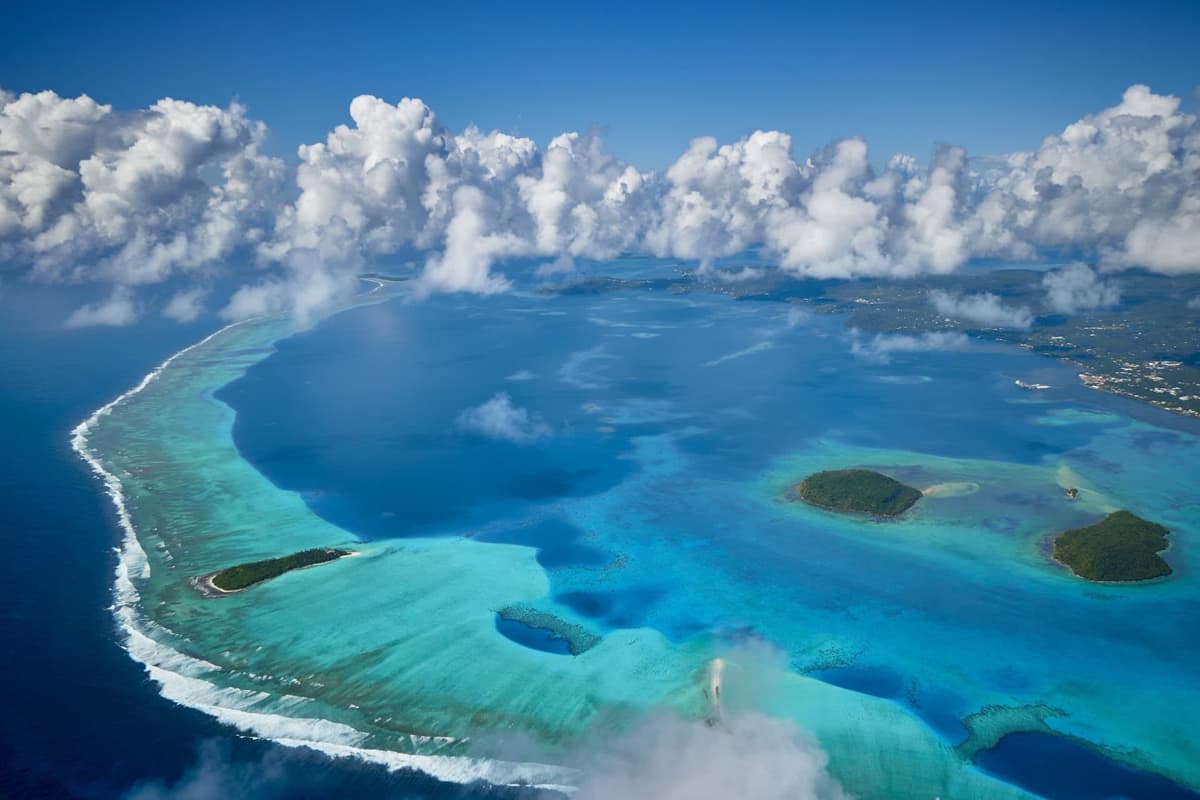
The New Caledonia lagoon, a World Heritage site, covers 24,000 square kilometres, ringed by the second longest barrier reef in the world after Australia's. You discover it by boat toward Amedee islet and its lighthouse, by diving on the passes and drop-offs, or by kitesurfing on the Noumea bays. The wildlife is dense: green turtles, rays, reef sharks, and a saltwater sirenian, the dugong, still present. Outside the lagoon, take care: currents, bull sharks near river mouths and sea snakes, not aggressive but very venomous.

Cities to visit in New Caledonia

Featured destinations appear first.
Coming soon.

New Caledonia in pictures

New Caledonia highlights

Eleven sites covering the lagoon, the Grande Terre and the islands.

UNESCO lagoon

24,000 square kilometres of shallow water ringed by the world's second barrier reef; six zones on the World Heritage list.

Tjibaou cultural centre

A set of tall curved-wood cases by Renzo Piano, in Noumea, devoted to Kanak and Oceanian art and culture.

Oro natural pool

A turquoise basin on the Isle of Pines linked to the ocean by a channel, ringed by columnar pines, reached on foot through the forest.

Heart of Voh

A naturally heart-shaped mangrove clearing on the west coast, made famous by a Yann Arthus-Bertrand photograph.

Amedee lighthouse

An 1865 iron lighthouse on a coral islet in the southern lagoon, 247 steps for the view over the barrier reef.

Riviere Bleue park

A Grand Sud rainforest with the thousand-year-old Grand Kaori, the drowned forest of Lake Yate and the cagou, a bird that barks and cannot fly.

Jokin cliffs, Lifou

White limestone cliffs dropping into a clear lagoon in northern Lifou, with a stairway to the water and Jinek bay below.

Ouvea beach

Twenty-five kilometres of white sand in a straight line on the west coast of Ouvea, often cited as one of the loveliest in the Pacific.

Prony bay whales

From July to September, humpback whales come into the southern lagoon to calve; supervised watching trips from Noumea.

Port Moselle market

Noumea's covered and open-air market, every morning, where produce, fish, Kanak crafts and flowers meet.

Lindericlique towers and the Hen of Hienghene

Black limestone rocks carved by erosion on the east coast, one profile suggesting a brooding hen seen from Hienghene.

Similar regions

Other regions you might like as much as New Caledonia.

Similar destinations

Other countries you might like as much as New Caledonia.

Frequently asked questions about New Caledonia

Do you need a visa or a passport for New Caledonia?
No visa for a French national: New Caledonia is a French collectivity and an identity card is enough for the territory. But all flights stop abroad, which requires a valid passport, and sometimes a transit authorisation depending on the stopover.
Is New Caledonia safe for travellers?
The territory has seen political tension and urban violence since 2024, mainly in Noumea and on the west coast. The situation changes: it is essential to check the current France Diplomatie sheet before booking, to register on the Ariane service and to follow local instructions once there.
What is the best time to visit New Caledonia?
From May to November, the cool dry season: clear skies, steady trade winds, clear sea for diving, and whales from July to September. September and October are the busiest. From January to March it is hot, humid and under cyclone risk.
How many days to visit New Caledonia?
A week covers Noumea, the Grand Sud and one island. Two weeks are a good format: a few days on the Grande Terre, the Isle of Pines and one or two Loyalty Islands, without long east-coast drives every day.
How do you get to the Isle of Pines and the Loyalty Islands?
By plane with Air Caledonie, the domestic airline, from Magenta airport in Noumea: 25 minutes to the Isle of Pines, 35 to 45 minutes to Lifou, Mare or Ouvea. The Betico, a fast boat, also serves these islands several times a week, but the crossing is longer.
What is Kanak custom and how should you behave in a tribe?
Custom is the set of social rules and ties to the land that structure Kanak society. In a tribe, you ask permission before entering or swimming, you offer a small gift to your host, the customary gesture, you dress in a covered way and you avoid photographing without consent.
Can you swim everywhere in New Caledonia?
In the lagoon protected by the barrier reef, swimming is not particularly dangerous. Outside it, or near river mouths and in murky water, the risk of bull sharks exists and attacks have occurred near Noumea; follow the local orders and advice.
When and where can you see whales in New Caledonia?
From July to September, when humpback whales come to calve in the southern lagoon. Supervised watching trips leave Noumea for Prony bay and the Havannah channel, with a limited number of boats and strict approach rules.
New Caledonia or French Polynesia: what is the difference?
New Caledonia, in the South Pacific near Australia, has a large mountainous island, a huge lagoon and a strong Kanak culture. French Polynesia, in the central Pacific, is a scattering of islands and atolls across five archipelagos, with the lagoons of Bora Bora and Moorea. The two are more than 4,000 kilometres apart.

Plan your trip to New Caledonia

Day-by-day itinerary, budget, bookings and packing in a single app.
Aperçu de l'application PlanTripNow