Skip to content

Visiting Bath : what to see from the Roman Baths to the Georgian city

Hot springs used for two thousand years, an abbey with angels climbing towards the sky, Bath stone facades designed like stage sets and a rooftop pool for a swim at sunset: Bath is best enjoyed over one or two days, on foot.

Why visit Bath?

Bath, in Somerset, is the only British city listed in its entirety as a UNESCO World Heritage Site, for its Roman baths and 18th-century Georgian architecture. Its hot springs, the only ones in the country where you can still bathe, feed a modern spa. London is about 1 hour 30 minutes away by train.

Bath's must-sees

Seven sites spanning Roman heritage, Georgian architecture and hot-water bathing, all within twenty minutes' walk of each other except Prior Park.

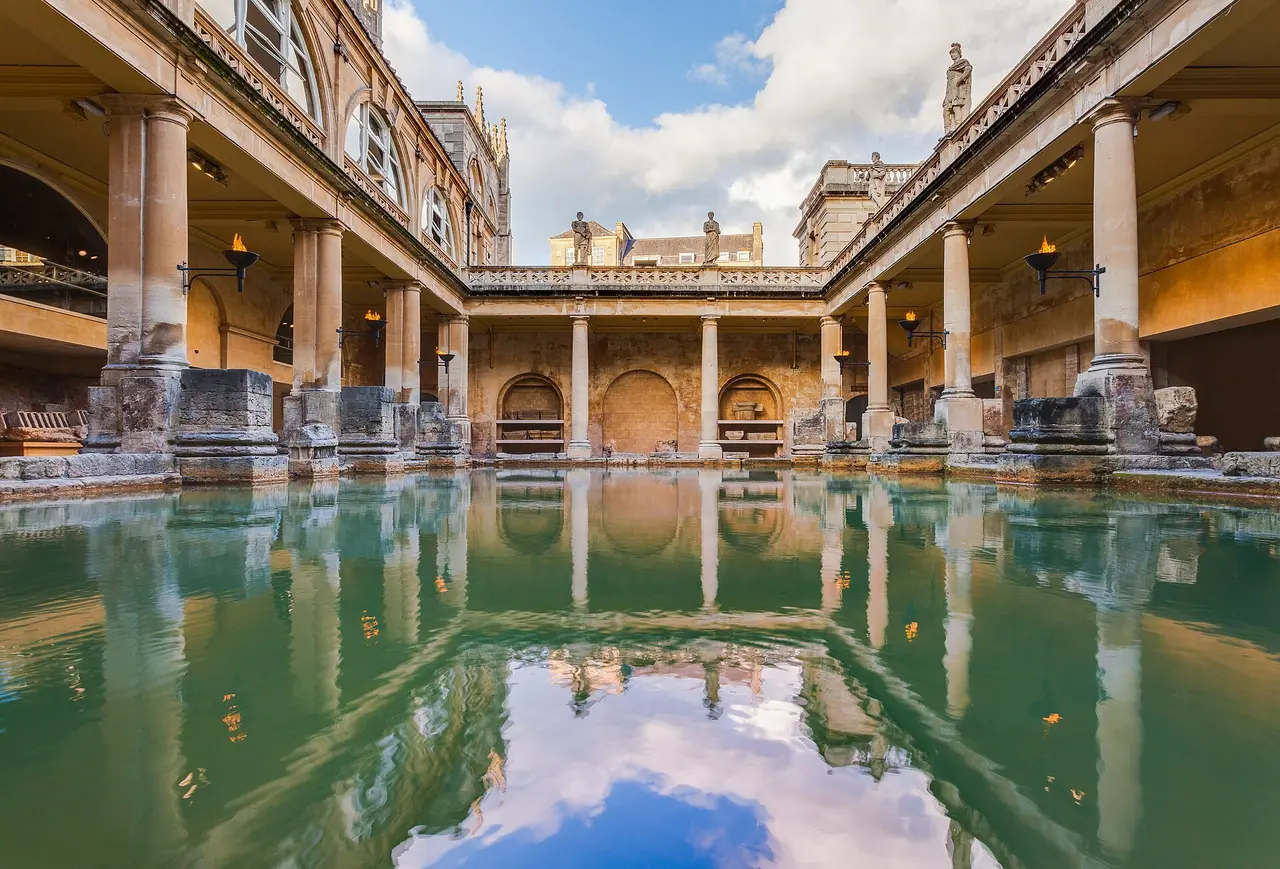
Roman Baths

A great open-air pool ringed by columns, remains of the temple of Sulis Minerva and a steaming sacred spring. The untreated water must not be touched.

Bath Abbey

A late Gothic church with vast windows, whose facade shows angels climbing ladders. The tower tour, 212 steps, is available only with a guide.

Royal Crescent

A crescent of thirty houses completed in 1774 facing a vast park. The No. 1 Royal Crescent museum recreates the interior of a Georgian home of the period.

The Circus

A perfect circle of houses with three orders of columns, designed by John Wood the Elder and completed by his son in 1768. The friezes show Masonic symbols and the arts.

Pulteney Bridge

A 1774 bridge designed by Robert Adam, one of the few in the world lined with shops on both sides. The best view is from Parade Gardens, by the weir.

Thermae Bath Spa

A spa opened in 2006, fed by the city's hot springs, with a rooftop pool facing the Abbey. Entry restricted to those aged 16 and over.

Prior Park

An 18th-century landscape garden run by the National Trust, south of the centre, with a Palladian bridge and a sweeping view over the city. Reach it on foot or by bus.

What to see in Bath, neighbourhood by neighbourhood?

The spa quarter, between Stall Street and the Abbey

Everything starts around the Abbey Churchyard, a pedestrian square enlivened by buskers, where the Abbey, the Georgian Pump Room and the entrance to the Roman Baths meet. The main spring rises here at around 46 °C. Allow two hours for the baths with the audio guide, and book a slot online: the walk-up queue often exceeds an hour in summer. Late afternoon is the quietest time. In the nearby lanes, Sally Lunn's has been serving the bun that bears its name for generations, in one of the city's oldest houses.

The Georgian upper town, from Gay Street to Lansdown

Walking up Gay Street, you step into the 18th-century Bath imagined by architects John Wood the Elder and the Younger. The Circus leads to the Royal Crescent, whose thirty houses overlook the lawn of Royal Victoria Park, opened in 1830. Close by, the Assembly Rooms, ballrooms run by the National Trust, once welcomed high society come to take the waters. Higher up, Lansdown Crescent looks out over the whole valley. The loop takes two to three hours on foot, but the streets climb steeply: comfortable shoes are essential.

Pulteney and the east bank of the Avon

Pulteney Bridge crosses the Avon above a curved weir and opens onto Great Pulteney Street, a Georgian avenue of about 300 metres, one of the widest in the country. It ends at the Holburne Museum, a fine art museum at the entrance to Sydney Gardens. The Kennet and Avon Canal runs through these gardens: its flat towpath leads in about 1 hour 30 minutes' walk to the Dundas Aqueduct. This is the quietest area to stay in, ten minutes on foot from the centre.

In the footsteps of Jane Austen

Jane Austen lived in Bath from 1801 to 1806, notably at 4 Sydney Place, opposite Sydney Gardens, and set parts of Northanger Abbey and Persuasion here. The Jane Austen Centre on Gay Street tells the story of her years in the city in about an hour, with a tea room upstairs. Every September, the Jane Austen Festival brings together hundreds of participants in Regency dress for a grand promenade through the streets, followed by balls and talks over some ten days. Book accommodation several months ahead for that period.

Day trips: the Cotswolds, Stonehenge and Bristol

Bath is a gateway to the southern Cotswolds: Lacock and Castle Combe, stone villages often seen on screen, are half an hour away by road. Stonehenge is just over an hour by car or on an organised day tour. Wells and its Gothic cathedral lie about forty minutes south-west. Bristol, a quarter of an hour by train, adds a harbour, street art and a lively food scene. To continue across the United Kingdom, Bath Spa station sits on the main line to London and Wales.

Getting there

Airports serving Bath, from main hubs to secondary ones.
  • ADXLeuchars Station AirfieldLeuchars, FifeSecondary
  • BBSBlackbushe AirportCamberley, SurreySecondary
  • BEBBenbecula AirportBalivanichSecondary
  • BEQRAF HoningtonBury Saint Edmunds, SuffolkSecondary
  • BEXRAF BensonWallingford, OxfordshireSecondary
  • BHDGeorge Best Belfast City AirportBelfastSecondary

Practical information for Bath

Bath Spa station

About 1 hour 30 minutes from London Paddington, 15 minutes from Bristol. The station is a five-minute walk from the Roman Baths.

Clean Air Zone

The centre is a low-emission zone: private cars do not pay, but polluting taxis, buses and vans are charged. Park and ride sites are recommended.

Timed tickets

The Roman Baths are booked online for a set slot, cheaper than at the door; it is close to essential from June to September and during school holidays.

Hilly city

The centre around the Abbey is flat, but the crescents and Prior Park involve steep climbs: plan on the bus for travellers with reduced mobility.

Tipping

10 to 12.5% in restaurants if service is not already added; nothing at the pub bar.

Christmas market

From late November into December, chalets fill the streets around the Abbey: the centre gets very busy at weekends.

Bath in pictures

Photo credits : Diego Delso, CC BY-SA 4.0, Wikimedia Commons ; Photograph by Mike Peel ( www.mikepeel.net )., CC BY-SA 4.0, Wikimedia Commons ; Julian Herzog ( Website ), CC BY 4.0, Wikimedia Commons

Frequently asked questions about Bath

Can you swim in the Roman Baths in Bath?
No: the water in the Roman Baths is untreated and must not be touched. To bathe in the hot spring water, head to Thermae Bath Spa, two minutes' walk away, whose rooftop pool looks out over the Abbey.
Is Bath doable as a day trip from London?
Yes: about 1 hour 30 minutes by train from Paddington leaves enough time for the Roman Baths, the Abbey, the Royal Crescent and Pulteney Bridge. Add a night for an evening at the spa, Prior Park or a trip into the Cotswolds.
When should you go to Thermae Bath Spa to avoid queuing?
Aim for opening time on a weekday: afternoons and weekends are the busiest, and the rooftop pool at sunset draws big crowds. Under-16s are not admitted, so plan an alternative if you are travelling as a family.
When is the Jane Austen Festival in Bath?
Every September, for about ten days. It opens with a grand promenade in Regency dress through the centre, followed by balls, talks and tours. Participants often hire their outfit locally, but accommodation goes very early.
Can you go inside the Royal Crescent?
Most of the houses are private, and one is a hotel. Only No. 1 Royal Crescent, at the start of the crescent, is a museum recreating life in a Georgian house, from the kitchen to the drawing room. Allow an hour for the visit.

Plan your trip to Bath

Build your day-by-day itinerary and manage budget, bookings and packing in PlanTripNow.
Aperçu de l'application PlanTripNow