Skip to content

Bogota at 2,640 m: what to see, where to stay and how to adjust

A capital of nearly eight million people on a high Andean plateau, where hot chocolate comes with cheese under the drizzle, where downtown walls are a canvas for graffiti artists and where Muisca gold tells the legend of El Dorado. Bogota rewards patience, and it is best explored by day.

At a glance

Visa
None
Tourist stay of up to 90 days
7-day budget
€630
Per person, comfort profile, excluding international flights.
Recommended length
3 days
For a first trip, without rushing.

Is Bogota worth more than a stopover in Colombia?

Yes, three days at least: one for La Candelaria and its free or nearly free museums, one for the Zipaquirá Salt Cathedral or the Guatavita lagoon, and one for Monserrate and the north of the city. The altitude and safety advice to be indoors by 7 pm set a slow pace.

When to visit Bogota

Temperatures, rainfall and crowds month by month, to pick your window.
When to visit Bogota
MonthTemperaturesRainCrowdsVerdict
January7 to 20 °C8 dBusyThe driest, sunniest month, but nights drop to 6°C: pack a fleece.
February8 to 21 °C11 dQuietOur favourite month: often clear skies over Monserrate and hotels back to normal rates.
March9 to 20 °C14 dModerateAfternoon showers return; if Holy Week falls in March, Monserrate fills with pilgrims.
April10 to 20 °C18 dModerateFirst rainy season: mornings for La Candelaria, afternoons in the Gold Museum.
May10 to 20 °C20 dQuietThe month with the most rainy days, few foreign visitors and gentle prices.
June9 to 19 °C18 dModerateFrequent drizzle but lighter totals; Colombian school holidays liven up Zipaquirá late in the month.
July9 to 19 °C17 dBusyThe coolest month by day, windy, with the arrival of European holidaymakers.
August9 to 19 °C16 dBusyKite season on the hillsides and moderate rain: a good window for Guatavita.
September8 to 20 °C16 dQuietA calm, affordable shoulder month, ideal for walking street art tours.
October9 to 20 °C18 dQuietThe wettest month by volume: afternoon storms, so a raincoat is essential.
November9 to 20 °C17 dQuietStill damp, but the last low prices before the holidays make it worthwhile.
December8 to 20 °C12 dPackedDry weather and Christmas lights return, but high season pushes up flights and hotels.
Source: Normales 1991-2020 de Bogota d'après climatestotravel.com (minimales, maximales, moyennes, précipitations, jours de pluie, ensoleillement), relevé octobre 2026. Ville d'altitude (2 640 m) proche de l'équateur : températures quasi constantes toute l'année, deux saisons des pluies (avril-mai et octobre-novembre) et deux périodes plus sèches (décembre-février, juillet-août). Pas de température de la mer, ville continentale. Affluence et prix estimés d'après le calendrier local (temporada alta de mi-décembre à mi-janvier, Semaine sainte, vacances scolaires colombiennes de mi-juin à début juillet, nombreux ponts fériés) et les vacances scolaires françaises.

Bogota's must-sees

Museums, sanctuaries and markets that justify staying more than one night in the capital.

Gold Museum

One of the world's largest collections of pre-Hispanic goldwork, including the gold Muisca raft that depicts the Guatavita ritual. Closed on Mondays, free on Sundays.

Botero Museum

A colonial house in La Candelaria showing the Medellín painter's donation, his rounded figures and his collection of European art, with free admission.

Monserrate

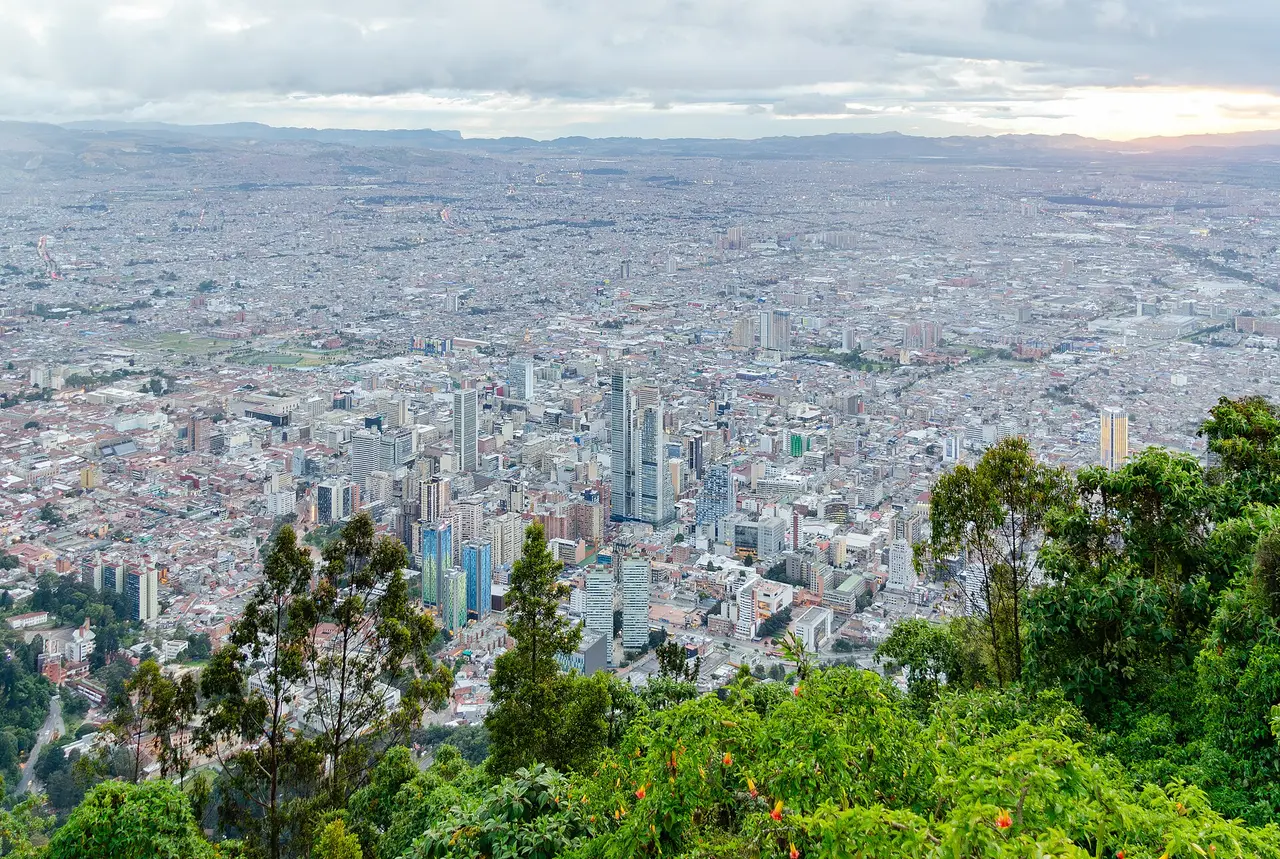
The white sanctuary overlooking the city from 3,152 m, reached by cable car or funicular, with the most complete view across the Bogota savanna.

Plaza de Bolívar

Colombia's great square of power, framed by the Primatial Cathedral, the National Capitol and the Palace of Justice, the natural starting point for La Candelaria.

Chorro de Quevedo

The small square where tradition places the city's founding in 1538, surrounded by narrow lanes, murals and bars serving chicha, a fermented corn drink.

Salt Cathedral

In Zipaquirá, a Way of the Cross and a monumental nave carved into the galleries of a salt mine, lit in shifting colours 180 m underground.

Guatavita lagoon

A round lake ringed by hills, where Muisca chiefs cast gold offerings, explored on a high-altitude trail at around 3,000 m.

Paloquemao market

The big market hall west of the centre, with cut flowers, Andean fruit such as lulo and granadilla, and tamal counters from early morning.

Usaquén market

The Sunday flea and craft market spread through the streets of the old village, with jewellery, ceramics and street food stalls.

Botanical garden

The José Celestino Mutis garden showcases the ecosystems of the Colombian Andes, from cloud forests to páramos, and a fine greenhouse orchid collection.

Sunday Ciclovía

Every Sunday morning, more than 100 km of avenues are handed over to cyclists, runners and families, a local institution best enjoyed on a rented bike.

What to do in Bogota?

The first 48 hours at altitude

At 2,640 m the air holds less oxygen: headaches, shortness of breath and restless nights are common after arriving from Europe. Keep the first two days for flat sightseeing downtown, drink plenty, go easy on alcohol and save Monserrate, which climbs to 3,152 m, for the third morning. The thermometer is deceptive too: a 14°C average all year, afternoons around 20°C and nights below 8°C. A fleece and a windbreaker will serve you far better than a swimsuit, even though the rest of Colombia is tropical.

La Candelaria, the colonial core

The historic district packs low houses with wooden balconies, baroque churches and universities between Plaza de Bolívar and the foot of the hills. You can walk it in half a day, but it deserves a full one with its museums, several of them free. France's foreign ministry reports frequent theft here: keep your phone away, carry a small closed bag and leave before nightfall, around 6 pm. La Candelaria is a handy, cheap place to sleep, but it empties at night; many travellers prefer to stay in the north and come down by app-booked taxi.

The painted walls of downtown

Since Bogota partly decriminalised graffiti in the early 2010s, the facades of La Candelaria and the walls along Calle 26 have become an open-air gallery: Indigenous portraits, Andean animals, political messages about the armed conflict. The best way to understand them is a guided walk of around two to three hours, often paid by tip. Take it in the morning or early afternoon, in a group, rather than hunting for murals alone on quiet streets.

The eastern hills and their sanctuaries

The city backs onto a wall of mountains that works as a compass everywhere: when you can see the hills, you are facing east. The cable car and funicular climb to the Monserrate sanctuary for 35,000 pesos return on weekdays, about ten euros. The footpath is free but steep and only open at set hours, and should be walked in the morning alongside other hikers. Skies are clearest at opening time, before afternoon clouds hide the savanna.

Chapinero and Zona G, for eating out

North of the centre, Chapinero mixes English-style brick houses, speciality coffee shops and small restaurants reinventing Colombian cooking, especially in Zona G and Quinta Camacho. It is the place to try ajiaco, a chicken soup with three kinds of potato and guascas, or a more creative dinner, at around €20 per person in a mid-range spot. Bag snatching and muggings are reported to be rising here: go home by app-booked taxi, even for a few blocks.

Usaquén, the village the city swallowed

A former market town absorbed by the metropolis, Usaquén keeps a square with a white church, low lanes and the feel of a quiet suburb. On Sundays and public holidays, craftspeople and second-hand sellers set up here, and you can combine a visit with the Ciclovía, when more than 100 km of avenues close to cars from 7 am to 2 pm. Allow half a day. The district is among those where France's foreign ministry notes thefts, so stay alert despite its peaceful air.

The Muisca savanna on day trips

Around the capital, the high plateau of Cundinamarca still bears traces of the Muisca people. To the north, some fifty kilometres away, Zipaquirá hides a cathedral carved into a salt mine 180 m underground; expect around 110,000 pesos for a foreign adult's basic ticket (2024 price, to be checked). To the north-east, the round Guatavita lagoon is the site of the gold-offering ritual that gave rise to the El Dorado legend. Each takes a full day, on an organised trip or with a driver rather than by bus.

Rain, safety and daily budget

Bogota has two rainy seasons, April to May and October to November; December to February is the driest period, but also the priciest around the holidays. On safety, the city is under heightened vigilance: avoid southern districts such as Kennedy and Ciudad Bolívar, never hail a taxi in the street and never leave your drink unattended because of scopolamine. Budget around €37 a day as a backpacker and €90 in comfort, less than in most capitals of South America.

Sample itineraries

Three routes built around the time you actually have.
3daysRecommended

Bogota in 3 days: the colonial centre, the Zipaquirá Salt Cathedral and Usaquén

  1. Day 1: La Candelaria on foot and the Botero Museum
  2. Day 2: the Zipaquirá Salt Cathedral
  3. Day 3: Usaquén market and Chapinero cafés

Best for: A gentle pace for adjusting to 2,640 m: a day in La Candelaria, a trip to the salt cathedral carved into a Zipaquirá mine, then the north of the city, from the old village of Usaquén to the cafés of Chapinero. Plan it over a weekend to catch the Sunday market in Usaquén.

How much it costs

Per person per day, excluding international travel.
Budget
37 €/ day
2 418 € for 2 people, 7 days, return flights included
Accommodation
11 €
Food
15 €
Local transport
3 €
Sights and activities
8 €
Comfort
90 €/ day
3 160 € for 2 people, 7 days, return flights included
Accommodation
30 €
Food
30 €
Local transport
10 €
Sights and activities
20 €
Premium
225 €/ day
5 050 € for 2 people, 7 days, return flights included
Accommodation
75 €
Food
65 €
Local transport
30 €
Sights and activities
55 €
Prices checked: Relevé octobre 2026. Taux Wise consulté le 12 octobre 2026 : 1 € = 3 582 pesos colombiens (COP), 1 £ = 1,18 €. Repas et transports d'après Numbeo Bogota (mise à jour du 11 octobre 2026, 937 relevés de 102 contributeurs sur 12 mois : repas bon marché 6,94 €, dîner pour deux en restaurant moyen 37,48 €, ticket de transport 0,99 €, prise en charge taxi 2,08 €). Dortoirs à 11,70 € la nuit en moyenne (prix d'appel « à partir de » de 24 auberges sur Hostelworld, octobre 2026). Hôtels : moyenne toutes catégories 81 £ la nuit selon HotelsCombined (prix mis à jour le 11 octobre 2026) ; moyennes 4 étoiles 62 € et 5 étoiles 136 à 165 € sur Skyscanner, chiffres incohérents sur la même page, utilisés comme ordre de grandeur seulement. Activités lissées sur une semaine : téléphérique ou funiculaire de Monserrate 35 000 COP aller-retour du lundi au samedi (tarifs 2026 relayés par RCN et Publimetro, pas la grille officielle) ; musée de l'Or environ 5 000 COP, gratuit le dimanche (montant relevé dans la presse en 2024, plus ancien) ; cathédrale de sel de Zipaquirá 110 000 COP pour un adulte étranger en formule de base (El País Cali, août 2024, plus ancien, probablement relevé depuis). Vol A/R Paris-Bogota estimé à 950 € par personne (PartirOu, statistiques du 11 octobre 2026 : moyenne 1 120 €, plus bas 686 €, prix jugé attractif vers 710 € ; Liligo, moyenne 932 € sur les trois derniers mois). Hébergement par nuit et par personne : lit en dortoir pour backpacker, chambre double 3 à 4 étoiles partagée à deux pour comfort, 5 étoiles partagée à deux pour premium. Transports comfort et premium : taxis commandés par application, comme le recommande France Diplomatie, et chauffeur privé pour Zipaquirá en premium. Peso volatil, budget à revérifier d'ici quelques mois.

Getting there

Airports serving Bogota, from main hubs to secondary ones.
  • APIGomez Nino Apiay Air BaseApiaySecondary
  • APOAntonio Roldán Betancur AirportCarepaSecondary
  • AUCSantiago Perez AirportAraucaSecondary
  • AXMEl Eden AirportArmeniaSecondary
  • BGAPalonegro AirportBucaramangaSecondary
  • BSCJosé Celestino Mutis AirportBahía SolanoSecondary

Entry, health and safety

For FR travellers

Entry requirements

No visa for a tourist stay

Pas de visa pour un séjour de 90 jours maximum en Colombie, accordé sur présentation d'un billet aller-retour. Arrivée en avion à l'aéroport El Dorado : le formulaire migratoire Check-Mig doit être rempli en ligne avant l'entrée comme avant la sortie du territoire. Les sommes supérieures à 10 000 € se déclarent à la douane.

Stay allowed for up to 90 days.

Health

Required: Fièvre jaune obligatoire pour les voyageurs en provenance du Brésil, de République démocratique du Congo, d'Ouganda et d'Angola, ainsi que pour entrer dans les parcs nationaux colombiens.

Advised: Être à jour de toutes ses vaccinations, rougeole et coqueluche comprises. Selon le séjour : hépatites A et B, typhoïde, rage. Fièvre jaune recommandée seulement si le voyage se poursuit vers l'Amazonie, La Guajira ou le Catatumbo, pas pour Bogota.

Bogota est à environ 2 600 à 2 700 m : maux de tête, insomnie et essoufflement possibles les premiers jours, ralentissez et buvez beaucoup. Pas de dengue ni de chikungunya à cette altitude, le moustique vecteur vivant sous 1 800 m. Eau capsulée ou rendue potable. Assurance couvrant tous les frais médicaux impérative. Sécurité : Bogota est en vigilance renforcée. Les quartiers populaires du sud (Kennedy, Ciudad Bolívar) et les banlieues d'Altos de Cazucá et de Soacha sont déconseillés sauf raison impérative. Vols à l'arraché et agressions armées en hausse au nord (Chapinero, Chicó, La Cabrera, Usaquén, Parque de la 93, Zona T), attaques à la scopolamine surtout dans la Zona T : ne jamais quitter son verre des yeux, éviter les applications de rencontre. Ne plus marcher après 19 h, même sur de courtes distances ; taxis commandés par application uniquement, jamais hélés dans la rue ; transports en commun jugés peu sûrs. Vols fréquents à la Candelaria et à Monserrate. Pas de retrait au distributeur après la tombée de la nuit. Zones frontalières et côte pacifique du pays formellement déconseillées.

Safety

Increased caution

Emergency

123

Checked in octobre 2026 against the official source. Entry rules change: check the official source before you travel, it alone is authoritative.

Practical information for Bogota

Altitude

2,640 m, two days of gentle sightseeing before Monserrate

Check-Mig

Online migration form required before arrival and before departure

Taxis

Only booked through an app, never hailed in the street

After 7 pm

Stop walking outside, even for short distances

Gold Museum

Closed on Mondays, booking required, free on Sundays

Ciclovía

Sundays and holidays from 7 am to 2 pm, avenues closed to cars

Clothing

Fleece, windbreaker and umbrella all year round

Tipping

10% suggested on restaurant bills, free to decline

Plugs

Types A and B, 110 V, adapter needed

Emergencies

123

Bogota in pictures

Photo credits : Steffen Schmitz ( more photos ), CC BY-SA 4.0, Wikimedia Commons ; Felipe Restrepo Acosta, CC BY-SA 3.0, Wikimedia Commons ; Javierleiva, CC BY-SA 4.0, Wikimedia Commons ; GRDN711, CC BY 4.0, Wikimedia Commons ; Michael Tieso, CC0, Wikimedia Commons

Frequently asked questions about Bogota

Is it really cold in Bogota even though it is in the tropics?
Yes, because of the altitude. The average sits around 14°C all year, afternoons rarely top 20°C and nights often drop below 8°C, down to 6°C in January. Pack layers, a fleece and a raincoat, as the weather changes quickly during the day.
Does altitude sickness spoil the first days in Bogota?
It is usually mild at 2,640 m: headaches, breathlessness on climbs and disturbed sleep. Symptoms fade within one or two days if you slow down, drink plenty and avoid alcohol on the first evening. Save Monserrate and high-altitude day trips for later in your stay.
Can you walk up Monserrate?
Yes, on a free but very steep trail that gains more than 500 m of elevation. It is only open at certain hours, should be done in the morning and never alone. If you have just arrived from Europe, take the cable car or funicular up and walk down if your lungs allow.
Which Bogota district is best for a safe stay?
Travellers split between La Candelaria, handy for museums but deserted at night, and the north (Chapinero, Zona G, Usaquén), with more restaurants. France's foreign ministry reports thefts in both areas. The working-class south, Kennedy and Ciudad Bolívar, is advised against unless essential.
Is the Gold Museum free on Sundays?
Yes, admission is free on Sundays, with shorter opening hours, and the rest of the week a ticket costs only a few thousand pesos. The museum is closed on Mondays, public holidays included, and online booking is requested. Arrive early on Sundays, as it gets busy.
Zipaquirá or Guatavita, which to choose with only one day?
The Zipaquirá Salt Cathedral is the more spectacular and the easier, with no physical effort. Guatavita will appeal more to walkers and anyone curious about the El Dorado legend, but involves a climb at altitude. Some organised trips combine both in one long day.
Can you flag down a yellow taxi in the street in Bogota?
No. France's foreign ministry advises against hailing taxis in the street because of the risk of assault, robbery or kidnapping. Book through an app so the ride is traceable, including at El Dorado airport and for short trips in the evening, when walking should be avoided.
How many days should you keep for Bogota before Medellín or Cartagena?
Three days let you see La Candelaria, Monserrate, the north of the city and a trip into the savanna. With two days, you stick to the centre. Starting your trip in Bogota also helps you acclimatise before the lower, warmer stops elsewhere in the country.
What is the ajiaco served all over Bogota?
It is the capital's signature soup: chicken, three varieties of potato, corn on the cob and guascas, an Andean herb, served with capers, cream and avocado. Ideal at lunchtime on a cool day, it is on the menu of traditional restaurants in La Candelaria and the north alike.

Plan your trip to Bogota

Build your day-by-day itinerary and manage budget, bookings and packing in PlanTripNow.
Aperçu de l'application PlanTripNow