Skip to content

Bologna: planning a stay in the red city

Red brick, endless arcades and stalls piled with mortadella: Bologna is best explored on foot, sheltered by its porticoes. Two to three days cover the city and San Luca; May, June and September bring the best weather, outside trade fair weeks.

At a glance

Visa
None
Tourist stay of up to 90 days
7-day budget
€1,092
Per person, comfort profile, excluding international flights.
Recommended length
3 days
For a first trip, without rushing.

Why choose Bologna?

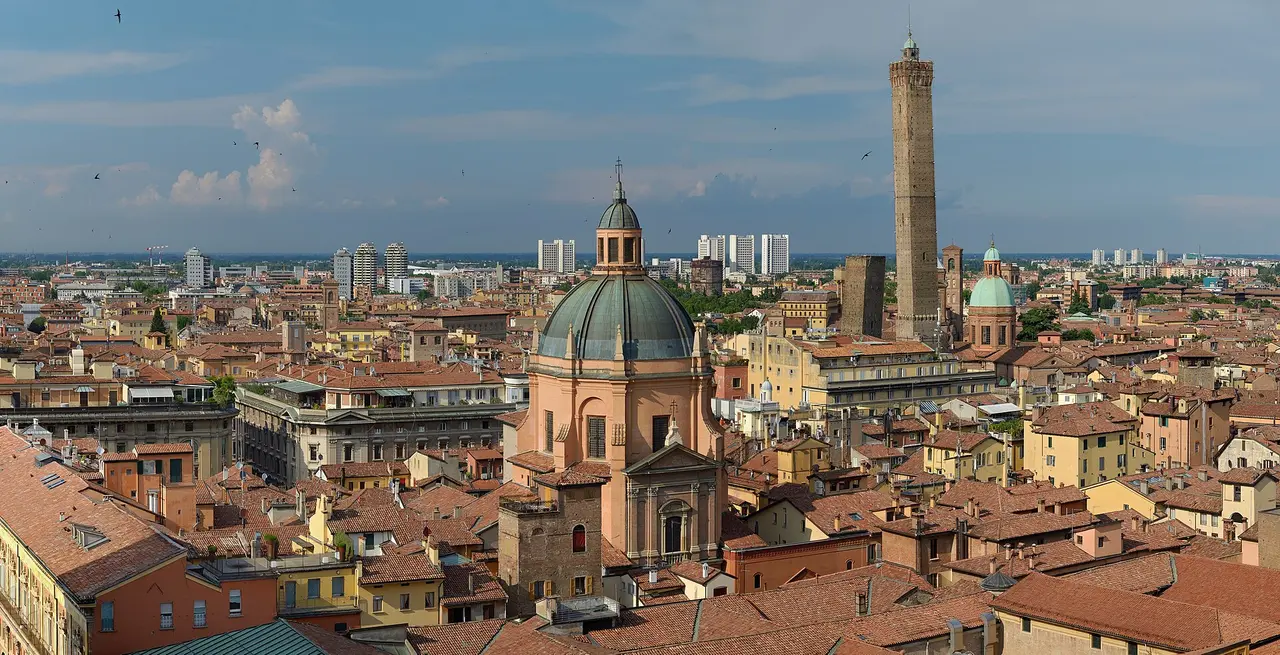
Bologna, the capital of Emilia-Romagna at the foot of the Apennines, has one of the largest and best-preserved medieval centres in Italy. Its porticoes have been on the UNESCO World Heritage list since 2021. Less crowded than Florence or Venice, it is also a handy base for Modena, Parma or Ravenna, all reachable by regional train.

When to visit Bologne

Temperatures, rainfall and crowds month by month, to pick your window.
When to visit Bologne
MonthTemperaturesRainCrowdsVerdict
January0 to 7 °C6 dVery quietThe coldest month, with possible frost at dawn and Po Valley fog: the covered porticoes and warm osterie are what make the stay worthwhile.
February1 to 10 °C6 dQuietStill chilly, under 10 °C in the afternoon; check the dates of Arte Fiera, which fills hotels for a few days.
March4 to 15 °C7 dModerate15 °C by day and light returning to the brick facades, but the Cosmoprof trade fair pushes prices up: book outside its week.
April8 to 19 °C8 dBusyThe wettest spring month, with Easter, 25 April and the Children's Book Fair: pleasant for walking, but rooms are expensive.
May13 to 24 °C8 dBusy24 °C and terraces full of students: the best time to walk up to San Luca under the portico.
June17 to 29 °C6 dModerateClose to 29 °C in the afternoon and a few thunderstorms; open-air cinema moves into Piazza Maggiore at the end of the month.
July19 to 32 °C4 dQuietOver 31 °C and muggy plain heat: sightsee in the morning, shelter under the porticoes and enjoy the free film evenings.
August19 to 31 °C5 dQuietHotels at their cheapest but the city empties around 15 August: many restaurants and shops close for the holidays.
September15 to 26 °C5 dModerate26 °C and only five rainy days, ideal weather; beware of the Cersaie fair in late September, which fills every hotel.
October11 to 19 °C7 dBusyTortellini in broth returns to the menus and the hills turn golden: 19 °C, though showers set in.
November6 to 13 °C6 dQuietGrey and misty, barely 13 °C, but the city belongs to its students and rates drop noticeably.
December1 to 8 °C6 dModerateDry cold or fog, softened by the Santa Lucia fair under the Servi portico and the Christmas markets.
Source: Normales 1991-2020 pour Bologne publiées par climatestotravel.com (minimales, maximales, moyennes, jours de pluie), relevé du 8 octobre 2026. Ville de plaine sans façade maritime : pas de température de la mer. Affluence et niveau de prix estimés d'après le calendrier local : salons de BolognaFiere (Arte Fiera début février, Cosmoprof en mars, Foire du livre jeunesse en avril, Cersaie fin septembre) qui font flamber les hôtels, Pâques et ponts de printemps, ville désertée autour du 15 août, marchés de Noël et foire de Santa Lucia en décembre. Brouillard fréquent dans la plaine du Pô en hiver, chaleur lourde et humide en juillet-août.

Seven places not to miss

From arcades to dissection halls, what gives Bologna its identity.

Basilica of San Petronio

A vast Gothic brick church with an unfinished facade and Cassini's meridian line traced on the floor.

San Luca portico

666 arches over nearly 4 km, climbing on foot to the sanctuary and its view over the Po plain.

Santo Stefano

The Seven Churches, a cluster of interlocking Romanesque churches around a courtyard, open onto a quiet triangular square.

Anatomical Theatre

A seventeenth-century dissection hall panelled entirely in fir wood, on the first floor of the Archiginnasio.

Quadrilatero

The old medieval market, a few lanes of delis, food shops and wine bars just east of Piazza Maggiore.

Pinacoteca Nazionale

Raphael, Perugino, the Carracci and Guido Reni gathered in the former Jesuit college of the university quarter.

Via Piella window

A small window in a wall that reveals the Moline canal, a reminder of Bologna's canal past.

Discovering Bologna

Piazza Maggiore, the civic heart

Everything starts on Piazza Maggiore, lined by Palazzo d'Accursio and the Basilica of San Petronio, whose facade has been unfinished since the Middle Ages. Inside, a 67-metre meridian line crosses the floor. Giambologna's Neptune Fountain stands on the neighbouring square. Behind the basilica, the Archiginnasio houses the Anatomical Theatre, a wooden amphitheatre where bodies were dissected before students, open to visitors for 3 €.

Under the porticoes to San Luca

Bologna has around 40 km of arcades, so you can cross the city without getting wet. The most spectacular starts at Porta Saragozza and climbs under 666 arches to the Sanctuary of the Madonna di San Luca on a hilltop. Allow one to one and a half hours on foot, with a steep final stretch. The two medieval towers, Asinelli and Garisenda, are admired from the street: the Asinelli climb is closed for works.

La Dotta, a student city

Founded in 1088, the venerable University of Bologna claims to be the oldest in the Western world, and its students set the tone around Via Zamboni. Palazzo Poggi displays maps, instruments and anatomical models from the old collections. Nearby, the Pinacoteca Nazionale shows Raphael's Ecstasy of Saint Cecilia and the masters of the Bolognese school, for 12 € at full price.

La Grassa, a capital of food

The nickname la Grassa, the fat one, is well earned. In the lanes of the Quadrilatero, delis overflow with mortadella, Parmesan and fresh pasta. Try tortellini in broth, tagliatelle al ragù and crescentine served with cured meats. A meal in a simple trattoria costs about 20 €, and dinner for two in a mid-range restaurant around 80 € (Numbeo, October 2026).

Modena, Ravenna and nearby towns

The central station puts much of Emilia-Romagna within an hour and a half. Modena, about half an hour away, combines a Romanesque cathedral, the Ghirlandina tower and balsamic vinegar cellars. Ravenna, a little over an hour away, preserves the Byzantine mosaics of San Vitale and Galla Placidia. Parma and Ferrara also make easy return trips in a day, with no car and no change of base.

Sample itineraries

Three routes built around the time you actually have.
3daysRecommended

Bologna in 3 days: the centre, the San Luca portico and the university quarter

  1. Day 1: Neptune, San Petronio and the Mercato delle Erbe
  2. Day 2: on foot to the San Luca sanctuary
  3. Day 3: Via Zamboni, Palazzo Poggi and the Pinacoteca

Best for: The most complete format without leaving the city: a day of centre and markets, a day devoted to the climb to San Luca under the world's longest portico, then the student quarter, its museums and the Pinacoteca.

How much it costs

Per person per day, excluding international travel.
Budget
67 €/ day
1 334 € for 2 people, 7 days, return flights included
Accommodation
32 €
Food
26 €
Local transport
3 €
Sights and activities
6 €
Comfort
156 €/ day
2 580 € for 2 people, 7 days, return flights included
Accommodation
71 €
Food
55 €
Local transport
8 €
Sights and activities
22 €
Premium
270 €/ day
4 176 € for 2 people, 7 days, return flights included
Accommodation
95 €
Food
95 €
Local transport
25 €
Sights and activities
55 €
Prices checked: Relevé du 8 octobre 2026. Repas et transports : Numbeo Bologne, mise à jour du 2 octobre 2026, 765 relevés de 73 contributeurs sur douze mois (repas bon marché 20 €, dîner de milieu de gamme pour deux 80 €, cappuccino 1,99 €, ticket de bus TPER 2,30 €, taxi 4,10 € de prise en charge puis 1,50 €/km). Hébergement : lit en dortoir de 22 à 38 € la nuit (Hostelworld, octobre 2026) ; hôtel 3 étoiles à 130 € la chambre double en moyenne, fourchette 66 à 267 € (combien-coute.net d'après hotels.com, mise à jour du 28 juin 2026) ; hôtel 4 étoiles à 176 €, fourchette 73 à 637 € (combien-coute.net, 28 septembre 2026) ; chambre double partagée à deux pour comfort et premium. Taxe de séjour 2026 (Bologna Welcome, tarifs du 1er janvier au 31 décembre 2026) : 2,80 € par personne et par nuit en auberge, puis 4 à 7 € selon le prix de la nuitée, incluse dans le poste hébergement ; Holidu indique qu'elle ne s'applique qu'aux quatre premières nuits, la page officielle ne le précise pas. Activités : Pinacoteca nazionale 12 € (site du musée, 2026), Teatro anatomico de l'Archiginnasio 3 €, montée à San Luca gratuite ; tour des Asinelli fermée pour travaux à la date du relevé. Vol A/R Paris-Bologne : 198 € par personne, moyenne Kayak sur douze mois (fourchette habituelle 140 à 265 €, novembre le moins cher, août le plus cher). Les prix hôteliers flambent pendant les salons de BolognaFiere.

Getting there

Airports serving Bologne, from main hubs to secondary ones.
  • BDSBrindisi AirportBrindisiMain
  • BGYIl Caravaggio International AirportOrio al SerioMain
  • BLQBologna Guglielmo Marconi AirportBolognaMain
  • BRIBari Karol Wojtyła International AirportBariMain
  • CAGCagliari Elmas AirportCagliariMain
  • CIACiampino–G. B. Pastine International AirportRomeMain

Entry, health and safety

For FR travellers

Entry requirements

No visa for a tourist stay

Pas de visa pour un séjour de moins de trois mois : carte nationale d'identité ou passeport en cours de validité. Le livret de famille n'est pas un document de voyage. Un mineur qui voyage sans ses parents doit présenter une autorisation de sortie du territoire, exigée par la loi française. Les cartes d'identité émises entre 2004 et 2013 bénéficient d'une prolongation de cinq ans, mais un passeport valide est recommandé faute de mention sur la carte.

Stay allowed for up to 90 days.

Health

Advised: Vaccinations du calendrier français à jour, notamment diphtérie, tétanos, poliomyélite, coqueluche et rougeole (alerte rougeole en Italie publiée le 13 mars 2026).

Demander la carte européenne d'assurance maladie au moins 15 jours avant le départ. Fièvre du Nil occidental possible dans le nord de l'Italie, dengue et chikungunya également signalés : répulsif et vêtements longs le soir en été, la plaine du Pô étant humide. Fortes chaleurs en juillet et août, prudence pour les personnes âgées et les jeunes enfants. Vols fréquents à l'arrivée dans les gares et aéroports et dans les transports. Risque sismique dans une grande partie du pays et crues soudaines possibles après de fortes pluies. Numéro d'urgence 112.

Safety

Normal precautions

Emergency

112

Checked in octobre 2026 against the official source. Entry rules change: check the official source before you travel, it alone is authoritative.

Useful information

Flights from Paris

198 € return on average over twelve months, November being the cheapest month and August the most expensive (Kayak, October 2026).

Tourist tax

From 2.80 € in hostels to 7 € per person per night depending on the room rate, 2026 rates published by Bologna Welcome.

Getting around

A TPER bus ticket costs 2.30 € (Numbeo, October 2026), but the centre is easy to cover on foot under the porticoes.

Trade fairs

Arte Fiera, Cosmoprof or Cersaie send hotel prices soaring: check the BolognaFiere calendar before booking.

Driving

The centre is a camera-controlled limited traffic zone: leave your rental car outside the ring boulevards.

August

Around 15 August, many restaurants and shops close for the holidays: check opening hours before heading out.

Bologne in pictures

Photo credits : Ввласенко, CC BY-SA 3.0, Wikimedia Commons ; Ingo Mehling, CC BY-SA 4.0, Wikimedia Commons ; Vanni Lazzari, CC BY-SA 4.0, Wikimedia Commons ; Luca Borghi, Public domain, Wikimedia Commons ; MenkinAlRire, CC BY-SA 4.0, Wikimedia Commons

Frequently asked questions about Bologna

How many days do you need in Bologna?
Two days cover Piazza Maggiore, the Archiginnasio, Santo Stefano and the Quadrilatero. A third day leaves time to climb to San Luca and explore the university quarter; beyond that, take the train to Modena or Ravenna.
When is the best time to visit Bologna?
May, June and September bring 24 to 29 °C in the afternoon and little rain. July and August exceed 31 °C with humid heat, while winter, around 7 °C, often brings fog from the Po plain.
Is Bologna expensive?
It remains more affordable than Florence or Venice. Allow about 67 € a day on a budget with a dorm bed, 156 € for a comfortable trip sharing a double room, and 270 € for a high-end stay, excluding flights.
Can you climb the two towers of Bologna?
Not for now: the Asinelli tower, usually open by reservation, is closed for safety works carried out around the Garisenda. Both towers can be admired from Piazza di Porta Ravegnana, at the foot of the pair.
How do you get from Bologna airport to the centre?
Guglielmo Marconi airport lies a few kilometres north-west of the centre. The Marconi Express monorail links it to the central station in a few minutes, and from there the historic centre is a short walk or bus ride away.
What dishes should you try in Bologna?
Tortellini in broth, tagliatelle al ragù, which locals never serve with spaghetti, and green lasagne. Add mortadella, fried crescentine with cured meats and a glass of local Lambrusco or Pignoletto wine.
Do French travellers need a passport for Bologna?
No, a valid national identity card is enough for French citizens staying under three months. If your card was issued between 2004 and 2013 and looks expired, the French foreign ministry advises travelling with a valid passport instead.
Is Bologna safe for travellers?
The French foreign ministry places Italy under normal vigilance. The main risk is pickpocketing, especially at the station, on buses and in the busy streets of the university quarter at night. Keep your bag closed and your phone in your pocket.
Can you visit Bologna without a car?
Yes, and it is the best option. The centre is compact and largely reserved for residents, with a camera-controlled limited traffic zone. Trains make easy day trips to Modena, Ravenna, Ferrara or Parma.

Plan your trip to Bologne

Build your day-by-day itinerary and manage budget, bookings and packing in PlanTripNow.
Aperçu de l'application PlanTripNow