Skip to content

Casablanca , the Atlantic metropolis: a mosque over the ocean and Art Deco facades

A business city where most flights to Morocco land, Casablanca is a different trip from the imperial cities: a giant mosque built on the Atlantic shore, a twentieth-century centre lined with Art Deco facades, neighbourhood markets and a corniche where you eat fish facing the ocean.

At a glance

Visa
None
Tourist stay of up to 90 days
7-day budget
€588
Per person, comfort profile, excluding international flights.
Recommended length
3 days
For a first trip, without rushing.

Is Casablanca worth more than a stopover?

Yes, as long as you take it for what it is: a modern metropolis rather than a picture-postcard medina. Two days cover the Hassan II Mosque, the Art Deco centre and the Corniche; a third allows a train trip to Rabat. For souks, riads and the desert, carry on to Marrakech.

When to visit Casablanca

Temperatures, rainfall and crowds month by month, to pick your window.
When to visit Casablanca
MonthTemperaturesRainCrowdsVerdict
January9 to 18 °C8 dQuietMild 17°C days but damp and windy, fine for indoor visits and the architecture.
February10 to 18 °C7 dQuietA quiet city and low rates, with frequent showers: bring an umbrella for the Art Deco centre.
March12 to 20 °C5 dModerateThe rain eases and the light returns to the Corniche, though the sea stays at 17°C.
April13 to 21 °C6 dBusyA cool 20°C spring, a good month for Rabat and El Jadida, with busier hotels over Easter.
May16 to 23 °C4 dModerateThe best compromise: 23°C, little rain and mosque tours without a queue.
June19 to 25 °C1 dModerateDry skies and 24°C, with possible morning sea mist as Aïn Diab beach comes to life.
July20 to 26 °C0 dPackedNo heatwave here at 26°C, but the diaspora is back, beaches are packed and flights peak.
August21 to 27 °C0 dPackedThe warmest sea of the year at 23.5°C and an escape from Marrakech's heat, but everything is full.
September20 to 26 °C1 dModerateA perfect late season: the sea still at 23°C, dry skies and cheaper flights once schools resume.
October17 to 24 °C5 dModerateStill 24°C with a 22°C sea, the first rains, and higher rates over the French autumn break.
November13 to 21 °C7 dQuietAtlantic rain returns, 21°C in the afternoon, and a city mostly busy with business travellers.
December11 to 19 °C9 dModerateThe wettest month, but 19°C by day and a gentle stopover before the holidays.
Source: Normales 1991-2020 de Casablanca d'après climatestotravel.com (minimales, maximales, moyennes, jours de pluie et température de la mer, tableau mensuel), relevé octobre 2026. Climat océanique doux sous l'influence de l'Atlantique et du courant des Canaries : écart faible entre saisons (17,6 °C de maximale en janvier, 26,6 °C en août), été sec et souvent voilé de brume marine le matin, pluies concentrées de novembre à mars (décembre le plus arrosé). Mer fraîche toute l'année, de 17 °C en hiver à 23,5 °C en août. Affluence et prix estimés d'après le calendrier : vacances de Pâques et de la Toussaint, retour estival de la diaspora et plages d'Aïn Diab pleines en juillet-août, fêtes de fin d'année ; les hôtels d'affaires restent chers en semaine toute l'année. Le ramadan se décale chaque année d'environ onze jours : horaires réduits des visites de la mosquée Hassan II et restaurants fermés en journée.

Casablanca's must-sees

An extraordinary mosque, a twentieth-century heritage and the ocean at every turn.

Hassan II Mosque

A guided tour of the prayer hall, the minaret hall and the ablutions hall, right on the Atlantic.

Boulevard Mohammed V

The flagship avenue of the Art Deco centre, lined with 1920s and 1930s buildings with sculpted facades.

Place Mohammed V

Neo-Moorish administrative buildings around a large square, a short walk from the Arab League park.

Habous district

The protectorate-era new medina, with its white arcades, bookshops and pastry shops.

Central market

Fish and seafood chosen at the stall, then grilled in the small eateries next door.

Sidi Abderrahmane marabout

A white shrine on a rocky islet, reachable on foot from the Corniche at low tide.

Sqala bastion

Eighteenth-century ramparts and cannons on the edge of the old medina, with a garden for lunch.

Portuguese city of El Jadida

The ramparts and vaulted cistern of former Mazagan, a UNESCO site reachable by train.

What to see in Casablanca

A metropolis before a museum city

Casablanca is Morocco's largest city and its economic heart: the port, company headquarters, office towers and traffic jams make up the scenery. Anyone looking for the medieval lanes of Fez or the palaces of Marrakech will be disappointed. The city tells another story, that of a small port that became, within a few decades under the French protectorate, an urban laboratory where Art Deco, neo-Moorish style and modernism met. It is also the country's main air gateway, with Mohammed V airport south of the city and ONCF trains leaving from Casa Voyageurs and Casa Port.

The Hassan II Mosque, above the ocean

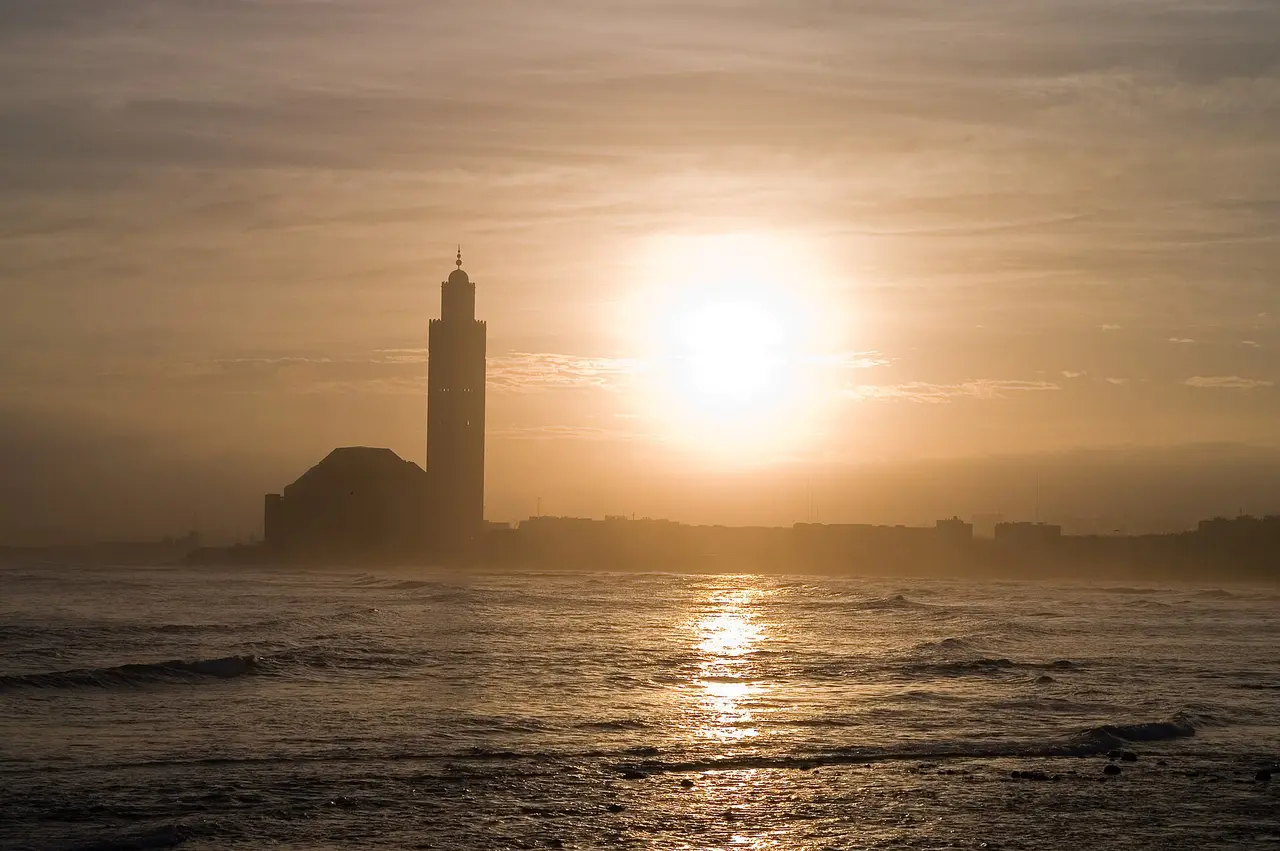
Inaugurated on 30 August 1993, the Hassan II Mosque is partly built over the sea, and its minaret towers over the whole coast. It is one of the few mosques in Morocco that non-Muslims can visit, on guided tours only: the prayer hall, the minaret hall and the ablutions hall. Tickets cost 140 dirhams for a foreign adult according to the foundation that runs the site, with tours in the morning and early afternoon, fewer on Fridays. Wear clothes covering shoulders and knees, and shoes that are easy to take off. The adjoining museum and the esplanade are visited separately.

Art Deco and neo-Moorish: the twentieth-century centre

Casablanca's real museum is outdoors. Along Boulevard Mohammed V and the surrounding streets, buildings from the 1920s and 1930s line up wrought iron, bas-reliefs, bow windows and geometric friezes, some restored, others weathered by the salty air. Place Mohammed V brings together neo-Moorish administrative buildings that combine arches, zellige and green tiles with entirely modern layouts. A little further on, the former Sacred Heart cathedral, white and slender, is now a cultural venue. Look up above the shop fronts: that is where the finest details hide.

The Habous and the central market

The Habous district, or new medina, was built under the protectorate to recreate the spirit of a traditional medina with wider, orderly streets. White arcades, small squares, religious bookshops, an olive souk and renowned pastry shops make it one of the most pleasant areas to explore on foot, without the hassle of the tourist souks. In the city centre, the central market is where locals go for fish and seafood: pick your catch at the stall and have it grilled in one of the small eateries next door, among florists and spice sellers.

The old medina and the Sqala bastion

Behind Casa Port station, the old medina is the city's historic core, far more modest than those of Fez or Marrakech. You come here for the feel of a working-class neighbourhood, with stalls selling clothes and everyday goods, rather than for monuments. On its edge, the Sqala bastion, an eighteenth-century fortification still lined with cannons, houses a restaurant in a garden sheltered by the ramparts. From there, a walk along the seafront leads to the Hassan II Mosque, so you can link both visits in the same half-day.

The Aïn Diab Corniche, on the ocean side

West of the mosque, the Corniche boulevard runs along the Atlantic for several kilometres: beaches, beach clubs, cafés and fish restaurants follow one another, with a busy promenade in the late afternoon. The sea stays cool, around 17°C in winter and up to 23°C in August, and the waves draw surfers. At the far end, the Sidi Abderrahmane marabout sits on a rocky islet you can reach on foot at low tide. Opposite, the Morocco Mall, a large seafront shopping centre, is a refuge on rainy days and a meeting point in the evening.

Rabat, Azemmour and El Jadida by train

Casablanca makes a good base for trips without a car. To the north, the Al Boraq high-speed train links Casa Voyageurs to Rabat Agdal, and shuttle trains serve Rabat Ville: the UNESCO-listed capital can be seen in a day, with the Hassan Tower, the Mohammed V Mausoleum and the Kasbah of the Udayas. To the south, the El Jadida line stops at Azemmour, a small white medina above the Oum Er-Rbia, then reaches the Portuguese city of Mazagan, also listed. The train avoids the Casablanca-El Jadida national road, which France Diplomatie ranks among the most dangerous in the country. Check the day's times on the ONCF website.

Sample itineraries

Three routes built around the time you actually have.
3daysRecommended

Casablanca in 3 days: the old medina, the Hassan II Mosque and Rabat by train

  1. Day 1: the old medina, the Sqala and the Hassan II Mosque
  2. Day 2: Rabat by train, the Kasbah of the Udayas and the Hassan Tower
  3. Day 3: the Art Deco centre, the Habous and the Arab League park

Best for: Three days linking the two cities of the Atlantic coast: old Casablanca, from the old medina and the Sqala bastion to the Hassan II Mosque, a day in Rabat by train from Casa Voyageurs, then twentieth-century Casablanca, between the Art Deco centre, the Habous and the Arab League park.

How much it costs

Per person per day, excluding international travel.
Budget
36 €/ day
904 € for 2 people, 7 days, return flights included
Accommodation
17 €
Food
12 €
Local transport
3 €
Sights and activities
4 €
Comfort
84 €/ day
1 796 € for 2 people, 7 days, return flights included
Accommodation
43 €
Food
22 €
Local transport
7 €
Sights and activities
12 €
Premium
205 €/ day
3 730 € for 2 people, 7 days, return flights included
Accommodation
92 €
Food
50 €
Local transport
28 €
Sights and activities
35 €
Prices checked: Relevé du 12 octobre 2026, hors vacances de Pâques, de la Toussaint et juillet-août. Taux Wise consulté le 12 octobre 2026 : 1 € = 10,94 dirhams (MAD). Repas et transports d'après Numbeo Casablanca (mise à jour du 2 octobre 2026, 844 relevés de 79 contributeurs sur 12 mois, valeurs propres à la ville) : repas bon marché 46 MAD (4,2 €), dîner pour deux en restaurant moyen 320 MAD (29 €), ticket de transport urbain 8 MAD, petit taxi 8 MAD de prise en charge puis 3 MAD le km. Dortoirs : 15 € (Medina Hostel) et 18 € (LHostel) en prix d'appel « à partir de » sur Hostelworld Casablanca, octobre 2026, seulement deux auberges de jeunesse listées. Hôtels : combien-coute.net (données hotels.com et Booking), 85 € la nuit en 3 étoiles (mise à jour du 28 septembre 2026) et 184 € en 5 étoiles (mise à jour du 28 juin 2026) ; momondo affiche des moyennes plus basses (44 € et 113 €, page non datée). Activités : visite guidée de la mosquée Hassan II à 140 MAD (12,8 €) pour un adulte étranger et visite VIP privée à 2 200 MAD pour 10 personnes au plus, tarifs officiels de la Fondation de la Mosquée Hassan II (fmh2.ma, page non datée consultée le 12 octobre 2026) ; le reste (Corniche, Habous, centre Art déco, ancienne médina) est gratuit, d'où un poste activités lissé sur la semaine. Train vers Rabat ou El Jadida non chiffré faute de tarif ONCF 2026 consultable. Vol A/R Paris-Casablanca par personne d'après KAYAK (page non datée, statistiques sur 12 mois glissants, consultée le 12 octobre 2026) : 200 € en backpacker (médiane de septembre, mois le moins cher, 201 €), 310 € en comfort (prix moyen de 312 €), 430 € en premium (médianes de juillet et août, 425 € et 436 €, vols directs aux horaires choisis) ; vols directs Royal Air Maroc, Air France, Transavia et TUI fly. Hébergement par nuit et par personne : lit en dortoir pour backpacker, chambre double en 3 étoiles partagée à deux pour comfort, 5 étoiles partagé à deux pour premium. Transports : tramway et marche pour backpacker, petits taxis et un aller-retour en train lissé pour comfort, chauffeur privé pour premium. weekTwoPax = deux vols + sept jours à deux.

Getting there

Airports serving Casablanca, from main hubs to secondary ones.
  • AGAAl Massira AirportAgadirMain
  • BEMBeni Mellal AirportOulad YaichMain
  • CMNMohammed V International AirportCasablancaMain
  • FEZFes Saïss International AirportSaïssMain
  • NDRNador Al Aaroui International AirportAl AarouiMain
  • OUDOujda Angads AirportAhl AngadMain

Entry, health and safety

For FR travellers

Entry requirements

No visa for a tourist stay

Pas de visa pour un séjour touristique de trois mois maximum au Maroc. Il faut un passeport en cours de validité couvrant toute la durée du séjour : la carte nationale d'identité seule ne permet plus d'entrer, y compris en voyage organisé. Les non-résidents doivent présenter à l'arrivée un billet de retour et des justificatifs de moyens de subsistance. À l'aéroport Mohammed V, vérifiez que la police aux frontières a bien tamponné le passeport, sinon le séjour peut devenir irrégulier. Au-delà de trois mois, une prolongation limitée à trois mois se demande au service marocain de l'immigration.

Stay allowed for up to 90 days.

Health

Advised: Aucun vaccin obligatoire. Être à jour du calendrier vaccinal français, notamment diphtérie, tétanos, poliomyélite, coqueluche et rougeole. Selon la durée et les conditions du séjour : hépatite A, fièvre typhoïde, hépatite B en séjours fréquents ou prolongés, tuberculose pour les enfants de moins de 15 ans en séjours fréquents ou prolongés, rage (jeunes enfants, séjour en milieu rural ou isolé) et mpox en cas d'exposition à risque.

Hygiène de l'eau et des aliments : fièvre typhoïde et poliomyélite se transmettent par l'eau et les aliments contaminés. Leishmaniose transmise par les phlébotomes, surtout la nuit : se protéger des piqûres. Chiens et chats errants de plus en plus nombreux : consulter immédiatement après toute morsure ou griffure, même vacciné contre la rage. Les hôpitaux peuvent exiger le paiement intégral avant la sortie : prévoir une assurance couvrant soins et rapatriement sanitaire. Sécurité : Casablanca n'est classée ni en zone jaune ni en zone rouge, mais France Diplomatie demande une vigilance accrue dans les grandes villes comme Casablanca, où des voleurs à moto arrachent sacs et téléphones jusque sur les trottoirs. Sortir avec le minimum d'argent et d'objets de valeur, prendre des taxis officiels, éviter les lieux déserts la nuit. Les femmes seules peuvent subir des comportements importuns. Sur la route, les nationales Casablanca-Marrakech et Casablanca-El Jadida comptent parmi les plus dangereuses du pays, et des jets de pierres depuis les ponts sont signalés sur l'autoroute Rabat-Casablanca : préférer le train. Le pays reste exposé à la menace terroriste, vigilance dans les lieux de rassemblement. Seule la frontière mauritanienne est formellement déconseillée, très loin de Casablanca. Consulat général de France à Casablanca, 1 rue du Prince Moulay Abdallah.

Safety

Normal precautions

Checked in octobre 2026 against the official source. Entry rules change: check the official source before you travel, it alone is authoritative.

Practical information

Airport

Mohammed V, south of the city, direct flights from Paris with Royal Air Maroc, Air France, Transavia and TUI fly

Stations

Casa Voyageurs for Al Boraq and main lines, Casa Port near the old medina

Getting around

Tram, tickets around 8 dirhams, and metered red petits taxis

Currency

Moroccan dirham (MAD), €1 = 10.94 MAD in October 2026

Budget

From €36 a day in a hostel, €84 in a shared 3-star hotel room

When to go

May, June and September: dry skies, 23 to 26°C, fewer crowds than in summer

Hassan II Mosque

Guided tours only, 140 dirhams, clothing covering shoulders and knees

Safety

Watch out for bag snatching from motorbikes, use official taxis, avoid deserted places at night

Casablanca in pictures

Photo credits : Milamber's portfolio, CC BY 2.0, Wikimedia Commons ; Sandra Cohen-Rose and Colin Rose from Montreal, Canada, CC BY-SA 2.0, Wikimedia Commons ; Helmut Seger, CC BY-SA 4.0, Wikimedia Commons ; Nasser el mounim, CC BY-SA 4.0, Wikimedia Commons ; Antony Stanley from Gloucester, UK, CC BY-SA 2.0, Wikimedia Commons ; Hamza Izourane, CC BY-SA 4.0, Wikimedia Commons

Frequently asked questions about Casablanca

How many days do you need in Casablanca?
Two days cover the essentials: the Hassan II Mosque and the Aïn Diab Corniche on the first, the Art Deco centre, the central market and the Habous on the second. Add a day for Rabat by train, or two for Azemmour and El Jadida.
Can non-Muslims visit the Hassan II Mosque?
Yes, but only on guided tours at set times in the morning and early afternoon, with fewer slots on Fridays. Expect 140 dirhams for a foreign adult according to the mosque's foundation. Clothing covering shoulders and knees is required, and you remove your shoes at the entrance.
When is the best time to visit Casablanca?
May, June and September offer the best balance: dry skies, 23 to 26°C and fewer crowds than in July and August, when the diaspora returns and the beaches fill up. Winter stays mild at around 18°C, but from November to March it rains roughly one week in four.
How do you get from Mohammed V airport to central Casablanca?
The easiest option is the ONCF train, which leaves from the airport station and serves Casa Voyageurs and Casa Port. Grand taxis also wait outside: agree on the fare before getting in. Check the time of the last train if you land late.
Is Casablanca safe for tourists?
Casablanca is not in an area advised against, but France Diplomatie calls for extra vigilance there: thieves on motorbikes snatch bags and phones, sometimes on the pavements. Carry as little as possible, use official taxis and avoid deserted streets at night.
Can you visit Rabat on a day trip from Casablanca?
Yes, very easily by train: Al Boraq runs from Casa Voyageurs to Rabat Agdal, and shuttle trains link Casa Port with Rabat Ville. Once there, the Hassan Tower, the Mohammed V Mausoleum and the Kasbah of the Udayas fit into a day before the evening train back.
Can you swim in Casablanca?
Yes, on the Aïn Diab Corniche beaches, but the Atlantic stays cool: around 17°C in winter and 23°C at best in August. Waves and currents can be strong, so swim at supervised beaches and follow the flags.

Plan your trip to Casablanca

Build your day-by-day itinerary and manage budget, bookings and packing in PlanTripNow.
Aperçu de l'application PlanTripNow