Skip to content

Visit Marrakech : medina, gardens and day trips

Behind its red earthen ramparts, Marrakech packs a thousand years of imperial history: a listed medina where you get lost between souks and madrasas, palaces and gardens to catch your breath, and the Atlas an hour away by road. Three days are enough to grasp the essentials, more to truly love it.

At a glance

Visa
None
Tourist stay of up to 90 days
7-day budget
€770
Per person, comfort profile, excluding international flights.

Why visit Marrakech?

Marrakech is the gateway to southern Morocco and the most visited imperial city in the country. Its UNESCO-listed medina is walked entirely on foot; its riads, gardens and food make it a short but very complete getaway, three hours by air from Europe.

When to visit Marrakech

Temperatures, rainfall and crowds month by month, to pick your window.
When to visit Marrakech
MonthTemperaturesRainCrowdsVerdict
January6 to 19 °C3 dQuietMild 19C days but chilly 6C nights, a quiet city and low room rates.
February8 to 21 °C4 dModerateAlmond trees blossom around the city and 21C days are ideal for exploring the medina.
March10 to 24 °C5 dPackedThe perfect month before the heat: 24C, green gardens, but riads sell out at Easter.
April12 to 26 °C3 dPackedStill pleasant at 26C, though peak season is in full swing and prices climb.
May15 to 29 °C2 dModerateThe last comfortable window, 29C afternoons, before June drives visitors away.
June18 to 34 °C1 dQuietHighs cross 33C, crowds thin out and riads slash their rates.
July21 to 38 °C0 dQuietA 38C furnace with spikes past 45C; the medina is punishing at midday.
August21 to 37 °C1 dModerateCrushing heat matching July, yet European holidaymakers still fill the pools.
September18 to 32 °C1 dModerateThe heatwave lingers near 32C early on, bearable and much quieter by late September.
October16 to 28 °C2 dBusyComfort returns at 28C, one of the best months; book early as everything fills.
November11 to 23 °C4 dBusy22C and golden light on the distant snow-capped Atlas, excellent for walking all day.
December7 to 20 °C4 dBusyMild 20C days, cold evenings; Christmas week sends both crowds and rates soaring.
Source: Normales 1991-2020, station Marrakech-Menara ; Wikipedia (source ONM/NOAA) recoupe avec Climates to Travel, releve septembre 2026.

Marrakech's must-sees

The sites not to miss, all reachable on foot in the medina or fifteen minutes away by taxi.

Jemaa el-Fna

A square listed by UNESCO for its oral heritage: Gnaoua musicians, snake charmers and street kitchens that set up every evening until midnight.

Ben Youssef Madrasa

Morocco's largest Quranic school, reopened after restoration: a pool courtyard, zellige and carved cedar over two floors of student cells.

Bahia Palace

A 19th-century vizier's residence, eight hectares of courtyards, painted ceilings and citrus gardens, one of the few palaces open in full.

Saadian Tombs

A 16th-century royal necropolis walled up then rediscovered in 1917, famous for its hall of twelve Carrara marble columns.

Majorelle Garden

A cobalt-blue botanical garden created by Jacques Majorelle, saved by Yves Saint Laurent, with the Berber Museum in the former studio.

Koutoubia

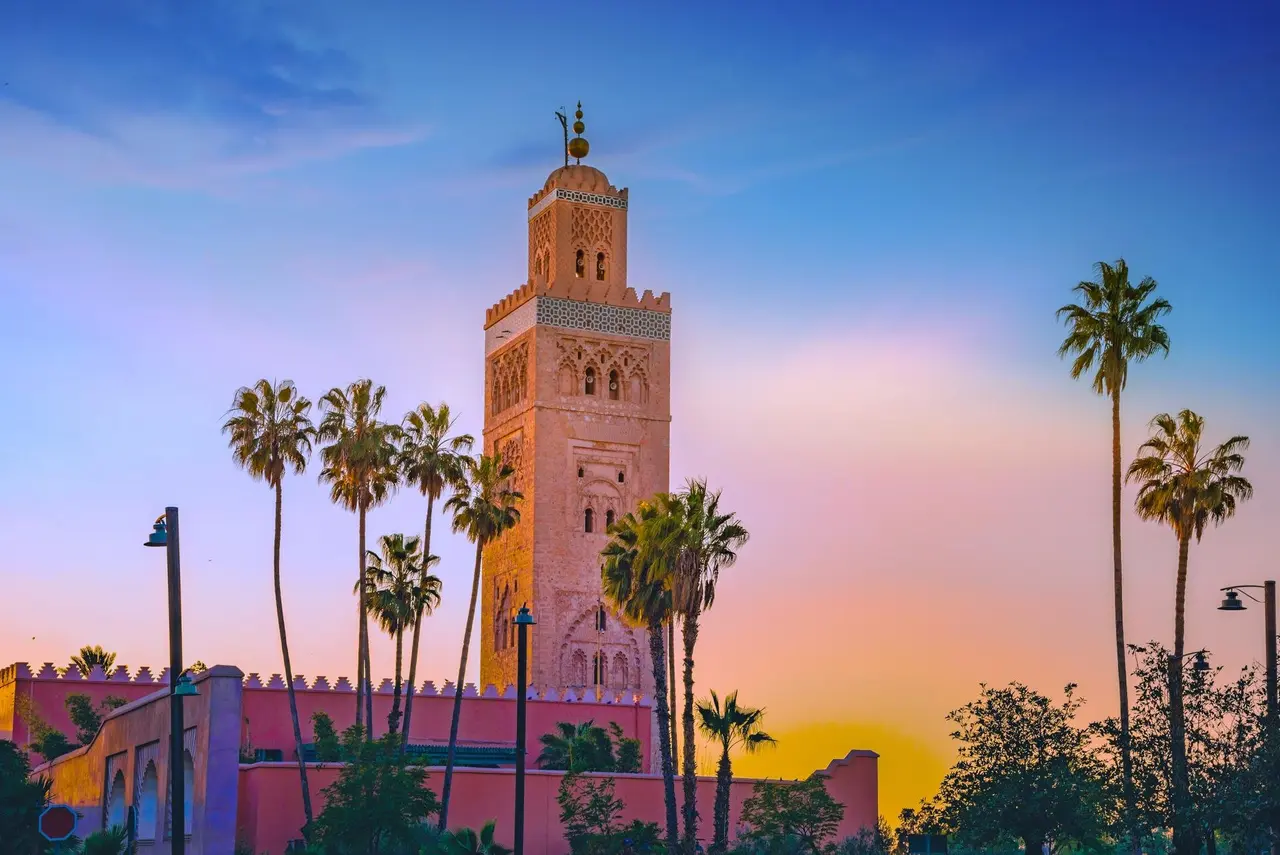
A 12th-century mosque whose 77-metre minaret was the model for the Giralda in Seville; the interior is for Muslims only.

Dyers' souk

A lane where skeins of dyed wool hang drying over passers-by; the dyeing vats can be seen in the late morning.

El Badi Palace

The grand ruins of a Saadian palace stripped of its marble in the 17th century, with panoramic terraces and stork nests on the walls.

Yves Saint Laurent Museum

A brick and terrazzo building by Studio KO, devoted to forty years of the designer's work, next door to the Majorelle Garden.

What to discover in Marrakech, district by district?

The medina and Jemaa el-Fna

The UNESCO-listed historic core, the medina is built around Jemaa el-Fna square, dusty and quiet by day, packed with food stalls and storytellers after dark. Allow two full days to cover it without rushing: the souks north of the square in the morning, the southern monuments in the afternoon. It is all done on foot, but an offline map keeps you from going in circles through a lattice of several thousand unmarked lanes.
The souks

North of Jemaa el-Fna, the souks are organised by trade: dyers, ironworkers, leatherworkers, basket makers. Prices are never displayed and are negotiated, usually down to about half the first figure quoted. The Rahba Kedima, a former auction square, and the Spice Square hold the finest stalls, while the covered lanes around them shelter carpet and lantern dealers. Go mid-morning, before the afternoon crowds and the partial Friday closure, and keep some small notes: change is often scarce.

The Kasbah and the southern palaces

The Kasbah quarter, south of the medina, gathers the Bahia Palace, the Saadian Tombs and the open-air ruins of the El Badi Palace. All three fit into half a day and stand less than ten minutes' walk apart. Arrive at opening, around 9am: by midday tour groups fill the Bahia courtyards one after another and the light turns harsh for photos.

Gueliz, the new town

Built by the French in the 1920s, Gueliz is contemporary Marrakech: straight avenues, cafes, art galleries and designer shops. People come mainly for the Majorelle Garden and the Yves Saint Laurent museum, both booked online with a timed slot. The district is fifteen minutes by petit taxi from the medina; the fare runs on the meter or is agreed before you get in, around 30 to 50 dirhams.

Hivernage and the gardens

Between Gueliz and the medina, Hivernage lines up the big hotels, palm groves and historic gardens. The Menara, a stone basin backed by an olive grove, gives the best view of the Atlas in the late afternoon and entry to the basin is free. Le Jardin Secret, deep in the medina, and the palm grove north of the city round out the walk for anyone escaping the density of the lanes.

Around Marrakech: the Atlas and the south

The city is an ideal base for the south: the Ourika Valley and its waterfalls are 1h15 by road, the Agafay desert 40 minutes away, the High Atlas passes and Berber villages such as Imlil reachable on a day trip. To go further, towards Ouarzazate and its film studios, the Dades Gorges or the dunes of the Merzouga desert, allow at least a three-day loop through southern Morocco.

How much it costs

Per person per day, excluding international travel.
Budget
34 €/ day
736 € for 2 people, 7 days, return flights included
Accommodation
12 €
Food
12 €
Local transport
3 €
Sights and activities
7 €
Comfort
110 €/ day
1 860 € for 2 people, 7 days, return flights included
Accommodation
45 €
Food
30 €
Local transport
10 €
Sights and activities
25 €
Premium
285 €/ day
4 490 € for 2 people, 7 days, return flights included
Accommodation
130 €
Food
60 €
Local transport
25 €
Sights and activities
70 €
Prices checked: Relevé septembre 2026 ; agrégateurs de prix voyage (BudgetYourTrip, guides budget Maroc 2026) et comparateurs de vols (momondo, Google Flights). Vol A/R Paris-Marrakech hors vacances scolaires estimé à 130 EUR/pers (backpacker), 160 (confort), 250 (premium). Chambre double partagée a deux, lit en dortoir pour le profil backpacker. Prix hors haute saison (mars-avril, octobre-novembre) et hors semaine de Noël ; l'hébergement à Marrakech augmente de 10 à 15% par an.

Getting there

Airports serving Marrakech, from main hubs to secondary ones.
  • AGAAl Massira AirportAgadirMain
  • BEMBeni Mellal AirportOulad YaichMain
  • CMNMohammed V International AirportCasablancaMain
  • FEZFes Saïss International AirportSaïssMain
  • NDRNador Al Aaroui International AirportAl AarouiMain
  • OUDOujda Angads AirportAhl AngadMain

Entry, health and safety

For FR travellers

Entry requirements

No visa for a tourist stay

Aucun visa pour un séjour touristique de 90 jours maximum. Le passeport doit être valide pour toute la durée du séjour ; au-delà de trois mois, il faut contacter le service marocain de l'immigration.

Stay allowed for up to 90 days.

Health

Advised: Aucun vaccin obligatoire. Selon les conditions du séjour : hépatite A, fièvre typhoïde, hépatite B, rage, tuberculose. Mise a jour du calendrier vaccinal français recommandée, notamment rougeole.

Pas de paludisme au Maroc. Fièvre typhoïde liée à l'eau et aux aliments, leishmaniose transmise par piqûres d'insectes, rage présente (chiens et chats errants nombreux). Hausse des cas de rougeole signalée en 2026. Marrakech est située en zone de risque sismique depuis le séisme de 2023.

Safety

Normal precautions

Emergency

19

Checked in septembre 2026 against the official source. Entry rules change: check the official source before you travel, it alone is authoritative.

Marrakech travel basics

Currency

Moroccan dirham (MAD), non-convertible: change it on arrival. Plenty of ATMs in the medina and in Gueliz.

Haggling

Expected in the souks and for non-metered taxis; aim for half the first price, without aggression.

Tipping

A few dirhams for a service, 10% in restaurants; coins are expected for any photo taken on Jemaa el-Fna.

Tap water

Not recommended for drinking; bottled water everywhere, around 5 dirhams for 1.5 litres.

Alcohol

Served in hotels, riads and tourist restaurants, rare elsewhere; sold in supermarkets in Gueliz, not in the medina.

Ramadan

Many medina restaurants close during the day and the pace slows; tourist sites stay open. Dates shift about 11 days earlier each year.

Dress

Shoulders and knees covered are advised for women in the medina; shorts and vest tops are frowned upon outside hotel areas.

Power sockets

Types C and E, 220 V: no adapter needed for a French or Belgian device.

From the airport

Menara airport is 6 km out; official taxis at a posted price (about 100 to 150 dirhams to the medina), bus 19 every 30 minutes.

Petit taxi

Beige, an urban ride costs 20 to 50 dirhams on the meter; insist on the meter or fix the price before getting in, especially at night.

Marrakech in pictures

Photo credits : Jakub Hałun, CC BY 4.0, Wikimedia Commons ; Baca12, CC BY-SA 4.0, Wikimedia Commons ; Viault, CC BY-SA 4.0, Wikimedia Commons ; C messier, CC BY-SA 4.0, Wikimedia Commons ; DimiTalen, CC0, Wikimedia Commons

Similar destinations

Other cities you might like as much as Marrakech.

Marrakech: frequently asked questions

How many days do you need to visit Marrakech?
Three full days are enough for the medina, the Kasbah palaces and the Majorelle Garden without rushing. Add a day for a trip to the Ourika Valley or the Agafay desert, and another if you want to take your time over the souks and rooftop terraces.
Should you stay in a riad or in Gueliz?
A riad in the medina puts everything within walking distance and is part of the experience, but rooms often face a dark courtyard and you reach it on foot with your luggage. Gueliz offers standard hotels, a pool and quiet, at the cost of a fifteen-minute taxi to Jemaa el-Fna.
Is Jemaa el-Fna worth it or is it a tourist trap?
The square is very touristy by day but stays a real gathering place in the evening: Marrakchi families, Gnaoua musicians, snail stalls. Eat at the cookshops around it rather than on the square itself, where prices are inflated and quality uneven.
How do you get from the Majorelle Garden to the medina?
By beige petit taxi, allow fifteen minutes and 30 to 50 dirhams depending on time and traffic; insist on the meter. On foot it takes 35 to 40 minutes along Avenue Yacoub el-Mansour, fine in the morning but hard in the afternoon heat.
Can you visit Marrakech during Ramadan?
Yes: monuments, gardens and museums stay open and the city is quieter. However many medina restaurants close during the day, the souks feel more subdued, and the breaking of the fast at sunset slows everything for about an hour.
Do you need to book the Majorelle Garden in advance?
Yes, tickets are sold online with a timed slot and on-site queues are long. Book a few days ahead, aim for the 8am opening, and take the combined ticket with the neighbouring Yves Saint Laurent museum if both interest you.
What day trips can you do from Marrakech?
The Ourika Valley and the Setti Fatma waterfalls (1h15 by road), the Agafay desert for a sunset (40 minutes), the Ouzoud waterfalls (2h30) or the Oukaimeden ski resort in winter. Ouarzazate and the Merzouga desert need at least two days.
Is Marrakech a good destination for families?
Yes, with some care: the medina is dense and noisy, scooters brush past pedestrians in the lanes and the summer heat is hard on young children. A riad with a pool, morning visits and trips into the Atlas make the stay comfortable.

Plan your trip to Marrakech

Build your day-by-day itinerary and manage budget, bookings and packing in PlanTripNow.
Aperçu de l'application PlanTripNow