Skip to content

Visiting Chamonix : what to do at the foot of Mont Blanc

A cable car climbing to 3,842 metres, a rack railway to the Mer de Glace, high lakes facing granite spires and legendary ski runs: Chamonix rewards three to five days, in summer or winter, provided you treat the mountains with respect.

Why go to Chamonix?

From the centre of Chamonix, a cable car rises to 3,842 metres facing Mont Blanc, the highest peak in Western Europe. The birthplace of mountaineering since the first ascent in 1786 and host of the first Winter Olympics in 1924, it offers hiking, glaciers and top-level skiing an hour's drive from Geneva.

Chamonix's must-sees

High-altitude viewpoints, glaciers and trails, to be scheduled according to the day's weather.

Aiguille du Midi

Terraces at 3,842 metres reached by cable car from the centre, with a close-up view of Mont Blanc, the Grandes Jorasses and, on clear days, the Matterhorn.

Step into the Void

A glass box suspended at the top of the Aiguille du Midi, above a drop of more than 1,000 metres. Expect queues around midday in summer.

Mer de Glace

France's largest glacier, reached by the Montenvers train. Its ice cave, dug out again each year, is a striking illustration of the retreat of Alpine glaciers.

Lac Blanc

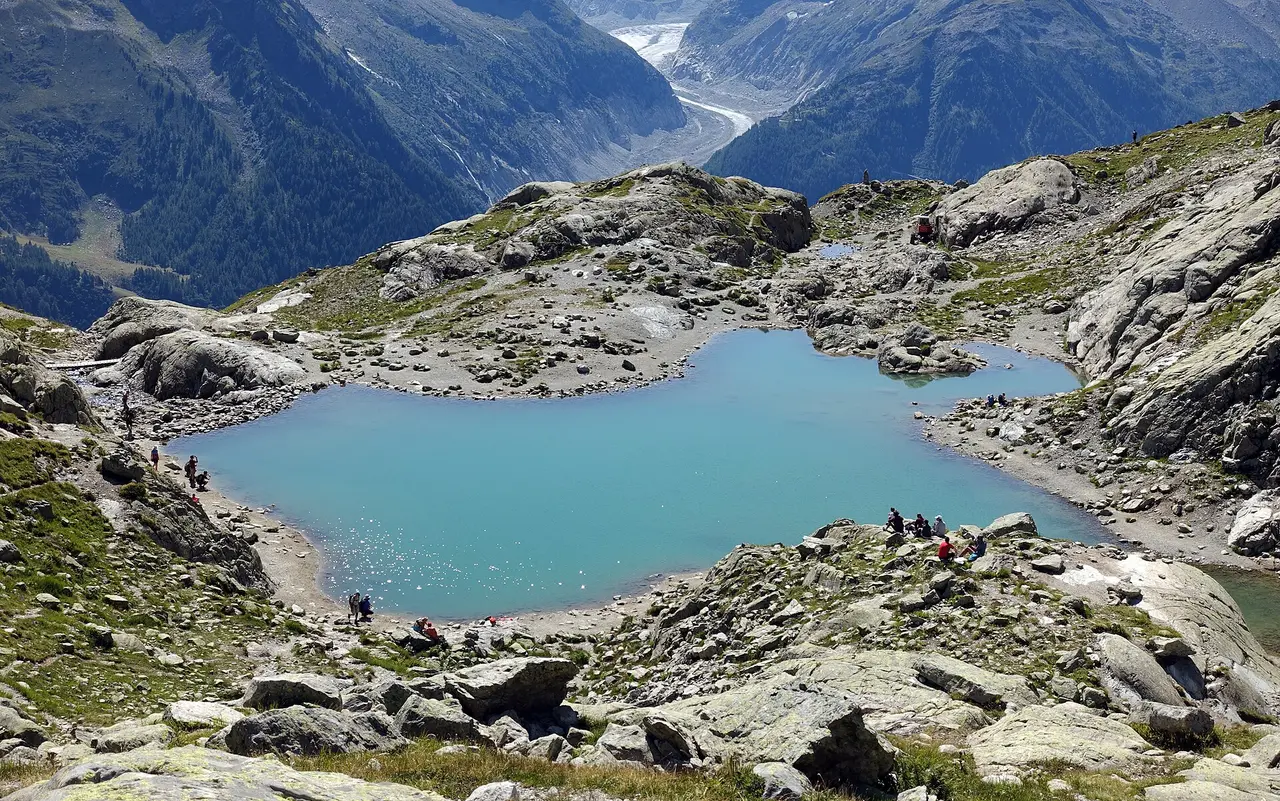
A high lake at 2,352 metres in the Aiguilles Rouges reserve, reflecting the Mont Blanc range. The valley's most popular summer hike.

Vallée Blanche

An off-piste descent of about twenty kilometres from the Aiguille du Midi to the Mer de Glace over crevassed glacier: a mountain guide is essential and good skiing ability required.

Pointe Helbronner

The Italian terminal at 3,466 metres, reached in summer by the Panoramic Mont-Blanc gondola, from which the Skyway Monte Bianco descends to Courmayeur.

Musée Alpin

Set in a former grand hotel in the centre, it traces the valley's history, from the first English travellers to the great mountaineering conquests, with maps and period objects.

Bossons Glacier

A glacier tongue reaching almost down to the valley floor, visible from the road and approached by a trail of about an hour to the glacier chalet.

Merlet Park

A wildlife park in Les Houches where chamois, ibex, deer and marmots live in semi-freedom on a forested balcony facing the Mont Blanc massif.

What to see in the Chamonix valley, area by area?

The town and its mountaineering heritage

The pedestrian centre, around Place Balmat and Rue du Docteur-Paccard, lines up Belle Époque hotels, outdoor gear shops and bars along the Arve. The statue of Balmat and Saussure, turned towards the summit, recalls the first ascent of Mont Blanc in 1786. In 1924, the town hosted the first Winter Olympics, held in France. On Place de l'Église, the Maison de la Montagne houses the Compagnie des Guides, founded in 1821, and the Office de Haute Montagne, the best source on route conditions. An hour is enough for the town itself, which mainly serves as a base for the whole valley.

The high mountains by cable car

The Aiguille du Midi cable car lifts visitors from the centre, at about 1,035 metres, to 3,842 metres in around twenty minutes, with a change at the Plan de l'Aiguille. At the top it is often 20 °C colder than in the valley and the thin air is noticeable: not recommended for very young children, and best avoided with heart problems. Book a time slot online in summer and go up before 9 am, as clouds often build in the afternoon. In the summer season, the Panoramic Mont-Blanc gondola glides over the glaciers to Pointe Helbronner, on the Italian border.

Montenvers and the retreating glaciers

From a station opposite the main train station, a rack railway climbs in about twenty minutes to Montenvers, at 1,913 metres, facing the largest glacier in France. The glacier retreats and thins every year: signs along the staircase mark its former levels, and you now have to descend several hundred steps to reach the ice cave, dug out again each season. Allow half a day and sturdy shoes. In summer, the Grand Balcon Nord trail links Montenvers to the Plan de l'Aiguille in two and a half to three hours, with a continuous view over the valley.

The Aiguilles Rouges side

Facing the Mont Blanc massif, the Aiguilles Rouges side of the valley offers the finest panoramas of the range. The Brévent lifts, from the town centre, and the Flégère lifts, from Les Praz, are the starting points for summer hikes. The busiest leads to a high lake at 2,352 metres, an hour and a half to two hours from La Flégère: start early, as the trail is crowded in July and August. This side is a nature reserve: dogs are banned, camping is regulated and picking plants is forbidden. In winter, Brévent and Flégère form a linked ski area that gets the afternoon sun.

Argentière, Le Tour and the upper valley

About ten kilometres up the valley, Argentière keeps a village feel and gives access to the Grands Montets ski area, famous for its off-piste and long descents. Higher up, Le Tour and the Balme area suit beginners and families better, with gentle slopes up to the Swiss border. In summer, this sector is the starting point for the Col de Balme and the Tour glacier. The valley train serves Argentière and continues as the Mont-Blanc Express to Martigny in Switzerland, about an hour and a half from Chamonix. Accommodation here is often cheaper than in the centre.

Les Houches and the lower valley

8 km down the valley from the centre, Les Houches has a wooded ski area, more sheltered in bad weather, and hosts the Kandahar World Cup downhill each winter. On a balcony facing Mont Blanc, the Merlet wildlife park shows chamois, ibex and marmots in semi-freedom, open mainly from May to September. Les Houches is also the classic starting point of the Tour du Mont Blanc, a hike of about 170 km through France, Italy and Switzerland, taking eight to eleven days. Huts and gîtes along the route are booked from winter for July and August.

Seasons, risks and getaways

December to April for skiing, late June to mid-September for hiking and mountaineering: in May, October and November many lifts close for maintenance. Warming is speeding up glacier melt and increasing rockfall in summer; climbing Mont Blanc by the normal route, which crosses the Goûter couloir, requires experience, acclimatisation and a hut booking. In late August, the Ultra-Trail du Mont-Blanc fills the valley. Through the tunnel, Courmayeur is about twenty minutes away, Annecy and its lake about an hour and a half by road, and Lyon under three hours.

Getting there

Airports serving Chamonix, from main hubs to secondary ones.
  • AGFAgen La Garenne airportAgenSecondary
  • AJAAjaccio Napoléon Bonaparte airportAjaccioSecondary
  • ANEAngers Marcé airportAngersSecondary
  • ANGAngoulême Brie-Champniers airportAngoulêmeSecondary
  • AUFAuxerre Branches airportAuxerreSecondary
  • AURAurillac airportAurillacSecondary

Practical information for Chamonix

Guest card

Given by your accommodation in return for the tourist tax, it gives free access to valley buses and to the train between Servoz and Vallorcine.

From Geneva

Geneva airport is about an hour's drive via the Autoroute Blanche, with many shared shuttles. It is the most convenient air gateway.

Valley train

The Saint-Gervais to Vallorcine line serves Les Houches, Chamonix and Argentière, then continues into Switzerland as the Mont-Blanc Express to Martigny.

Lift passes

The Mont-Blanc Multipass in summer and multi-area passes in winter cover several lifts: worthwhile from two or three high-altitude outings.

Office de Haute Montagne

At the Maison de la Montagne, it gives free advice on trail, glacier and hut conditions. Check with it before any high-altitude outing.

Acute mountain sickness

Headaches and nausea are possible above 3,000 metres, even on a simple sightseeing trip: go back down if symptoms persist.

Mountain rescue

Dial 112. Rescue is free on the French side, but not in Italy or Switzerland: insurance covering search and rescue is strongly recommended.

Mont Blanc Tunnel

About 11.6 km, tolled, to Courmayeur, with strict distance and speed rules. Night closures or roadworks can occur: check before setting off.

Winter equipment

In Haute-Savoie, winter tyres or snow chains are compulsory from 1 November to 31 March on the mountain roads concerned.

Shoulder seasons

In May and from mid-October to mid-December, many lifts, huts and restaurants close. Plan high-mountain outings from June to September.

Chamonix in pictures

Photo credits : Tiia Monto, CC BY-SA 3.0, Wikimedia Commons ; Nicolas Sanchez, CC BY-SA 3.0, Wikimedia Commons ; Christian David, CC BY-SA 4.0, Wikimedia Commons ; Ximonic , Simo Räsänen, CC BY-SA 3.0, Wikimedia Commons ; Florian Pépellin, CC BY-SA 4.0, Wikimedia Commons

Frequently asked questions about Chamonix

Do you need to book the Aiguille du Midi cable car?
In July and August, yes: booking online gives you a departure slot and avoids hours of queuing. Out of season, buying on the spot is usually fine. Check the summit weather that morning, as tickets are not always refunded if it clouds over.
How can you tell if the Aiguille du Midi summit is clear?
Check the Compagnie du Mont-Blanc webcams and the Office de Haute Montagne weather bulletin before going up. Skies are generally clearer early in the morning: leaving before 9 am greatly improves your chances of seeing Mont Blanc without cloud.
How many steps down to the Mer de Glace ice cave?
Several hundred, and the number grows every year as the glacier melts. Allow twenty to thirty minutes going down and more coming back up, on metal walkways. It is not suitable for people with walking difficulties.
Can you climb Mont Blanc without a guide?
Legally yes, but only experienced, acclimatised mountaineers should consider it. The normal route crosses the Goûter couloir, exposed to rockfall, and huts must be booked. For a first attempt, hire a guide and plan several days of acclimatisation.
Is Lac Blanc doable with children?
With children used to walking, yes: allow about two hours up from La Flégère on a rocky trail with a few ladders and steep sections. Bring water and warm clothes, and come down before the storms that often build in late afternoon.
Do you need a guide to ski the Vallée Blanche?
Yes, unless you are a ski mountaineer skilled in crevasse rescue. The route crosses unmarked crevassed areas and starts with a ridge descended in crampons. A guide provides safety gear and picks the variant according to snow conditions.
Does the Chamonix guest card cover the train to Vallorcine?
Yes, it allows free travel by train between Servoz and Vallorcine and on the valley buses. Beyond that, towards Martigny in Switzerland or Saint-Gervais, you need a ticket. Ask your accommodation for it on arrival.
Which Chamonix ski area is best for beginners?
Le Tour and the Balme area, as well as Les Houches, have the gentlest slopes and most suitable lifts. The Grands Montets and Brévent are aimed more at strong skiers. The small beginner areas on the valley floor are fine for the first days.
Can you visit Courmayeur as a day trip from Chamonix?
Yes, by car or coach through the Mont Blanc Tunnel, about twenty minutes' drive. In summer, a spectacular loop runs via the Aiguille du Midi, the Panoramic Mont-Blanc gondola and the Skyway, but it is expensive and weather-dependent.
When should you book huts on the Tour du Mont Blanc?
As soon as bookings open, often in winter, for a July or August start. The most popular huts fill up very early. Setting off in late June or early September gives more choice, but snowfields may linger on some passes early in the season.

Plan your trip to Chamonix

Build your day-by-day itinerary and manage budget, bookings and packing in PlanTripNow.
Aperçu de l'application PlanTripNow