Skip to content

Visiting Geneva : what to do between lake, Old Town and the UN

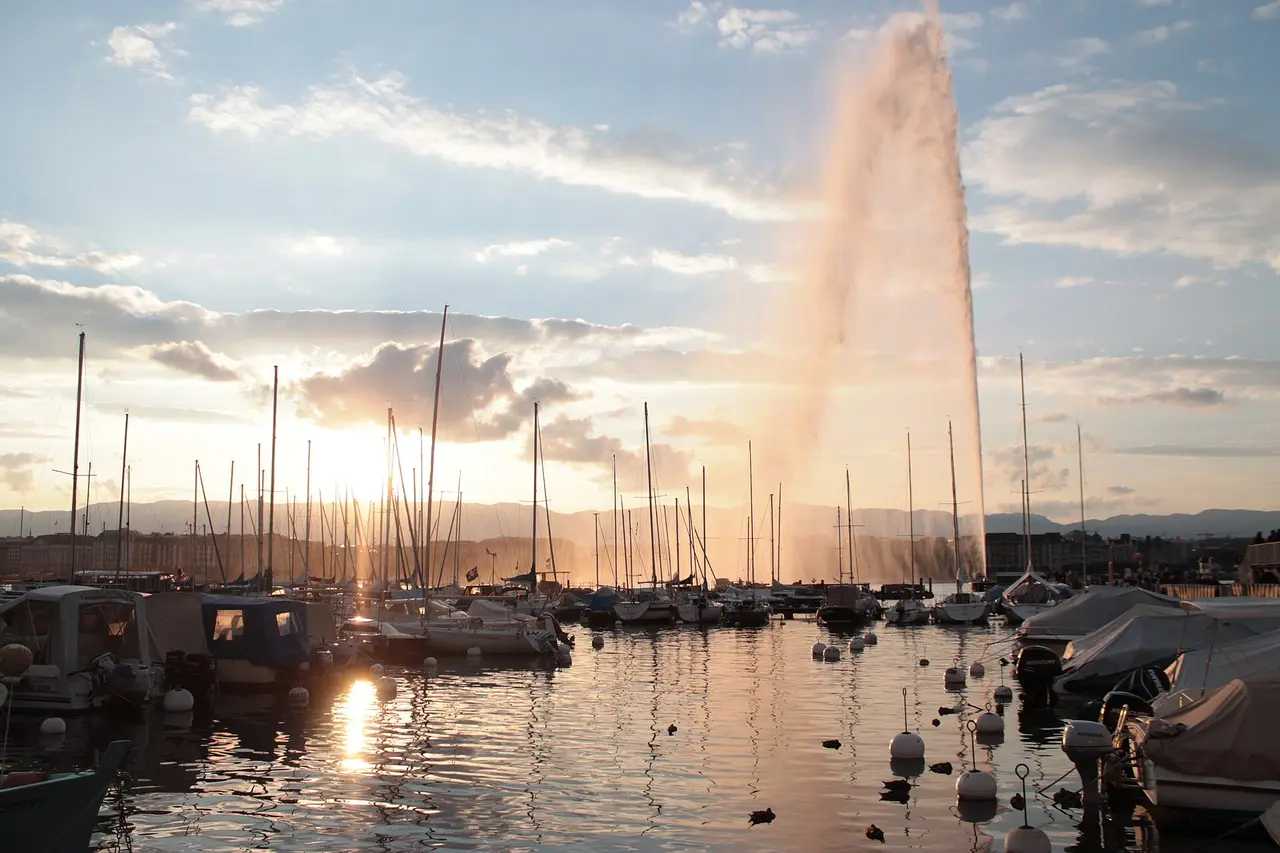
A 140-metre water jet, a medieval hill crowned by St Pierre, quays where people dive into the lake and a whole district devoted to diplomacy: Geneva is best explored on foot and by water taxi. Two to three days are enough, one more for CERN or the Salève.

Why visit Geneva?

Geneva packs into a few kilometres an old town shaped by the Reformation, the European headquarters of the United Nations and a lakeside harbour where people swim in summer. Several major museums are free, and guests staying in local accommodation receive a free public transport card for their whole stay.

Geneva's must-sees

Landmarks, free museums and swimming spots, nearly all within thirty minutes of the lake on foot or by tram.

Jet d'Eau

The city's symbol shoots lake water 140 metres into the air from the Eaux-Vives jetty. A walkway lets you get close, but expect to be sprayed.

St Pierre Cathedral

A Gothic church turned Protestant temple at the Reformation, where Calvin preached. Its towers offer the finest view over the harbour and the Alps on clear days.

Reformation Wall

A monument unveiled in 1909 in the Parc des Bastions, set against the old fortifications. Calvin, Farel, Beza and Knox tower over about a hundred metres of carved stone.

Palais des Nations

The UN's European headquarters, built for the League of Nations. Guided tour of about an hour through conference rooms and grounds, booking and ID required.

Red Cross Museum

The International Red Cross and Red Crescent Museum tells the story of humanitarian action through three immersive spaces. Opposite the Palais des Nations, closed on Mondays.

Bains des Pâquis

1930s public baths at the end of a jetty: swimming and diving board in summer, sauna, hammam and fondue at the snack bar in winter. A very local atmosphere.

Museum of Art and History

A large encyclopaedic museum with free permanent collections, from archaeology to fine arts. It holds Konrad Witz's altarpiece showing a miraculous catch on Lake Geneva.

Flower Clock

A clock face made of flowers created in 1955 at the entrance to the Jardin Anglais, honouring Geneva watchmaking. Its design changes with the seasons, facing the water jet.

Maison Tavel

Geneva's oldest private house, in the Old Town, now a free museum of urban life. Its Magnin relief model shows the fortified city around 1850.

CERN Science Gateway

A free exhibition centre designed by Renzo Piano in Meyrin, opened in 2023. Interactive exhibitions, workshops and shows about the accelerator and particles, no booking needed for exhibitions.

What to see in Geneva, neighbourhood by neighbourhood?

The Old Town and St Pierre hill

Set on the left bank, the Old Town revolves around the cathedral, the Place du Bourg-de-Four, the oldest square in the city, and the Grand-Rue where Rousseau lived as a child. Its sloping lanes take two to three hours to explore, stepping into the Town Hall and its cobbled ramp once climbed on horseback. The archaeological site beneath the cathedral reveals two thousand years of settlement. Come early in the morning or late in the day: the Bourg-de-Four terraces fill up at aperitif time.

The harbour, Les Pâquis and the right bank

The harbour is Geneva's visual heart: flower-lined quays, the water jet, the Mont-Blanc bridge and Rousseau Island. On the right bank, the cosmopolitan, working-class Pâquis district lines up small restaurants from all over the world between Cornavin station and the lake. Its jetty leads to the baths, open all year, where people swim in summer and eat fondue in winter. To switch banks, hop on a mouette, the small yellow boats that are part of the public transport network: the crossing takes a few minutes.

The international district

Twenty minutes on foot north of the station, the Nations district brings together the Palais des Nations, built in the 1930s for the League of Nations, the International Committee of the Red Cross and many UN agencies. On the Place des Nations, the Broken Chair, a giant three-legged chair, recalls the fight against landmines. Guided tours of the Palais last about an hour and require an ID document. Combine them with the Red Cross museum and the Ariana park for a full half-day.

Plainpalais, the Bastions and the museum quarter

South of the Old Town, the Parc des Bastions holds the university and its giant open-air chessboards. The Plaine de Plainpalais, a vast gravel diamond, hosts the flea market on Wednesdays and Saturdays, the best time to browse. The area is also home to MAMCO, the contemporary art museum, and on the nearby Tranchées hill the Museum of Art and History, whose permanent collections are free. Plan half a day, and note that most of these museums close on Mondays.

Carouge, the little Sardinian town

Built in the late 18th century by the kings of Sardinia to rival Geneva, Carouge only joined the canton in 1816. It has kept a Mediterranean feel: low houses, inner courtyards, arcaded squares and craft workshops. The tram links it to the centre in about fifteen minutes. On Wednesday and Saturday mornings, the market on the Place du Marché draws locals, and in the evening its bistros offer a more relaxed alternative to the lakefront. Two to three hours are enough to see it.

Eaux-Vives and the left shore of the lake

Walking along the Quai Gustave-Ador from the Jardin Anglais, you reach the foot of the water jet, accessible by a jetty, then the lakeside beaches of Baby-Plage and Genève-Plage. Further back, the Parc La Grange has a rose garden that peaks in June, and the Parc des Eaux-Vives overlooks the lake. The lively, residential Eaux-Vives district has its own Léman Express station. Allow an hour and a half one way from the Mont-Blanc bridge, ideally on a summer late afternoon.

CERN, the Salève and the Geneva countryside

In Meyrin, twenty-five minutes by tram from the station, CERN opened the Science Gateway in 2023, a free exhibition centre devoted to particle physics. On the French side, the Salève, nicknamed Geneva's balcony, is reached by bus to the border then by cable car: bring an ID document. The vineyards of Satigny and Dardagny, among the largest in Switzerland, can be explored by bike or during the spring open cellars. The Léman Express also reaches Annecy and Évian without a car.

Getting there

Airports serving Geneva, from main hubs to secondary ones.
  • GVAGeneva International AirportGenevaMain
  • ZRHZürich AirportZurichMain
  • ACHSankt Gallen Altenrhein AirportSt. GallenSecondary
  • BRNBern AirportBernSecondary
  • EMLEmmen Air BaseEmmenSecondary
  • LUGLugano AirportAgnoSecondary

Practical information for Geneva

Free airport ticket

A machine in the baggage reclaim area issues a free ticket valid for 80 minutes; the train reaches Cornavin station in about 7 minutes.

Geneva Transport Card

Given free by hotels, hostels and campsites: unlimited buses, trams, mouettes and trains within the urban zone for your whole stay.

Currency

Swiss franc. Euros are often accepted but change is given in francs at a poor rate: pay by card, contactless is everywhere.

Power sockets

Swiss type J, 230 V. Flat two-pin European plugs fit, round earthed plugs do not: bring an adapter.

Tipping

Service is included in prices. People happily round up the bill by a few francs at restaurants, with no obligation.

Fountain water

Drinkable at almost all public fountains unless signposted otherwise: refill your bottle for free.

Mondays at museums

The Museum of Art and History, Maison Tavel, the Red Cross museum and CERN Science Gateway are closed on Mondays.

Sundays

Most shops are closed; the shops at Cornavin station and the airport stay open.

Lake swimming

The water often exceeds 20 °C in high summer. Bains des Pâquis, Baby-Plage and Genève-Plage are supervised; in the Rhône, the current is strong.

Geneva in pictures

Photo credits : John Samuel, CC BY-SA 4.0, Wikimedia Commons ; karlheinz klingbeil, CC BY 4.0, Wikimedia Commons ; C messier, CC BY-SA 4.0, Wikimedia Commons ; Mina Kara, CC BY-SA 4.0, Wikimedia Commons

Frequently asked questions about Geneva

Does Geneva's Jet d'Eau run all year round?
It runs for much of the year and is lit up in the evening, but it is switched off in strong wind, in freezing weather and during its annual maintenance period. Check its status on the day on the Geneva utility company's website before heading to the jetty.
Do you need to book a tour of the Palais des Nations?
Yes, it is strongly advised: guided tour places are limited and times vary depending on ongoing conferences. Arrive early at the Pregny gate with a passport or ID card, as the security check is similar to an airport's.
Is staying on the French side a good idea to visit Geneva?
To cut costs, yes: Annemasse is linked to Eaux-Vives and Cornavin stations by the Léman Express in about twenty minutes. You do, however, lose the Geneva Transport Card, reserved for guests staying in the canton, and must buy your own tickets.
Can you visit CERN for free from Geneva?
Yes. The Science Gateway and its exhibitions are free and open without booking, Tuesday to Sunday. Guided tours of experimental sites, also free, are booked online and go quickly. Tram 18 links Cornavin station to the CERN stop in about twenty-five minutes.
What is the Escalade festival?
It commemorates the failed Savoyard attack on the night of 11 to 12 December 1602. On the nearest weekend, the Old Town hosts a historical procession in costume, and locals smash a chocolate cauldron. The Escalade race, a few days earlier, runs through the same streets.
How do you get up the Salève from central Geneva?
Take the bus to the Veyrier customs post, cross the border on foot, then walk to the cable car station on the French side. The ride takes a few minutes up to a plateau at about 1,100 metres. Bring an ID document and check the annual maintenance closure.
How long for the Old Town, the harbour and the Bastions?
One full day is enough: morning in the Old Town and at the cathedral, lunch at the Bourg-de-Four, a stop at the Reformation Wall, then an afternoon along the quays to the water jet. Keep a second day for the international district and Carouge.
Are Geneva's mouettes included in public transport?
Yes, the four mouette lines crossing the harbour are part of the urban network: a regular ticket or the Geneva Transport Card is enough. Larger cruises on the lake, run by a different company, are paid for separately.
Is Geneva a good base for Lake Geneva and Annecy?
Yes, it is an excellent car-free starting point. The Léman Express reaches Annecy and Évian, paddle steamers sail along the shore towards Nyon and Lausanne, and trains to the rest of Switzerland leave Cornavin several times an hour.

Plan your trip to Geneva

Build your day-by-day itinerary and manage budget, bookings and packing in PlanTripNow.
Aperçu de l'application PlanTripNow