Skip to content

Visit Innsbruck : what to do in winter and summer

Innsbruck is one of the few cities where you can go from a Gothic lane to a summit at 2,256 metres in the same morning. In winter, skiers base themselves here to reach a dozen ski areas; in summer, hikers set off straight from the centre towards the Nordkette's high pastures.

Why visit Innsbruck?

Innsbruck, capital of the Austrian Tyrol, combines a historic centre tied to Emperor Maximilian I with direct access to high mountains: the Nordkette is reached from the old town by funicular and cable car. The city hosted the Winter Olympics in 1964 and 1976 and works as a year-round base for skiing and hiking alike.

Innsbruck's must-sees

Five places that sum up the city, between imperial heritage and high mountains.

Golden Roof

A Gothic balcony built around 1500 for Maximilian I, covered with more than 2,600 gilded copper tiles, the old town's emblem with a small museum alongside.

Nordkette

A mountain range reached from the centre by funicular then cable car up to the Hafelekar at 2,256 metres, overlooking the Inn valley and the Karwendel range.

Bergisel Ski Jump

An Olympic ski jump redesigned by Zaha Hadid in 2002, with a panoramic tower and cafe above the city, on the hill that hosts international competitions.

Ambras Castle

The Renaissance residence of Archduke Ferdinand II on the heights, famous for its Spanish Hall, armour and cabinet of curiosities, set in a large park.

Hofkirche

The court church housing the cenotaph of Maximilian I surrounded by 28 larger-than-life bronze statues, and the tomb of Tyrolean hero Andreas Hofer.

What to see in Innsbruck, district by district?

The Altstadt and Maria-Theresien-Strasse

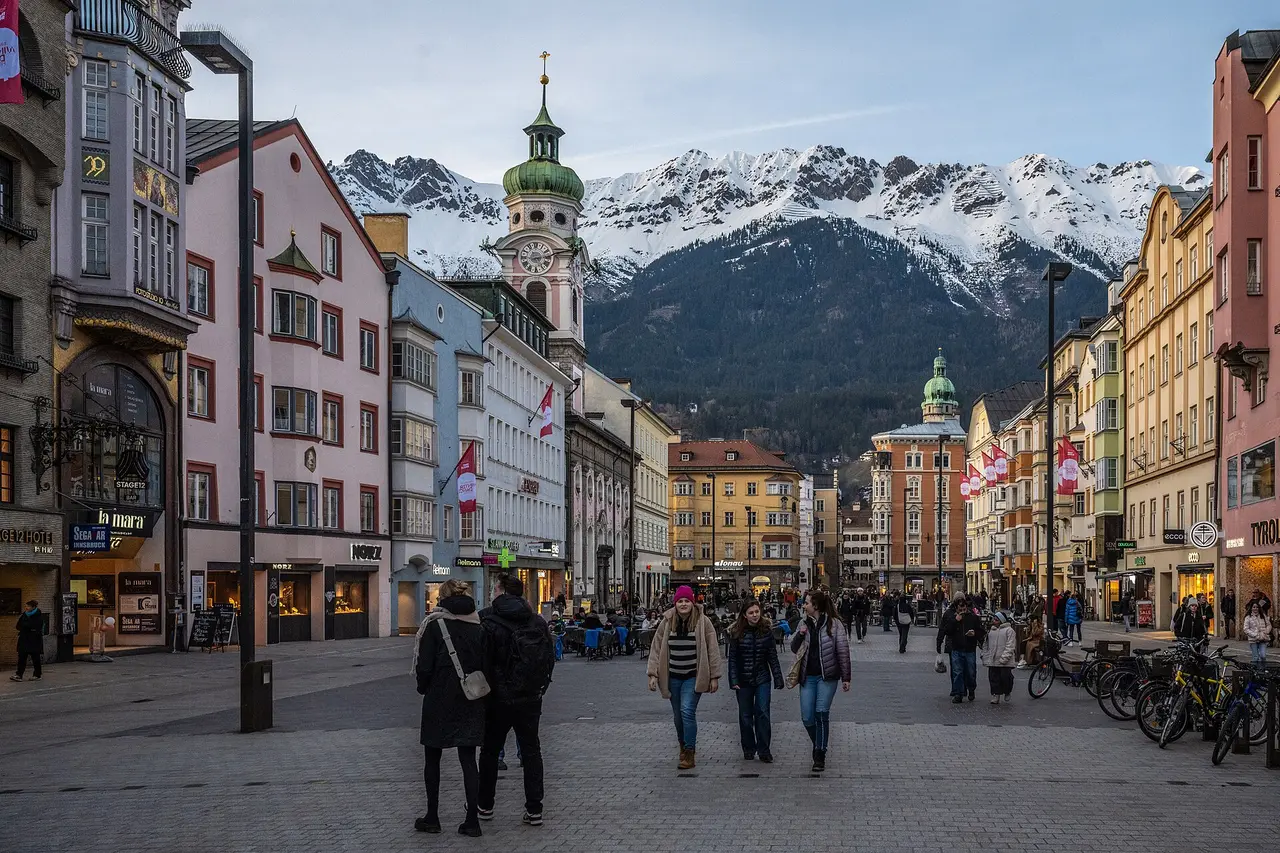
The old town fits into a square roughly 400 metres across, between the Inn and the Graben: Gothic arcades, painted facades and pedestrian lanes you can cover in an hour. It continues south along Maria-Theresien-Strasse, a baroque avenue where St Anne's Column and the 1765 triumphal arch frame the Nordkette in the background. From mid-November to early January, several Christmas markets set up on these squares. Come early in summer: day-trip groups arrive around 10 am. Innsbruck is also a handy gateway to the rest of Alpine Austria, with Salzburg less than two hours away by train.

Mariahilf, St. Nikolaus and the Hungerburg

On the north bank of the Inn, the colourful houses of Mariahilf make up the city's most photographed view, best seen from the Innbrücke bridge late in the day. Behind them, St. Nikolaus and Hötting are quieter residential districts with inns and small breweries. This is where the city climbs: the Hungerburgbahn funicular, designed by Zaha Hadid, leaves from Congress station and reaches the Hungerburg at 860 metres in about ten minutes. From there, cable cars continue to the Seegrube and the Hafelekar, the starting point for high-altitude trails from June to September and steep runs for confident skiers in winter.

Wilten, Igls and the surrounding resorts

South of the centre, Wilten combines a rococo basilica, the Premonstratensian abbey and Bergisel hill, twenty minutes' walk from the station. Higher up, the village of Igls, at 900 metres, gives access to the Patscherkofel, a family mountain for skiing in winter and panoramic hiking in summer. For a proper ski holiday, allow four to six days and use the shuttles to reach the Stubai areas, whose glacier, skiable for much of the year, is about an hour away. Skiers can also aim for the Bavarian resorts, with the German border some forty kilometres away via Seefeld.

Getting there

Airports serving Innsbruck, from main hubs to secondary ones.
  • GRZGraz AirportFeldkirchen bei GrazMain
  • INNInnsbruck AirportInnsbruckMain
  • KLUKlagenfurt AirportKlagenfurt am WörtherseeMain
  • LNZLinz-Hörsching AirportLinzMain
  • SZGSalzburg AirportSalzburgMain
  • VIEVienna International AirportViennaMain

Innsbruck travel tips

Airport

Innsbruck Airport is about 4 km west of the centre, linked by bus line F in around twenty minutes. Munich is the most common alternative, close to two hours away by train.

Innsbruck Card

A 24, 48 or 72-hour pass covering city transport, entry to the main museums and one return trip on the Nordkette: worth it as soon as you head up the mountain.

Guest card

Handed out by many accommodations from one night, it unlocks local perks, including a programme of free guided hikes in summer.

Ski pass

The Ski plus City Pass Stubai Innsbruck covers around a dozen ski areas, including the Stubai Glacier, with ski shuttles from the city included.

Sundays

Most shops close on Sundays in Austria; only station shops, a few convenience stores and restaurants stay open.

Motorway vignette

Compulsory on Austrian motorways and now available in digital form; the Brenner motorway towards Italy also has its own toll.

Innsbruck in pictures

Photo credits : Wilfredor, CC0, Wikimedia Commons ; böhringer friedrich, CC BY-SA 2.5, Wikimedia Commons ; Michielverbeek, CC BY-SA 4.0, Wikimedia Commons

Frequently asked questions about Innsbruck

How long does it take to get from central Innsbruck to the Hafelekar?
Allow under half an hour of actual travel: the Hungerburgbahn funicular from Congress station, then two cable cars to the Seegrube and the Hafelekar. Add connections and a margin in high season. The top section can close in strong wind, so check the weather before setting off.
Can you ski from Innsbruck without renting a car?
Yes. With the Ski plus City Pass, free shuttles leave the centre for nearby areas such as the Patscherkofel, Axamer Lizum or the Stubai Glacier. Staying near the station or the old town makes morning departures, often before 8.30 am, much simpler.
Is the Nordkette suitable for beginner skiers?
No. The Nordkette runs are short, steep and largely for confident skiers, with a well-known freeride route. Beginners will be better off on the gentler slopes of the Patscherkofel, Mutters or the Stubai areas, all reachable by shuttle.
Which hikes can you do from Innsbruck in summer?
Marked trails lead from the Seegrube and the Hafelekar along the Nordkette ridges, including the Nordkette via ferrata for experienced climbers. The Patscherkofel offers an easier panoramic path. The season runs roughly from June to September, depending on lingering snow.
Can you go inside the Golden Roof?
The balcony itself is viewed from the street, but the building houses a small museum devoted to Maximilian I, worth half an hour. It is best seen early in the morning, before the groups arrive, while Herzog-Friedrich-Strasse is still quiet.
Are the Swarovski Crystal Worlds worth the trip from Innsbruck?
The Wattens site, about twenty kilometres east, is reached by shuttle from the centre. Allow two to three hours there between the exhibition rooms and the garden. It appeals mostly to families and design lovers, less to those who came for the mountains.
Can you combine Innsbruck with Vienna and Bratislava by train?
Yes. Direct trains link Innsbruck to Vienna in just over four hours, and Bratislava, the Slovak capital, is then only about an hour from Vienna. A seven to ten-day car-free trip from west to east is therefore entirely realistic.
Do you need to book ahead for Innsbruck's Christmas market season?
For Advent weekends, yes: central hotels fill up fast, as skiers and market visitors overlap from December. On weekdays the pressure drops noticeably and it is easier to find somewhere to stay near the old town.
Can you visit Bergisel outside competitions?
Yes, the site is open almost all year. An inclined lift and an elevator take you up the tower, where the cafe and platform give a full view over the city and the Nordkette. The jump is reached from the centre by tram or on foot via Wilten.

Plan your trip to Innsbruck

Build your day-by-day itinerary and manage budget, bookings and packing in PlanTripNow.
Aperçu de l'application PlanTripNow