Skip to content

Visit Bratislava in one or two days

Bratislava fits in a compact area: a pedestrian old town of baroque palaces, a square castle above the Danube and a bridge topped by a 1970s flying saucer. One day covers the essentials, two let you add the ruins of Devín and the vineyards of the Little Carpathians.

Why visit Bratislava?

Bratislava, the capital of Slovakia, was the coronation city of the kings of Hungary from 1563 to 1830. Its historic centre can be explored on foot in a day, about an hour by train from Vienna, which makes it an easy stop to combine on a trip through Central Europe.

Bratislava's must-sees

Four sights that sum up the city, all reachable on foot or by bus from the centre.

St Martin's Cathedral

Gothic church where the kings and queens of Hungary were crowned between 1563 and 1830; a gilded crown still tops its spire.

SNP Bridge

A 1972 suspension bridge whose pylon carries a saucer, nicknamed UFO, with a restaurant and observation deck above the Danube.

Devín Castle

Ruins perched on a rock where the Danube meets the Morava, about ten kilometres west of the city centre.

Blue Church

The Art Nouveau Church of St Elizabeth, blue down to its roof tiles, ten minutes' walk from the old town.

What to see in Bratislava, district by district?

Staré Mesto, the pedestrian old town

The historic centre takes about twenty minutes to cross on foot, from Michael's Gate, the only surviving gate of the medieval walls, to Hlavné námestie square and the old town hall. The lanes are lined with baroque palaces, cafes and bronze statues such as Čumil, the worker peering out of a manhole. This centre came through the Second World War without major destruction, unlike that of Warsaw, rebuilt after 1945. Allow half a day, and aim for the morning in summer: tour groups from Vienna arrive late in the morning.

Castle Hill and Podhradie

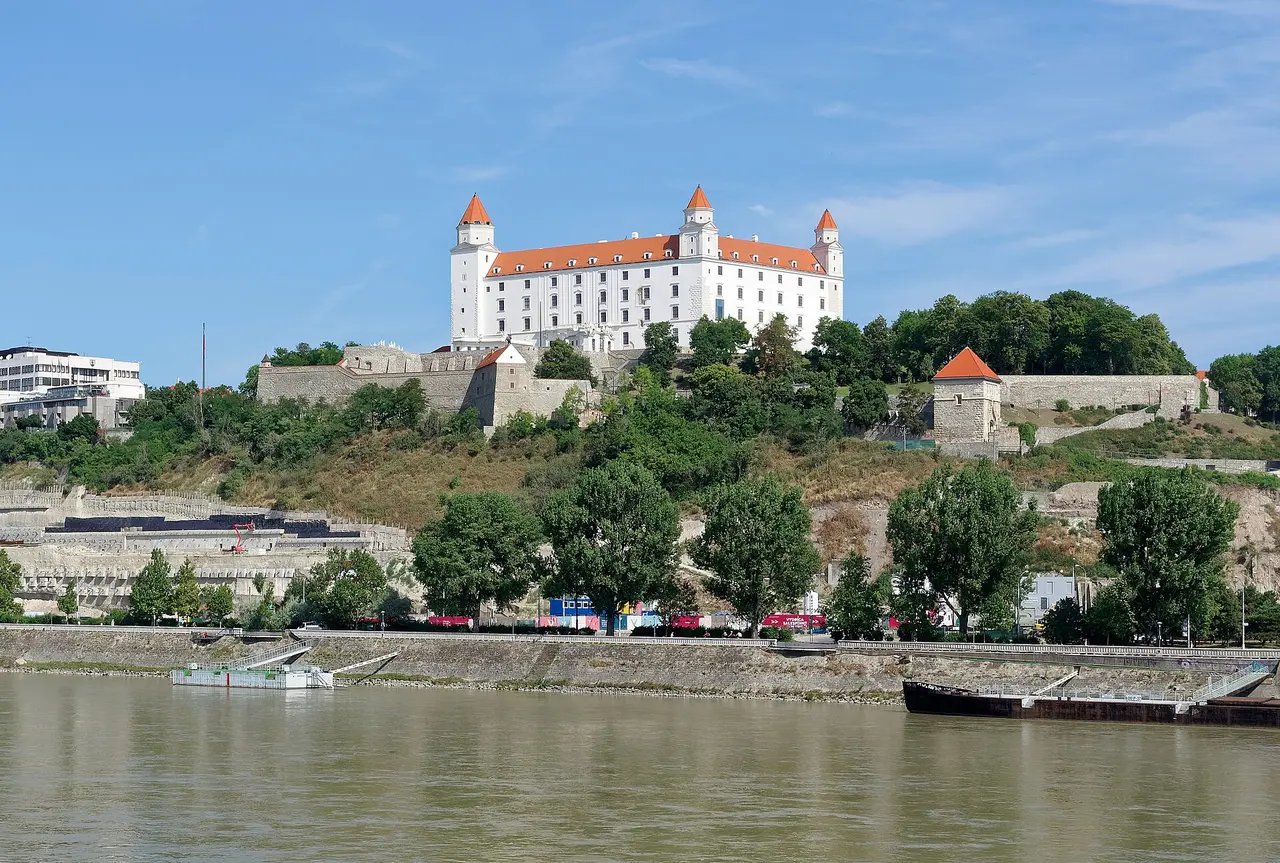
Above the old town, the castle with its four corner towers burned in 1811 and was rebuilt in the 1950s and 1960s; it now houses part of the national museum. Its gardens and terraces are free to enter and give the best view over the Danube and the Petržalka district. The climb from the cathedral takes about ten minutes. At the foot of the hill, the Podhradie quarter and the former Jewish quarter were largely razed in the 1960s and 1970s to build the SNP bridge and its expressway.

Petržalka and the Danube banks

On the right bank, Petržalka is the largest prefabricated housing estate in Slovakia, a raw testimony to socialist urban planning. The district touches the border of Austria: Bratislava is the only capital in the world bordering two countries, Austria and Hungary. Along the river, Sad Janka Kráľa park, opened in 1775, ranks among the oldest public parks in Central Europe. One to two hours are enough to cross the bridge on foot, stroll the bank and return over the Starý most, open only to pedestrians, bikes and trams.

Getting there

Airports serving Bratislava, from main hubs to secondary ones.
  • BTSM. R. Štefánik AirportBratislavaMain
  • ILZŽilina-Dolný Hričov AirportDolný HričovSecondary
  • KSCKošice International AirportKošiceSecondary
  • PZYPiešťany AirportPiešťanySecondary
  • SLDSliač AirportSliačSecondary
  • TATPoprad-Tatry AirportPopradSecondary

Bratislava travel tips

From Vienna

Trains roughly every hour between Wien Hauptbahnhof and Bratislava, about a one-hour ride. From April to October, the Twin City Liner catamaran links the two cities along the Danube.

Airports

M. R. Štefánik airport is about ten kilometres out, linked to the main station by bus 61. Vienna-Schwechat, about 50 km away, is served by direct buses.

Transport tickets

Time-limited tickets bought from machines or the app, to be validated as soon as you board the tram or bus; inspections are frequent.

Currency and plugs

Euro since 2009, bank cards accepted almost everywhere. Type E sockets, as in France, at 230 V.

Tipping

Customary in restaurants: round up or leave about 10 % if you enjoyed the service, telling the waiter when you pay.

Bratislava in pictures

Photo credits : Jakub Hałun, CC BY-SA 4.0, Wikimedia Commons ; Thomas Ledl, CC BY-SA 4.0, Wikimedia Commons ; Pudelek (Marcin Szala), CC BY-SA 3.0, Wikimedia Commons ; Ingo Mehling, CC BY-SA 4.0, Wikimedia Commons

Frequently asked questions about Bratislava

Bratislava from Vienna: is the train or the boat better?
The train is simplest: frequent departures all year, about an hour, arriving at the main station twenty minutes' walk from the centre. The Twin City Liner, April to October, is slower and pricier but docks at the foot of the old town after a ride along the Danube.
Should you stay overnight in Bratislava or is a day trip from Vienna enough?
A day trip covers the old town, the cathedral and the castle. A night in town lets you enjoy the centre in the evening, once the groups have left, and spend the next morning at Devín or in the wine cellars of the Little Carpathians.
How do you get to Devín Castle from central Bratislava?
Bus 29 leaves from the stop beneath the SNP bridge and reaches Devín village in about twenty minutes. In summer, boats also sail up the Danube to the foot of the ruins. Allow two to three hours on site including the climb.
Can you go up into the UFO saucer on the SNP bridge?
Yes, a lift inside one of the pylon's legs leads to the restaurant and the observation deck at the top. Access is paid. On a clear day the view stretches over the castle, Petržalka and as far as Austria.
How do you continue to the Tyrol after Bratislava?
You need to go back through Vienna, then take a direct train to western Austria. Allow more than five hours in total to reach Innsbruck and its mountains, which makes a night in Vienna on the way worthwhile.

Plan your trip to Bratislava

Build your day-by-day itinerary and manage budget, bookings and packing in PlanTripNow.
Aperçu de l'application PlanTripNow