Skip to content

Visit Interlaken and the Jungfrau region

Two turquoise lakes, a central meadow where paragliders land and, to the south, the Eiger, Mönch and Jungfrau: Interlaken is the starting point of a network of trains, rack railways and cable cars unique in the Alps. Allow four days for the Jungfrau, Lauterbrunnen and one lake.

Why stay in Interlaken?

Interlaken, at about 570 m in the canton of Bern, is the main rail hub of the Bernese Oberland. From its two stations you reach Grindelwald, Lauterbrunnen or Wengen in under an hour, and the Jungfraujoch at 3,454 m in about two hours. Boats on Lakes Thun and Brienz also leave from the town.

Interlaken highlights

High viewpoints, waterfalls and lakes, all reachable by public transport from Interlaken's stations.

Jungfraujoch

Europe's highest railway station at 3,454 m, with an ice palace, the Sphinx terrace and views over the Aletsch Glacier, listed by UNESCO.

Harder Kulm

Viewpoint at 1,322 m above town, with a walkway overhanging both lakes and a head-on view of the Eiger, Mönch and Jungfrau.

Staubbach Falls

A waterfall dropping from a cliff of nearly 300 m above Lauterbrunnen, approachable by a path cut behind the falling water.

Trümmelbach Falls

Ten underground waterfalls draining the glaciers of the Eiger, Mönch and Jungfrau, seen from lit galleries inside the rock.

Schilthorn

A 2,970 m summit above Mürren, with a revolving panoramic restaurant and memories of a James Bond shoot in the late 1960s.

Schynige Platte

Rack railway from 1893 climbing to an alpine botanical garden and ridge trails above both lakes, from June to October.

Ballenberg Museum

Open-air museum near Brienz gathering around a hundred Swiss farms and rural houses dismantled and rebuilt, open in the warmer months.

What to do in and around Interlaken?

The centre, the Höhematte and Unterseen

The centre stretches less than 2 km between Interlaken West and Interlaken Ost stations, linked by the Höheweg, the avenue of grand nineteenth-century hotels. In the middle, the Höhematte, a meadow protected from building, is the landing field for paragliders coming down from the nearby slopes. Across the Aare, the small town of Unterseen keeps a medieval square and a fifteenth-century bell tower, much quieter at night. The Harder Kulm, at 1,322 m, is reached in about ten minutes by funicular from Ost: go up late in the day to see both lakes and the three peaks.

The Jungfraujoch and the Eiger

The Jungfraujoch, at 3,454 m, is the highest railway station in Europe. From Interlaken Ost the fastest route goes via Grindelwald Terminal and the Eiger Express, then the Jungfrau railway, which crosses the Eiger in a tunnel bored in the early twentieth century; allow about two hours one way. The climb via Lauterbrunnen, Wengen and Kleine Scheidegg is slower but more scenic, and ideally you combine both. Book on the day according to the weather: in overcast conditions you see nothing at the top. The ticket remains expensive, and regional passes give discounts.

The Lauterbrunnen valley and the car-free villages

Twenty minutes away by train, the Lauterbrunnen valley is a glacial corridor with sheer walls from which dozens of waterfalls drop, including Staubbach, visible from the village. Further on, the Trümmelbach Falls rush down inside the mountain, reached by a lift, from April to November. Above, Wengen and Mürren are closed to cars: you go up by rack railway or cable car. From Mürren the cable car continues to the Schilthorn, at 2,970 m, whose revolving restaurant was the set of a James Bond film. One full day is enough for the valley and one of the two villages.

Grindelwald and the First area

Grindelwald, 35 minutes away by train, spreads out at the foot of the Eiger north face. Its gondola climbs to First, at about 2,170 m, where the cliff walk clings to the rock face and the trail to Bachalpsee starts, a high lake reached in an hour of easy walking. For the descent, scooters and summer toboggans are offered on part of the way. In winter the Grindelwald and Wengen ski area is one of the largest in the region. Set off early in July and August: queues at the gondola grow from mid-morning.

Lake Thun and Lake Brienz

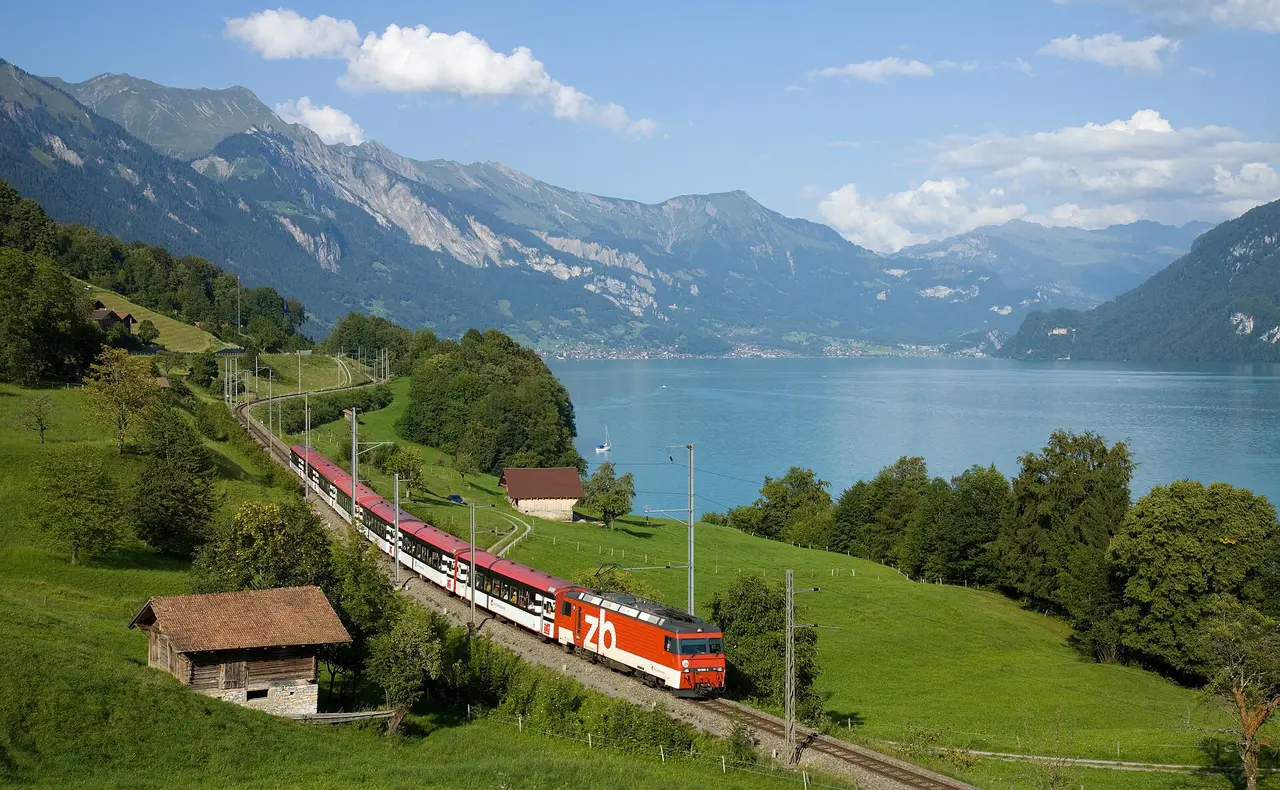
Scheduled boats link Interlaken to Thun in a little over two hours and to Brienz in about an hour and a quarter, stopping at wooden villages. On Lake Brienz the water takes a turquoise shade from glacial sediment; the hamlet of Iseltwald draws crowds and its jetty now charges a fee. The Giessbach Falls are reached by a historic funicular from the landing stage. On the Thun side, the castles of Spiez and Oberhofen make good day visits. These trips suit cloudy days, when going up high is not worth it. They round off a trip to Switzerland focused on the Alps.

Getting there

Airports serving Interlaken, from main hubs to secondary ones.
  • GVAGeneva International AirportGenevaMain
  • ZRHZürich AirportZurichMain
  • ACHSankt Gallen Altenrhein AirportSt. GallenSecondary
  • BRNBern AirportBernSecondary
  • EMLEmmen Air BaseEmmenSecondary
  • LUGLugano AirportAgnoSecondary

Practical information for Interlaken

Stations

Interlaken Ost for mountain trains and Lake Brienz, Interlaken West for Lake Thun; Bern is less than an hour away.

Guest card

Given by your accommodation in exchange for the tourist tax, it grants free use of local buses in Interlaken and the surroundings.

Passes

The Swiss Travel Pass and the Berner Oberland Pass cover a large share of trains and boats, with a discount on the Jungfraujoch.

Mountain weather

Check the lift webcams before buying a summit ticket: sunshine in Interlaken does not guarantee a view at 3,000 m.

Power sockets

Swiss type J, 230 V; flat two-pin European plugs fit, plugs with a protruding earth pin such as French ones do not.

Water

Tap water and public fountain water are drinkable unless signposted otherwise: a refillable bottle is enough.

Sunday

Most shops close; station supermarkets and tourist shops on the Höheweg usually stay open.

Currency

Swiss franc; euros are sometimes accepted but change comes back in francs, so a bank card is better value.

Interlaken in pictures

Photo credits : Kabelleger / David Gubler ( http://www.bahnbilder.ch ), CC BY-SA 3.0, Wikimedia Commons ; Ank Kumar, CC BY-SA 4.0, Wikimedia Commons ; Keith Halstead, CC BY-SA 3.0, Wikimedia Commons ; JoachimKohler-HB, CC BY-SA 4.0, Wikimedia Commons

Frequently asked questions about Interlaken

Should you book the Jungfraujoch train in advance?
In July and August, booking a seat on the Jungfrau railway ahead avoids waiting at busy times. The rest of the year it is wiser to buy the day before or that morning based on the webcams, so as not to pay for a summit lost in fog.
Interlaken, Grindelwald or Lauterbrunnen: where to stay?
Interlaken has the most accommodation, restaurants and connections to both lakes. Grindelwald and Lauterbrunnen put you at the foot of the mountains and save time for the summits, but offer less choice. For a first car-free stay, Interlaken remains the most flexible base.
How many days should you spend in the Interlaken region?
Three days cover the Jungfraujoch, the Lauterbrunnen valley and the Harder Kulm. With four or five days, add Grindelwald First, the Schilthorn and a lake cruise, keeping a margin for cloudy days.
Can you go paragliding in Interlaken without experience?
Yes, several schools offer tandem flights with a licensed pilot, landing on the Höhematte in the town centre. Flights depend on the wind and are cancelled in bad weather: book early in your stay so you can reschedule if needed.
Is Iseltwald worth the trip from Interlaken?
The village on Lake Brienz is pretty and reached by boat or bus in about twenty minutes. Its famous jetty, made popular by a Korean series, now charges a fee and is very busy: come early in the morning or choose the nearby Giessbach Falls instead.
When are the Lauterbrunnen waterfalls at their strongest?
From May to July, snowmelt swells the Staubbach and Trümmelbach. In late summer the Staubbach can shrink to a veil, and Trümmelbach closes in winter, usually from November to April.
Can you visit Interlaken in winter?
Yes, the Jungfraujoch, the Schilthorn and the mountain railways run all year, though the Harder Kulm closes. The Grindelwald, Wengen and Mürren areas open for skiing and sledging, but some trails and the Schynige Platte stay closed until spring.

Plan your trip to Interlaken

Build your day-by-day itinerary and manage budget, bookings and packing in PlanTripNow.
Aperçu de l'application PlanTripNow