Skip to content

Visit Jeju : what to see on the volcanic island and when to go

Jeju is volcanic Korea: a crater rising from the sea at sunrise, lava tubes several kilometres long, waterfalls dropping into the ocean and, in the centre, Hallasan, the country's highest peak. Between hikes, you taste the island's black pork and tangerines.

At a glance

Visa
None
Tourist stay of up to 89 days
7-day budget
€721
Per person, comfort profile, excluding international flights.

Why visit Jeju?

Jeju, a volcanic island in southern South Korea, is UNESCO-listed for its Hallasan volcano, its lava tubes and the Seongsan Ilchulbong cone. It is an hour's flight from Seoul. Allow three to four days with a rental car, ideally in April, May or October.

When to visit Jeju

Temperatures, rainfall and crowds month by month, to pick your window.
When to visit Jeju
MonthTemperaturesRainCrowdsVerdict
January4 to 9 °C12 dQuietCold wind and snow on top of Hallasan: winter hiking with crampons required.
February4 to 10 °C10 dQuietHallabong citrus harvest and the first camellias, with hotel prices at their lowest.
March7 to 13 °C10 dModerateYellow rapeseed fields below Seongsan peak and cherry blossoms at the end of the month.
April11 to 18 °C9 dBusyThe best month for walking the Olle trails, 18 °C and blooming countryside.
May15 to 22 °C10 dBusyAzaleas on Hallasan and Korean long weekends that fill flights and rental cars.
June19 to 25 °C12 dModerateThe jangma rainy season arrives late in the month, with hydrangeas across the island.
July24 to 29 °C12 dPackedBeaches open and sea at 24 °C, but Korean holidays and the first possible typhoons.
August25 to 30 °C13 dPackedThe hottest and busiest month, at the heart of typhoon season: stay flexible.
September21 to 26 °C11 dModerateThe sea is still warm and families have gone, but typhoons remain possible early in the month.
October16 to 22 °C7 dBusyThe driest month: silver grass on the oreum hills and clear skies for Hallasan.
November10 to 16 °C10 dModerateAutumn foliage on the slopes of Hallasan and tangerine picking.
December6 to 11 °C12 dQuietStrong wind and changeable skies, but camellias in bloom and Seogwipo's hot springs.
Source: Normales 1991-2020 de la ville de Jeju (côte nord) via climatestotravel.com, recoupées avec Weathermonth (réanalyse Open-Meteo) ; température de la mer climatestotravel.com, relevé novembre 2026. Le sud de l'île, autour de Seogwipo, est un peu plus doux, et le sommet du Hallasan bien plus froid.

Jeju's must-sees

Volcanoes, waterfalls, beaches and traditions, the sights behind the island's reputation.

Seongsan Ilchulbong

A volcanic tuff cone rising from the sea, UNESCO-listed, famous for sunrise at the summit.

Mount Hallasan

A 1,947 m volcano, South Korea's highest peak, with a crater lake at the top.

Manjanggul Cave

A UNESCO-listed lava tube, about a kilometre of which is open to the public.

Udo Island

A small island fifteen minutes away by ferry, with coral beaches, cliffs and fields to explore by bike.

Jeongbang Waterfall

A rare Asian waterfall falling straight into the sea, on the Seogwipo coast.

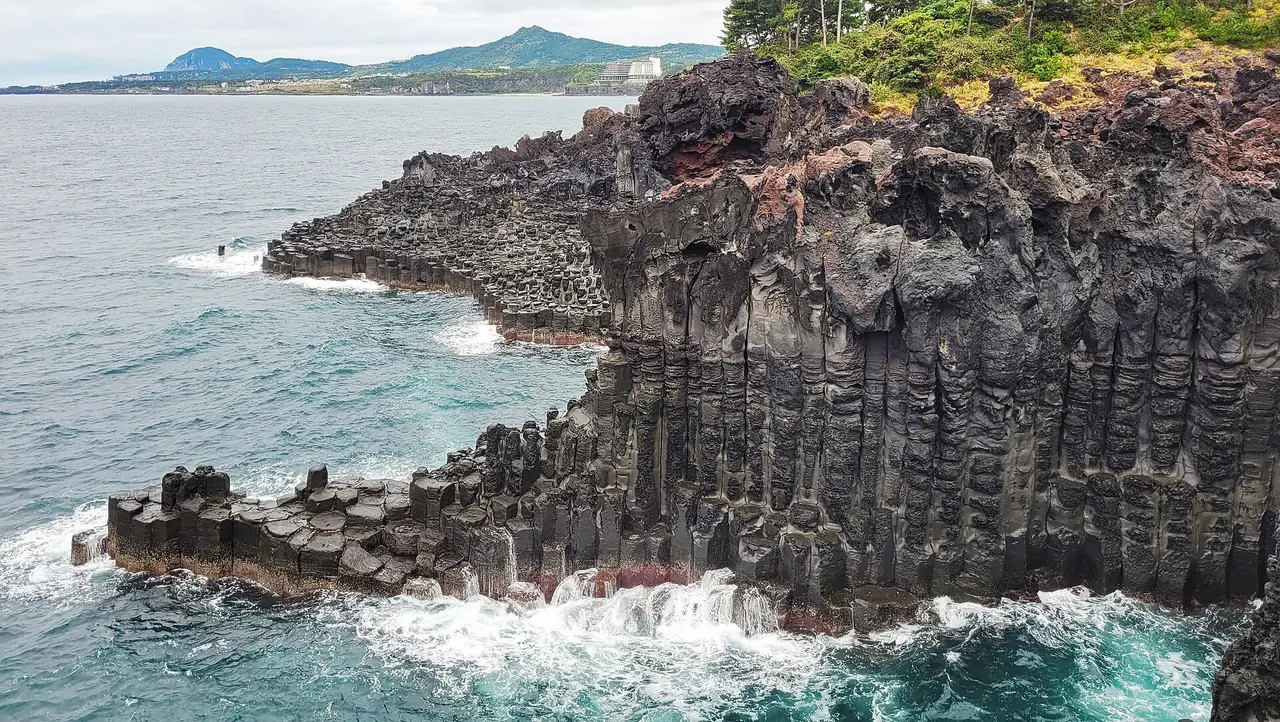
Jusangjeolli Cliffs

Hexagonal basalt columns formed by lava, pounded by the waves of the south coast.

Hyeopjae Beach

A white sand, turquoise water beach facing Biyangdo island, on the west coast.

Olle Trails

A network of 27 hiking routes circling the island along coasts and villages.

Haenyeo divers

Women who fish by free-diving, a UNESCO intangible heritage tradition, seen at Seongsan.

Dongmun Market

Jeju City's big market for black pork, fish, citrus and evening street food.

What to discover in Jeju?

The volcanic east: Seongsan and Manjanggul

Seongsan Ilchulbong, a tuff cone rising from the sea, takes about twenty minutes to climb; sunrise there is spectacular. At its foot, the haenyeo, free-diving women listed as UNESCO intangible heritage, give demonstrations. The Manjanggul lava tube offers about a kilometre open to visitors. Udo Island, fifteen minutes away by ferry, is explored by e-bike. Arrive before dawn to beat the tour groups.

Hallasan, the roof of Korea

A 1,947 m shield volcano, Hallasan is South Korea's highest peak. The Seongpanak and Gwaneumsa trails lead to Baengnokdam crater in eight to nine hours return, with online booking and an early morning start. The shorter Yeongsil trail offers forests, standing rocks and sea views in five hours, without reaching the crater. Bring warm layers and plenty of water. Snow covers the top in winter.

Seogwipo and the south coast

In the milder south, Seogwipo concentrates the waterfalls: Jeongbang, which falls straight into the sea, and Cheonjiyeon, at the end of a gorge. The Jusangjeolli cliffs line up hexagonal basalt columns pounded by the waves. Olle trail route 7, about 17 km along the coast, is one of the finest of the 27 routes that circle the island. Allow a full day for the coast.

The west, beaches and food

Hyeopjae beach, white sand and turquoise water facing Biyangdo island, is the finest in the west. The O'sulloc green tea fields and their museums are free to visit. As for food, grilled black pork, seafood caught by the haenyeo and hallabong citrus are the specialities; Dongmun market, in town, is ideal for tasting them. Evenings at the market are the liveliest.

How much it costs

Per person per day, excluding international travel.
Budget
45 €/ day
2 390 € for 2 people, 7 days, return flights included
Accommodation
18 €
Food
15 €
Local transport
6 €
Sights and activities
6 €
Comfort
103 €/ day
3 202 € for 2 people, 7 days, return flights included
Accommodation
28 €
Food
35 €
Local transport
25 €
Sights and activities
15 €
Premium
240 €/ day
5 120 € for 2 people, 7 days, return flights included
Accommodation
75 €
Food
75 €
Local transport
50 €
Sights and activities
40 €
Prices checked: Relevé novembre 2026 : Champion Traveler, Gotripzi et guides de voyage pour les repas et l'hébergement (lit en auberge env. 18 €, fourchette Hostelz de 5 à 25 dollars ; hôtel 2 à 3 étoiles env. 55 € la chambre ; complexe de luxe de Jungmun env. 150 € la chambre), faute de page Numbeo dédiée à Jeju. Lit en dortoir pour backpacker, chambre double partagée à deux pour comfort et premium ; voiture de location partagée incluse dans les transports comfort et premium. Trajet A/R env. 880 € par personne : Paris-Séoul env. 800 € (moyenne Liligo sur 3 mois), plus un vol intérieur Séoul-Jeju aller-retour à bas coût. Won converti en euros, hors juillet-août.

Getting there

Airports serving Jeju, from main hubs to secondary ones.
  • CJJCheongju International Airport/Cheongju Air Base (K-59/G-513)CheongjuMain
  • CJUJeju International AirportJeju CityMain
  • GMPGimpo International AirportSeoulMain
  • ICNIncheon International AirportSeoulMain
  • MWXMuan International AirportMuanMain
  • PUSGimhae International AirportBusanMain

Entry, health and safety

For FR travellers

Entry requirements

No visa for a tourist stay

Pas de visa pour un court séjour touristique de moins de 90 jours. L'exemption temporaire d'autorisation électronique K-ETA est prolongée jusqu'au 31 décembre 2026 ; une carte d'arrivée électronique gratuite (e-Arrival card) est à remplir sur e-arrivalcard.go.kr dans les trois jours avant l'arrivée, ou sur papier à l'arrivée. Les allers-retours répétés de type visa run peuvent entraîner un refus d'entrée.

Stay allowed for up to 89 days.

Health

Passeport en cours de validité, sans exigence de six mois après la sortie, mais en bon état : un passeport abîmé peut être refusé. Corée du Sud en vigilance normale, sauf la zone démilitarisée avec la Corée du Nord. Typhons et intempéries de juillet à fin septembre, le sud du pays étant le plus exposé. Intoxications au GHB signalées dans les grandes villes.

Safety

Normal precautions

Checked in novembre 2026 against the official source. Entry rules change: check the official source before you travel, it alone is authoritative.

Practical information for Jeju

Entry

French citizens need no visa for up to 90 days, K-ETA suspended until 31 December 2026, e-Arrival card before arrival. Check the rules for your nationality.

Rental car

Essential to explore the island; an international driving permit is required on top of your national licence.

Hallasan booking

The summit trails, Seongpanak and Gwaneumsa, are booked online and close beyond a cut-off time in the morning.

Typhoons

From July to September, typhoons can cancel flights and ferries; keep a spare day before your return flight.

Access

Domestic flights from Seoul-Gimpo in about an hour, among the busiest in the world; book early for Korean weekends.

Payment

Cards accepted almost everywhere; T-money for the island's buses.

Jeju in pictures

Photo credits : Bernard Gagnon, CC0, Wikimedia Commons ; Basile Morin, CC BY-SA 4.0, Wikimedia Commons ; Yoo Chung, CC BY-SA 2.5, Wikimedia Commons ; Justin De La Ornellas from China Town, Hawaii, CC BY 2.0, Wikimedia Commons

Frequently asked questions about Jeju

Can you climb Hallasan without a booking?
Not on the summit trails, Seongpanak and Gwaneumsa, which require online booking and a morning cut-off time. The shorter Yeongsil and Eorimok trails, which stop before the crater, can be walked without a booking.
Do you need to rent a car in Jeju?
It is strongly advised: buses exist, but the sights are spread around the island. Bring an international driving permit in addition to your national licence. Roads are good and driving is on the right.
How many days do you need for Jeju?
Three to four days let you see the volcanic east, hike Hallasan, discover the southern waterfalls and the western beaches. With two days, focus on Seongsan, Manjanggul and Udo. Add a day if you want the full Hallasan climb.
How do you get from Seoul to Jeju?
By plane from Gimpo Airport, about an hour, with dozens of cheap daily flights. From Seoul, it is the simplest option. Ferries from the south coast also exist, but take longer.
Jeju or Busan for a seaside stay?
Jeju for nature, volcanoes and hikes; Busan for a big port city with beaches, temples and fish markets. The two are linked by a flight of about an hour, so you can combine them.
What is the best season for Jeju?
April and May for flowers and hiking, October for dry skies and silver grass. Summer is hot, very busy and typhoon-prone; winter is windy but calm, with snow on top of Hallasan.
What should you eat in Jeju?
Grilled black pork, the island's speciality, seafood caught by the haenyeo, such as abalone, fish soup and hallabong citrus. Dongmun market and Seogwipo's restaurants are the best places to try them.
Can you see the haenyeo divers?
Yes, demonstrations take place at the foot of Seongsan Ilchulbong at set times, weather permitting. The Haenyeo Museum, on the east coast, tells the story of this UNESCO-listed intangible heritage tradition.
Do you need a visa for Jeju?
Not for French citizens, for up to 90 days. The K-ETA authorisation is suspended until 31 December 2026, but a free electronic arrival card must be completed within three days before arriving in South Korea. Check the rules for your nationality.

Plan your trip to Jeju

Build your day-by-day itinerary and manage budget, bookings and packing in PlanTripNow.
Aperçu de l'application PlanTripNow