Skip to content

Visiting Krakow : what to see, how many days and which day trips

A huge medieval square where the hejnał bugle call sounds every hour, the royal castle above the Vistula, Kazimierz's synagogues and concert cellars, and Wieliczka and Auschwitz an hour away: Krakow needs four days to combine the city and its day trips.

Why visit Krakow?

Krakow was the capital of Poland until the late 16th century, and its historic centre was among the very first UNESCO World Heritage listings, in 1978. Little damaged during World War II, it keeps an outstanding Gothic and Renaissance ensemble. It is also the base for visiting the Wieliczka salt mine and the Auschwitz-Birkenau memorial.

Krakow's must-sees

Royal heritage, 20th-century memory and underground sites, between the old town and day trips.

Rynek Główny square

Medieval square of nearly 4 hectares, among the largest in Europe, lined with palaces and terraces. The heart of the city, lively by day and by night.

Cloth Hall

Renaissance Sukiennice in the middle of the square, with craft stalls on the ground floor and a gallery of 19th-century Polish painting upstairs.

St Mary's Basilica

Gothic church with two unequal towers, home to Veit Stoss's carved wooden altarpiece. The hejnał is played on a trumpet every hour from the taller tower.

Rynek Underground

Museum beneath the Main Square, showing medieval remains uncovered during excavations, with a multimedia route on the city's trade history.

Collegium Maius

Oldest building of the Jagiellonian University, with an arcaded Gothic courtyard and a clock whose figures parade several times a day. Copernicus studied here.

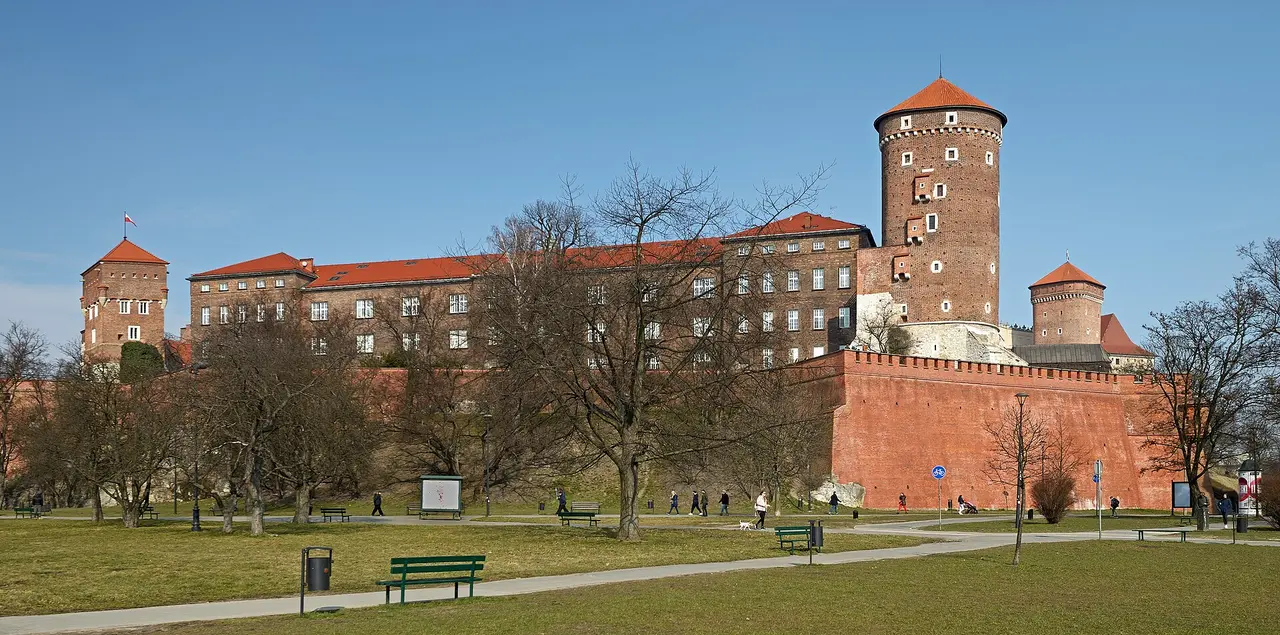
Wawel Royal Castle

Residence of the Polish kings, with state rooms, an arcaded Renaissance courtyard and a collection of 16th-century Flemish tapestries.

Wawel Cathedral

Coronation church and burial place of Polish kings. Climbing the bell tower lets you see the Zygmunt Bell, rung on major national occasions.

Schindler's Factory

Museum in Oskar Schindler's former enamel factory in Podgórze, tracing life in Krakow under Nazi occupation from 1939 to 1945.

Kościuszko Mound

Artificial hill raised in the 19th century in honour of the national hero, west of the centre. Panoramic views over the city and, on clear days, the Tatras.

Wieliczka Salt Mine

Galleries worked for more than seven centuries, with chapels and sculptures carved from salt, including St Kinga's Chapel, around a hundred metres underground.

Auschwitz-Birkenau

Former Nazi concentration and extermination camp, now a memorial and museum. A harrowing and essential visit, to be booked in advance on the official website.

What to see in Krakow, district by district?

The old town within the Planty ring

Stare Miasto fits into an oval you can cross on foot in about twenty minutes, encircled by the Planty, a park laid out in the 19th century where the walls once stood. Only St Florian's Gate and the Barbican survive, to the north. From there, Floriańska Street leads to the Main Square, then Grodzka Street runs down to Wawel: this was the old Royal Route of coronations. The streets around the Jagiellonian University, founded in 1364, are quieter. Allow a full day for the old town, interiors included.

Wawel and the Vistula banks

Wawel Hill overlooks a bend of the Vistula south of the old town. Castle and cathedral formed the former centre of royal power; Polish kings were crowned and buried in the cathedral. The castle exhibitions are ticketed separately with limited timed entry: book online or arrive at opening time in summer. Allow half a day. Below, the landscaped riverbanks make a 20-minute walk to Kazimierz, and boats offer one-hour river cruises.

Kazimierz, the former Jewish quarter

An independent town founded in the 14th century, Kazimierz was home for centuries to one of Europe's largest Jewish communities, decimated in the Holocaust. Seven synagogues remain, including the Old Synagogue, now a museum, and the still-active Remuh Synagogue with its adjoining cemetery. Szeroka Street and Plac Nowy concentrate restaurants, bars and the famous zapiekanki sold in the central rotunda. Allow half a day of sightseeing, then come back at night: it is the liveliest district after 9 pm.

Podgórze and the memory of the ghetto

On the right bank of the Vistula, linked to Kazimierz by the Father Bernatek footbridge, Podgórze held the Krakow Ghetto from 1941 to 1943. Ghetto Heroes Square, with its 70 bronze chairs, recalls the deportations. Oskar Schindler's former factory houses a museum on the city under Nazi occupation, very popular: buy your ticket in advance. Next door, MOCAK shows contemporary art. Allow three to four hours, 15 minutes on foot from Kazimierz.

Nowa Huta, the socialist new town

Built from 1949 around a huge steelworks, Nowa Huta was meant to be the ideal town of socialist realism. Its radial plan starts from the central square, now Ronald Reagan Square, and its wide avenues lined with monumental blocks contrast with the old town. The Ark of the Lord church, built by residents despite the communist authorities, is a symbol of resistance. The district is about 25 minutes by tram from the centre: half a day is enough, possibly with a guided tour in a Trabant.

Days out of the city

The Wieliczka salt mine, a UNESCO site, is about 30 minutes away by train; the guided tour lasts nearly three hours, including some 800 steps going down. The Auschwitz-Birkenau memorial and museum in Oświęcim is about 1 hour 30 by road: entry is free but must be booked, and guided visits are compulsory at peak times. Don't combine both sites on the same day, you would rush one of them. Zakopane and the Tatras, about 2 hours away, deserve at least one night.

When to come and how many days

May, June and September offer the best balance of mild weather and crowds. July and August are hot and very busy, especially with groups. Winter is cold, often below 0 °C, but the Main Square Christmas market, from late November to late December, draws many visitors. Four days cover the city and two day trips; three days if you only do one. For a wider tour, the capital, Warsaw, is about 2 hours 30 by express train.

Getting there

Airports serving Krakow, from main hubs to secondary ones.
  • GDNGdańsk Lech Wałęsa AirportGdańskMain
  • KRKKraków John Paul II International AirportBaliceMain
  • KTWKatowice Wojciech Korfanty International AirportKatowiceMain
  • LCJŁódź Władysław Reymont AirportŁódźMain
  • LUZLublin AirportLublinMain
  • POZPoznań-Ławica AirportPoznańMain

Practical information for Krakow

Airport

Kraków-Balice Airport, linked to the main station by train in about 20 minutes.

Currency

Polish złoty (PLN); avoid exchange offices on the Main Square, whose rates are often poor.

Auschwitz booking

Named ticket required, to be booked on visit.auschwitz.org several weeks ahead in summer; ID required.

Wawel tickets

Limited places per exhibition and per day; online booking recommended in high season.

Trams and buses

Validate tickets as soon as you board; on-board machines take cards; inspections are frequent.

Taxis

Prefer ride-hailing apps or phone-booked taxis to cabs hailed near bars.

Places of worship

Cover shoulders and knees in churches; St Mary's Basilica has one entrance for worshippers and another for visitors.

Sunday shopping

Most shops close on most Sundays; do your shopping the day before.

Tap water

Officially drinkable; locals still often drink bottled water out of habit.

Winter air quality

Smog is common on some winter days; check the air quality index if you are sensitive.

Krakow in pictures

Photo credits : Ввласенко, CC BY-SA 3.0, Wikimedia Commons ; Scotch Mist, CC BY-SA 4.0, Wikimedia Commons ; Igor123121, CC BY 4.0, Wikimedia Commons ; Jakub Hałun, CC BY-SA 4.0, Wikimedia Commons ; Андрей Романенко, CC BY-SA 4.0, Wikimedia Commons

Frequently asked questions about Krakow

Can you visit Auschwitz-Birkenau without a guide from Krakow?
Yes, outside peak hours, when guided visits are compulsory. In all cases you must book a free named ticket on the museum's official website. Buses and trains link Krakow and Oświęcim in about 1 hour 30, then a free shuttle connects the two camps.
Do you need to book the Wieliczka Salt Mine in advance?
It is strongly advised in summer and at weekends, as guided tours in each language run at fixed times. Booking online lets you choose the language and slot. The tour ends with a lift ride back to the surface.
Why does the trumpeter stop mid-tune at St Mary's Basilica?
The hejnał is played every hour from the taller tower, towards the four points of the compass. It breaks off abruptly, recalling according to legend a watchman struck by an arrow during a 13th-century invasion. The noon call is broadcast on national radio.
Where to stay in Krakow: old town or Kazimierz?
The old town puts everything within walking distance but is noisy around the Main Square at weekends. Kazimierz has more character and lively nightlife, 15 minutes on foot from the Rynek. Podgórze, just across the river, is quieter and often cheaper.
What to see at Wawel if you only have an hour?
The castle courtyard and the cathedral, climbing the bell tower to see the Zygmunt Bell. The hilltop grounds and ramparts are free. The royal apartments and the treasury each take about another hour with separate tickets.
Was Schindler's List filmed in Krakow?
Yes, largely in Kazimierz and Podgórze, which is why many visitors look for its filming locations. The Schindler's Factory museum, however, is not about the film: it tells the story of the city under Nazi occupation.
Can you go from Krakow to Zakopane for the day?
It is doable, with about 2 hours by bus each way, but the road is often congested at weekends. To hike in the Tatras or go up Kasprowy Wierch, a night there is better. Buses leave from the bus station next to the main train station.
What street food should you try in Krakow?
The obwarzanek, a braided bread ring sold from blue carts and protected by an EU designation. The zapiekanka from Plac Nowy, a toasted half-baguette, is the classic late-night snack. Pierogi are eaten in milk bars, cheap traditional canteens.
Is the Krakow Christmas market worth a winter trip?
It is one of the best known in Poland, set on the Main Square from late November to late December. Krakow nativity scenes, a craft listed as UNESCO intangible heritage, are displayed in early December. Bring warm clothes, temperatures often drop below zero.

Plan your trip to Krakow

Build your day-by-day itinerary and manage budget, bookings and packing in PlanTripNow.
Aperçu de l'application PlanTripNow